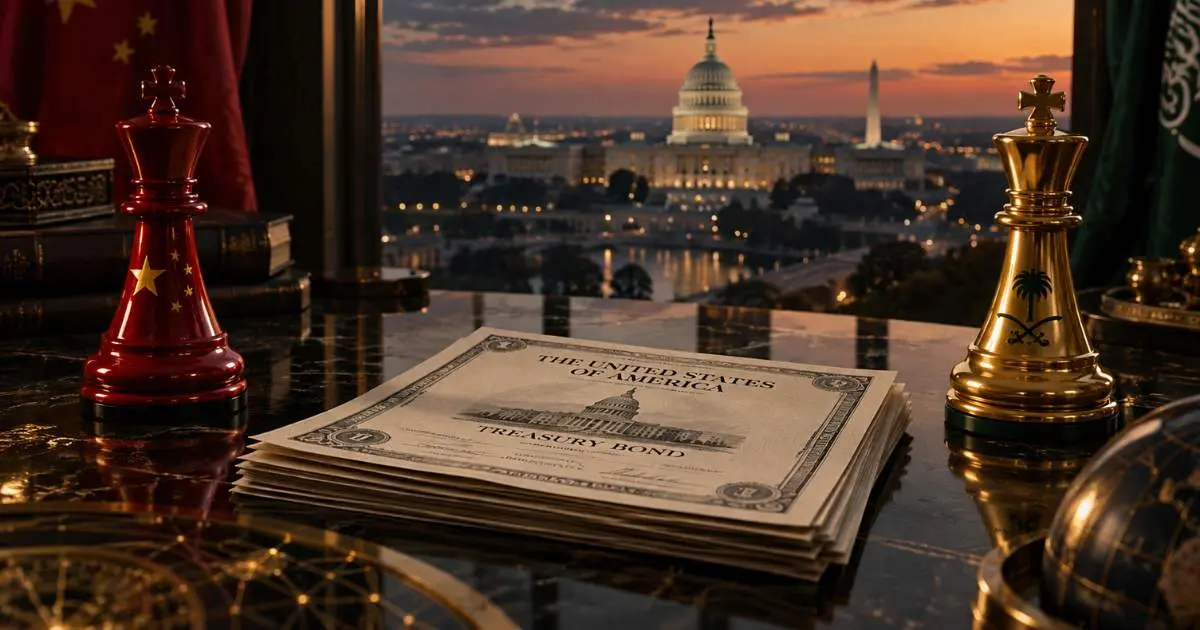
America’s foreign creditors hold trillions of dollars in claims, yet ownership does not necessarily give them the upper hand. The borrower also helps set the terms on which their wealth can be used—and the price of finding somewhere else to keep it.
There is something intuitively backward about the financial position of the United States. The federal government owes tens of trillions of dollars, foreign investors hold trillions of that debt, and some of those investors belong to countries Washington regards as strategic competitors. In the ordinary imagination of debt, this should place the borrower at the mercy of the lender. Yet China cannot summon the US Treasury to Beijing and demand repayment, Saudi Arabia cannot dictate American law by threatening to sell bonds, and Russia discovered after invading Ukraine that reserves accumulated inside Western jurisdictions could become inaccessible precisely when geopolitical relations collapsed.
The contradiction disappears once ownership is separated from power. Holding an asset gives its owner rights, but those rights exist inside markets, currencies, legal jurisdictions, clearing systems and political relationships that determine what the asset can actually do. In the American case, the borrower also issues the principal reserve currency, hosts the world’s largest and most liquid sovereign-debt market, and exercises enormous influence over financial infrastructure. The United States does not control global finance by decree: European governments, private institutions and foreign jurisdictions retain powers of their own. But the concentration of monetary, market and legal advantages makes the conventional distinction between debtor and creditor incomplete.
The revealing questions are therefore not simply who owns America’s debt, but under whose jurisdiction the asset sits and which side can reduce its dependence on the relationship at lower cost. Ownership, jurisdiction and exit are different sources of power. Once they are separated, the geopolitics of American debt looks less like a creditor holding a mortgage over a debtor and more like a contest over alternatives.
The numbers already challenge the popular story. Of the $30.2 trillion in federal debt held by the public at the end of fiscal year 2025, roughly 70 percent was held by domestic entities and about 30 percent by foreign investors. Mainland China represented only about 2 percent of the total, behind domestic holders such as the Federal Reserve, mutual funds and financial institutions. By July 2026, Treasury data showed Japan holding about $1.104 trillion in Treasury securities, the United Kingdom about $998 billion and mainland China $618 billion. Even those country labels require caution: securities kept through overseas custodians may be attributed to the location of custody rather than the ultimate economic owner.
The myth that “China finances America” survives because it contains enough truth to be memorable. China is a significant creditor, and foreign demand matters to Treasury financing, but Washington is not dependent on a single foreign government. America’s foreign creditors include central banks, funds, banks, insurers, corporations and private investors buying securities within a financial system that serves purposes of their own. The harder question begins when those purposes change, or when an asset purchased for safety becomes entangled with strategic rivalry.
China Is a Creditor, Not America’s Banker
China once occupied a much larger place in the Treasury market. Official US data show mainland Chinese holdings above $1.3 trillion at their peak in the previous decade; by July 2026, the reported position had fallen to $618 billion. The decline is unmistakable, but assigning one geopolitical motive to it would go beyond the evidence. Reserve management, exchange-rate intervention, changes in trade flows, diversification and geopolitical risk can all influence the composition of Chinese foreign assets.
The official number is also less complete than it first appears. Custody arrangements can obscure ultimate ownership, and Chinese institutions can obtain dollar exposure through agency securities, bank deposits and other instruments outside the headline Treasury figure. Reuters reported in September 2026 that Chinese commercial banks had been buying Treasuries after attracting more dollar deposits, even while the country-level total remained far below its historical peak. The portfolio decisions of commercial institutions and those of the authorities managing sovereign reserves need not move together.
Beijing has reduced its reported Treasury exposure over the long term, but that does not establish a centrally coordinated campaign to attack the dollar. China can reduce one form of dependence while remaining deeply entangled with dollar finance, American markets and a trading system in which the dollar continues to perform valuable functions. Assessing leverage therefore requires identifying the objective: disrupting another country’s financing involves a different calculation from reducing one’s own vulnerability to its financial system.
Why “Dumping Treasuries” Is the Wrong Question
The fantasy of a Chinese financial strike usually begins with a simple order from Beijing: sell the bonds. Treasury prices fall, yields rise, the dollar comes under pressure and Washington discovers that its creditor has become its adversary. There is enough economic logic in the opening sequence to explain why the scenario persists. A sufficiently large and disorderly sale could disrupt markets, especially during an existing period of financial stress.
What the scenario usually omits is that China would not be standing outside the market it was trying to damage. Selling aggressively into falling prices can reduce the value of securities remaining in the portfolio, and the proceeds still have to be placed somewhere. Beijing would have to choose among euros, yen, gold, other dollar instruments or some combination of them, each carrying different liquidity, currency and political consequences. A sufficiently large move could also affect exchange rates in ways that matter to Chinese exporters and to the value of China’s remaining foreign holdings.
Scale makes the threat more complicated. Foreign investors collectively held about $9.25 trillion in Treasuries in July 2026, while mainland China’s reported $618 billion position was one component of a much larger market. China is large enough to matter, but far less dominant than the political image of “America’s banker” suggests. Large portfolio decisions can still move prices, yields and expectations; the size of a holding alone cannot establish how effectively its owner could use it.
A weapon based on liquidating an asset is partly consumed in the act of using it. Reducing dependence gradually can preserve room for manoeuvre while avoiding the self-inflicted costs of a fire sale. The most consequential Chinese financial strategy may therefore concern the ability to make a dramatic liquidation increasingly unnecessary.
The Power to Leave Slowly
Geopolitical analysis is attracted to coercion because coercion produces visible events. Sanctions are announced, tariffs arrive with percentages, frozen assets make headlines and a large bond sale would appear instantly on financial screens. Diversification is harder to dramatise because it can occur through thousands of ordinary decisions: fewer reserves in one instrument, more gold, different custodians and investment in additional payment connections.
The cumulative effect can nevertheless be strategic. A country that once had one practical settlement channel and later has three has not overthrown the old system, but it may have become harder to isolate. A central bank that still holds dollars while distributing more reserves across assets and jurisdictions has purchased some insurance against political risk. A government able to conduct more trade without relying on the same currency or intermediary has acquired an option it did not previously possess.
An attack attempts to impose costs on the dominant system; an exit strategy attempts to reduce the costs that system can impose on you. The first requires enough power to injure the centre. The second requires alternatives that make dependence less complete, even if none can replace the existing system in its entirety. For a government concerned about future vulnerability, the useful achievement may be acquiring a credible choice rather than demonstrating a capacity for retaliation.
Saudi Arabia and the Politics of Assets
A different version of the creditor problem became visible in 2016, when the US Congress debated the Justice Against Sponsors of Terrorism Act, or JASTA. The legislation created an exception to sovereign immunity for certain terrorism-related claims and became law after Congress overrode President Barack Obama’s veto. Saudi Arabia feared its exposure to litigation connected with the September 11 attacks, although the legislation itself did not establish Saudi responsibility for them.
During the debate, Reuters relayed a New York Times report that Saudi Foreign Minister Adel al-Jubeir had warned US officials that the kingdom could be forced to sell as much as $750 billion in Treasury securities and other American assets before they became vulnerable to possible court freezes. The widely repeated figure referred to Treasuries and other US assets, not to $750 billion of Treasury securities alone. Official data subsequently disclosed Saudi Treasury holdings of about $116.8 billion in March 2016.
Al-Jubeir disputed that account, describing his remarks instead as a warning about the consequences of weakening sovereign immunity. The distinction between a threat and a warning did not remove the underlying constraint: selling assets on a disruptive scale could impose costs on the owner as well as on the market. Riyadh’s investments connected it to a system whose stability served Saudi interests too.
The legal distinction is equally consequential. Removing immunity from a lawsuit does not automatically remove immunity from attachment or execution against assets; those questions are governed by separate provisions of US law. Foreign central-bank assets held for the bank’s own account receive specific protection under 28 USC §1611(b)(1), subject to the provision’s express-waiver exception. JASTA therefore did not make every Saudi asset available for seizure. The controversy illustrated concern about changing legal exposure, rather than demonstrating an unrestricted American power to confiscate foreign wealth.
The relationship extends far beyond a Treasury portfolio. Saudi Arabia held about $142.4 billion in Treasuries in July 2026, but its dealings with Washington also encompass energy, investment, defence cooperation, technology and security. The word “creditor” describes one line on a balance sheet while leaving out dependencies that shape bargaining power. Assets held abroad can provide influence, but the owner’s rights must still be exercised within a legal order it does not control.
The Creditor Inside the Debtor’s Jurisdiction
The relationship between ownership and jurisdiction became harder to ignore after Russia’s full-scale invasion of Ukraine in February 2022. The United States and its partners coordinated measures that immobilised roughly $300 billion in Russian central-bank assets worldwide. Around €210 billion was immobilised within the European Union. Most of these assets were outside the United States: the case concerns coordinated action across jurisdictions, rather than Washington exercising unilateral control over the world’s reserves.
The EU has distinguished immobilisation from outright confiscation and established arrangements allowing extraordinary revenues generated by the immobilised assets to support Ukraine. The principal’s status remains legally and politically contested. In December 2025, the Council temporarily prohibited transfers of the immobilised Russian central-bank assets back to Russia.
The context cannot be detached from the policy. Western governments imposed the measures in response to Russia’s invasion and describe them as instruments to constrain Moscow’s capacity to wage war and support Ukraine. Russia disputes their legitimacy. Recognising the access risk other reserve managers can observe does not require accepting Moscow’s account of the measures’ legality or justification.
A bond may remain financially sound, and its issuer fully capable of paying it, while its owner loses the practical ability to use it. Creditworthiness and access are different questions. Sanctions made the difference concrete for institutions holding assets whose use depended on the policies of foreign jurisdictions.
Putin sought to turn that experience into a wider critique of the dollar-centred system. In 2024, he argued that freezing Russian reserves demonstrated the political risk of holding state wealth in currencies and jurisdictions that could become inaccessible during confrontation, linking that experience to interest in alternative assets and payment technologies. That was the argument of the leader of the sanctioned state, not an independent assessment of Western policy. Other governments could nevertheless consider the exposure he described without adopting his political position.
For states contemplating geopolitical conflict, financial safety consequently involves at least two questions: will the issuer repay, and will the owner still be able to reach the asset when it is needed? Reserve management cannot answer the second question through an assessment of the issuer’s balance sheet alone. The reliability of a claim and the conditions governing its use belong in the same calculation.
When Financial Coercion Creates an Insurance Motive
Western financial sanctions work because the networks through which they operate are difficult to avoid. Dollar transactions often touch banks or counterparties exposed to US law, euro assets carry European jurisdictional exposure, and Western financial institutions remain central to global trade and finance. Exclusion would be a weaker sanction if the services being withheld were readily available elsewhere.
Centrality produces a strategic paradox. The more useful a financial network becomes as an instrument of coercion, the more clearly potential targets can see the vulnerability created by relying on it. A substitute need not outperform the dominant system in ordinary conditions to become strategically valuable. It needs to work well enough in circumstances when access to the dominant system might be restricted.
This does not mean sanctions are necessarily self-defeating. They can impose severe immediate costs, restrict financing and technology, disrupt trade and advance objectives policymakers consider more important than any incentive they create for diversification. Tactical effectiveness and a longer-term cost to the system’s attractiveness can coexist. Whether that cost outweighs a policy’s gains requires a judgment about the particular case.
Governments expecting stable relations with Washington may rationally continue maximising liquidity and efficiency within dollar markets. Those perceiving a higher probability of confrontation may accept additional expense to develop alternative settlement routes, custody arrangements or reserve assets. They need not believe the American-led financial order is about to collapse. They need only consider dependence on it a risk worth insuring against before a crisis occurs.
De-Dollarisation Without a Successor
Much of the debate about the dollar remains trapped inside a false binary. One side announces the end of American monetary dominance whenever a BRICS member signs a local-currency agreement. The other correctly notes that no rival currency offers the same combination of scale, liquidity, convertibility and financial infrastructure, then treats the absence of a replacement as proof that little of consequence is changing.
The reserve figures provide no support for a sudden global abandonment of the dollar. The IMF reported that it accounted for 57.13 percent of global foreign-exchange reserves in the first quarter of 2026, up from 56.42 percent in the previous quarter. Valuation effects explained part of that movement, so the change should not be read simply as a collective decision by central banks to buy more dollars.
Yet the absence of a successor does not mean the absence of diversification. At the September 2026 BRICS summit in New Delhi, members supported greater use of local currencies and increased interoperability between payment systems and central-bank digital currencies. Agreement on that direction did not settle who should control the infrastructure. Reuters reported that concerns over Chinese influence had kept India from joining mBridge as a full participant, while the platform itself originated in cooperation among several central banks and the Bank for International Settlements.
BRICS is not a unified monetary bloc. Its members have competing strategic interests, and several remain deeply dependent on dollar finance. A government can settle more bilateral trade in local currencies while retaining substantial dollar reserves; a central bank can accumulate gold without abandoning Treasuries. These partial alternatives serve particular functions, rather than adding up automatically to a common currency capable of replacing the dollar across global markets.
There are forces pushing in the opposite direction too. Dollar-backed stablecoins may expand dollar usage in digital finance and create demand for short-term Treasury securities held to support them. Technology can produce routes around traditional banking while strengthening demand for the currency those routes use. Neither the growth of a new payment mechanism nor the nationality of its operator, by itself, establishes whether dollar dependence is rising or falling.
The consequential question is how many important financial functions still require the same currency, jurisdiction and infrastructure. The dollar can remain dominant while users gain alternatives for some transactions. Whether those alternatives matter politically depends on what they allow a government to do when access to an established route is restricted.
America’s Foreign Creditors Are Also Its Customers
The durability of American financial power becomes easier to understand when Treasury securities are viewed as a financial service as well as a debt. The Federal Reserve Bank of New York describes the Treasury market as the world’s largest and most liquid sovereign-debt market. Treasuries supply investors with liquidity, collateral, price benchmarks and a means of moving enormous quantities of capital through a market whose depth is difficult to reproduce.
When a foreign central bank buys a Treasury security, it finances Washington. It also purchases a liquid dollar asset backed by the taxing capacity of the US government. The relationship involves mutual dependence, with the issuer and the investor receiving different benefits from the same transaction. Complaining about American financial dominance does not remove a reserve manager’s need for the services American markets provide.
Replacing hundreds of billions of dollars in Treasuries requires somewhere else to place them. China’s renminbi is an important international currency, but capital controls and the structure of Chinese financial markets limit its ability to reproduce the Treasury market’s role at equivalent scale. The euro offers a sophisticated alternative but lacks one unified sovereign security comparable to the entire Treasury market. Gold can reduce credit risk and, depending on custody, some jurisdictional exposure, but cannot perform every function of a liquid, interest-bearing government bond market.
Participation persists partly because it remains useful. Governments, central banks and private investors accept dependence when its benefits exceed the economic and political costs they perceive. That gives Washington a durable advantage, but also makes the quality and accessibility of its financial services part of the basis of its power. Dissatisfied users may continue buying the service while investing in ways to need it less.
The System Can Weaken Without the Dollar Losing
American financial primacy need not disappear for some of its advantages to erode. One change could appear in price rather than status: if Treasury issuance rises while demand shifts from stable official buyers towards more price-sensitive or leveraged investors, the market may continue absorbing debt on different terms. Continued access to funding does not guarantee an unchanged cost of obtaining it.
Reuters commentary in September 2026 highlighted the growing importance of hedge funds in the Treasury market as China and other official holders became less dominant, drawing attention to leverage and stability concerns. This is not evidence that a Treasury funding crisis is imminent. It does show why “someone will buy the debt” and “the identity and required return of the buyer do not matter” are different propositions. A dollar-centred world can persist while its financing advantages become less generous.
Another change concerns the reach of sanctions. Alternative settlement mechanisms need not replace Western banking to make restrictions against particular targets less comprehensive. Sanctioned states develop workarounds, while governments imposing restrictions expand enforcement and target new networks. The contest is iterative: pressure produces adaptation, which generates further pressure.
Custody presents a related calculation. Governments placing greater weight on jurisdictional risk may distribute reserves across more locations or choose assets whose accessibility depends less on a particular foreign authority. Such arrangements can be more expensive or less convenient than concentrating wealth in the deepest markets. Their attraction is the protection they may offer when ordinary assumptions about access no longer hold.
America could therefore retain the central institutions of the system while losing part of the discount that comes from being the system. The larger the volume Washington needs markets to absorb, the more valuable deep and reliable demand becomes. A modest erosion in privilege can matter to a heavily indebted issuer even when no rival is close to replacing its currency.
What Saudi Arabia, China and Russia Actually Have in Common
The three cases belong to different political and legal categories. China is a strategic competitor with an immense commercial relationship with the United States and a declining but substantial reported Treasury position. Saudi Arabia is a security partner whose JASTA dispute exposed anxieties about investment and American law. Russia is an adversary whose sovereign reserves were immobilised following its invasion of Ukraine.
Treating them as a common anti-dollar coalition would obscure those differences. China illustrates the constraints on a creditor that depends on the market it could theoretically destabilise. The Saudi controversy concerns the relationship between foreign wealth and legal exposure, including the protections that distinguish different kinds of assets. Russia’s experience shows how an owner’s access to reserves can change without the issuer becoming insolvent. These are distinct routes to the same analytical problem: a claim’s face value does not measure the power its holder can exercise.
Studying America’s foreign creditors requires keeping three questions in view. Ownership identifies who holds the claim. Jurisdiction identifies the authorities whose laws and decisions govern its use. Exit concerns the cost to each side of reducing dependence on the relationship. The answers can point in opposite directions: a government may retain substantial legal power over a relationship while the other side gradually acquires better alternatives.
The Most Dangerous Competitor May Be the One That Does Not Attack
A dramatic liquidation would give Washington an identifiable crisis to which the Federal Reserve, Treasury and diplomatic system could respond. A decade of portfolio adjustments, bilateral currency arrangements and additional payment links offers no single emergency to solve. Its effects would emerge through changes in the choices available to other governments, often without a moment that could be identified as an attack.
Gradualism also allows those governments to preserve useful access while testing alternatives. They can avoid crystallising losses in a fire sale and wait for substitute arrangements to become more capable. These decisions need not belong to one coordinated geopolitical project to affect dependence. Commercial incentives, reserve management and political insurance can push different institutions in similar directions for different reasons.
For Washington, neutralising an immediate threat would not necessarily address that process. A creditor seeking less exposure may have no demand that could be met in a single negotiation. Its concern may be the possibility of future coercion, including by governments not yet in office. Continued participation and preparation to leave parts of the relationship can therefore coexist for years.
The Debtor Who Still Sets the Rules
The United States occupies a position that would look paradoxical in a simpler account of debt. It is the world’s largest sovereign debtor, yet its securities remain central to global reserves, collateral and liquidity. Foreign governments and investors finance part of Washington’s borrowing while purchasing safety, market depth and transactional flexibility from institutions that American law and policy help sustain.
Those services support powers ordinary debtors do not possess. American law governs assets and transactions within US jurisdiction, and coordinated sanctions can restrict access to financial networks because those networks matter. The continued demand for what the system provides helps explain both its resilience and the costs facing governments that seek greater autonomy within it.
The strongest form of financial leverage may therefore be less dramatic than the ability to punish another country. It may be the ability to absorb the cost of needing that country less. For now, the United States possesses more of that advantage than many predictions of de-dollarisation acknowledge: its markets are deeper, its currency more widely used and its financial infrastructure harder to replace than its critics often suggest.
Those advantages endure because other actors continue to choose them, not because history has guaranteed their permanence. The debtor can keep setting much of the financial agenda while its creditors still prefer the arena in which it sets the rules. The long-term challenge begins when enough of those creditors stop asking how to defeat that arena and start asking how much of their future they truly need to keep inside it.