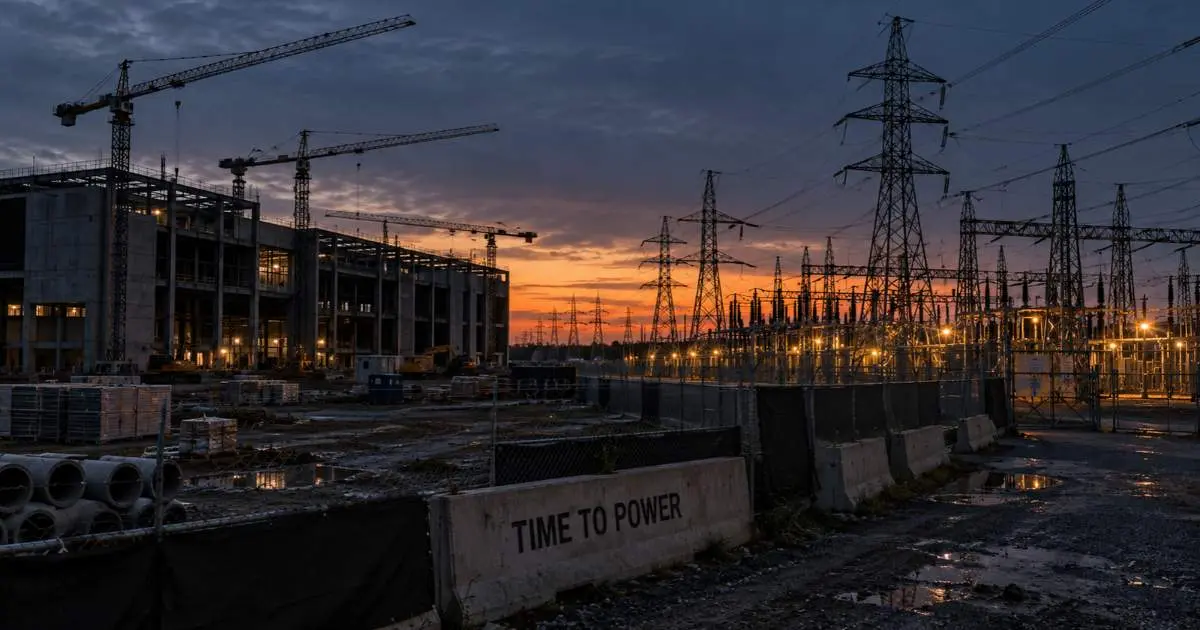
Capital used to ask where land, labour, finance and taxes were cheapest. Increasingly, another question comes first: when can the site actually be powered? As electricity access becomes harder to secure, the grid’s waiting list is starting to perform a function that looks surprisingly like capital allocation.
The Economy Is Waiting for Power
A modern investment project can have financing, planning permission, land, customers and equipment suppliers and still lack the one thing that determines when it becomes an operating asset: a credible date for electricity. That distinction is becoming uncomfortable for economies accustomed to thinking about power mainly through price. Electricity that is cheaper in 2032 may be considerably less valuable to an investor than somewhat more expensive electricity available in 2028.
In practical terms, electricity access means obtaining usable capacity at a specific location by a commercially useful date. That is different from asking whether a country produces enough electricity overall. For an investor, capacity that exists somewhere else, or will arrive several years after a project is ready, may have little immediate economic value.
Amazon Web Services has encountered that problem directly in Europe. In 2026, its head of energy markets and regulation for Europe, the Middle East and Africa said grid connections can take as long as seven years in some European markets, while a data centre itself can be developed in roughly two. The International Energy Agency describes the mismatch more broadly: major grid infrastructure can require five to fifteen years to plan, permit and complete, compared with one to three years for a data centre and one to five years for many renewable projects.
The backlog is large enough to invite exaggeration. The IEA estimates that more than 2,500 gigawatts of projects are stalled in connection queues worldwide, but that figure combines renewable generation, storage and large electricity loads. It is not 2,500 GW of certain future demand, much less 2,500 GW of AI infrastructure waiting for power. What it shows is that investment on both sides of the electricity system is moving faster than the physical and administrative systems that connect it.
A grid connection queue is therefore more than a list of projects waiting for engineers. It determines when proposed investment gains access to scarce network capacity. Once connection dates influence where projects locate, which proceed and which are abandoned, the queue has already entered the investment decision.
Electricity Exists. Access Does Not.
“Power shortage” is often the wrong diagnosis. Electricity cannot be separated from where it is generated, where it is consumed and what lies between the two. A country can have ample generating capacity and still be unable to deliver another few hundred megawatts to a particular site because the relevant transmission line, substation or transformer cannot carry it.
The reverse can happen at the same time. At the end of 2025, more than 2,060 GW of proposed generation and storage was actively seeking connection to the US transmission system. Berkeley Lab stresses that most projects entering such queues historically withdraw before becoming operational, but the number still illustrates an awkward reality: generators can wait to supply a system in which new consumers are also waiting for power.
There is no contradiction once geography is restored to the picture. A solar project in one region cannot necessarily serve a semiconductor plant in another without adequate transmission. A new data centre may sit close to generation but behind a constrained substation. A battery can shift energy across time but cannot repair a missing transmission corridor. What is scarce is often not electricity in the abstract but deliverable capacity at a specific place by a commercially useful date.
That is why electricity access should not be confused with electricity availability. The first asks whether a project can obtain enough power here and soon enough to justify investment. The second says much less about whether that electricity can reach the site.
Two industrial plots can therefore have similar land costs, labour pools and tax treatment while belonging to very different economic realities. If one can obtain 200 MW within eighteen months and the other must wait six years, time has become part of the infrastructure being sold.
The Shadow Interest Rate of the Grid
Finance already has a language for the cost of time. Capital committed today is expected to earn a return, and the longer that return is postponed, the harder a project must work economically to justify itself. Grid delay imposes a comparable penalty without appearing as a neat percentage on a central bank chart.
Land may already have been acquired. Engineering teams may be working. Financing terms can expire or become more expensive. Equipment reservations may need renegotiation. Customers can move elsewhere, incentives can change, technology can improve and competitors can open first. A project approved under one set of assumptions may reach its connection date in a different market.
The consequences vary by industry. A data centre can miss part of an investment cycle in computing. A factory can lose contracts before its machines start. A battery developer can see its revenue assumptions change before energisation. The same year of waiting does not cost every project the same amount, but it costs almost none of them zero.
It is useful to think of that burden as the shadow interest rate of the grid. This is not an established economic indicator; it is an analytical way of exposing a hidden cost. Every additional year between committing capital and obtaining usable electricity raises the effective hurdle facing an investment even if formal interest rates do not move.
Unlike a central bank rate, this shadow rate varies by location. A company may reduce it not by refinancing but by moving. A region with somewhat higher energy prices can beat a cheaper competitor if it can provide a credible connection several years earlier.
That has an uncomfortable implication for industrial policy. Governments can offer tax credits, cheap land, grants and training support, only to discover that the value of those incentives is diluted by a grid date they do not control. But building vast amounts of unused network capacity in advance carries its own cost. The real tension is between the cost of waiting and the cost of building before demand has proved that it is real.
The Queue Is Not Demand
That tension becomes more dangerous when the queue itself gives a distorted picture of the future. Queued capacity is not the same as committed investment, and connection requests are not the same as actual demand.
Berkeley Lab’s US data make the distinction clear. More than 2,060 GW of generation and storage remained active in transmission queues at the end of 2025, but historically most proposed projects entering those queues have not reached commercial operation. Queue capacity is evidence of development pressure, not a forecast of what will ultimately be built.
Demand-side queues are developing the same pathology. Britain’s Ofgem says contracted demand connection applications surged from 41 GW to 125 GW between November 2024 and June 2025, with data centres accounting for at least 80 GW of the increase. The regulator also says a significant part of the queue may be non-viable and has proposed commitment fees and progress milestones intended to force developers to demonstrate that they genuinely intend to proceed.
Texas offers an even more dramatic headline. By September 2026, more than 470 GW of proposed data-centre projects were seeking grid connection in the state, several times existing peak electricity demand. That figure says something important about investor interest and competition for capacity. It does not mean Texas is certain to add 470 GW of operating data centres.
The inflation of the queue can emerge from rational behaviour. When future capacity is scarce, an application behaves partly like an option. Developers may pursue several sites before choosing one, duplicate projects across jurisdictions or apply early simply because waiting until a final investment decision could mean losing access altogether.
Scarcity can therefore generate more apparent scarcity. Developers file defensively because the queue is long; those applications make the queue longer; the enlarged queue encourages even earlier filings. A mechanism designed to organise development begins manufacturing congestion of its own.
Regulators are responding by making queue positions harder to hold casually. FERC’s US generator reforms moved transmission providers toward first-ready, first-served cluster processes supported by financial deposits and site-control requirements. Britain is experimenting with its own methods for removing unlikely demand projects.
Once authorities decide what counts as ready, how much money must be put at risk and which milestones justify retaining scarce capacity, queue management becomes more than administration. It starts sorting serious capital from optionality.
Powered Land
The consequences are already visible in real estate. In the data-centre industry, land with credible access to power is increasingly valued differently from land that merely has favourable geography. Industry research now treats grid-connected capacity and delivery time as decisive variables in markets where an otherwise excellent site can be commercially useless if electricity arrives too late.
Europe offers a striking example. Data centres scheduled for delivery later in the decade are increasingly being located farther from major cities than projects built earlier, as developers search for land, faster utility connections and energy availability. The important change is not suburbanisation or decentralisation by itself. It is that connection time is repricing geography.
An unremarkable industrial parcel near a strong substation can acquire strategic value. A former heavy-industrial site can become attractive because its electrical infrastructure survived the factory it once served. A secondary city can compete for investment that might previously have gravitated toward a major metropolitan hub. Conversely, expensive land in an established market can become unattractive if a viable power date sits too far into the future.
Data centres reveal this mechanism vividly because they concentrate enormous loads in single locations, but they are not alone. Battery manufacturing, semiconductor fabrication, large charging depots, electrolysers and other power-intensive industries can all become sensitive to the same variable even when their operating profiles differ.
Economic geography has usually treated infrastructure as something that supports locations already considered valuable. Grid scarcity can reverse part of that sequence. Infrastructure readiness itself becomes a reason capital chooses one location over another.
A transmission corridor can therefore become a development corridor before a planning document labels it as one, and a spare transformer bay can alter land value without changing the land itself. What is being repriced is not only space. It is the time attached to that space.
Who Gets Connected First?
Scarcity becomes openly political when not everybody can be served at once. Imagine a constrained region with applications from a semiconductor plant, new housing, several data centres, a battery facility, an electric transport depot and conventional manufacturing. First-come, first-served appears neutral because nobody has to decide which activity deserves greater social value. That neutrality weakens when early applicants are speculative or when one stalled project blocks several more advanced projects behind it.
Britain has crossed that threshold explicitly. Ofgem says the demand queue contains viable projects that cannot connect quickly enough, non-viable projects acting as blockers and no existing mechanism for prioritising strategically important demand projects. Its reform programme now contemplates doing exactly that.
The significance is easy to miss. If a government or regulator can accelerate one strategically important connection, electricity access becomes an instrument of industrial policy even when no subsidy is paid. Moving a project forward by several years can confer enormous economic value.
Every alternative contains a bias of its own. First-come favours whoever files early. First-ready can favour developers with stronger balance sheets and greater ability to satisfy costly milestones. Auctions favour willingness to pay. Strategic prioritisation creates room for lobbying and political discretion. Economic-value tests would ask grid institutions to make judgments about industries they were never designed to rank.
There is no rule that abolishes allocation; there are only different methods of performing it. In a constrained grid, the question of who connects first can influence which factory produces, which housing scheme proceeds, which battery earns revenue and which investor chooses another jurisdiction. When capacity is scarce, connection rules become capital-allocation rules.
Who Pays for the Wire?
Permission to connect does not settle who should finance the infrastructure required to make that connection possible. A very large new user may trigger a substation extension, transformers, new local lines or reinforcement deeper inside the network. Charging the project for all of those costs has an intuitive logic: the new demand caused the need. The complication is that the upgraded network may later serve many other users, leaving the first entrant to finance infrastructure whose benefits extend beyond its own meter.
Socialising the cost reverses the risk. Spreading reinforcement expenses across the network can make productive investments easier to connect, but electricity consumers then carry part of the cost if the expected growth never materialises.
Real regulatory systems are reaching different answers. Northern Ireland changed its distribution rules in 2026 to socialise a larger share of reinforcement costs, shifting part of the burden from individual connecting customers to the wider customer base. Victoria, Australia, has moved toward a different principle for future data centres, expecting new facilities to secure their own energy arrangements and bear connection and network-upgrade costs rather than transferring them indiscriminately to the wider system.
Neither approach resolves the issue in principle. The first entrant should not necessarily pay forever for an asset that later becomes common infrastructure; neither should households automatically underwrite dedicated infrastructure for wealthy private developers.
The argument becomes sharper when governments declare an industry strategic. A state may want AI infrastructure, semiconductor fabrication or electrified heavy industry while simultaneously insisting that private investors pay the full cost of serving themselves. Those positions can coexist only after somebody decides where the private connection ends and the common network begins.
That boundary determines who carries the risk if expected growth fails to appear, which makes it an economic choice even when it arrives dressed as engineering.
Access Is Becoming Negotiable
Scarcity can also be reduced by changing what a connection means. Traditional connection logic is close to binary: a project receives the firm capacity it requests, or it waits until the network has been upgraded sufficiently to provide it.
The IEA argues that more flexible arrangements could release a substantial part of the backlog. Its 2026 analysis estimates that non-firm connections could enable roughly 750 to 900 GW of advanced-stage projects worldwide, while grid-enhancing technologies and larger upgrades could raise the total potentially unlocked capacity to around 1,200–1,600 GW. These are estimates rather than guaranteed additions, but they illustrate how much capacity can remain inaccessible when every applicant is treated as requiring the same form of service.
A non-firm connection changes the bargain. A project may connect earlier in exchange for accepting restrictions during periods when the network is congested. Batteries, flexible demand and operating agreements can sometimes reduce the amount of guaranteed capacity a project needs.
The product being allocated is therefore becoming more complicated than “a connection.” A company might choose between firm power later and conditional power sooner, conventional network service and co-location with generation, or full grid dependence and a hybrid system incorporating onsite assets.
The United States is already wrestling with these questions around large loads located alongside power plants. FERC has required PJM to develop clearer arrangements for co-located data centres and other large users because such projects can alter transmission needs and the distribution of system costs.
Flexibility is not free. Highly capital-intensive facilities may find curtailment expensive, and AI-oriented data centres in particular have strong incentives to keep costly computing equipment working. Yet location, storage, onsite assets and operational flexibility can still alter what the network must guarantee.
The emerging electricity connection begins to resemble a contract with several dimensions: quantity, firmness, location, timing and flexibility. Fast electricity access can therefore acquire a price of its own, sometimes paid through operating constraints rather than a larger cheque. A developer willing to accept those conditions may effectively buy years without waiting for the entire network to be rebuilt.
The Grid Has a Supply Chain Too
Queue reform has hard limits because no procedural innovation can manufacture physical equipment. Networks depend on cable factories, transformer plants, specialised steel, copper, engineers and manufacturing capacity that cannot expand as quickly as an application register.
The IEA found that high-voltage cables can require two to three years to procure and large power transformers as much as four years. Average lead times for both have nearly doubled since 2021, while prices for key grid equipment have also risen substantially.
It would be inaccurate to describe this simply as “AI inflation.” Data centres are one source of new demand, but transmission expansion, ageing-network replacement, renewable integration, offshore wind and industrial electrification are all competing for overlapping supply chains. Several investment cycles are arriving at once.
That simultaneity spreads scarcity beyond the grid queue itself. A transformer shortage delays a substation; the delayed substation postpones a factory; the postponed factory accumulates financing costs or changes its investment plans. A constraint deep inside electrical-equipment manufacturing can therefore influence decisions made by companies that will never purchase a transformer directly.
The IEA estimates that annual global grid investment needs to rise by roughly 50 per cent from around $400 billion today by 2030 to meet expected demand. But expenditure and physical output are not the same thing. If many countries accelerate investment simultaneously without a comparable expansion in manufacturing and engineering capacity, part of the additional money can appear as higher prices and longer order books.
The constraint has moved upstream. A connection date can depend not only on the local utility’s willingness to build but on whether a specialised factory thousands of kilometres away has a production slot available.
The Coordination Trap
Some bottlenecks are not fundamentally shortages of electricity, money or equipment. They arise because several rational actors need one another to commit first.
An industrial company wants confidence that power will be available before investing billions in a site. A network operator wants evidence that the investment will really happen before constructing expensive infrastructure for it. A generator wants credible future demand. The regulator wants to prevent consumers from paying for assets that turn out to be unnecessary. Each position is defensible, yet together they can create paralysis.
The problem becomes more severe as projects grow. A modest commercial development can often fit inside existing infrastructure. A gigawatt-scale campus or industrial cluster can alter the planning assumptions of an entire region. Building too slowly risks losing the investment; building too early risks creating stranded assets.
Britain’s experience captures the dilemma. Ofgem acknowledges that serious projects are being delayed while simultaneously warning that a substantial part of the demand queue may never materialise. Stronger commitments, better data and more active prioritisation are attempts to solve an information problem as much as an infrastructure problem.
This is the coordination trap of the new electricity economy. A country can have abundant capital, willing investors and solvent utilities yet still fail to align generation, transmission, equipment and demand on the same timetable.
Large technology companies are trying to reduce that dependence by moving deeper into energy procurement through long-term power contracts, batteries, co-location and dedicated generation. Yet every shortcut encounters another dependency. Dedicated generation may still need transmission. Batteries need energy with which to charge. Gas generation requires turbines and fuel infrastructure. Private wires need land and permission.
The underlying mismatch is temporal. Finance can be approved in months and computing equipment replaced in a few years, while substations and transmission corridors often operate on much longer clocks. Capital moves faster than steel, but investment becomes productive only when the two finally meet.
When Capital Builds Around the Grid
When that meeting takes too long, some investors begin building around the network instead. Data centres make the shift especially visible because the revenue attached to bringing computing capacity online quickly can justify energy infrastructure that would once have seemed extravagant.
FERC’s work on co-location in PJM arose partly because large loads were seeking faster pathways by locating beside generation rather than relying entirely on conventional network arrangements. Elsewhere, developers are combining onsite generation, batteries, microgrids and private energy systems to change the timetable on which electricity becomes available.
None of those alternatives is costless. Gas generation needs fuel infrastructure and equipment whose own supply chains may be constrained. Batteries move energy between hours rather than creating it. Private networks require land and permissions. Dedicated systems can sacrifice some of the diversification and efficiency provided by large interconnected grids.
The relevant economic question is therefore not whether bypassing the grid is inherently good or bad. It is at what point waiting for the grid becomes more expensive than building around it.
The answer differs by balance sheet as much as by technology. A global technology company may be able to finance generation and storage to protect a launch schedule. A medium-sized manufacturer may have no equivalent option and must remain exposed to the public network’s timetable.
Scarcity can therefore produce a two-speed electricity economy. Firms with very large balance sheets can purchase an alternative path to power, while less wealthy companies continue waiting in line. A queue may appear formally equal because everyone faces the same procedure, but the ability to escape it is profoundly unequal.
Grid scarcity can therefore widen the distinction between firms that possess capital and firms wealthy enough to purchase time.
When Phantom Demand Builds Real Infrastructure
The opposite risk appears when network planners believe the queue too readily. A bad queue can delay real projects, but it can also persuade the system to build for projects that never arrive.
Suppose a network operator receives tens of gigawatts of new demand applications. If planners assume most are speculative and they later materialise, infrastructure arrives too late and investment may go elsewhere. If they treat every application as firm and most disappear, consumers can be left financing equipment built for demand that existed mainly on paper.
Britain’s proposed commitment fees and milestones are partly an attempt to improve the information content of the queue. A developer required to put meaningful capital at risk is less likely to retain a speculative position indefinitely. FERC’s generator reforms pursue similar logic from the supply side through deposits, cluster studies and site-control requirements.
Texas shows how difficult the problem becomes when the headline numbers are enormous. More than 470 GW of data-centre connection requests is meaningful evidence of investor interest, but treating the entire figure as future load would produce a radically different infrastructure plan from assuming that only a fraction becomes real.
Connection queues are therefore beginning to resemble markets with poor price discovery. Applications contain information about future investment, but the quality of that information varies. Some represent committed projects, others alternative sites, early exploration or options held because developers fear that applying later will leave them without capacity.
Deposits and commitment fees perform a function loosely analogous to margin requirements: they force applicants to reveal how strongly they believe their own plans. Once billions are being committed to wires and substations, improving that signal matters because mistakes no longer remain inside an application database. They appear on balance sheets and electricity bills.
A bad queue can therefore damage the economy in opposite directions. It can keep productive capital waiting behind projects that never exist, or direct real infrastructure toward demand that never arrives. A bad queue does not merely delay capital; it can misdirect it.
The Queue That Decides the Economy
The emerging electricity constraint is easy to describe badly. It is not simply that the world needs more power, that AI consumes too much electricity or that regulators have created excessive bureaucracy. In different places all of those factors can matter, but none captures the mechanism on its own.
The more consequential shift is that electricity access—usable capacity at a particular location and time—is acquiring economic properties of its own.
Three prices follow. There is the price of waiting: capital committed before an asset can operate. There is the price of going around the network: dedicated generation, batteries, co-location and other ways of purchasing a faster timetable. And there is the price of being wrong: wires, substations and transformers built because a queue appeared to promise demand that never materialised.
That is why connection policy is moving out of the technical background. Readiness rules influence which investments advance. Strategic prioritisation can reshape industrial geography. Decisions over reinforcement costs distribute risk between companies and households. Flexible connections create different grades of access, while shortages of transformers and cables transmit scarcity from industrial supply chains into projects far downstream.
Data centres are useful here not because they are the entire story but because they are a stress test. They combine unusually large loads, short development cycles and developers wealthy enough to explore alternatives. They expose a problem that electrified manufacturing, transport, storage and housing would eventually have forced onto grids anyway: investment can now arrive faster than conventional infrastructure can accommodate it.
The traditional economic map emphasised ports, roads, labour costs, taxes, interest rates and proximity to customers. None of those has disappeared. But another variable can increasingly overrule them: the date on which reliable power becomes available.
In that environment, electricity access begins to resemble an asset. Not electricity in the abstract and not ownership of the grid, but a credible claim on capacity at a particular place and time. Such a claim can raise the value of land, change a financing decision, rescue a project from years of delay or redirect investment hundreds of kilometres away.
The connection queue matters because it sits where financial abstraction meets physical reality. A company may possess billions in capital, but capital does not manufacture anything, process data or charge a battery until energy can reach the asset that money built.
The grid does not decide who owns capital. Increasingly, its rules help decide when and where capital is permitted to become productive.