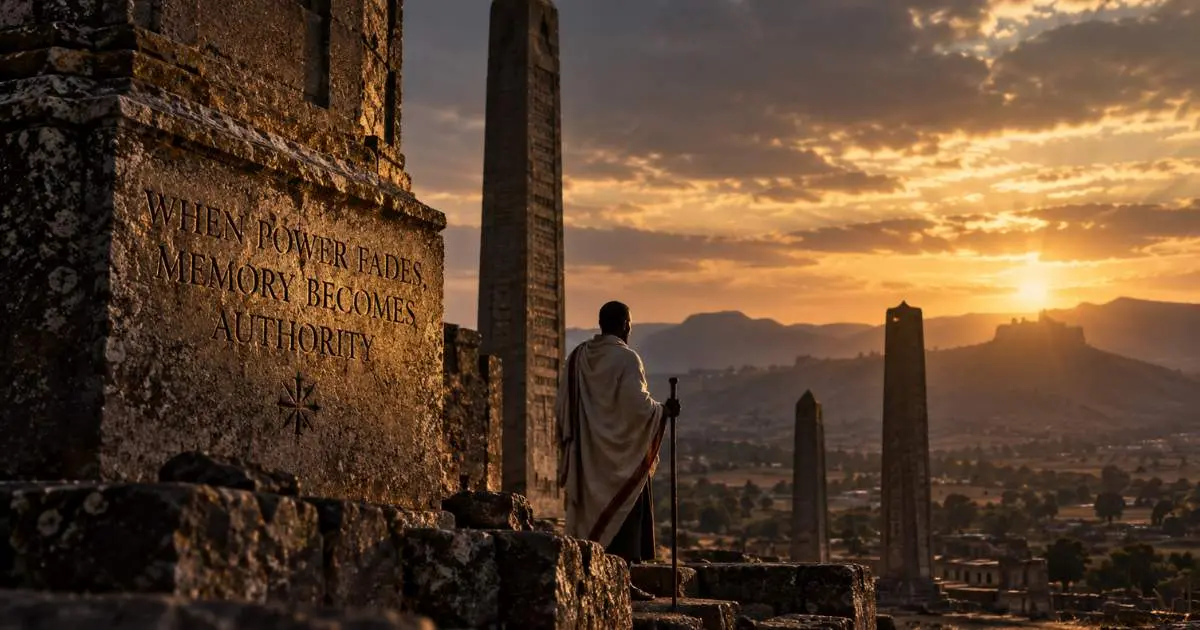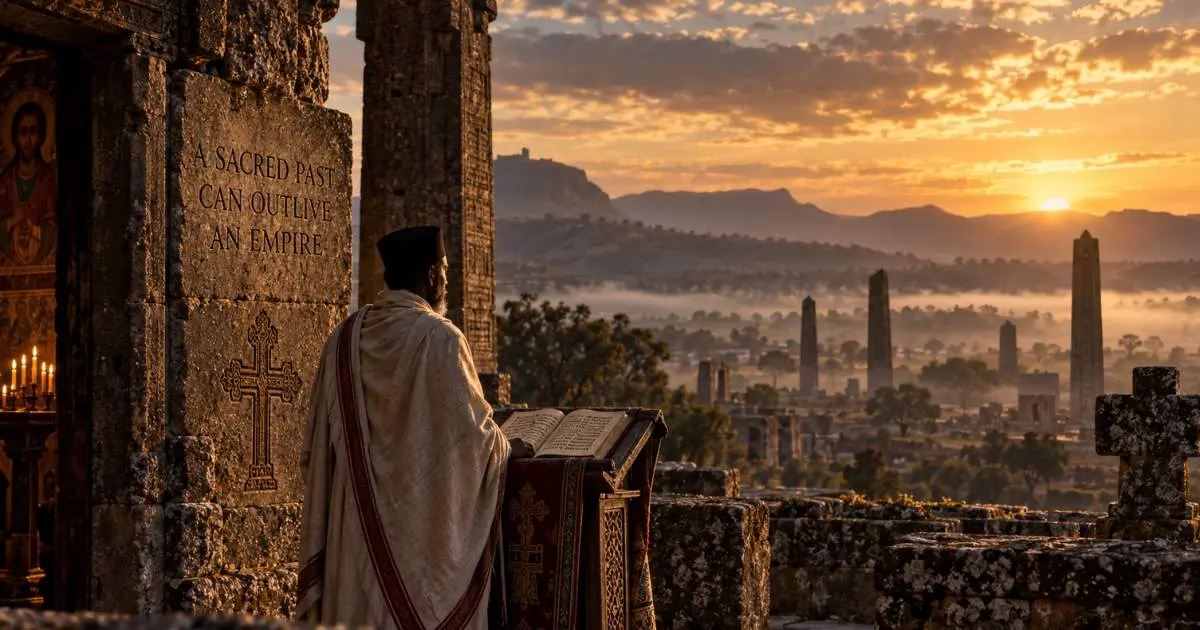
Long after Aksum’s imperial networks weakened, its name continued to confer authority. Medieval dynasties used scripture, sacred geography and royal ancestry to claim its inheritance; centuries later, the same lineage appeared in Ethiopia’s constitutions. An empire no longer ruled the Red Sea, but its past still shaped who could claim the right to rule.
Empires usually lose territory before they lose meaning. Armies retreat, capitals shrink, trade routes move and dynasties disappear, yet the political language created by an empire can survive long after its institutions have weakened. Rome became useful to rulers who never governed from Rome. Jerusalem exercised political and religious authority across societies that did not control it. Ancient capitals can acquire a second life in which their greatest asset is no longer an army, a treasury or a port, but the ability to make later power look older, holier and more legitimate than it really is.
Aksum underwent something similar, though by a distinctively Ethiopian route. By the later first millennium, the commercial and political system described in Part I had changed profoundly. The old capital had declined, coinage disappeared, monumental construction on the earlier scale had ceased, and political centres shifted deeper into the highlands. Yet Christianity survived, Geʽez remained a vehicle of sacred and literary culture, churches preserved institutional continuity, and Aksum itself retained a religious prestige that outlived the empire that had created it. Archaeology and textual evidence do not support a clean moment at which one civilisation ended and another began. They reveal a long transformation in which parts of the Aksumite inheritance were abandoned, others were preserved, and still others were reconstructed later for purposes the original kings could not have anticipated.
That distinction matters because the most famous stories associated with Aksum today do not all come from Aksumite antiquity. The Queen of Sheba as the Ethiopian Makeda, her son Menelik, the transfer of the Ark of the Covenant from Jerusalem to Ethiopia, and the fully developed claim that Ethiopian kings descended from Solomon belong to a later architecture of memory whose most influential surviving expression is the fourteenth-century Kebra Nagast. To treat those traditions as straightforward records of the ancient empire is bad history. To dismiss them as merely invented stories is equally inadequate, because they became politically and religiously consequential in ways that archaeology alone cannot explain.
The second life of Aksum therefore requires a different question from the first. Part I asked how a highland state turned land, caravan routes, Adulis, coinage, Christianity and the Red Sea into power. The question here is what happened after that system no longer worked in the same way. The answer is not that Aksum simply vanished. Its most durable resources became less material and more symbolic: church, language, sacred geography, royal ancestry and claims about where Ethiopia belonged in biblical history. Later rulers would discover that an ancient empire could still govern the present if they could persuade people that the present was its continuation.
When an Empire Recedes but a Civilisation Remains
The decline of Aksum did not resemble the capture of a capital followed by the immediate disappearance of a state. Archaeological evidence points instead to a protracted contraction and relocation of political life. David Phillipson’s synthesis of the evidence describes economic deterioration in the Aksum area from the sixth century, population decline, reduced monumental activity and changes in coinage, followed eventually by political centres shifting away from the old capital. His treatment of the post-Aksumite period emphasises transformation rather than a single catastrophic ending.
Such transitions are difficult to narrate because the evidence itself changes. The Aksumite kings left coins and inscriptions that allow historians to see rulers announcing themselves directly. The centuries after the decline of the ancient kingdom are less generous. Written evidence becomes thinner, later chronicles look backward through the political needs of medieval dynasties, and archaeological sequences remain incomplete. The temptation is to fill that silence with stories of abrupt collapse, foreign invasion or civilisational darkness, but the surviving record is better understood as evidence that the centre of political gravity moved while many cultural institutions endured.
Christianity was among the most important of those continuities. What had begun as a transformation of royal ideology under Ezana and developed through subsequent centuries did not disappear when Aksum’s external power contracted. Monasteries, churches, biblical traditions and clerical networks became increasingly important carriers of continuity across a fragmented political landscape. Geʽez, already used in Aksumite royal inscriptions and late antique Christian translations, also survived the political system that had first monumentalised it. The transmission of written texts through the poorly documented centuries between the seventh and thirteenth remains difficult to reconstruct, and the surviving evidence does not establish an uninterrupted sequence of literary production. What eventually endured was Geʽez’s role as the classical liturgical and literary language of Ethiopian Christianity.
This survival changed the nature of historical inheritance. Under the ancient empire, Geʽez could communicate authority because an Aksumite king commanded territory and resources. Later, the same language could communicate antiquity because scripture, liturgy and religious learning linked medieval communities to an earlier Christian past. Political continuity was uncertain; textual and ecclesiastical continuity could be stronger, even where the precise routes of transmission remain obscure. The civilisation did not need to preserve the same palace in order to preserve the memory of where legitimate Christian kingship had once been centred.
Aksum consequently became more valuable even as it ceased to function in its old imperial form. An active capital competes with other centres through taxation, armies and administration. A sacred predecessor can be claimed by successors ruling elsewhere. The old city was gradually becoming available not merely as a place from which kings had ruled, but as a past from which later kings could derive meaning.
The Zagwe Problem: Who Inherits a Sacred Kingdom?
By the high Middle Ages, political power in the Christian highlands was centred much farther south, in Lasta, under the dynasty later known as the Zagwe. The chronology of their rise remains difficult, but the emergence of a new centralised authority followed a period of political fluidity after the weakening of earlier northern centres. The Zagwe court was associated with Roha, the settlement later known as Lalibela, and the dynasty is generally linked to Agaw origins.
For centuries, the Zagwe were frequently presented through the eyes of the dynasty that defeated them. Later Solomonic traditions depicted their rule as an interruption in a legitimate line: the throne had supposedly passed away from the descendants of Israel and was eventually “restored” to the rightful house. Some medieval chronicles explicitly classified the Zagwe as outsiders to the Israelite succession. Yet the sources describing the transfer are late, partisan and sometimes contradictory, and the precise circumstances by which Yekuno Amlak displaced the Zagwe around 1270 remain uncertain.
The language of usurpation should therefore be treated as evidence of later political ideology rather than a neutral description of what occurred. The Zagwe were Christian rulers operating within the religious world inherited from Aksum. Archaeological and historical scholarship has also pointed to ways in which Zagwe authority drew upon Aksumite precedents of its own, even though later rivals had strong reasons to minimise those continuities.
This is one of the most revealing features of Aksum’s afterlife. Rival dynasties could disagree over who possessed legitimate authority while sharing the assumption that legitimacy required some relationship to the older Christian inheritance. Aksum no longer needed to govern the kingdom directly to define the language in which succession was argued. The political problem was not merely who controlled the highlands, but how a ruling house could transform control into rightful rule. Military victory answers who possesses the throne today; dynastic legitimacy tries to answer why the throne should belong to the victor tomorrow. Medieval Ethiopian rulers increasingly solved that problem through sacred history, and the Zagwe created one of the most extraordinary physical expressions of that strategy.
Lalibela: Building a New Sacred Geography
The churches of Lalibela are so visually extraordinary that their political meaning can disappear behind their architecture. Eleven major rock-hewn churches form a sacred landscape associated in tradition with King Lalibela, whose reign is usually placed around the late twelfth and early thirteenth centuries. The complex has long been understood as a kind of Ethiopian “New Jerusalem,” with a river named Jordan and spaces whose religious geography consciously evokes the Holy Land.
The familiar story attributes the creation of the entire ensemble to a single ruler determined to provide an Ethiopian Jerusalem after access to the Holy Land became difficult. That tradition remains important to the site’s sacred identity, but archaeology makes the building history more complicated. Scholars have argued that the churches and related rock-cut structures developed across a longer period, drawing on earlier local traditions of excavated architecture rather than appearing suddenly as the product of one royal project. Some structures may also have had earlier non-ecclesiastical functions before being integrated into the Christian complex.
That uncertainty does not reduce Lalibela’s importance; it changes what makes the place historically interesting. Instead of being merely evidence that one remarkable king ordered remarkable churches to be carved from stone, Lalibela becomes evidence of how a Christian society could take inherited architectural forms, local landscapes and biblical geography and combine them into a new sacred centre after political power had moved away from ancient Aksum.
The site also demonstrates that continuity does not require duplication. The Zagwe did not rebuild the Aksumite capital in Lasta. They created something new while working within a Christian civilisation whose institutional and architectural ancestry reached back toward Aksum. Architectural continuities between later Ethiopian churches and older Aksumite precedents reinforce the point, but Lalibela was not simply a copy of an earlier age. It represented the creative relocation of an inherited sacred language.
Lalibela can therefore be read as an act of sacred relocation. If political authority had moved south, sacred geography could move with it. Jerusalem could be re-created in the Ethiopian highlands; Aksumite Christian forms could be reworked in Lasta; a dynasty without the later Solomonic genealogy could build legitimacy through monumental devotion. That helps explain why the later destruction of Zagwe legitimacy required more than defeating Zagwe armies. Their religious achievements were too deeply embedded in Ethiopian Christianity simply to be erased. Later rulers would instead produce a different claim: not that sacred history began with them, but that their blood entitled them to inherit a sacred history older than the Zagwe themselves.
The Solomonic Restoration Was Also a Political Reclassification
Around 1270, Yekuno Amlak defeated the last Zagwe ruler and established the line conventionally known as the Solomonic dynasty. The event is often described as a “restoration,” but the word already contains the later dynasty’s political argument. It presumes that Yekuno Amlak recovered a legitimate succession that the Zagwe had interrupted rather than simply creating a new ruling order after military victory. Contemporary and near-contemporary evidence for the exact genealogy is limited, while much of the developed restoration narrative survives in later sources.
The new dynasty needed more than control of territory because its claim was larger than conquest. It presented itself as the legitimate continuation of Ethiopia’s ancient kings, ultimately linking that royal ancestry beyond Aksum to the biblical house of Solomon. Early Solomonic rulers grounded their right to rule in an asserted lineage connecting them to the ancient Aksumite monarchy and, through the Queen of Sheba, to Solomon.
This was not ancestry in the modern genealogical sense. It was political theology. A ruler who traced his authority to Solomon was not merely claiming an impressive family tree. He was positioning Ethiopian kingship within biblical history, transforming succession from a question of military possession into a question of sacred order.
Genealogy, in that sense, could function almost like constitutional language. Medieval Ethiopia did not possess a modern written constitution defining hereditary legitimacy through secular law. A dynastic narrative could nevertheless perform some of the same work by answering the fundamental questions that constitutions answer: where authority comes from, who may inherit it, why one ruling house is legitimate and why another can be classified as an interruption.
The political usefulness of this claim becomes clearer when placed beside the Zagwe experience. If a rival dynasty can govern effectively, sponsor Christianity and create Lalibela, then competence alone cannot establish exclusive legitimacy. The Solomonic claim solved that problem by moving the argument backward in time. The Zagwe could possess the throne for generations; the new dynasty could still portray them as temporary because rightful ownership supposedly predated them by centuries. Control of the past thus changed the meaning of the present. Yekuno Amlak had won a kingdom, but his successors would build an intellectual structure explaining why it had always been theirs.
The Queen of Sheba: Where Scripture Becomes Ethiopian History
The Queen of Sheba already possessed a long history before medieval Ethiopian authors made her Makeda. The biblical books of Kings and Chronicles describe a wealthy queen who travels to Jerusalem to test Solomon’s wisdom, bringing gold, spices and precious stones. The Qur’an also contains a celebrated account of the ruler of Saba in its story of Solomon, although it does not name her Bilqis; that name developed in later Islamic tradition. Neither the biblical nor Qur’anic narratives identify the queen as Makeda.
The historical kingdom of Saba is generally associated with southern Arabia, particularly the region of present-day Yemen, whose pre-Islamic kingdoms have left extensive inscriptions and archaeological remains. Later traditions on both sides of the Red Sea appropriated the Queen of Sheba in different ways, and scholarship increasingly treats those traditions as part of a shared Red Sea world rather than assuming that one later national narrative straightforwardly identifies the biblical monarch.
The Ethiopian transformation of the story becomes politically decisive in the Kebra Nagast. There the queen is Makeda, ruler of Ethiopia. She travels to Solomon, returns pregnant and gives birth to Menelik, who later visits his father in Jerusalem. This changes the Queen of Sheba from a foreign visitor in Solomon’s story into the founding mother of Ethiopian sacred kingship.
For a historian, the distinction between those narrative layers is essential. We do not possess contemporary evidence establishing that a historical Queen of Sheba named Makeda ruled Aksum, and Aksum itself arose centuries after the period traditionally associated with Solomon. The later Ethiopian tradition should therefore not be retrojected into the first millennium BC as though it were an Aksumite royal archive.
Historical verification, however, is only one way a story can matter. The political significance of Makeda lies in what the narrative accomplished once it became authoritative. It placed Ethiopia inside biblical time rather than at the edge of it. The kingdom was no longer merely a Christian society that had received Christianity from abroad in late antiquity. Its royal history could now be imagined as reaching back before Christianity itself, through Solomon, to Israel.
That transformation reverses the direction of dependence embedded in many conventional stories of Christianisation. A narrative in which Ethiopia simply receives religion from the Mediterranean can make the kingdom appear peripheral to an older sacred centre. A story in which Solomon’s own descendant carries sacred legitimacy into Ethiopia allows the highlands to become a centre in their own right. Medieval political memory did not merely connect Ethiopia to biblical history; it rearranged biblical geography around Ethiopia.
Menelik and the Politics of Descent
In the Kebra Nagast, the son born from Solomon and Makeda becomes Menelik, the figure through whom the royal line passes into Ethiopia. The story allows a later dynasty to construct an unbroken chain from biblical Israel through Ethiopian antiquity to medieval kingship. Modern historians generally treat Menelik I as a legendary figure rather than a securely documented ruler of ancient Aksum, but the absence of historical verification does not diminish the importance of the role assigned to him in the political imagination.
Menelik solved a problem that Makeda alone could not solve. The Queen of Sheba could connect Ethiopia to Solomon, but succession required transmission. A son provided the genealogical bridge through which divine favour, royal blood and political authority could supposedly move from Jerusalem into a permanent Ethiopian dynasty.
The resulting claim did more than glorify the monarch. It classified political rivals. If legitimate kings descended from Menelik and Solomon, then a dynasty unable to claim that descent could be represented as possessing power without possessing the deepest title to it. The later portrayal of the Zagwe as rulers outside the Israelite succession makes sense within precisely this structure.
This kind of genealogy should not be dismissed as primitive credulity. Medieval European rulers likewise traced dynasties to biblical, Trojan or classical ancestors; Islamic rulers cultivated prophetic, tribal or sacred lineages; imperial houses across Eurasia constructed political descent to make contingent victories appear ordained. The Ethiopian case is distinctive in its content, not in the political mechanism.
What made the Ethiopian construction especially durable was the fusion of genealogy with place. The story did not leave Solomon and Menelik floating in literary abstraction. It pulled them toward Aksum, the ancient Christian capital whose ruins and churches already possessed historical weight. A later dynasty could therefore join three kinds of authority in one sequence: biblical ancestry, Aksumite antiquity and contemporary kingship. The past became politically useful because the distance between scripture, antiquity and the reigning dynasty could be collapsed into a single genealogy.
The Kebra Nagast: When a Book Reorders the Past
The Kebra Nagast, or Glory of the Kings, is the central text in this transformation. Its surviving Geʽez form reached its final redaction in the fourteenth century, after the rise of the Solomonic dynasty. Scholars have debated the age and origin of some traditions incorporated into it, and the work draws upon a much wider body of biblical, apocryphal and late antique material. What it is not is a contemporary chronicle written by the ancient kings whose origins it claims to explain.
That chronology changes how the book should be read. If the Kebra Nagast were treated as a straightforward record of Aksumite events, its distance from those events would be an obvious weakness. Read as a product of medieval political theology, the distance becomes its greatest historical value. It tells us how later Ethiopian elites wished the relationship between scripture, Aksum and monarchy to be understood.
Scholarship has argued that the work’s ideological function was closely connected to the legitimation of the early Solomonic elite and has cautioned against pushing its fully developed dynastic ideology backward into the Aksumite period. Memories of Aksum’s wars in southern Arabia and older Christian traditions may have supplied material that later authors could reuse, but reuse is not the same as uninterrupted preservation of the medieval narrative in its final form.
The word “invention” can therefore become misleading. Political traditions are rarely invented from nothing. More often, they are assembled. Existing scripture, remembered kings, older Christian identities, local legends, Aksumite prestige and contemporary dynastic needs are brought together until they form a story capable of explaining the present.
The Kebra Nagast did exactly that. It did not simply say that medieval rulers resembled Aksumite kings. It placed both inside a sacred chronology that began with Solomon. Aksum was transformed from an ancient capital into the middle chapter of a much longer covenantal story. Once that story acquired religious and political authority, it could affect institutions far beyond the manuscript itself. Art portrayed Solomon and Sheba through Ethiopian visual conventions. Churches and liturgy reproduced Old Testament imagery. Royal titles and ceremonial language treated the dynasty’s claimed antiquity as part of political reality.
A document can therefore be historically late and politically ancient at the same time. Its pages may date from the Middle Ages, while the order it authorises claims to have existed since biblical antiquity. The power lies in persuading a society to inhabit the second chronology, because a regime whose legitimacy begins in scripture can present contemporary political victory as the recovery of something older than politics itself.
The Ark: A Relic Beyond Verification, a Claim Beyond Ornament
The most dramatic act in the Kebra Nagast is not Menelik’s birth. It is the movement of the Ark of the Covenant. According to the Ethiopian tradition developed in the text, Menelik travels to Jerusalem and the Ark ultimately leaves Solomon’s kingdom for Ethiopia. In the religious tradition associated with Aksum, the original Ark is believed to be preserved at the Church of Our Lady Mary of Zion. International heritage descriptions appropriately describe the church as believed to hold the Ark rather than presenting the claim as an archaeologically established fact.
There is no independent archaeological verification that the biblical Ark is in Aksum, and the object identified within the tradition is not available for ordinary scholarly examination that could establish such a provenance. A responsible historical account therefore cannot move from “Ethiopian tradition holds” to “the Ark is there” without crossing a boundary the evidence does not permit.
Yet stopping at that boundary would miss the more interesting history. The question is not only whether the object in Aksum can be authenticated, but what centuries of belief in the Ark’s presence did to Ethiopian sacred geography. In biblical tradition, the Ark represents divine presence and covenant. By relocating it from Jerusalem to Ethiopia, the Kebra Nagast does more than give Ethiopia a prestigious relic. It transfers sacred centrality. Jerusalem remains foundational, but Zion is no longer geographically exclusive. Aksum can become a new Zion because the covenant itself has moved.
The Ethiopian concept of the tabot extends this logic throughout the church. In Ethiopian Orthodox practice, the term refers not only to the Ark tradition at Aksum but also to the consecrated altar tablets central to individual churches. Ark symbolism therefore becomes embedded in ordinary ecclesiastical life rather than remaining confined to one inaccessible relic.
This makes the Ark politically important without requiring us to imagine a cynical ruler inventing a sacred object for political purposes. Sacred claims structure hierarchies of places. If Aksum possesses Zion, then Aksum possesses a form of authority that no later court can reproduce simply by constructing a larger palace. Lalibela could create a New Jerusalem and a later dynasty could establish its administrative centre elsewhere, but Aksum held something harder to duplicate: the claim that sacred history had physically arrived there.
Aksum Returns as a Coronation City
The sacred prestige of Aksum eventually became part of royal ceremony. It would be too simple to say that every Ethiopian monarch across every period had to be crowned there, because the formal role of Aksum in Solomonic coronation developed historically rather than operating as an unchanged ritual from antiquity. Recent scholarship on Emperor Zara Yaqob argues that he was the first ruler of the restored Solomonic dynasty to travel to Aksum to consolidate his coronation there, giving the ancient city a renewed institutional role in fifteenth-century kingship.
That development is more interesting than an imagined unbroken coronation tradition because it shows memory being institutionalised. The Solomonic dynasty had already been ruling for well over a century. Yet returning physically to Aksum offered something possession of the throne alone could not provide. The monarch could place contemporary authority inside the landscape from which ancient Ethiopian kingship derived its prestige.
Ceremony turned geography into proof. Clergy, churches, royal regalia and ritual movement made the dynasty’s historical claim visible to participants. The king did not merely say that he descended from an ancient order; he went to the city where that order was believed to have been anchored. Aksum’s ruins were therefore not politically dead. They had become a stage upon which later legitimacy could be performed.
There is a larger principle here. Capitals are usually powerful because government is present, but sacred capitals can remain powerful precisely because government has moved away. Once the bureaucracy leaves, the old centre becomes less threatening to the new court and more useful as a reservoir of legitimacy. The monarch can rule elsewhere while returning ceremonially to a place whose distance from everyday administration makes it appear almost outside ordinary political time. Aksum’s decline thus produced a paradox: it lost much of the material concentration that had made it an empire, but this separation between ancient city and contemporary administration helped turn it into a source of authority no ordinary capital could replace.
Aksum in Islamic Memory
Aksum’s afterlife was never exclusively Christian. Islamic tradition also preserved a powerful memory of the Christian kingdom of al-Habasha through the first hijra, the migration of a group of Muhammad’s early followers who sought refuge from persecution in Mecca. Early Islamic narratives describe the Prophet directing them toward a land ruled by a just negus, a king under whom they would not be wronged. The episode is generally placed around 615, before the later migration to Medina.
The episode belongs chronologically to the final phase of the Aksumite world discussed in Part I, but its importance for later memory is different. In Islamic historical tradition, Christian Ethiopia becomes associated not primarily with imperial competition or theological difference, but with protection granted to vulnerable Muslims before an Islamic state existed.
In Islamic tradition, the ruler is commonly called al-Najashi, an Arabic rendering of the royal title negus rather than a personal name. Later accounts identify him by the personal name Ashama, sometimes rendered Aṣḥama, but attempts to identify him confidently with a particular ruler known from Aksumite coins or inscriptions remain uncertain. Archaeology has likewise not produced evidence that allows every element of the literary tradition to be tied securely to a specific Aksumite site or ruler. The distinction between the importance of the narrative tradition and the limits of independent historical confirmation therefore has to remain visible.
Historical caution does not make the memory insignificant. The refuge story gave Ethiopia a distinctive place in Islamic historical consciousness. Medieval Arabic writers retained interest in al-Habasha, and the first hijra helped sustain an image of the Christian ruler as a figure of justice in the formative history of Islam.
This creates an unusual overlap. Christian Ethiopian memory increasingly made Aksum the home of Zion and the inheritance of Solomon, while Islamic memory preserved the Christian kingdom as a sanctuary for the Prophet’s followers. The traditions are different, and neither should be collapsed into the other, yet together they demonstrate how Aksum acquired more than one sacred afterlife. Its military power could fade from memory while its moral and religious geography remained useful to communities whose theologies were otherwise profoundly different.
Sacred Memory Is Not Historical Continuity
There is a danger in writing this history from either direction. One can accept medieval traditions too literally and project them backward until Makeda, Menelik, the Ark and the Solomonic dynasty appear as straightforward features of ancient Aksum. Or one can react so strongly against those claims that the entire medieval inheritance is dismissed as fabrication. Neither approach explains what happened.
Some continuities are historically tangible. Christianity survived the political decline of the ancient kingdom. Geʽez retained literary and liturgical authority. Churches, monasteries and clerical networks carried institutions forward. Architectural forms and religious practices show adaptation across centuries. Aksum itself remained physically present as a landscape of monuments and Christian memory.
Other continuities were constructed retrospectively. The fully developed genealogy linking Solomonic rulers through Menelik to Solomon belongs to medieval dynastic ideology, not to securely documented Aksumite royal self-description. Scholarship has specifically cautioned against interpreting ambiguous Aksumite evidence as proof that ancient kings already claimed the Solomonic descent later articulated by the Kebra Nagast.
Then there are sacred traditions whose historical value lies partly outside the question of empirical verification. The belief that the Ark resides in Aksum, for example, cannot be confirmed by the methods available to historians, yet its impact on religious practice, sacred geography and political imagination is observable. The historian can reject an unsupported factual claim without pretending that belief in the claim had no historical consequences.
This threefold distinction—continuity, retrospective construction and sacred memory—is essential because societies do not inherit the past in only one way. Some things survive. Some things are forgotten. Some are rediscovered. Others are rearranged until they serve needs their creators never anticipated. Aksum became unusually powerful in medieval Ethiopian memory because all three processes converged in the same name, allowing historically demonstrable continuities and later sacred reconstructions to reinforce one another without being the same thing.
Why Later Rulers Needed Aksum
The persistence of Aksum cannot be explained only by nostalgia. Later rulers needed old legitimacy because political authority in the Ethiopian highlands was repeatedly mobile, contested and difficult to monopolise. Courts could move, dynasties could change and regions could resist. An ancient sacred centre provided something more stable than the location of the monarch.
The extraordinary durability of the Solomonic claim becomes visible when the history moves beyond medieval chronicles. Article 3 of Ethiopia’s 1931 Constitution declared that imperial authority would remain attached to the line of Haile Selassie I, tracing his ancestry through Menelik I to King Solomon and the Queen of Sheba. Article 2 of the revised Constitution of 1955 reaffirmed that descent. A genealogy developed through centuries of sacred and dynastic tradition had entered the written constitutional law of a twentieth-century state.
Those constitutional provisions did not establish that the claimed ancient lineage was historically authentic. They established something different and politically more revealing: the narrative had acquired enough authority to help define the lawful succession to a modern imperial throne. What medieval rulers had used to distinguish legitimate kingship from mere possession of power had become part of the formal language of government. The symbolic inheritance had acquired an institutional function without becoming a demonstrable ancient genealogy.
This was a striking continuation of the relationship between ancestry and sacred geography. The constitutions expressed the claim in law, but the historical authority invoked by that claim still reached back through Menelik and Solomon towards the religious world associated with Aksum. Churches, royal ceremony and traditions surrounding the Ark and Zion supplied forms of recognition that a constitutional article alone could not create. The ancient city remained useful because the dynasty’s assertion of descent was embedded in institutions and places older than the modern state.
This convergence gave Aksum unusual political durability. A dynasty could challenge another dynasty’s genealogy; it was harder to discard the city itself because Christian sacred history had become embedded there. The Zagwe reveal the point from the opposite direction. Later Solomonic texts could deny their genealogical legitimacy, yet Lalibela could not simply be erased from Ethiopian Christianity. Its churches remained holy, and its kings entered religious memory. The winners of dynastic history could rewrite succession more easily than they could rewrite devotion.
Power over memory was therefore real but incomplete. Medieval Ethiopian rulers could organise the past, privilege one genealogy and marginalise another, but they inherited religious institutions and landscapes that imposed constraints on the story they wished to tell. Aksum’s afterlife cannot consequently be reduced to propaganda. Political narratives can be revised or abandoned, but Aksum endured because claims of authority attached themselves to institutions, places and practices that had lives of their own.
The Empire That Survived as an Argument
The Aksum described in Part I was a system of connections. Its rulers linked a productive highland interior to caravan routes and Adulis, minted currencies legible beyond their borders, adopted Christianity within a wider eastern Christian world and projected military power into southern Arabia. When those networks changed, the material conditions of Aksumite power changed with them.
What survived was not the same empire in reduced form. The centre of political authority moved. Dynasties with different regional and linguistic backgrounds ruled. Lalibela created a new sacred geography. Muslim polities and trading communities developed across other parts of the Horn. The medieval Ethiopian world was not simply ancient Aksum prolonged for another thousand years.
Yet the old kingdom became harder to escape precisely because it no longer had to govern directly. The Zagwe could draw on its Christian inheritance even while ruling from Lasta. Their Solomonic successors could defeat them and then present the victory as the restoration of an older Aksumite and biblical order. The Kebra Nagast could take traditions scattered across scripture, late antiquity and Ethiopian memory and organise them into a genealogy of kingship. Aksum could become Zion; its church could become associated with the Ark; its landscape could later anchor royal coronation. Islamic memory could preserve another image of the old Christian kingdom as the refuge of persecuted believers.
This is the deeper reason Aksum matters beyond the history of a vanished state. Political systems usually try to control space: borders, roads, ports, cities and populations. Successful traditions also try to control time. They decide which past is ancestral, which interruption is illegitimate, which story explains authority and which landscape proves continuity.
The medieval Solomonic order did not need to reconstruct the ancient empire in order to inherit it. It needed to make the ancient empire explain the medieval present. That achievement also requires us to change what we mean by the survival of a civilisation. Survival does not always mean an unbroken state, an unchanged ethnicity or a dynasty passing seamlessly from father to son. Sometimes institutions survive while genealogies are reinvented; languages become sacred after they cease to be ordinary speech; cities lose administrative power and acquire ritual power; historical figures merge with scriptural ones; ruins become evidence for stories composed centuries later.
Aksum survived in precisely this more complicated sense. Its first greatness had depended on the ability to make geography productive: highland agriculture, inland routes and the Red Sea were connected until location became leverage. Its second greatness depended on another conversion, as later societies turned antiquity into legitimacy. The city that could no longer command the networks of the Red Sea came to command something less tangible but in some respects more durable—the terms through which later rulers explained who they were.
Aksum’s imperial power had once travelled through caravans, ports, coinage and armies. Its post-imperial power travelled through liturgy, manuscripts, genealogies, churches, coronations and stories. The first system required control over routes; the second required control over meaning. The empire had receded, but the argument it left behind endured.
Read also:
Aksum: How a Highland Kingdom Turned the Red Sea into Power — Part I