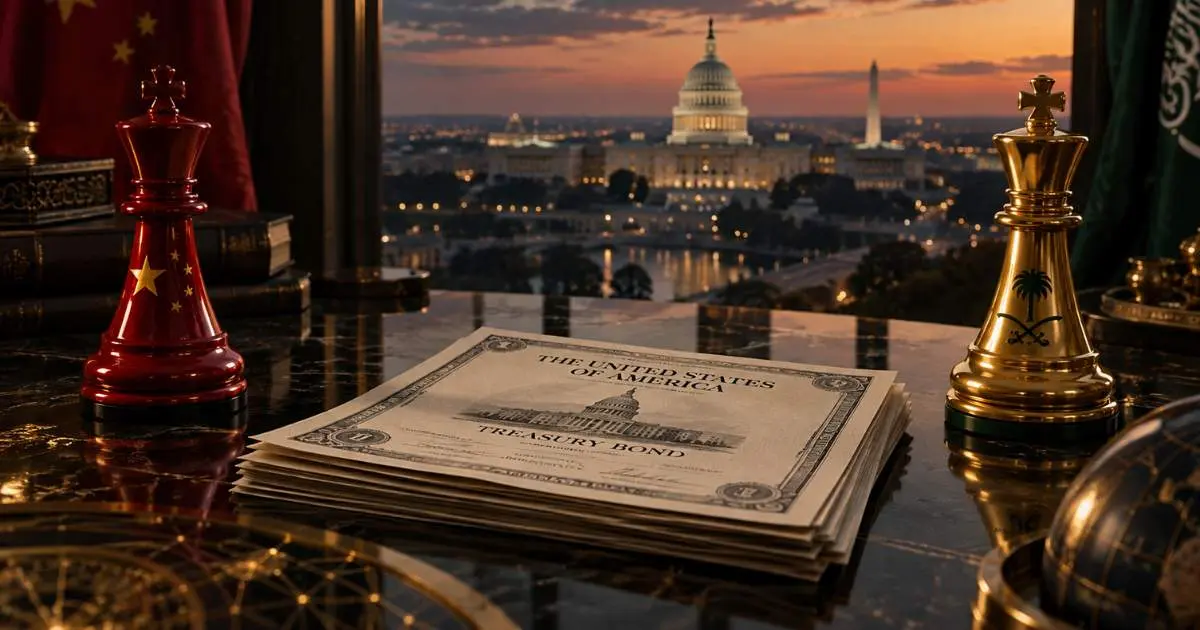
There is something intuitively backward about the financial position of the United States. The federal government owes tens of trillions of dollars, foreign investors hold trillions of that debt, and some of those investors belong to countries Washington regards as strategic competitors. In the ordinary imagination of debt, this should place the borrower at the mercy of the lender. Yet China cannot summon the US Treasury to Beijing and demand repayment, Saudi Arabia cannot dictate American law by threatening to sell bonds, and Russia discovered after invading Ukraine that reserves accumulated inside Western jurisdictions could become inaccessible precisely when geopolitical relations collapsed.
The contradiction disappears once ownership is separated from power. Holding an asset gives its owner rights, but those rights exist inside markets, currencies, legal jurisdictions, clearing systems and political relationships that determine what the asset can actually do. In the American case, the borrower also issues the principal reserve currency, hosts the world’s largest and most liquid sovereign-debt market, exercises enormous influence over financial infrastructure, and possesses a legal system capable of restricting assets and transactions within its jurisdiction. The United States does not control global finance by decree—European governments, private institutions and foreign jurisdictions retain powers of their own—but the concentration of monetary, market and legal advantages makes the conventional distinction between debtor and creditor incomplete.
The more revealing questions are therefore not simply who owns America’s debt, but who owns the asset, under whose jurisdiction it sits, and which side can reduce its dependence on the relationship at lower cost. Those are three different forms of power: ownership, jurisdiction and exit. Once they are separated, the geopolitics of American debt looks less like a creditor holding a mortgage over a debtor and more like a contest over alternatives.
The numbers themselves already challenge the popular story. Of the $30.2 trillion in federal debt held by the public at the end of fiscal year 2025, roughly 70 percent was held by domestic entities and about 30 percent by foreign investors. Mainland China represented only about 2 percent of the total, behind domestic holders such as the Federal Reserve, mutual funds and financial institutions. By July 2026, Treasury data showed Japan holding about $1.104 trillion in Treasury securities, the United Kingdom about $998 billion and mainland China $618 billion. Even those country labels require caution: Treasury notes that securities kept through overseas custodians may be attributed to the location of custody rather than the ultimate economic owner.
The myth that “China finances America” survives because it contains enough truth to be memorable. China is a significant creditor, and foreign demand matters to Treasury financing, but Washington is not dependent on a single foreign government. Foreign holders themselves are a mixture of central banks, funds, banks, insurers, corporations and private investors buying securities inside a financial architecture that serves purposes of their own. The harder question begins when those purposes change and when an asset purchased for safety becomes entangled with strategic rivalry.
China Is a Creditor, Not America’s Banker
China once occupied a much larger place in the Treasury market. Official US data show mainland Chinese holdings above $1.3 trillion at their peak in the previous decade; by July 2026, the reported position had fallen to $618 billion. The decline is unmistakable, but assigning one geopolitical motive to it would go beyond the evidence. Reserve management, exchange-rate intervention, changes in trade flows, diversification, gold accumulation and geopolitical risk can all influence the composition of Chinese foreign assets.
The official number is also less complete than it first appears. Treasury warns that custody arrangements can obscure ultimate ownership, and Chinese institutions can obtain dollar exposure through agency securities, bank deposits and other instruments that do not appear in the headline Treasury figure. Reuters reported in September 2026 that Chinese commercial banks had actually increased Treasury purchases after attracting more dollar deposits, even while the country-level Treasury total remained far below its historical peak. Chinese investors were also continuing to seek exposure to US assets through legal outbound-investment channels.
That complexity matters because “China is dumping American debt” is a cleaner story than the evidence allows. Beijing has plainly reduced its reported Treasury exposure over the long term, but this does not establish a centrally coordinated campaign to attack the dollar. A more defensible interpretation is that China has been reducing one form of dependence while remaining deeply entangled with dollar finance, American markets and a trading system in which the dollar continues to perform functions that Beijing cannot simply wish away.
The distinction also changes the meaning of leverage. If China’s objective were to inflict maximum immediate disruption on Washington, a rapid liquidation of hundreds of billions of dollars in Treasuries would be one conceivable instrument. If its objective is instead to make itself less vulnerable in a future confrontation, then the more useful strategy may be almost the opposite: reduce exposure slowly while building enough alternatives that a dramatic liquidation is never required. The second strategy attracts fewer headlines, but it changes the structure of dependence rather than merely exploiting it once.
Why “Dumping Treasuries” Is the Wrong Question
The fantasy of a Chinese financial strike usually begins with a simple order from Beijing: sell the bonds. Treasury prices fall, yields rise, the dollar comes under pressure and Washington discovers that its creditor has become its adversary. There is enough economic logic in the opening sequence to explain why the scenario persists. A sufficiently large and disorderly sale could disrupt markets, especially if it occurred during an existing period of financial stress.
What the scenario usually omits is that China would not be standing outside the market it was trying to damage. Selling aggressively into falling prices can reduce the value of whatever securities remain in the portfolio, and the proceeds still have to be placed somewhere. Beijing would have to choose among euros, yen, gold, other dollar instruments, domestic assets or some combination of them, each carrying different liquidity, currency and political consequences. A sufficiently large move could also affect exchange rates in ways that matter to Chinese exporters and to the value of China’s remaining foreign holdings.
Scale makes the threat still more complicated. Foreign investors collectively held about $9.25 trillion in Treasuries in July 2026, while mainland China’s reported $618 billion position was one component of a market much larger than any single official holder. China is large enough to matter, but far less dominant than the political image of “America’s banker” suggests.
The correct conclusion is not that China possesses no financial leverage. Large portfolio decisions can move prices, yields and expectations, particularly in stressed markets, and the transition in the Treasury investor base itself may carry risks. Reuters noted in September that leveraged hedge funds had become increasingly important Treasury holders as foreign official ownership declined, illustrating that a market can remain fully funded while the nature of the buyers changes.
The more important distinction is between a weapon and an exit. A weapon based on liquidating an asset is partly consumed in the act of using it; a strategy that reduces dependence gradually can preserve optionality while avoiding the self-inflicted costs of a fire sale. That is why the most consequential Chinese financial strategy may not be the ability to dump Treasuries, but the ability to make such a dump increasingly unnecessary.
The Power to Leave Slowly
Geopolitical analysis is naturally attracted to coercion because coercion produces visible events. Sanctions are announced, tariffs arrive with percentages, frozen assets make headlines and a large bond sale would appear instantly on financial screens. Diversification is harder to dramatise because it can occur through thousands of ordinary decisions: fewer reserves in one instrument, more gold, more bilateral settlement in local currencies, different custodians and gradual investment in payment connections that reduce dependence on a single route.
The cumulative effect can nevertheless be strategic. A country that once had one practical settlement channel and later has three has not overthrown the old system, but it has become harder to isolate from it. A central bank that still holds dollars while distributing more reserves across other assets and jurisdictions has not abandoned the dollar, but it has purchased insurance against a specific category of political risk. A government that can conduct a larger share of trade without routing every transaction through the same currency or financial intermediary has acquired an option it did not previously possess.
This is the crucial difference between attack and exit. An attack attempts to impose costs on the dominant system; an exit strategy attempts to reduce the costs that system can impose on you. The first requires enough power to injure the centre. The second requires only enough alternatives to make dependence less complete.
China’s long decline in reported Treasury holdings is compatible with this logic, although it cannot prove it on its own. Ordinary reserve management remains part of the story, and Chinese institutions continue to purchase American assets when the economics favour doing so. The analytical point is narrower: for a state concerned about future financial vulnerability, gradual diversification is structurally more useful than a spectacular liquidation that would damage both sides.
This idea extends well beyond China. The most durable response to dependence is often not retaliation inside the existing system, but the creation of enough outside options that retaliation becomes less necessary.
Saudi Arabia and the Politics of Assets
A different version of the creditor problem became visible in 2016, when the US Congress debated the Justice Against Sponsors of Terrorism Act, or JASTA. The legislation created an exception to sovereign immunity for certain terrorism-related claims and ultimately became law after Congress overrode President Barack Obama’s veto. The controversy acquired a financial dimension because Saudi Arabia, a major American security partner and investor, feared that the legislation could expose Saudi assets to litigation connected with the September 11 attacks, although JASTA itself did not establish Saudi liability.
During the debate, Reuters relayed a New York Times report that Saudi Foreign Minister Adel al-Jubeir had warned US officials that the kingdom could be forced to sell as much as $750 billion in Treasury securities and other American assets before they became vulnerable to possible court freezes. The wording matters. The widely repeated $750 billion figure referred to Treasuries and other US assets, not to $750 billion of Treasury securities alone. Official data later showed Saudi Treasury holdings at about $116.8 billion in March 2016.
The dispute also became less clear-cut when al-Jubeir publicly rejected the characterisation of the Saudi position as a crude threat, presenting it instead as a warning about the consequences of weakening sovereign-immunity protections. Whatever language was used privately, the Obama White House responded by stressing that Riyadh shared an interest in global financial stability and would itself suffer from actions that seriously disrupted markets. The exchange therefore revealed not a simple Saudi financial weapon but a relationship in which both sides understood that the value of the asset depended partly on the stability of the system containing it.
The episode remains important because the most dramatic version of it is unnecessary. JASTA exposed the intersection of finance and jurisdiction. A foreign state can own securities, equities, property and other assets in the United States, but ownership does not remove those assets from the legal environment in which they exist. Saudi officials were confronting the possibility that a change in American law could alter the legal risk surrounding wealth held inside the United States.
The present relationship remains far larger than the Treasury portfolio alone. Saudi Arabia held about $142.4 billion in Treasuries in July 2026, but the bilateral relationship also encompasses energy, investment, defence cooperation, technology and security ties. The word “creditor” therefore describes one line on a balance sheet while obscuring many of the other dependencies that determine bargaining power.
Saudi Arabia illustrates an uncomfortable truth about cross-border wealth: having assets inside another state can provide influence, but it can also create exposure. Financial leverage is not measured only by how much you own; it is also shaped by the legal environment in which ownership must be exercised.
The Creditor Inside the Debtor’s Jurisdiction
The relationship between ownership and jurisdiction became much harder to ignore after Russia’s full-scale invasion of Ukraine in February 2022. The United States and its partners restricted transactions involving the Central Bank of Russia and coordinated measures that immobilised roughly $300 billion in Russian central-bank assets worldwide. The European Union says that around €210 billion of Russian central-bank assets are currently immobilised within the EU.
Most of those assets are not located in the United States, which is an important distinction. The Russian case reflects coordinated action across Western jurisdictions rather than Washington exercising unilateral control over every reserve asset in the international system. The EU has also distinguished immobilisation from outright confiscation and has created legal arrangements allowing extraordinary revenues generated by the immobilised assets to support Ukraine, while the status of the principal remains legally and politically contested. In December 2025, the Council temporarily prohibited transfers of the immobilised Russian central-bank assets back to Russia.
The context cannot be detached from the policy. Western governments imposed these measures in response to Russia’s invasion of Ukraine and describe them as instruments intended to constrain Moscow’s capacity to wage war and to support Ukraine. Russia disputes their legitimacy and portrays them as evidence that Western reserve assets are politically conditional. A serious analysis does not have to accept the Russian argument in order to recognise the precedent that reserve managers elsewhere can now observe.
Before 2022, the phrase “safe reserve asset” was often discussed mainly in terms of credit risk, liquidity, inflation and currency stability. The Russian case placed another dimension in the foreground: jurisdictional access. A bond may remain financially sound, the issuer may remain fully capable of paying it, and the owner may nevertheless lose the practical ability to use the asset because of sanctions imposed by the jurisdiction in which it is held.
Putin has explicitly tried to turn that fact into a wider critique of the dollar-centred system. In 2024 he argued that freezing Russian reserves demonstrated the political risk of holding state wealth in currencies and jurisdictions that could become inaccessible during confrontation, and he linked that experience to growing interest in alternative assets and payment technologies. That is the argument of the leader of the sanctioned state, not an independent judgment on the legality or effectiveness of Western measures, but it identifies a question that other governments can ask without sharing Moscow’s political position.
Financial safety therefore has at least two dimensions for states contemplating geopolitical conflict with the West: Will the issuer repay me, and will I still be able to reach the asset when I need it? The first question has long dominated reserve management. The second is now harder to treat as theoretical.
When Financial Coercion Creates an Insurance Motive
Western financial sanctions work precisely because the systems through which they operate are difficult to avoid. Dollar transactions often touch banks or counterparties exposed to US law, euro assets create their own European jurisdictional exposure, and Western financial institutions remain central to global trade and finance. If these networks were marginal, exclusion from them would not be a powerful sanction.
Centrality, however, produces a strategic paradox. The more useful a financial network becomes as an instrument of coercion, the more clearly potential targets can see the vulnerability created by depending on it. A substitute does not have to outperform the dominant system in ordinary conditions to become strategically valuable. It only has to work well enough during the circumstances in which access to the dominant system might be restricted.
This does not mean sanctions are self-defeating, nor does it imply that governments should refrain from using them. Sanctions can impose severe immediate costs, restrict financing and technology, disrupt trade and advance objectives that policymakers judge more important than any long-term incentive they create for diversification. The more careful conclusion is that tactical effectiveness and structural cost can coexist.
The strategic cost is best understood as an insurance motive, not an inevitable revolt against the dollar. Governments that expect stable relations with Washington may rationally continue maximising liquidity and efficiency within dollar markets, while governments that perceive a higher probability of future confrontation may accept some additional cost to create alternative settlement routes, custody arrangements or reserve assets.
That distinction matters because insurance is purchased before the crisis that proves whether it was necessary. A government does not have to believe that the American-led financial order is about to collapse; it only has to believe that complete dependence on that order creates a risk worth hedging.
The deeper paradox is that successful financial coercion can therefore demonstrate two things at once. It demonstrates the extraordinary power of the existing system to the state applying the pressure, while demonstrating the danger of dependence to the state receiving it. The same event can strengthen leverage in the present and weaken the target’s willingness to remain equally exposed in the future.
De-Dollarisation Without a Successor
Much of the debate about the dollar remains trapped inside a false binary. One side announces the end of American monetary dominance whenever a BRICS member signs a local-currency agreement; the other correctly notes that no rival currency currently offers the same combination of scale, liquidity, convertibility and financial infrastructure, then treats the absence of a replacement as proof that little of consequence is changing.
The latest reserve data strongly argue against dramatic claims. The IMF reported that the dollar accounted for 57.13 percent of allocated global foreign-exchange reserves in the first quarter of 2026, up from 56.42 percent in the previous quarter, although valuation effects explain part of the movement. There is no evidence in those figures of a sudden global abandonment of the dollar.
Yet the absence of a successor does not mean the absence of diversification. At the September 2026 BRICS summit in New Delhi, members supported greater use of local currencies and increased interoperability between payment systems and central-bank digital currencies. The same summit also revealed the bloc’s limits: India rejected China’s mBridge platform amid concerns over Chinese influence, demonstrating that states interested in reducing dollar dependence do not necessarily agree on whose alternative infrastructure should replace it.
This is a more interesting reality than the imagined birth of a single anti-dollar currency. BRICS is not a unified monetary bloc, its members possess competing strategic interests, and several remain deeply dependent on dollar finance. What is emerging instead is a collection of partial alternatives serving particular functions.
The process can be understood as de-dollarisation without a post-dollar world. A government can settle a larger share of bilateral trade in local currencies while keeping most of its reserves in dollars. A central bank can accumulate more gold without abandoning Treasuries. Regional payment systems can grow without producing a common currency capable of replacing the dollar across global capital markets.
The dollar can therefore remain dominant at the centre while the financial system becomes more plural at its edges. Such a change matters because dominance is not binary. A currency can remain first while losing share in particular transactions, and even marginal reductions in dependence can alter the effectiveness of sanctions or the options available during a geopolitical dispute.
There are also forces pushing in the opposite direction, which is why a straight-line decline narrative would be misleading. Dollar-backed stablecoins may expand dollar usage in digital finance and create additional demand for short-term Treasury securities; Reuters reported in 2025 that stablecoin issuers were already directing substantial reserves into Treasury bills, with analysts debating whether further growth could reinforce the dollar’s international role. Technological change can therefore create new routes around traditional banking while simultaneously strengthening demand for dollar assets.
The future is unlikely to be a clean contest in which one currency defeats another. The more consequential struggle may be over how many important financial functions still require the same currency, jurisdiction and infrastructure, and how costly it becomes for governments to operate when access to any one of them is restricted.
America’s Creditors Are Also Its Customers
The durability of American financial power becomes easier to understand once Treasury securities are viewed not only as debt but also as a financial service. The Federal Reserve Bank of New York describes the Treasury market as the largest and most liquid sovereign-debt market in the world. Treasuries provide investors and reserve managers with liquidity, collateral, price benchmarks and the ability to move enormous quantities of capital through a market whose depth remains difficult to reproduce elsewhere.
When a foreign central bank buys a Treasury security, it is financing Washington in one sense. In another, it is purchasing access to a highly liquid dollar asset backed by the taxing capacity and institutional credibility of the US government. The relationship therefore involves mutual dependence rather than a simple hierarchy between borrower and lender.
This explains why American debt can continue rising while governments simultaneously complain about American financial dominance. The system solves genuine problems for its users. A reserve manager cannot replace hundreds of billions of dollars in Treasury securities merely because its government dislikes US foreign policy; the replacement must provide sufficient liquidity, scale, convertibility, legal predictability and market depth.
China’s renminbi is a major international currency, but capital controls and the structure of Chinese financial markets limit its ability to reproduce the Treasury market’s role at equivalent scale. The euro provides a sophisticated alternative but lacks one unified sovereign security directly comparable to the entire Treasury market. Gold reduces some credit and jurisdictional risks but cannot perform every function of a liquid, interest-bearing government bond market.
The strongest form of American financial power has therefore never been simply the ability to compel participation. It has been the ability to make participation rational because the system offers services that governments, central banks and private investors genuinely want. That is a more durable source of power than coercion, but it also establishes a clear condition: users remain most committed when the benefits of the system continue to exceed the economic and political costs of dependence.
If those perceived costs increase, states do not need to overthrow the system to respond. They can diversify at the margin, and marginal diversification repeated across many countries and many years is precisely the kind of change that produces no dramatic moment while still altering the distribution of leverage.
The System Can Weaken Without the Dollar Losing
Predictions of American financial collapse obscure a much more plausible path. The United States could remain the centre of global finance for decades while gradually losing some of the advantages that extreme centrality once provided. No ceremonial date would mark the transition, and no new currency would have to replace the dollar.
One possible change would appear in price rather than status. If Treasury issuance keeps increasing while the composition of demand shifts away from some stable official buyers toward more price-sensitive or leveraged investors, the market can continue absorbing American debt while demanding different yields. Reuters argued in September that hedge funds have become a much larger marginal force in Treasuries as China and other official holders have reduced their relative importance, with leverage in parts of that investor base creating a different set of stability concerns.
The point is not that a Treasury funding crisis is imminent. It is that “someone will buy the debt” and “the identity and required return of the buyer do not matter” are different propositions. A dollar-centred world can persist while the financing advantages associated with that world become slightly less generous.
A second change could occur through sanctions. Alternative settlement mechanisms do not need to replace the dollar or Western banking in order to make restrictions against particular targets somewhat less comprehensive. Sanctioned states have strong incentives to develop workarounds, while Western governments respond by expanding enforcement and targeting the new networks. The resulting contest is iterative: pressure produces adaptation, which generates new forms of pressure.
A third change could occur through custody itself. Governments that assign greater weight to jurisdictional risk may distribute reserves across more locations or hold a larger share in assets whose accessibility depends less on any single legal authority. Such arrangements can be less efficient than concentrating wealth in the deepest markets, but insurance is often economically inefficient until the event being insured against occurs.
The most significant change may therefore be one of degree. America could retain the dollar, retain the Treasury market and retain powerful sanctions while paying somewhat more for borrowing, confronting more alternative payment channels and finding that certain states have become more expensive to coerce financially. None of those outcomes amounts to the end of American financial primacy.
They would amount to something subtler: America could keep the system while losing part of the discount that comes from being the system.
That possibility links the international problem back to America’s domestic debt trajectory. The larger the volume Washington needs global markets to absorb, the more valuable deep and reliable demand becomes. A modest erosion in financial privilege can therefore matter more to a heavily indebted issuer than it would to a government with little need to borrow.
What Saudi Arabia, China and Russia Actually Have in Common
At first glance, the cases belong to different categories. China is a strategic competitor with an immense commercial relationship with the United States and a declining but still substantial Treasury position. Saudi Arabia is a security partner whose JASTA dispute exposed the interaction between investment and American law. Russia is an adversary whose sovereign reserves were immobilised following its invasion of Ukraine.
Treating them as a common anti-dollar coalition would be analytically careless. Their strategic objectives, legal situations and economic relationships with Washington differ profoundly. What connects them is narrower and more useful: each case reveals a different weakness in the simple equation creditor equals leverage.
China demonstrates that owning debt does not automatically make the creditor dominant when the creditor depends on the same market it could theoretically destabilise. Saudi Arabia demonstrates that foreign-owned assets remain embedded in the jurisdiction of the country in which they are held. Russia demonstrates that a reserve can remain financially sound while geopolitical conflict changes the owner’s practical access to it.
These cases suggest a more useful framework for understanding financial power. Ownership determines who holds the claim. Jurisdiction determines which legal and political authorities surround the claim. Exit determines how costly it would be for either side to reduce dependence on the relationship.
The three dimensions can point in opposite directions simultaneously. Washington may possess jurisdictional power while Beijing develops greater diversification capacity. Riyadh may own American assets while depending on American security and financial relationships. Moscow may lose access to Western-held reserves while devoting increasing effort to systems designed to make similar pressure less effective in the future.
Financial power is therefore not a number sitting in an account. It is the distribution of dependencies across the relationship, and the most consequential advantage often belongs to the party with the wider set of credible alternatives.
The Most Dangerous Competitor May Be the One That Does Not Attack
The geopolitical imagination prefers rupture because rupture provides a visible date on which an era appears to change. A Chinese Treasury liquidation, the launch of a successful BRICS currency or a coordinated rejection of the dollar would be immediately recognisable as historical events. Slow diversification offers no comparable spectacle.
Yet gradualism has important strategic advantages for a country seeking greater autonomy. It avoids crystallising losses in a single fire sale, reduces the risk of provoking an unnecessary confrontation, preserves access to the dominant system and buys time for alternatives that remain too weak to function as complete replacements.
China’s behaviour is consistent with parts of such a strategy without proving that every decision belongs to one centrally designed project. Its reported Treasury holdings have fallen sharply from their earlier peak, Beijing promotes greater international use of the renminbi, and China participates in efforts to expand alternative payment infrastructure. At the same time, Chinese banks and private investors continue to buy American securities when yields and market conditions make them attractive.
That combination is more revealing than either “China is leaving the dollar” or “nothing is changing.” Beijing can remain inside the system while trying to reduce specific vulnerabilities created by being too dependent on it. Diversification and continued participation are not opposites; for a state seeking optionality, they can be complementary.
From Washington’s perspective, that process is harder to confront than a dramatic hostile sale. A sudden liquidation would create an identifiable crisis to which the Federal Reserve, Treasury and diplomatic system could respond. A decade of portfolio adjustments, bilateral currency agreements, new payment links and alternative reserve choices offers no single emergency to solve.
The deeper challenge to American financial power may therefore come not from a creditor deciding to use its holdings as a weapon, but from creditors deciding they would prefer to own fewer assets that might ever need to become weapons at all. A competitor does not have to defeat the system if it can gradually reduce the system’s ability to constrain its choices.
The Debtor Who Still Sets the Rules
The United States occupies a financial position that would look paradoxical in a simpler world. It is the world’s largest sovereign debtor, yet its securities remain central to global reserves, collateral and liquidity. Foreign governments and investors finance part of Washington’s borrowing while simultaneously purchasing safety, market depth and transactional flexibility from the financial architecture that American institutions help anchor.
That structure allows the debtor to exercise forms of power ordinary debtors do not possess. American law can affect assets and transactions within US jurisdiction. Coordinated Western sanctions can restrict access to financial networks because those networks matter. The international role of the dollar supports demand for dollar-denominated assets, while the Treasury market provides foreign wealth with a place to reside at a scale few alternatives can match.
The architecture nevertheless contains its own long-term tension. Every exercise of jurisdiction reminds foreign asset holders that jurisdiction exists, and every use of financial centrality as coercive leverage reveals both the power of the system and the vulnerability created by depending on it. When alternatives become commercially usable, even in narrow functions, the cost of resisting the dominant network falls slightly.
None of this means the dollar is approaching collapse. Current evidence points in the opposite direction: it remains the leading reserve currency, foreign investors continue holding trillions of dollars in Treasuries, and no competing system offers a comprehensive substitute. Claims of an imminent post-dollar world are not supported by the structure of global finance today.
The more serious possibility is quieter. American financial primacy could survive while becoming less exclusive. The dollar could remain first while more bilateral trade takes place in other currencies, Treasuries could remain the principal global reserve asset while central banks diversify more deliberately, and sanctions could remain formidable while selected targets become better prepared to withstand them.
In that world, the United States would not lose the system; it would lose some of the premium that comes from being the system. China does not need to destroy the Treasury market to become harder to pressure, Saudi Arabia does not need to liquidate American investments to understand that foreign assets remain exposed to foreign law, and BRICS does not need a successful common currency to create useful alternatives for particular transactions.
The strongest form of financial leverage may therefore be less dramatic than the ability to punish another country. It may be the ability to absorb the cost of needing that country less. For now, the United States possesses more of that advantage than many predictions of de-dollarisation acknowledge: its markets are deeper, its currency more widely used and its financial infrastructure harder to replace than its critics often suggest.
Those advantages endure because other actors continue to choose them, not because history has guaranteed their permanence. The debtor can keep setting much of the financial agenda while its creditors still prefer the arena in which it sets the rules. The long-term challenge begins when enough of those creditors stop asking how to defeat that arena and start asking how much of their future they truly need to keep inside it.