
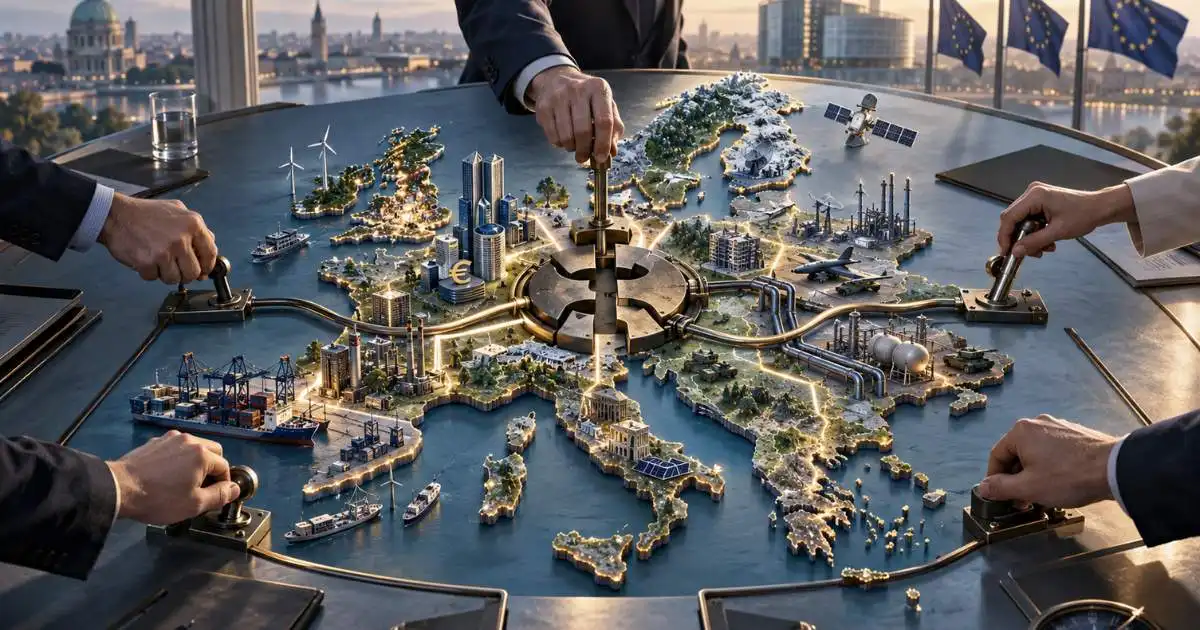
Europe has spent years being told that it must become more powerful. The strange thing is that, by many conventional measures, it already is. The European Union alone is one of the world’s largest economic blocs, its member states collectively spend hundreds of billions of euros on defence, and the wider European security landscape includes Britain, France, two nuclear arsenals, advanced aerospace and defence industries, sophisticated intelligence services, a major global currency and a market large enough to force multinational corporations to adapt to rules written in Brussels. The familiar picture of a continent simply lacking power therefore misses the more interesting problem: Europe possesses an impressive quantity of power, but not all of it can be converted into collective action when time, disagreement and risk make action difficult.
That distinction matters because power on paper and power in use are not the same thing. Money has to become industrial capacity; industrial capacity has to become military capability; twenty-seven national calculations have to become a political decision; and that decision has to arrive before events have already created a new reality. Economic dependence remains manageable only while suppliers remain predictable. Regulation remains powerful only while access to the underlying technology cannot be withheld. An alliance remains a partnership only while dependence on the ally does not make serious disagreement practically impossible. Europe’s strategic difficulty lies somewhere along this chain from possession to use.
The question, then, is not whether Europe should become a single state, abandon NATO or imitate the United States or China. It is whether a continent that clearly possesses many of the raw materials of great-power status has built the political and institutional machinery needed to use them when events move quickly and interests diverge. That is a harder question than asking whether Europe is strong or weak, and it leads to a less comfortable answer.
Europe Is Not the European Union
Any serious discussion of European power has to begin by separating Europe from the European Union. The EU has twenty-seven members, but European security does not stop at the borders of the Union. Britain left the EU in 2020 without leaving European geography, NATO or the continent’s strategic balance. It remains one of Europe’s strongest military powers, a permanent member of the UN Security Council and, alongside France, one of only two European states possessing nuclear weapons.
That distinction has become more important rather than less important since Brexit. In May 2025, Britain and the EU established a new security and defence partnership covering Ukraine, military mobility, maritime security, cyber threats, space, critical infrastructure and defence-industrial cooperation. Two months later, Britain and France signed the Northwood Declaration, deepening nuclear coordination while explicitly preserving the independence of each country’s deterrent. The arrangement showed something fundamental about European power: some of the continent’s most consequential capabilities exist outside EU institutions even when they are clearly part of European security.
The result is an unusual architecture. Brussels can negotiate trade agreements, impose competition rules and regulate multinational corporations, but it cannot command British nuclear submarines or French strategic forces. NATO integrates European militaries with the United States and Canada, while national governments retain decisive authority over war, intelligence and much defence procurement. A statistical table can add all these assets together and produce an impressive European total, but a crisis cannot simply add sovereign decisions together in the same way.
Europe therefore possesses more power than any single European institution controls. That gap between aggregate strength and usable strength is not a minor technical issue; it runs through almost every strategic problem the continent faces.
Twenty-Seven Governments Do Not See the Same Map
European disagreements are often presented as evidence that the continent lacks political seriousness. Sometimes they do reveal indecision, but many of them begin with geography rather than ideology. Estonia, Poland and Finland cannot look at Russia in the same way as Portugal or Spain. Italy and Greece experience instability in North Africa and the Mediterranean through different security, energy and migration pressures than Sweden or the Czech Republic. France has spent decades defending a tradition of strategic independence, while Poland and several eastern states have often regarded a strong American military presence as one of the clearest guarantees of their own sovereignty.
Economic history creates another layer of difference. Germany built an industrial model that benefited for years from relatively cheap Russian energy and deep export relationships. France combined European ambitions with a global military posture and an independent nuclear deterrent. Mediterranean states have political interests in North Africa that do not always occupy the same place in northern European strategic thinking. Smaller member states, meanwhile, have good reason to resist any arrangement in which “the European interest” quietly becomes another name for the preferences of Paris, Berlin or another large capital.
The EU was designed around these differences, not in ignorance of them. It integrated states deeply while leaving some of the powers most closely associated with sovereignty in national hands. That restraint helped make integration possible because governments were prepared to share authority over trade, competition, borders and, for euro-area states, monetary policy without surrendering the full machinery of statehood. The arrangement works remarkably well in many areas of economic governance, but foreign policy and defence reward something that regulatory politics often does not: speed.
A more centralised power can decide first and negotiate afterward. Europe frequently has to negotiate internally before it can decide what it is negotiating externally. Russia, China and the United States occupy very different positions in relation to Europe and should never be treated as equivalent actors, but all three encounter a continent whose political authority is distributed across several institutions and capitals. An outside power does not always need to manufacture European divisions; sometimes it only needs to recognise the divisions that already exist and work through them.
Europe Often Pays for Crises It Does Not Shape
The Middle East and North Africa expose this problem with unusual clarity because instability there reaches Europe quickly through energy prices, maritime disruption, terrorism risks, refugee movements and domestic political conflict. Europe lives close enough to bear many of the consequences, yet proximity has not consistently given European governments a proportionate ability to shape the decisions that produce those consequences. The record is complicated because Europe has sometimes been divided, sometimes active, sometimes marginal and sometimes directly responsible for choices whose consequences later returned to the continent.
Iraq in 2003 showed one version of the problem. The United States led the invasion, Britain and Spain supported it, while France and Germany opposed it. Europe did not possess one coherent position because European governments had made fundamentally different strategic judgements. The war therefore exposed both the weight of American leadership and the absence of a common European policy at the moment when one of the most consequential decisions affecting the region was being taken.
Libya in 2011 showed the opposite danger. Britain and France were not passive spectators but leading advocates and participants in the intervention. A later British parliamentary inquiry concluded that the campaign drifted from civilian protection toward regime change without a credible strategy for the political order that would follow Muammar Gaddafi. The subsequent collapse contributed to armed conflict, weapons proliferation, terrorism, human-rights abuses and migration pressures. In Libya, Europe’s problem was not the absence of agency but the failure to convert military initiative into a sustainable political outcome.
Syria presented another configuration entirely. European governments imposed sanctions, provided humanitarian assistance and participated to varying degrees in military and diplomatic efforts, yet the decisive balance of the war was shaped largely by the Syrian regime, Russia, Iran, Turkey, the United States and armed actors on the ground. Europe nevertheless experienced enormous political consequences when displacement reached its borders. By the end of 2015, the arrival of refugees and migrants had transformed debates over asylum, national identity, borders, integration and solidarity across the continent.
These episodes should make European migration politics more uncomfortable than it usually is. Political energy becomes intense once migration is visible at a border, while far less sustained attention is devoted to the years in which states are collapsing, regional balances are deteriorating, diplomatic settlements are failing or interventions are proceeding without credible plans for what comes next. Parties that build much of their domestic appeal around opposing irregular migration frequently speak most loudly at the downstream stage of the crisis, when people are already moving, rather than demanding equally forceful upstream strategies capable of reducing the conditions that produce displacement.
This does not mean Europe can prevent every war, and it certainly does not mean military intervention is the answer. Libya is one of the strongest arguments against such simplistic thinking. The narrower point is harder to escape: Europe often knows with considerable accuracy how instability around its neighbourhood will eventually affect European energy, borders and politics, yet its capacity or willingness to shape that instability before the consequences arrive is far less consistent. A continent can become extremely proficient at managing the political effects of crises while remaining less effective at influencing the crises themselves.
The current Gulf environment reinforces the same lesson in economic form. Escalation involving Iran, Israel and the United States has repeatedly demonstrated how quickly disruption around the Strait of Hormuz can affect European energy prices and shipping costs. European governments may be diplomatically active, but the military decisions capable of moving oil and gas prices dramatically are often taken elsewhere. Europe’s exposure to the consequences can therefore be much larger than its influence over the escalation that caused them.
The American Alliance Solved a Problem and Created a Habit
The European relationship with the United States cannot be understood properly through the language of either submission or complete independence. For most of the post-war period, relying heavily on American military capabilities was rational. NATO deterred the Soviet Union, stabilised Western Europe and later anchored the wider European security order. European governments could rebuild their economies, expand welfare systems and integrate their markets without independently reproducing every expensive capability already supplied inside the alliance.
That arrangement succeeded so well that dependence became embedded in institutions. European armed forces developed for decades within a system in which the United States provided exceptional capabilities in intelligence, strategic transport, command and control, air-to-air refuelling, missile defence, space assets, logistics and nuclear deterrence. If an ally reliably provides something expensive, governments naturally have less incentive to duplicate it, especially when defence budgets face constant competition from pensions, healthcare, education and infrastructure.
The result is a form of dependence that does not require American coercion. If a major European operation cannot realistically proceed without American intelligence, transport, communications, targeting or ammunition, Washington does not need to issue a threat in order to possess leverage. The dependency exists in the structure of the capability itself. A European government can be legally sovereign and still face a narrow menu of practical options because several of the tools required to implement its decision are controlled elsewhere.
That does not make the transatlantic alliance a trap. Much of the dependence was accumulated voluntarily under a security arrangement that delivered real benefits. Yet the historical success of the alliance should not obscure the strategic question now facing Europe: can it remain closely allied to the United States while building enough independent capacity that American participation is not a technical prerequisite for every major European security decision? Friendship and autonomy are not opposites, but autonomy becomes difficult to claim when the absence of the friend makes action impossible.
Europe Is Spending, but Spending Is Not Yet Strategy
The old accusation that Europe simply refuses to pay for its defence has become increasingly difficult to sustain. Since Russia’s full-scale invasion of Ukraine, defence budgets have risen sharply across the continent. EU governments spent more than €400 billion on defence in 2025, and spending is continuing to rise. NATO members in Europe and Canada have also increased investment substantially, while the alliance has adopted an ambitious long-term spending commitment extending to 2035.
Those numbers matter because they show that European governments have changed course. The more interesting question now lies beyond the headline total. A large defence budget does not become military power merely by appearing in a finance ministry’s accounts. Money has to become contracts, factories, ammunition, trained personnel, maintenance, transport, interoperable systems and enough industrial depth to replace equipment in a long conflict rather than merely purchase it in peacetime.
Fragmentation remains a central obstacle. European governments still buy significant amounts of equipment nationally, protect domestic manufacturers and maintain multiple systems that often perform similar functions. From the perspective of a national defence ministry, many of these decisions are entirely rational. A government may choose an American weapon because it is available sooner, proven in service and already interoperable with NATO. Another may favour a national company because it preserves jobs, industrial knowledge and sovereign production. What makes sense in one capital can nevertheless produce duplication and dependency when repeated across the continent.
Ukraine forced this issue out of policy papers and into factories. Ammunition stocks built for a lower-intensity post-Cold War environment were consumed rapidly. Expanding production required long-term orders, investment in manufacturing lines, secure supplies of explosives and components, trained workers and political confidence that governments would continue buying once the immediate emergency had passed. Europe discovered that industrial capacity cannot simply be summoned by increasing the budget after a war has already begun.
The problem is therefore no longer simply how much Europe spends. It is what kind of strategic system the spending creates. Hundreds of billions can make Europe significantly stronger while still leaving it less independent than the total suggests if national procurement remains fragmented and critical capabilities continue to depend on outside suppliers.
Strategic Autonomy Means Different Things in Different Capitals
Few European expressions have acquired as much prestige and as little agreement as “strategic autonomy.” The phrase can mean independence from excessive American reliance, greater European industrial capacity, protection from Chinese economic pressure, energy security, technological sovereignty or simply the ability to act when other allies choose not to. The definition changes partly because different European states fear different forms of dependence.
For France, autonomy belongs to a long tradition of preserving independent room for manoeuvre. For Poland and several countries closer to Russia, American military engagement can itself be understood as a condition of national autonomy because it strengthens their ability to resist pressure from Moscow. Brussels increasingly uses the language in relation not only to defence but also semiconductors, artificial intelligence, cloud infrastructure, trade, energy and supply chains. Britain, meanwhile, remains outside the EU while occupying a position that cannot realistically be excluded from European defence.
The nuclear question exposes the limits of the concept more clearly than almost anything else. France possesses the EU’s only nuclear arsenal, Britain possesses another European arsenal outside the Union, and NATO’s overall deterrence remains heavily dependent on the United States. The Northwood Declaration created a deeper framework for British-French coordination without transferring sovereign control of either force. Europe therefore possesses nuclear weapons but does not possess a single European authority capable of ordering their use.
That is not a bureaucratic defect that Brussels can solve with another agency. Nuclear authority lies at the most sensitive edge of state sovereignty, and transferring it would require a political union Europe has never created. The same tension appears in less extreme forms throughout European defence: governments may agree that more autonomy is desirable while disagreeing sharply about what they want autonomy from, how much they are prepared to pay for it and which powers they are willing to share.
Dependence Becomes Political When There Is No Easy Exit
Russia’s use of energy leverage forced Europe to reconsider an assumption that had shaped much of its post-Cold War economic thinking: deep interdependence was expected to make confrontation less attractive because both sides would have too much to lose. For years, Russian gas was commercially attractive and especially important to European industry. The relationship looked efficient until political conflict made the dependence itself part of the strategic equation.
Europe responded with remarkable speed after 2022. Russian gas fell from roughly 45 percent of EU imports before the invasion of Ukraine to a much smaller share within a few years, while Europe expanded LNG capacity, found alternative pipeline suppliers, accelerated renewable investment and reduced consumption. The adjustment demonstrated that dependence can be reduced when governments are willing to absorb extraordinary costs.
It also demonstrated that vulnerability can migrate rather than disappear. LNG diversification exposes Europe more directly to global shipping routes and competition for cargoes. Disruption in the Gulf can raise European prices even when Russian pipelines no longer dominate supply. A country can therefore become less dependent on one producer while remaining highly exposed to a market whose critical routes are shaped by crises beyond its control.
China’s economic pressure on Lithuania illustrated the same principle through trade. After Lithuania deepened relations with Taiwan, Chinese measures affected Lithuanian exports and products from elsewhere in the EU containing Lithuanian inputs. The dispute helped accelerate European thinking about economic coercion and contributed to the development of the Anti-Coercion Instrument, which gives the Union a framework for responding when another state uses trade or investment pressure to force a political decision.
The lesson is not that Europe should produce everything itself. A strategy of autarky would sacrifice many of the gains created by European openness and would probably reduce rather than increase economic power. The more useful distinction is whether a dependency remains replaceable. A commercial relationship becomes a strategic vulnerability when the other side can withdraw something Europe needs faster than Europe can find an alternative and when the threat of doing so can alter a European political decision.
The Veto Is Not Merely a Technical Problem
Unanimity in European foreign policy is often described as one of the clearest reasons the EU struggles to act geopolitically. The criticism is understandable because a single government can delay or block action supported by almost every other member. Yet treating unanimity as simple institutional stupidity misses why the rule exists in the first place.
Foreign policy can involve sanctions, war, energy security and relations with neighbouring states. Smaller countries have no reason to assume that the preferences of larger members will always coincide with their own interests. The veto therefore protects something central to the political bargain behind European integration: states share substantial sovereignty without surrendering the right to resist on issues they regard as vital.
The difficulty emerges when that protection becomes bargaining power over unrelated issues. Hungary has repeatedly demonstrated how a national government can use unanimity requirements surrounding Ukraine, sanctions or financial support to increase its leverage in broader disputes with Brussels or other governments. The specific merits of each Hungarian dispute are less important than the institutional fact exposed by them: where unanimity is required, one national calculation can become a European constraint.
Removing the veto would not solve the problem without creating another. Qualified-majority voting could make European foreign policy faster while allowing governments to be overruled on decisions they regard as fundamental to national security. Coalitions of willing states offer flexibility but risk producing permanent inner and outer circles of strategic Europe. Keeping unanimity protects national sovereignty while giving obstruction and delay political value.
Europe has not failed to discover an obvious solution because no obvious solution exists. The dispute is constitutional rather than technical. The real question is how much national control Europe can preserve before collective control over events becomes too weak to matter.
Europe Can Regulate Technologies It Does Not Control
Europe’s regulatory power is one of the clearest examples of influence that does not depend on military force. The size of the single market means companies around the world often change products, privacy practices, competition strategies and digital services to comply with European rules. The Brussels Effect is real because global corporations generally cannot afford to abandon access to hundreds of millions of European consumers.
The limitation becomes visible when Europe moves from regulation to infrastructure. American companies dominate large parts of Europe’s cloud market, while European dependence remains substantial in several layers of advanced digital technology. Brussels can impose conditions on foreign providers, fine them and regulate how they operate within the European market, yet legal authority does not automatically produce a European substitute if access to an essential service suddenly becomes a geopolitical issue.
The same tension runs through semiconductors and artificial intelligence. Europe possesses world-class research, advanced industrial firms and strategically important companies in semiconductor equipment and specialised manufacturing. It is not technologically helpless. At the same time, several critical parts of the digital stack remain heavily dependent on non-European suppliers, which is why technological sovereignty has moved from a specialist concern to an explicit political objective.
This distinction matters because a regulator and an owner possess different kinds of power. Europe can write rules for a cloud provider, but it cannot create an alternative cloud infrastructure by legislation. It can regulate an artificial-intelligence platform while still depending on foreign processors or computational capacity. In normal commercial conditions, that combination may work perfectly well. Under geopolitical pressure, however, the difference between governing access and controlling capacity becomes strategically important.
The Brussels Effect was largely built in an era when the main political question was how global markets should be governed. The emerging era asks an additional question: who owns the technological systems on which those markets and governments increasingly depend? European regulation remains a significant source of power, but regulatory power cannot completely substitute for technological capacity.
Who Gets to Define the European Interest?
Not every constraint on European strategy comes from Washington, Moscow or Beijing. Brussels and national capitals contain dense networks of companies, business associations, trade unions, NGOs, consultancies, think tanks, professional organisations and foreign interests that compete to shape policy long before most citizens hear about the final decision.
Lobbying itself is not corruption. Governments regulating banking, pharmaceuticals, defence, artificial intelligence or energy need technical information, and organised interests have legitimate reasons to make their case. The EU’s Transparency Register exists precisely because lobbying is treated as a normal part of democratic policymaking rather than an inherently illicit activity.
The uncomfortable question concerns unequal access. Major corporations can maintain teams of lawyers, economists, engineers, consultants and former officials who follow a proposal from its earliest stages. They can respond to consultations, commission research, supply technical information and remain engaged through years of legislative development. An ordinary citizen generally encounters the decision much later, when the regulatory architecture is already largely formed.
The European Court of Auditors has itself identified weaknesses in transparency rules, including categories of meetings and contacts that do not always leave the same public record. That does not prove that secret interests control Brussels, and claiming so would replace analysis with conspiracy. It does reveal a democratic problem that deserves more attention: citizens cannot always reconstruct who had access to a policy process, what arguments were presented or how heavily different interests were represented before a decision became official.
Strategic autonomy makes this issue particularly sensitive. National defence manufacturers are not merely companies selling equipment; they provide employment, technology, exports and political influence in specific countries. A government deciding whether to purchase jointly at European level or protect a domestic supplier is making an industrial and electoral calculation as well as a military one. The same dynamic exists in energy, finance and technology, where decisions presented as technically necessary can also benefit well-organised interests.
The phrase “lobbies control Europe” therefore says too much and explains too little. No hidden command is necessary for influence to matter. If some actors can remain permanently present inside the policy process while most citizens see only the finished policy, political access is already uneven. A Europe serious about sovereignty has to examine not only dependence on foreign states but also the domestic structures through which particular definitions of the “European interest” become more influential than others.
NATO Is Not the Problem; Inability to Act Without Washington Would Be
Debates over European autonomy often produce a false choice between Atlantic loyalty and independence. Europe is supposedly required either to remain firmly attached to the United States or to emancipate itself from American influence. In practice, stronger European capabilities could make NATO more balanced and durable rather than weaken it.
The real test begins when American and European priorities diverge. Washington is a sovereign actor with its own geography and interests. It may choose to devote more attention to Asia or the Western Hemisphere, and an American administration may judge a crisis on Europe’s periphery differently from governments in Paris, Warsaw, Rome or London. None of that requires hostility toward Europe.
European institutions have begun to acknowledge this possibility more openly. The European Parliament has called for contingency planning for a substantial reduction in the American military presence while simultaneously describing the United States as Europe’s most important strategic ally. Those positions make sense together. A responsible ally should be capable of preparing for circumstances in which another ally has different priorities.
The practical questions are far more revealing than the slogans. Could European states secure a vital maritime route without waiting for Washington to organise the operation? Could they sustain a major military commitment if American strategic attention moved elsewhere? Could Europe provide enough intelligence, command, transport, air defence and ammunition for a crisis it regarded as vital but Washington did not? Could European governments resist an American economic or technological demand if doing so imposed significant costs?
An alliance between capable partners is different from an alliance in which one partner’s absence makes the other unable to act. European strategic autonomy does not require hostility toward America. It requires enough capability that cooperation remains a choice made from strength rather than a condition imposed by the absence of alternatives.
The Problem Is Not Unity. It Is Conversion
Europe will probably never speak with one political voice on every crisis, and expecting it to do so obscures rather than clarifies the problem. The United States is deeply divided internally, NATO includes dozens of governments, and every major power contains competing bureaucracies, industries and political factions. Perfect unity is not the normal condition of strategic power. What matters is whether institutions can convert sufficient agreement into action while action can still change the outcome.
Europe’s route from resources to action is unusually long. Economic weight must become political leverage, defence budgets must pass through national procurement systems before becoming usable capabilities, intelligence must be shared, governments must perceive a threat similarly enough to justify action, legal authority has to exist, domestic publics have to tolerate the cost and, in some areas, unanimity has to be achieved. When a critical technology, energy source or military capability is controlled elsewhere, another actor enters the chain before Europe reaches a decision.
Seen from this perspective, apparently separate problems begin to look related. Europe can spend hundreds of billions on defence while retaining fragmented procurement. It can possess two nuclear powers without a single nuclear authority. It can regulate digital giants while relying heavily on their infrastructure. It can reduce dependence on Russian gas and remain exposed to another vulnerable energy route. It can understand that instability in the Middle East or Africa may later affect European migration and security without possessing a consistent strategy for influencing the crisis while the political outcome is still open.
The continent is not standing still. Defence spending has risen sharply, industrial production is expanding, Britain and the EU have rebuilt structured security ties, France and Britain are coordinating more closely on deterrence, Russian energy dependence has fallen dramatically, new instruments exist against economic coercion and technological sovereignty has become an explicit European objective. The idea that Europe is simply asleep no longer describes the evidence.
What remains unresolved is whether European adaptation can move faster than the strategic environment around it. That will require choices governments have often postponed because each one carries a real cost. Europe must decide which military capabilities are too important to outsource even to a trusted ally, which industrial capacities are worth paying more to retain, how much national procurement should be sacrificed for European scale, which technological dependencies are tolerable, how much veto power governments are prepared to preserve and how transparent the networks influencing strategic policy should become.
Those choices are difficult precisely because dependence is often efficient. American protection has worked. Foreign technology is often excellent. Global energy markets are cheaper than national self-sufficiency. National defence companies employ real workers and preserve skills that governments do not want to lose. European governments did not accumulate all these dependencies because they were irrational or asleep; many were sensible choices inside a world in which alliances appeared durable, globalisation seemed increasingly irreversible and economic interdependence was expected to restrain geopolitical conflict.
That world has changed faster than many of the institutions built within it. Europe’s vulnerability does not lie in an absence of wealth, weapons, laws or diplomatic experience. It lies in the distance between possessing those assets and being able to use them when saying no carries a price, when an ally chooses another priority, when a supplier closes a route, when twenty-seven governments disagree, or when a crisis outside Europe is moving toward Europe faster than European policy is moving toward the crisis.
Europe already possesses far more power than the language of decline suggests. The unresolved question is whether it can make enough of that power usable before somebody else has shaped the conditions under which Europe will have to respond.