
For much of the twentieth century, capitalism was widely credited with lifting hundreds of
millions of people out of poverty. Industrialization, global trade, and market-driven innovation undeniably transformed societies, expanded the middle class, and improved living standards across large parts of the world. This historical reality is often invoked to defend capitalism against any criticism.
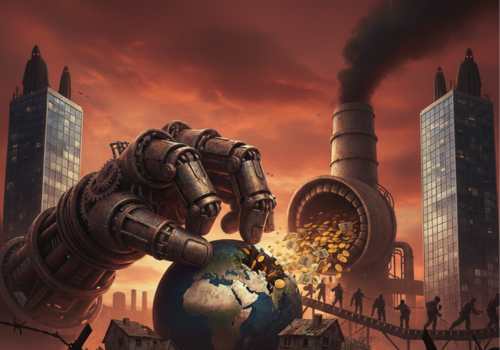
Yet today’s capitalism is no longer the system that once promised broad-based prosperity. What we are witnessing instead is a mutated form of capitalism—one that increasingly concentrates wealth, distorts democracy, and manufactures illusions of hope while quietly deepening inequality.
From Competitive Markets to Elite Capture
Contemporary capitalism is defined less by fair competition and more by elite capture. A narrow class of economic and financial actors now wields disproportionate influence over political decision-making, both at the national and international levels. Their power is not derived solely from market success, but from proximity to decision-making centers: governments, regulatory bodies, central banks, and global institutions.
This has created a closed ecosystem where wealth generates political influence, and political influence generates even more wealth. The result is extreme enrichment for a small minority, while the majority experience stagnating wages, precarious employment, and declining social mobility.
The Soft Lie Told to Societies
Unlike past systems of domination that relied on brute force, modern capitalism often governs through soft deception. Societies are constantly reassured through polished rhetoric: innovation will save us, growth will trickle down, markets will self-correct, and opportunity is available to all who work hard enough.
These narratives are rarely outright lies, but they are selectively framed half-truths. They obscure structural barriers, inherited privilege, and systemic inequalities. Hope is distributed generously—but real power and real wealth are not.
The Political and Economic Backstage
Behind public speeches and economic summits, a different conversation takes place. Lobbying networks, corporate pressure, and revolving doors between government and business shape policies long before citizens ever vote. Tax systems are engineered to favor capital over labor. Financial crises are socialized, while profits are privatized.
Critics argue that this backstage governance has hollowed out democratic accountability. Elections continue, but key economic decisions are increasingly insulated from popular pressure, justified as “technical,” “inevitable,” or “too complex” for public debate.
What Analysts and Critics Are Warning About
Economists, sociologists, and political analysts across ideological lines are raising alarms. They warn that unchecked inequality undermines social cohesion, fuels political extremism, and erodes trust in institutions. Concentrated wealth, they argue, is not just an economic problem—it is a democratic one.
Risk analysts also point to growing systemic vulnerabilities: over-financialization, speculative bubbles, climate externalities, and fragile global supply chains. These are not accidents, but consequences of a system optimized for short-term profit rather than long-term stability.
Predictions for the Future
Looking ahead, forecasts diverge. Optimists believe reform is still possible: stronger regulation, fairer taxation, and renewed social contracts could realign capitalism with public interest. Pessimists, however, foresee deeper polarization, recurring crises, and the rise of authoritarian governance as societies struggle to contain the fallout.
What is increasingly clear is that the status quo is unsustainable. The question is no longer whether contemporary capitalism has flaws, but whether political will exists to confront the forces that benefit most from those flaws