The international order never eliminated great-power privilege. It made that privilege part of a bargain: unequal authority in exchange for rules, restraint and shared benefits. As the bargain weakens, the danger is not simply that powerful states violate principles. It is that others begin to regard dependence on the system itself as a strategic risk.
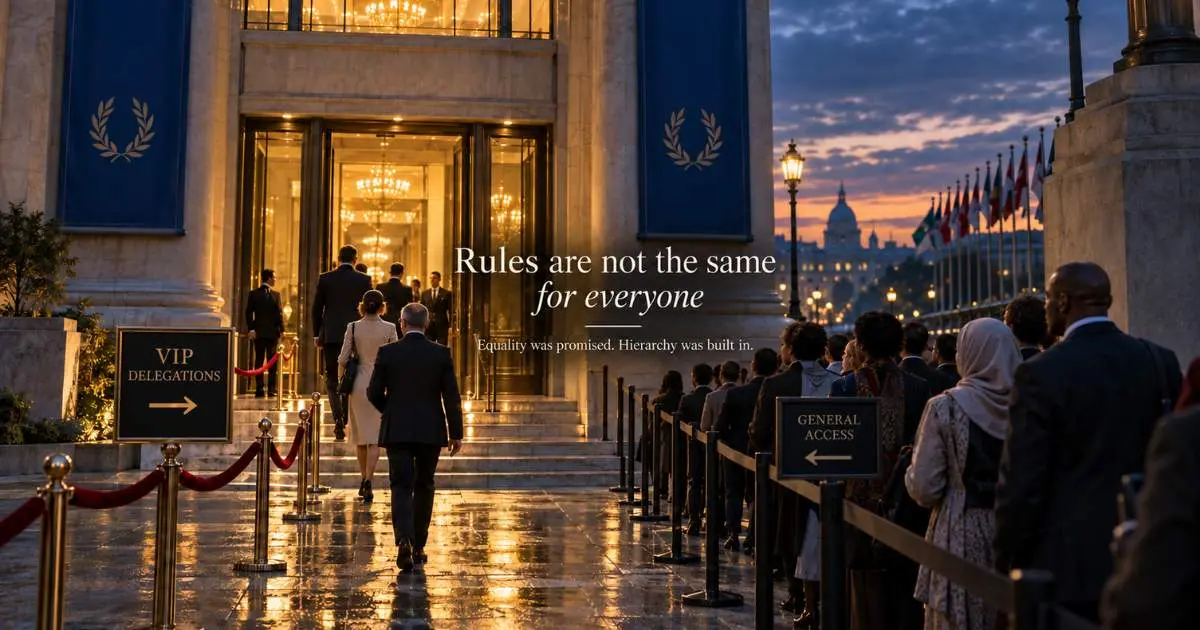
The international order built after 1945 contains a contradiction so visible that it is often treated as background rather than argument. The United Nations Charter declares the sovereign equality of its members, yet the same architecture gives five states permanent seats on the Security Council and a veto over substantive decisions. Equality entered the system as a legal principle; hierarchy entered it as an operating condition. The post-war settlement did not abolish power politics. It tried to make power live inside a framework of rules without asking the strongest states to surrender the privileges they considered indispensable.
That starting point matters because much criticism of the “rules-based international order” begins too late. It begins with Iraq, Ukraine, Gaza, Donald Trump, sanctions, or the latest Security Council veto, as if hypocrisy suddenly infected a previously equal system. The opposite defence is just as shallow: it points to decades of trade, alliances and relative stability and concludes that complaints about double standards are exaggerated. The more difficult truth sits between those positions. The order endured because unequal power coexisted with enough genuine rules, institutions, benefits and restraint to persuade a large number of states that remaining inside the system was better than living outside it. Its current crisis is not that the world has discovered inequality. It is that the bargain that made inequality tolerable is becoming harder to sustain.
The Bargain Hidden Inside 1945
The United Nations began with 51 members. Today it has 193, and the difference is not merely numerical. When the organisation was founded, roughly 750 million people—nearly a third of the world’s population—still lived in territories dependent on colonial powers. Large parts of Africa and Asia therefore had no sovereign voice of their own in the design of institutions that would later claim universal legitimacy. Decolonisation transformed the composition of the General Assembly, but it did not transform the permanent membership of the Security Council.
That Council embodied the political lesson the victors of the Second World War believed they had learned from the collapse of collective security between the wars. An institution that formally treated great powers like everyone else but could not keep them participating would be weak precisely when it mattered most. The five permanent members were consequently given special status and the ability to stop substantive Council action. The veto violated any simple notion of political equality, but its designers regarded great-power consent as more valuable than constitutional symmetry.
This is why the veto should not be described merely as a defect that prevents the United Nations from functioning as intended. It can certainly make the Council fail to act, sometimes in catastrophic circumstances, but the privilege is also part of the design that made the Council acceptable to the strongest states in the first place. The institution was built around a compromise that democratic systems would normally find intolerable within a state: the law speaks universally while enforcement acknowledges a hierarchy among those subject to it. International politics accepted that contradiction because no world government existed above the great powers to impose a different settlement.
The order that emerged from 1945 was therefore neither an egalitarian legal community nor a disguised empire with no meaningful rules. It was a negotiated hierarchy. The strongest states retained exceptional room for manoeuvre, while the wider membership gained institutions that could constrain behaviour, organise cooperation and create political costs for some forms of coercion. The arrangement was never morally clean, but it was politically intelligible.
There Was Never Just One Order
Part of today’s confusion comes from speaking of “the international order” as though it were one institution with one constitution and one enforcement system. It is not. The phrase usually compresses several overlapping arrangements into a single political shorthand: the Charter-based legal order of the United Nations; the monetary and financial institutions that grew from Bretton Woods; the trading system that evolved from GATT into the World Trade Organization; and the network of American-led alliances, security guarantees, markets and financial relationships that expanded after the Second World War and, especially, after the Cold War.
These layers overlap, but they are not interchangeable. A challenge to American leadership is not automatically a violation of international law. A violation of the UN Charter does not mean that the WTO has ceased to operate. A tariff dispute, a NATO disagreement and an International Court of Justice judgment belong to different institutional universes even when governments place all of them under the broad label of a “rules-based order.” The imprecision is politically useful because it can allow a preferred geopolitical arrangement to be presented as though it were identical to universal law, but analytically it obscures more than it explains.
The distinction also prevents a common mistake in arguments about decline. If Washington becomes more transactional with allies, the United Nations Charter does not disappear. If the Security Council is paralysed, international trade law does not automatically vanish. If states reduce their dependence on the dollar, that does not by itself dismantle the prohibition on territorial conquest. What is changing is not one building called “the order” but the relationship among several systems whose authority was reinforced for decades by a particular distribution of power.
Those systems were never equally universal or equally neutral, but neither were they fictitious. GATT and later the WTO reduced barriers and gave governments procedures for contesting trade restrictions. Bretton Woods institutions helped organise monetary cooperation after the instability of the interwar years, even while their voting structures gave greater weight to larger economies. Diplomatic law, maritime rules, treaties, technical standards and international organisations created predictable routines that governments and firms could actually use. A serious critique has to explain these achievements rather than pretend they did not happen, because the benefits are part of the reason the hierarchy lasted.
What Inequality Bought
The most revealing question is not why weaker states complained about an unequal system. It is why so many of them invested in it. Countries fought to join international organisations, sent diplomats to them, invoked their rules, demanded better representation within them and, in many cases, built economic strategies around access to the markets and institutions the system organised. If international rules were only theatre, decades of political struggle for a better seat inside the theatre would make little sense.
For a small or middle power, predictability has material value. Such a state cannot secure global sea lanes, issue the dominant reserve currency, deter every potential aggressor or compel a larger trading partner through force. Institutions give it alternative instruments: recognised procedures, coalition building, legal claims, reputational pressure, treaty rights and forums in which an abuse can become an international issue rather than remain a bilateral fact. None of those guarantees victory, but they can raise the cost of arbitrary behaviour and reduce the number of questions decided solely by the size of an army or economy.
The American-led dimension of the post-war settlement added public goods that were inseparable from American advantage. US military power underwrote alliance systems and contributed to the security of important maritime routes. The centrality of the dollar gave the United States extraordinary financial privileges while also supplying the world with a highly liquid reserve asset and a common medium for enormous volumes of trade and finance. Open markets benefited competitive American firms while also allowing other economies, from post-war Germany and Japan to South Korea and later China, to grow within a wider trading environment. Hegemony persisted partly because the hegemon gained from the arrangement and partly because many others gained enough to stay invested in it.
This is where legitimacy becomes more than moral decoration. A state can force another state to comply with one demand, but a durable order is cheaper when governments, companies and institutions organise their behaviour around rules because they expect the system to remain useful tomorrow. Consent in international politics is never pure; it is mixed with dependence, bargaining and fear. Yet even constrained consent reduces the amount of coercion required to keep an order functioning.
The implicit bargain was not that strong states would stop pursuing national interests. No serious government believed that. The bargain was that power would restrain itself often enough, act through institutions often enough, and continue providing enough shared benefits that the privileges at the top would not make the entire structure intolerable. The legitimacy of the order rested less on equality than on a practical belief that inequality would not become unlimited arbitrariness.
Power Writes Through Law as Well as Against It
The easiest abuse of power to identify is the open violation of a rule. The more sophisticated form is harder to see because it occurs inside legal and institutional language. Powerful states possess greater capacity not only to break rules but to shape agreements, define exceptions, extend domestic regulation beyond their borders, fund legal expertise and make their preferred interpretation of a dispute more influential internationally.
The 2003 invasion of Iraq remains an instructive case. The United States and the United Kingdom argued that existing Security Council resolutions provided legal authority to use force against Saddam Hussein’s government; many international lawyers and governments rejected that interpretation, and the invasion proceeded without a new Security Council resolution explicitly authorising force. UN Secretary-General Kofi Annan later stated that the war was not in conformity with the Charter. What is revealing is not simply that powerful states acted despite international opposition. They did not say law was irrelevant. They constructed a legal argument because even overwhelming military power still sought the legitimacy that law could provide.
Economic statecraft works in a similar grey zone between law and power. The United States can impose primary sanctions on persons subject to its jurisdiction, but secondary sanctions can threaten foreign companies with loss of access to the American financial system if they engage in specified conduct with sanctioned actors even when the underlying transaction does not occur in the United States. Washington defends such measures as tools of national security and foreign policy. Critics, including many developing countries and at times close American allies, have described their extraterritorial effects as coercive. The dispute is not simply between states that respect law and states that reject it; it is often a dispute over whose jurisdiction may reach whom and whose interpretation can impose the greater cost.
The same struggle occurs through political vocabulary. One government’s “sanctions enforcement” becomes another’s “unilateral coercive measure”; one state’s claim of necessary security action can become another’s allegation of unlawful force. Naming does not determine legal validity, and media repetition cannot turn an illegal act into a legal one. Yet states with larger diplomatic networks, influential media ecosystems, think tanks, legal communities and market power possess greater capacity to make their preferred vocabulary the starting point from which others must argue.
This is why an international order can become selective without every act of selectivity looking like a violation. Power influences the rules, the exceptions, the forum, the remedy and the political description of what happened. The sharpest question is therefore not only whether a state obeyed a rule, but how much influence it possessed over the environment in which obedience, violation and punishment were defined.
The Veto: Where Hierarchy Becomes Constitutional
Nowhere is hierarchy more explicit than in the Security Council. All five permanent members have used the veto at some point since 1946, although their patterns of use differ sharply across periods and issues. The mechanism means that the institution entrusted with primary responsibility for international peace and security is structurally least reliable when coercive action collides with the vital interests of one of its permanent members.
Russia demonstrated the contradiction immediately after its full-scale invasion of Ukraine in February 2022. Eleven Security Council members supported a draft deploring the aggression, three abstained, and Russia vetoed it. Days later the General Assembly adopted a resolution deploring the aggression and demanding Russian withdrawal by 141 votes to five, with 35 abstentions. The diplomatic judgment was overwhelming, but the Assembly could not transform that judgment into the kind of binding coercive action a unified Security Council might have authorised. The legal principle survived; enforcement met the architecture of power.
The United States has used the same institutional privilege repeatedly in relation to Israel and Palestine. In February 2024, for example, a draft demanding an immediate humanitarian ceasefire in Gaza received 13 votes in favour and one abstention but failed because Washington vetoed it, arguing that the text could jeopardise negotiations over hostages and a temporary ceasefire. One may evaluate the American reasoning on its merits, but the constitutional reality does not change: support from almost the entire Council could not overcome the opposition of one permanent member.
International courts reveal a related limit without reproducing the veto structure. The International Court of Justice can issue binding orders in cases within its jurisdiction, but it has no independent enforcement arm. The International Criminal Court can issue arrest warrants, yet it relies on states to arrest and surrender suspects. Law can therefore reach further in judgment than the international system can always reach in compulsion, especially when the target is protected by substantial military, diplomatic or economic power.
Even the trading system, often treated as one of the strongest examples of rule-based dispute settlement, illustrates the dependence of law on political consent. The WTO’s Appellate Body has been unable to review appeals because its vacancies remained unfilled after the United States blocked the appointment process, arguing that the body had exceeded its mandate. Other members developed interim arrangements and the WTO continues to function in many areas, so the organisation did not collapse. The episode nevertheless exposes a central vulnerability: sophisticated enforcement machinery remains effective only while enough powerful members continue to accept the machinery when it constrains them.
Ukraine and Gaza: When Principles Meet Alliances
Ukraine and Gaza are not interchangeable conflicts, and treating them as such would weaken rather than strengthen the case for consistency. Russia launched a full-scale interstate invasion of Ukraine and attempted to annex Ukrainian territory. The Gaza war followed the Hamas-led attacks of 7 October 2023, in which civilians were killed and hostages were taken, and unfolds within the much older Israeli-Palestinian conflict, including legal questions surrounding occupation, blockade, self-determination and Israel’s invocation of self-defence. Different facts generate different legal questions.
The useful comparison concerns the attitude toward institutions and principles once they become politically costly. In March 2023, after the International Criminal Court issued a warrant for Russian President Vladimir Putin over the alleged unlawful deportation and transfer of Ukrainian children, President Joe Biden called the decision justified while noting that the United States itself does not recognise the Court’s authority in the same way a state party does. Washington strongly supported accountability for alleged Russian crimes, and the warrant reinforced the wider Western argument that political office should not immunise leaders from international criminal scrutiny.
The reaction was very different when ICC scrutiny reached senior Israeli officials. In November 2024, the Court issued arrest warrants for Israeli Prime Minister Benjamin Netanyahu and former defence minister Yoav Gallant after rejecting Israel’s jurisdictional challenges as premature at that stage. The decision did not finally settle the jurisdictional dispute. On 24 April 2025, the ICC Appeals Chamber reversed the earlier ruling on Israel’s jurisdictional challenge and returned the question to the Pre-Trial Chamber for reconsideration. It did not suspend the arrest warrants, which had been issued separately, and the validity of those warrants was not determined by that appeal. The distinction is important: the existence of arrest warrants does not mean that every contested jurisdictional question has received a final judicial answer.
The Court also pursued alleged crimes by Hamas leaders, so its Palestine investigation was not framed around criminal responsibility on only one side. Israel rejected the Court’s jurisdiction and allegations, while the United States opposed the proceedings against Israeli leaders. The contrast became still sharper in 2025 and 2026, when the Trump administration imposed sanctions on ICC officials under an executive order describing actions against the United States and Israel as illegitimate.
There are legal arguments here that deserve to be stated rather than brushed aside. Neither the United States nor Israel is a party to the Rome Statute, and Washington argues that the Court lacks a legitimate basis for exercising jurisdiction over nationals of non-parties without their consent. Russia is also not a state party, however, and the Court’s jurisdiction in the Ukraine and Palestine situations rests on territorial connections to jurisdictions that accepted its authority, although through different legal routes. Ukraine had accepted ICC jurisdiction over crimes committed on its territory before later becoming a state party, while Palestine acceded to the Rome Statute in 2015.
A specialist may dispute aspects of those jurisdictional arguments, but the political contrast remains significant: American leaders treated ICC action against a major adversary as a valuable form of accountability and action involving a close ally as institutional overreach, later grave enough for Washington to sanction Court officials.
The International Court of Justice adds another layer that is often distorted in public argument. In South Africa’s case against Israel under the Genocide Convention, the Court ordered provisional measures in 2024, including measures concerning acts covered by the Convention and humanitarian assistance. Those orders were legally significant and binding, but they were not a final judgment that Israel had committed genocide. Collapsing provisional measures into a final verdict exaggerates what the Court decided; pretending they were merely political commentary understates it. Consistency requires respecting both the content and the limits of the decision.
The concern about double standards is not confined to Russian, Chinese or anti-Western rhetoric. In March 2024, UN Secretary-General António Guterres told European leaders that the protection of civilians under international humanitarian law had to be upheld in Ukraine and Gaza without double standards. The force of that warning lies precisely in the differences between the conflicts: consistency does not require identical policies in non-identical cases, but it does require governments to explain why the same institution, legal principle or category of civilian protection deserves confidence in one theatre and suspicion in another. Alliances may justify different strategic choices. They cannot, without cost, make universality appear conditional on friendship.
The Infrastructure of Coercion
The formal rulebook tells only part of the story because twenty-first-century power often operates through networks that no international constitution formally assigns to a great power. Currency, correspondent banking, export controls, semiconductor supply chains, insurance, shipping, energy, digital infrastructure and access to large consumer markets can impose consequences more immediate than a General Assembly resolution.
The dollar gives the United States the most important example. American officials themselves have acknowledged that the effectiveness of financial sanctions rests partly on the centrality of the US financial system and the dollar. Secondary sanctions can force a foreign company to choose between a transaction Washington opposes and continued access to American finance or markets. That does not mean every sanction is illegitimate, nor that the United States uniquely uses economic leverage. It means that a formally sovereign decision by another actor can carry a price determined by infrastructure controlled elsewhere.
This point is often muddled by claims that Washington “controls SWIFT.” It does not. SWIFT is a cooperative based in Belgium and operates under applicable European law, including European sanctions decisions. American leverage comes more directly from the dollar, US banks, market access and the network effects created by the financial system’s scale. Precision matters because the real architecture of power is more interesting than the conspiracy-like version: no secret command centre is required when dependence itself can transmit coercion.
Other powers exploit different dependencies. Europe’s heavy pre-war reliance on Russian gas became an obvious strategic vulnerability when the confrontation over Ukraine shattered the old energy relationship. China’s economic weight offers another example: after Lithuania allowed the opening of a Taiwanese Representative Office in Vilnius, the European Union accused Beijing of discriminatory and coercive trade restrictions affecting Lithuanian goods and EU products containing Lithuanian inputs, eventually taking the dispute to the WTO; China rejected the accusation and said its actions were lawful. Export controls on advanced technology, leverage over critical minerals, energy supplies, shipping and access to major markets all demonstrate the same underlying mechanism. Power belongs not only to the actor that can write a rule, but also to the actor that controls something others cannot replace cheaply.
This changes what sovereignty feels like without formally abolishing it. A government can remain legally free to choose while knowing that one option may isolate its banks, interrupt an energy supply, close an export market or deny its industries technology they cannot quickly replace. Modern power frequently works by changing the cost of a sovereign choice rather than removing the legal right to make it. The rule-based order therefore rests not only on law but on an infrastructure whose chokepoints are distributed very unevenly.
Trump Did Not Invent the Contradiction
Donald Trump is central to the present disruption, but making him the origin of the problem would give the international system an innocence it never possessed. The United States and the United Kingdom invaded Iraq in 2003 without obtaining a new Security Council resolution explicitly authorising the war and defended the operation through a contested interpretation of previous resolutions; France, Germany and other partners opposed the invasion, a reminder that “the West” has never been a single political actor. Successive American administrations have nevertheless used extraterritorial financial power, while Russia invokes sovereignty even as it occupies and claims Ukrainian territory. The contradiction between principle and power is systemic, not biographical.
Trump matters because he often changes the language through which that contradiction is managed. Previous American administrations frequently worked to present national interests through the vocabulary of alliances, common values and international public goods, even when practice fell short of those claims. Trump is more willing to present tariffs as leverage, alliances as bargains and territory as strategic property. The shift is not from pure idealism to pure realism. It is from a style that worked harder to reconcile interest with universality to one that often treats the demand for universality itself as negotiable.
Greenland makes the difference unusually visible because it moves the sovereignty test inside the Atlantic alliance. Trump has repeatedly argued that the United States should control Greenland, the self-governing territory within the Kingdom of Denmark, citing Arctic security and competition with Russia and China. Denmark and Greenland have rejected that position, insisting that Greenland’s future belongs to its people, while European leaders have defended sovereignty and self-determination. In September 2026, the European Union also announced a €200 million partnership package with Greenland as American pressure kept the territory’s strategic future at the centre of transatlantic politics.
The significance of Greenland is not that an American takeover must happen. It is that the strongest member of NATO can make territorial control over land linked to another NATO member a subject of open strategic pressure, forcing allies to invoke toward Washington principles they more commonly invoke together against adversaries. The episode becomes a revealing test of the order’s rhetoric: sovereignty is easiest to defend when it constrains an enemy; its credibility is measured more severely when it frustrates the preferences of the alliance’s most powerful state.
Trump therefore exposes more than he creates. He did not invent power politics or double standards. He has reduced the diplomatic distance between them and the language used to describe them, making a long-standing bargain harder to preserve through rhetoric alone.
The Global South Has a Longer Memory
There is no single “Global South” position on world order. India, Brazil, South Africa, Indonesia, Gulf monarchies, African democracies and smaller developing states have different security needs, political systems and economic interests. They frequently disagree with one another, and presenting them as an emerging anti-Western civilisation would simply replace one crude geopolitical story with another.
What many of these states share is a memory of entering institutions whose most powerful structures had already been designed. The UN’s expansion from 51 to 193 members occurred largely through decolonisation, while the permanent Security Council remained fixed. Developing countries did not merely complain about this from the sidelines. They formed the Group of 77, built UNCTAD, advanced demands for a New International Economic Order, pushed for different trade and development rules and spent decades seeking changes to voting power and representation in international financial institutions.
The persistence of the African representation question makes the historical lag especially difficult to ignore. In 2026, António Guterres again described the absence of permanent African representation on the Security Council as a historic injustice and argued that global institutions must reflect present realities rather than those of 1945. Africa accounts for more than a quarter of UN member states, yet no African country holds a permanent Council seat. This is not evidence that the United Nations has no legitimacy; the fact that African governments demand greater permanent representation shows continued investment in the institution. It is evidence that legitimacy can decay when an institution asks a transformed world to live indefinitely inside an old distribution of authority.
The same history complicates Western frustration when governments in Africa, Asia or Latin America refuse to align automatically in contemporary great-power contests. Many voted to condemn Russia’s aggression against Ukraine, demonstrating that scepticism about Western policy does not translate into acceptance of Russian revisionism. Yet those governments also carry political memories of colonial rule, Iraq, Palestine, economic conditionality and institutions they regard as insufficiently representative. Their refusal to treat every Western geopolitical priority as synonymous with the defence of universal order is not necessarily ideological defection. In many cases, it reflects the behaviour of states that want rules but no longer accept that one group of countries should possess a near-monopoly over interpreting what defending those rules requires.
When the Centre Admits the Bargain
In January 2026, Canadian Prime Minister Mark Carney gave this argument an unusual source of confirmation. Canada is a G7 democracy, a NATO member, a close American ally and a country that benefited heavily from the post-war Western system.
Speaking at the World Economic Forum in Davos, Carney said countries such as Canada had known that the story of the rules-based international order was “partially false.” He pointed to powerful states exempting themselves when convenient, asymmetric enforcement of trade rules and varying rigour in the application of international law, but he also argued that American hegemony had provided public goods including open sea lanes, financial stability, collective security and support for dispute-resolution frameworks.
The important part of the speech was not the accusation of hypocrisy. Critics outside the Western core had made that accusation for decades. What was unusual was the description of hypocrisy as part of a bargain knowingly tolerated by a beneficiary of the system. Carney said countries had participated in the rituals and largely avoided confronting the gap between rhetoric and reality because the arrangement remained useful, before concluding that “this bargain no longer works.”
Taken seriously, that admission changes the diagnosis. An international order does not lose legitimacy simply because someone proves that its principles were applied inconsistently; governments have always understood that power affects outcomes. Legitimacy erodes more dangerously when states conclude that the asymmetry is increasing while the public goods, predictability or restraint that compensated for it are shrinking. A system can survive a great deal of inequality if participation remains rational. It becomes brittle when privilege begins to look less like the price of order and more like permission for arbitrariness.
The implication is uncomfortable for defenders of the old arrangement because it turns moral criticism into strategic accounting. The states that benefited most from the system’s hierarchy could afford to treat the gap between principle and practice as an imperfection. States that experienced interventions, exclusion or economic coercion paid a different share of the cost. Once countries inside the core begin to question the bargain too, complaints that were previously dismissed as resentment from the periphery become evidence of a wider structural problem.
Strategic Debt: What Happens When Trust Is Spent
A double standard can be strategically profitable in the moment. A government protects an ally from a resolution, exempts itself from a rule, stretches a legal interpretation or uses a financial chokepoint to compel another actor, and the immediate objective may be achieved. The cost often arrives later, when that same government needs other states to believe that a principle it invokes is more than a convenient description of its present interest.
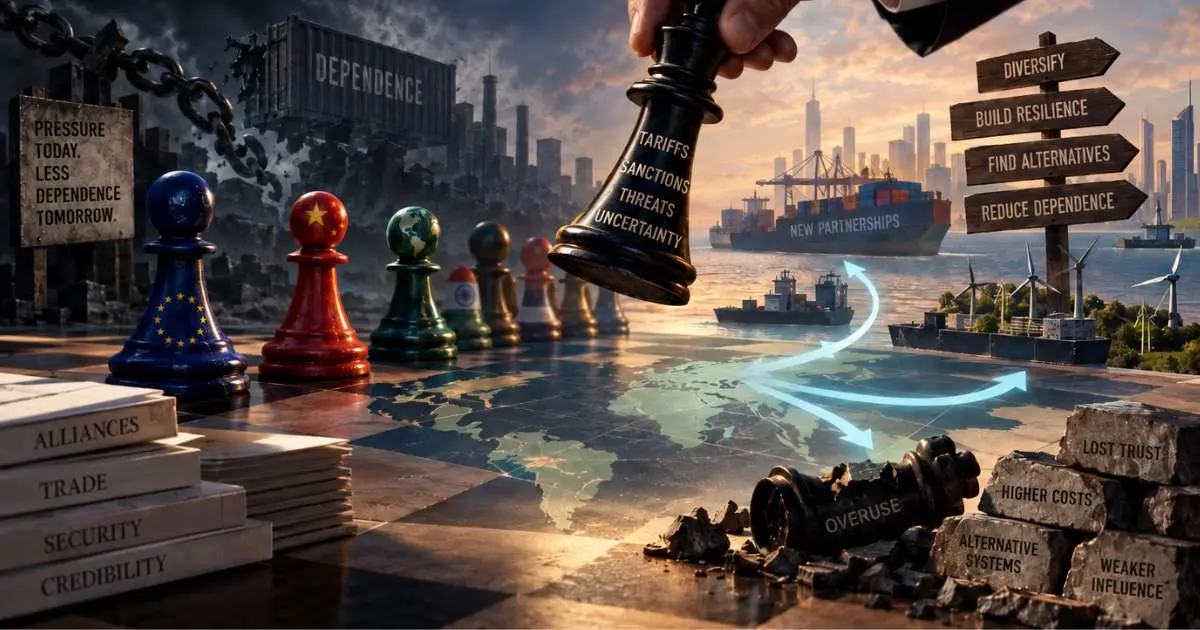
Call that accumulated liability strategic debt. The term is not a formal measure, and it should not be mistaken for one. It is an analytical way to describe the delayed cost of repeatedly spending legitimacy: coalition building becomes harder, neutral states demand greater inducements, partners diversify critical relationships, governments become less willing to join sanctions, and appeals to defend “the order” encounter memories of cases in which the same principles were treated more flexibly.
The most important response to declining trust is usually not revolt but hedging. States rarely abandon a dominant system overnight when their banks, trade, security and institutions remain connected to it. Instead they build options. India can deepen security cooperation with the United States through the Quad while remaining a central member of BRICS and maintaining a relationship with Russia. Gulf states can rely on American security ties while expanding economic links with China. Governments can hold dollar reserves while experimenting with local-currency settlement or connecting domestic payment systems to reduce dependence on a single channel.
The evolution of BRICS illustrates this behaviour better than the dramatic language of “de-dollarisation.” The grouping has expanded and its members have explored payment interoperability, local currencies and, in 2026, proposals to connect central-bank digital currency systems. Yet it remains internally diverse, and India has framed its latest payment initiative as a way to make cross-border transactions easier rather than as a plan to replace the dollar with a new BRICS reserve currency. The point is not that a coherent alternative order is about to displace the existing one. It is that governments increasingly perceive strategic value in having more than one route.
American policymakers have long understood the danger. US Treasury reviews have warned that alternative payment systems and digital assets could reduce the effectiveness of sanctions, while American officials have cautioned that excessive reliance on secondary sanctions could encourage foreign actors to reduce exposure to the dollar and the US financial system. This does not mean the dollar is about to lose its dominant role; network effects, market depth and liquidity make such transitions difficult. It means that every new mechanism built partly to insure against political dependence slightly reduces the exclusivity from which coercive power is derived.
Strategic debt is therefore collected not when the world stages a dramatic rebellion, but when dependence becomes a risk governments feel compelled to insure against. An order can retain most of its institutions while gradually losing the presumption that its central infrastructure will remain politically neutral enough to be relied upon without a backup plan. That is a slower form of fragmentation, and precisely for that reason it can advance for years before its cumulative significance becomes obvious.
Rules Matter Most to Those Who Cannot Impose Their Will
There is a dangerous temptation in exposing double standards. Once the gap between universal language and unequal enforcement is made visible, the collapse of the existing order can begin to sound like liberation. That conclusion confuses the failure of rules to eliminate power with evidence that a world with fewer rules would distribute power more fairly.
Great powers possess substitutes for law that small states do not. If a major power’s interests are ignored, it may retaliate militarily, impose economic costs, mobilise allies or exploit control over strategic infrastructure. A small state often turns to treaties, courts, international organisations, reputational pressure and coalitions precisely because it cannot compel a stronger neighbour by itself. International law is imperfect protection for the weak, but naked power politics is not stronger protection.
As confidence in external guarantees declines, rational governments spend more on self-help. They diversify alliances, harden supply chains, seek greater domestic military capacity and avoid dependencies that could later be weaponised. Some of this increases resilience. Taken far enough, however, the same logic produces arms races, competing economic blocs and a world in which every state must assume that protection depends primarily on what it can deter or what a patron is willing to defend. The poorest and smallest states are least able to buy that insurance.
This is why reforming international rules is not a sentimental project for people who dislike realism. It is a realist response to the cost of a system whose legitimacy is becoming too uneven. Reform cannot make the United States, China, Russia, India or any other major power equal in capability to a small state, nor can a treaty remove geography, nuclear weapons, market size or technological advantage. It can, however, narrow the distance between the cost paid by a weak state for violating a rule and the cost paid by a strong one.
That would require more than adding moral language to communiqués. Security Council representation that better reflects the present world, credible dispute settlement in trade, less selective support for international courts, and enforcement arrangements less dependent on the political discretion of a handful of states would not create global equality. They would make hierarchy less arbitrary. The purpose is not to construct a fantasy in which national interests disappear, but to preserve enough constraint that governments still have reason to believe rules are worth invoking before they reach for coercion.
The Test Is Whether Rules Can Bind Power When It Hurts
The deepest test of an international order is not whether it can punish a weak state whose friends are few. Almost any hierarchy can do that. The test is whether rules retain enough authority to impose meaningful costs on power when obeying them is inconvenient, when an ally is exposed, or when a legal judgment collides with a strategic interest. If the strongest can invoke universal rules against opponents while treating the same institutions as optional when they reach friends or themselves, the problem eventually moves beyond hypocrisy. Other states begin to price selectivity into their own behaviour.
This is also why institutional reform cannot be reduced to the hope that powerful governments will become morally consistent. States will continue to pursue interests, alliances will continue to matter, and no redesign of the Security Council can remove the reality of military, economic and technological inequality. A more credible order would instead make selective behaviour more expensive, give a wider range of states meaningful influence over rules they are expected to defend, and make enforcement less dependent on whether the accused happens to possess a veto, a crucial market, a nuclear arsenal or a powerful patron.
The African demand for meaningful Security Council representation, the unresolved crisis of WTO appellate adjudication and the controversy over political pressure on international courts are usually discussed as separate problems. They are connected by a deeper question: whether states still receive enough voice, predictability and reciprocal restraint to justify accepting a system whose power remains profoundly unequal. An institution does not need to eliminate hierarchy to retain legitimacy, but it cannot indefinitely ask those below the summit to treat privilege at the top as though it had no consequences.
The post-war order survived for eight decades not because it eliminated power and not because the world believed its rhetoric literally. It survived because power was constrained often enough, institutions worked often enough and the system produced enough shared value to make an unequal arrangement preferable to the alternatives for a very large number of states. Its future depends on whether that judgment remains rational.
The line the system cannot cross indefinitely is not inequality itself; international politics has never offered equality of power. It is the point at which inequality becomes indistinguishable from arbitrariness, and rules cease to look like restraints on power because they look instead like instruments reserved for those who lack the strength to refuse them.