From an inland capital in the African highlands, Aksum built a kingdom whose influence reached across the Red Sea and into the wider ancient world. Its power came not from geography alone, but from connecting land, trade, institutions and military ambition into a system whose greatest strengths would eventually become sources of vulnerability.
Aksum is often introduced through a comparison. It was one of the great powers of late antiquity, we are told, a kingdom important enough to appear in the same historical landscape as Rome, Persia and other imperial centres. The comparison is useful for correcting neglect, but it also creates a trap. If Aksum matters only because it can be placed beside more familiar empires, then Africa has once again been asked to borrow significance from somebody else’s history.
The more interesting question is how Aksum became powerful in the first place. Its capital did not sit on the Mediterranean coast or directly beside a major seaway. It stood high in the northern Horn of Africa, around 2,100 metres above sea level and roughly 150 kilometres from the Red Sea. Yet from this inland setting, Aksum developed a state that minted gold, silver and bronze coins, erected extraordinary stone monuments, projected military force across the Red Sea, adopted Christianity at court in the fourth century, and inserted itself into political struggles stretching from Nubia to southern Arabia.
Geography alone cannot explain that achievement. Many societies live beside valuable routes without controlling them, and many states command productive land without becoming international powers. Aksum’s success came from joining things that are too often studied separately: the agricultural depth of the highlands, towns and caravan routes linking the interior to the coast, the port of Adulis, royal control over resources, coinage, writing, religious legitimacy and military intervention. The Red Sea became a source of power because an inland state learned how to connect itself to it.
That same structure contained a vulnerability. Aksum grew by turning connection into leverage, but connection is never entirely under one state’s control. Trade routes can shift, allies can become competitors, overseas conquests can escape direct rule, ecological pressures can weaken the interior, and new political systems can reorganise the seas on which prosperity depends. Aksum’s history is therefore more than the rise and fall of a forgotten empire. It is a study in how a state can build power by becoming indispensable to a network—and what happens when the network begins to change.
Before Aksum: A Highland World Already Connected
The story does not begin with Aksum. Long before the kingdom emerged as a major state, northern Ethiopia and Eritrea contained farming communities, trade routes, ritual centres and political formations of their own. Yeha, one of the most important pre-Aksumite sites, preserves monumental architecture and inscriptions with unmistakable South Arabian connections, including a major temple built around the seventh century BC.
Inscriptions also preserve the name Dʿmt, often rendered Daʿamat, a pre-Aksumite polity associated with the northern highlands and the region around Yeha. Some of its rulers used titles and writing conventions with South Arabian connections, while the archaeological record also reveals deeply rooted local traditions. The evidence does not establish that Dʿmt was simply a colony ruled from across the Red Sea, nor does it allow historians to reconstruct its exact territorial extent or a direct dynastic succession from Dʿmt to Aksum. Its importance lies in showing that political authority, monumental construction and international cultural exchange were already present in the region centuries before the Aksumite kingdom emerged.
For much of the twentieth century, such evidence encouraged a model in which political complexity in the northern Horn was explained largely through migration or colonisation from South Arabia. That older model has not survived intact. Archaeology now presents a more complicated landscape in which South Arabian influences were real but unevenly distributed. At Yeha, foreign styles appear prominently in monumental architecture, inscriptions and elite religious forms, while much of the ordinary ceramic record points to local traditions. Rodolfo Fattovich and other scholars have argued that what was once treated as a single “pre-Aksumite culture” was probably a mosaic of communities in which external symbols were selectively adopted rather than evidence of wholesale replacement by settlers from Arabia.
This distinction is larger than a technical debate about pottery. Histories of Africa have repeatedly faced a particular interpretive temptation: when complex architecture, writing or centralised authority appears, explanation is sought outside the continent. In the case of the northern Horn, the opposite extreme would be equally misleading. Arabia and Africa had interacted across the Red Sea for centuries, and South Arabian people, scripts, religious ideas and political forms clearly mattered. The evidence simply does not require us to choose between “foreign civilisation” and an isolated indigenous world. Aksum grew from a region in which local societies were already participating in exchanges that crossed the sea.
Recent work at Beta Samati, near Yeha, has strengthened that picture of continuity. Excavations revealed a large settlement occupied from the pre-Aksumite era through the Aksumite centuries, contradicting an older idea that the Yeha region was substantially abandoned before Aksum’s rise. The site contained domestic activity, craft production, administrative objects, imported goods and later a basilica, suggesting that the transition toward Aksumite state power occurred across an inhabited landscape rather than after some clean civilisational break.
The origins of Aksum are therefore best understood not as a single founding event but as a long process of concentration. Local agricultural communities, older ceremonial centres, evolving political authority, contacts with Arabia and routes toward the Red Sea gradually created conditions in which a larger state could emerge. This makes Aksum no less extraordinary. It makes its achievement more intelligible, because the kingdom did not materialise at the moment foreign observers noticed it; it inherited and reorganised a much older highland world.
The Inland Engine of a Maritime Power
Aksum’s international history can make the kingdom appear almost coastal. The port of Adulis dominates accounts of its trade, and its military adventures in Yemen pull attention naturally toward the Red Sea. The capital, however, was a highland city. Before Aksum could profit from overseas commerce, it needed an inland economy capable of feeding people, sustaining towns, maintaining animals, supporting specialised labour and moving goods toward the coast.
Archaeology makes that interior visible. At Beta Samati, researchers found evidence of teff, wheat and barley, alongside cattle, sheep, goats, donkeys and camels. Grinding stones, storage areas, cooking spaces and craft production reveal a settlement whose inhabitants were not merely waiting for imported luxuries to arrive from abroad. They were producing, processing, transporting and consuming within a regional economy that connected ordinary subsistence to wider exchange.
The distinction is essential because maritime trade is often described as if ports themselves generate wealth. A port is only the visible end of a much larger system. Ivory must reach the coast from somewhere; food must supply merchants and labourers; pack animals must carry goods across difficult terrain; rulers must secure routes, settle disputes and extract revenue. Aksum’s inland power gave the state something a purely commercial entrepôt would not have possessed: political depth beyond the shoreline.
This is also why the capital’s distance from the Red Sea should not be treated as a geographical disadvantage overcome by accident. The highlands offered water, cultivable land, defensible terrain and access to routes stretching west and north as well as east. From there, the kingdom could draw on inland resources while connecting itself to Adulis. Aksumite power had two foundations that reinforced one another: the highlands generated the resources of statehood, while the sea multiplied the value of those resources by linking them to distant markets.
Beta Samati complicates another familiar image of ancient kingdoms—the idea that power flowed only from one capital outward. Its location on routes between Yeha, Aksum and the Red Sea, its imported amphorae and glass, its coins and seals, and its combination of domestic, religious and administrative activity point to a kingdom held together through intermediary settlements. Aksum was not simply a royal city attached to a port. It was a network of farms, towns, roads, religious centres and trading nodes through which authority and goods could move.
That network helps explain both the kingdom’s resilience and its later fragility. A state based solely on a single export can collapse when demand disappears; one based solely on land can remain powerful locally but peripheral internationally. Aksum bound productive land to long-distance circulation. Its political achievement was not merely possession of favourable geography, but the organisation of that geography into a system.
Adulis and the Economics of Connection
Adulis was where the interior touched the wider commercial world. The Periplus of the Erythraean Sea, a first-century merchant’s guide to the Red Sea and Indian Ocean, describes the region as part of an active trading system in which Mediterranean goods, Indian textiles and metal products moved toward the African coast while ivory, rhinoceros horn, tortoiseshell and other commodities moved outward. The text also indicates the presence of foreign traders and the use of imported coinage in commerce.
Adulis did more than enrich merchants. Trade created opportunities for rulers to tax, supervise, protect and politically shape flows of goods. A state able to control the routes linking inland resources to a major port could convert circulation into revenue, information and diplomatic relevance. Traders carried news as well as merchandise; imported objects transmitted technologies and tastes; foreign communities created channels through which political relationships could develop beyond formal embassies.
The Periplus associates the region with a ruler called Zoskales, describing him as familiar with Greek. Older histories often turned Zoskales into an early king of Aksum and used him as the convenient starting point of the dynasty. That identification is no longer secure. David Phillipson, among others, has argued that the text does not provide sufficient grounds to make Zoskales an Aksumite monarch, and the earliest unambiguous reference to a “king of Aksum” appears later in an inscription naming a ruler GDR.
The uncertainty is instructive. Ancient states do not always enter the historical record at the moment they are born; they enter when somebody leaves evidence that happens to survive. Greek and Roman merchants were interested in ports and rulers relevant to commerce, while Aksum’s own royal inscriptions and coins become much richer only later. The gap between the first external descriptions and the first secure Aksumite rulers is therefore not an empty period so much as a reminder that political formation is usually easier to detect after it has become powerful enough to write itself into durable materials.
By the third century, that visibility was unmistakable. Aksum was no longer merely one inland power connected to a commercial coast. Its rulers were beginning to communicate sovereignty in forms legible both locally and internationally, and the state had acquired the resources to turn trade into something more ambitious than prosperity.
Stone, Script and Coin: Making Power Visible
Power is never only the ability to command. Durable states also learn how to display command, repeat it and make it recognisable. Aksum did this through stone, writing and money on a scale that makes the physical remains of the kingdom inseparable from its political history.
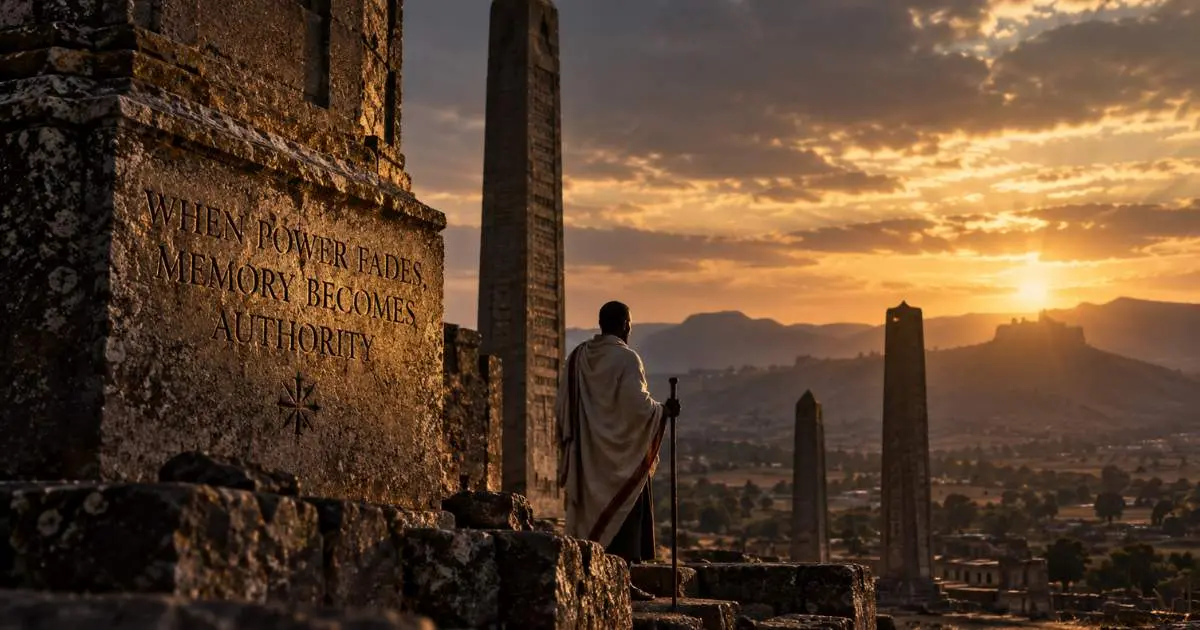
The great stelae at Aksum are the most dramatic example. Carved from massive blocks of stone and erected in elite funerary landscapes, the tallest were shaped to resemble multi-storeyed buildings, complete with false doors and windows. Their production required quarrying, transport, skilled carving and organised labour. The largest known examples came from quarries several kilometres away, and differences in size and elaboration appear to correspond to differences in status and wealth among those commemorated.
These monuments were not simply expressions of artistic taste. They demonstrated that Aksum’s ruling elite could mobilise resources on a scale far beyond an ordinary household or village. A giant monolith is frozen administration: behind the stone stand quarrymen, transport workers, planners, food supplies, tools, authority and the ability to command labour over time. The monument’s political message was therefore embedded not only in what viewers saw, but in the collective effort required to make it exist.
Writing performed a related function. Aksumite inscriptions appear in Geʽez, South Arabian script traditions and Greek, sometimes within the same royal commemorative context. Multilingualism was not evidence of a confused identity; it was an instrument of reach. A king could speak to local constituencies in forms rooted in the northern Horn while also using Greek, the major language of eastern Mediterranean trade and diplomacy, to project authority into a wider world. The famous inscriptions of Ezana preserve this ability to move between linguistic audiences.
Coinage made royal presence even more mobile. Under Endubis, around the late third century, Aksum began striking its own coins; surviving issues include silver, and the kingdom would produce gold, silver and copper denominations across subsequent reigns. A British Museum coin of Endubis dated roughly to 270–300 already carries royal imagery and the disk-and-crescent religious symbol later associated with Aksum’s pre-Christian coinage.
Endubis’s successor Aphilas developed one of the most elaborate early Aksumite coinages, experimenting with different denominations and weight standards in gold, silver and copper. His issues reveal a level of monetary sophistication that complicates any image of Aksum as a kingdom merely imitating the coinage of its Mediterranean trading partners. The variation in weights and designs suggests an effort to create a more differentiated monetary system, although the precise purposes of every denomination cannot be reconstructed with certainty.
Coins did several things simultaneously. They facilitated exchange, but they also standardised value, carried royal portraits, declared names and titles, and circulated political imagery far beyond the palace. Gold issues using Greek could travel through international commercial networks, while copper and other denominations could speak more directly to domestic exchange. The same object could therefore serve market integration and royal propaganda at once.
Aksum had reached an important threshold. Its rulers were no longer merely controlling resources; they were creating a political language in which authority could be seen in monumental stone, read in inscriptions and held in the hand. State power had become reproducible.
Ezana and the Transformation of Kingship
King Ezana, who ruled in the fourth century, occupies so much space in Aksumite history that he can make earlier development disappear behind him. Yet his importance is best understood as a transformation of an already expanding state rather than the creation of one from nothing. Under Ezana, royal inscriptions, military activity, coinage and eventually Christianity converged to produce a new language of kingship.
His inscriptions record campaigns against multiple peoples, including the Noba and Kasu in the Nile region. Older narratives often presented these campaigns as the decisive Aksumite blow that destroyed the kingdom of Meroe. Modern scholarship is more cautious. Ezana unquestionably projected force toward Nubia, and his inscriptions are important evidence for the political turbulence surrounding Meroe’s decline, but historians have challenged the simple picture of one Aksumite invasion single-handedly bringing the Meroitic state to an end.
That caution reveals something about Aksum that an exclusively Red Sea narrative can hide. The kingdom did not face only Arabia and the Mediterranean. Its rulers operated within northeast Africa, where routes toward the Nile, pastoral societies and older states created another arena of competition and exchange. Aksum was a Red Sea power because it was first an African territorial power with ambitions in several directions.
Ezana’s inscriptions also allow us to watch royal ideology change. Pre-Christian texts invoke older divine powers, while his post-conversion material adopts explicitly Christian language. One Greek inscription uses a Trinitarian formulation that scholars have linked to the theological world of Athanasius of Alexandria and Frumentius, suggesting that Aksum’s Christianity was already connected to disputes and institutions within the wider eastern Christian world.
The transition can also be seen on coins. Earlier Aksumite issues display the disk and crescent; after conversion, the cross appears in royal currency. The change was visually simple but politically profound. Money passing through markets now carried a declaration that the king’s legitimacy had been repositioned within a new sacred order.
It would be easy to describe this as a king changing religion and leave it there. The more revealing interpretation is that Christianity altered the vocabulary through which monarchy presented itself. Aksum’s rulers had long used ritual, monument and inscription to make authority visible. Under Ezana, the source of that authority was rewritten.
A Christian King Did Not Create a Christian Society Overnight
The traditional story of Aksum’s conversion often centres on Frumentius, a Christian from the eastern Mediterranean who entered the royal court and was later consecrated bishop through the Alexandrian church. The account is important, and the institutional connection with Alexandria would have lasting consequences. But court conversion and social conversion are not the same process. A king can adopt a religion in a moment; a society absorbs it through institutions, communities, buildings, texts and changing practices over generations.
Beta Samati offers unusually vivid evidence of that slower transformation. Its fourth-century basilica contained Christian symbols and ritual material, yet excavators also found objects associated with older practices, including figurines and bucrania, alongside administrative and commercial artefacts. The site does not allow us to reduce the period to a simple struggle between “Christians” and “pagans.” Instead, it suggests a society in which new religious forms entered spaces still carrying older habits and meanings.
Christianity also connected Aksum to networks already important for trade and diplomacy. Egypt, the eastern Roman Empire and Christian communities in Arabia became part of a shared religious geography, but Aksum was not simply absorbed into a Byzantine religious sphere. Geʽez developed into a major literary and liturgical language, local institutions took their own forms, and Ethiopian Christianity would eventually preserve traditions markedly different from those dominant in western Europe.
This is why describing Aksum merely as “one of the first Christian kingdoms” is correct but insufficient. The significant change was not just chronological priority. Christianity gave the monarchy a new transregional language while also being domesticated within an African social world. The kingdom could become more deeply connected abroad without becoming culturally derivative.
Religion consequently became another form of infrastructure. Churches, clergy, texts and liturgical practices linked communities internally while connecting the kingdom to external centres of authority. In the following century, that religious connection would interact with strategic interests across the Red Sea in ways that make it impossible to separate faith neatly from commerce and power.
The Kingdom That Crossed the Red Sea
Aksum’s involvement in southern Arabia long predated its most famous sixth-century campaign. South Arabian inscriptions name Aksumite rulers or political interventions from earlier centuries, although the precise extent of control is often difficult to reconstruct. The important point is that the sea between Africa and Arabia did not function as a hard political boundary. A state commanding routes through Adulis had strong reasons to care about the opposite shore.
Yemen mattered because the southern entrance to the Red Sea connected Indian Ocean traffic to routes leading north toward Egypt and the Mediterranean. Political influence there could affect commerce, shipping and alliances far beyond Yemen itself. The kingdom of Himyar, which became the dominant power in southern Arabia, was therefore not a distant neighbour but a participant in the same strategic system.
By the sixth century, religion made that rivalry more combustible. Himyar’s ruler Yusuf Asʾar Yathʾar, better known in later sources as Dhu Nuwas, embraced Judaism and became associated with violent campaigns against Christian communities, most famously at Najran in 523. Epigraphic evidence and later literary traditions confirm severe conflict, although modern scholarship warns against reading the episode only through later Christian martyr narratives.
King Kaleb of Aksum intervened militarily across the Red Sea around 525. Christian sources naturally presented the expedition as a defence of persecuted believers, and religion clearly mattered to a Christian monarch operating within a broader Christian diplomatic world. Yet a purely confessional explanation is too narrow. Recent scholarship has argued that economic and strategic interests in southern Arabia were also central and that religious language provided a powerful justification for intervention rather than necessarily its sole cause.
The distinction is important because late antique states did not separate faith and strategy as cleanly as modern analytical categories often do. Protecting Christians could strengthen Kaleb’s legitimacy, align Aksum with Byzantine interests, weaken a hostile regime and secure influence over commercially important territory at the same time. None of those motives cancels the others. The expedition makes sense precisely because several forms of power converged in the same place.
For a moment, Aksum had achieved something extraordinary: a highland African kingdom had projected enough force across the sea to overthrow a ruler in southern Arabia and shape the political order there. But successful invasion and durable control are not the same achievement, and the difference would soon become decisive.
Kaleb, Dhu Nuwas and the Politics of Intervention
The war in Himyar is often narrated as a clean sequence: persecution, Aksumite rescue, Christian victory. The actual political aftermath was less orderly. Removing Dhu Nuwas did not give Aksum an uncomplicated overseas province. Local elites, Aksumite commanders, Himyarite political traditions and external powers continued to interact in a landscape that no conqueror could permanently simplify.
This is where the notion of Aksum as an empire needs precision. The kingdom clearly possessed the capacity to project military power and install influence across the Red Sea. That does not mean Yemen became administratively equivalent to the Aksumite heartland. Maritime distance, local social structures and the costs of sustaining troops made direct rule more difficult than conquest itself.
The role of Byzantium illustrates the same ambiguity. The eastern Roman Empire shared Christian interests with Aksum and had strategic reasons to prefer friendly governments along Red Sea routes that could offer alternatives to Persian influence. Yet Aksum was not a Byzantine proxy. It acted from its own position, with its own commercial interests and its own monarchy, and alliances could coincide without erasing autonomy.
Kaleb’s coins preserve the self-image of a Christian ruler whose authority was still articulated from Aksum itself. Gold and silver issues carrying crosses linked Christian kingship to the older monetary traditions of the kingdom, while finds outside the highlands show the wide circulation of Aksumite money. A gold coin of Kaleb in the British Museum was acquired in Aden, an evocative reminder that political and economic connections across the sea were not theoretical abstractions.
The intervention in Yemen thus represents the height of Aksum’s ability to turn its Red Sea position into geopolitical action. It also exposes the first major limit of that strategy. A state can dominate a route without being able to control permanently every society connected by that route.
Abraha and the Limits of Conquest
Abraha makes that limitation impossible to ignore. He emerged from the Aksumite military-political presence in Yemen but eventually established himself as the dominant ruler there. The details of his rise differ among surviving traditions, yet the larger outcome is clear: the territory Aksum had conquered did not remain a straightforward extension of royal authority from the African highlands. A new Christian regime took shape in Yemen with substantial autonomy of its own.
Abraha’s inscriptions show a ruler acting on a large Arabian stage. They record military campaigns, public works and diplomatic contacts, and his famous Marib dam inscription refers to delegations from several powers, including Persia. His Christian language continued to invoke the religious world created by Aksumite intervention, but political authority had become increasingly localised in Yemen rather than simply transmitted from Kaleb’s court.
This is one of the most revealing episodes in Aksumite history because it separates influence from ownership. Aksum had changed the political and religious order of southern Arabia, but the regime that emerged could not be managed indefinitely as a distant possession. Conquest created an outcome, but not necessarily the outcome the conqueror could continue to dictate.
The consequences became clearer when Persia entered more directly into southern Arabian politics. By roughly 570, Yemeni opponents of Ethiopian rule sought Sasanian help, and forces sent under the Persian general Vahriz defeated the regime associated with Abraha’s successors. Persian influence then replaced Ethiopian predominance in Yemen.
The episode changed the meaning of Aksum’s greatest overseas success. Yemen had demonstrated that the kingdom could project force across one of the ancient world’s most important commercial corridors. It also demonstrated that maritime expansion could stretch Aksum beyond the zone where its inland institutions gave it the strongest advantages. The Red Sea multiplied power, but it did not abolish distance.
The Network That Made Aksum Also Set Its Limits
Aksum’s strength is often reduced to “control of trade,” as if long-distance commerce were a tap that a king could turn on and off. The reality was more demanding. Trade depended on producers in the interior, caravan routes, functioning ports, maritime security, foreign demand, political relations abroad and enough domestic stability to keep the entire sequence working.
That complexity was an advantage while the system held together. Aksum could draw resources from the highlands, direct them toward Adulis, participate in Indian Ocean and Mediterranean commerce, use imported wealth to support elite authority and then project some of that power back across the Red Sea. Each part reinforced another. Gold and ivory brought external value; coinage facilitated exchange and royal representation; religious ties strengthened diplomatic channels; political influence helped secure commercial routes.
But networks distribute dependency as well as opportunity. Aksum could control some nodes and influence others, yet it could not determine Roman demand, Persian strategy, Arabian politics, rainfall, soil fertility or every shift in maritime commerce. The same outward orientation that magnified the kingdom’s resources meant that changes far beyond the capital could alter the value of its position.
Signs of pressure appear before any single event that might be called a collapse. David Phillipson’s synthesis of the archaeology notes declining population around Aksum by the middle decades of the sixth century, deterioration or changing use of monumental buildings, reduced monumental quarrying and changes in the quality and composition of coinage. He also points to possible pressure on timber and other local resources as part of a broader transformation of the Aksumite heartland.
These developments overlap chronologically with the loss of direct influence in Yemen, intensifying Persian involvement in Arabia and a changing late antique economy. The weakening of Aksum was therefore already under way before the rise of Islamic powers completely transformed the political map of Egypt, Arabia and the Red Sea. That chronology matters because it prevents a simplistic story in which one external conquest suddenly caused a prosperous empire to disappear.
Decline Without a Single Collapse
There is no satisfactory date on which Aksum “fell.” Coinage appears to have ceased in the early seventh century, monumental and urban patterns changed, long-distance connections weakened, and political gravity gradually moved away from the old capital region. Yet settlements such as Beta Samati remained occupied into the seventh century, and cultural and religious continuities survived well beyond the period of imperial expansion.
Environmental explanations have played an important role in scholarship. Earlier geoarchaeological work connected population pressure, soil erosion and increasingly difficult rainfall conditions to reduced carrying capacity in the highlands, while later syntheses have treated ecological stress as one factor among several rather than a single cause. Such explanations fit the inland side of Aksum’s power: a maritime state cannot remain strong if the agricultural and demographic system supporting the capital is under strain.
External changes were equally significant. The collapse of Aksumite control in Yemen reduced direct leverage on the Arabian shore. Persian intervention altered the balance in southern Arabia, and the seventh-century Islamic conquests subsequently transformed Egypt, the Near East and maritime politics around the Red Sea. Older histories sometimes turned that sequence into the claim that Islam “cut Aksum off” and caused its collapse. The evidence supports a more careful conclusion: Islamic expansion changed the commercial and diplomatic environment profoundly, but it acted upon a kingdom already undergoing economic and political transformation.
Trade itself did not vanish. The Red Sea continued to carry merchants, goods and pilgrims under new political arrangements, and the Ethiopian highlands did not become an isolated world overnight. What changed was Aksum’s privileged place within the older late antique system. A kingdom that had prospered partly by linking Mediterranean, African and Arabian circuits now faced a network organised around different centres of power.
The distinction between collapse and transformation matters because Aksum’s most durable institutions did not disappear with its imperial reach. Christianity remained embedded in the highlands. Geʽez endured as a sacred and literary language. Aksum itself retained religious and royal significance long after it ceased to command the commercial position it once held. Political power would move, dynasties would change, and the economic geography of the region would be reorganised, but later Ethiopian rulers continued to live in a world for which Aksum was not merely an archaeological ruin.
This is where the first part of Aksum’s story ends. The kingdom’s achievement was not simply that an African state became rich through Red Sea trade. It was that a highland polity learned to join land, labour, agriculture, towns, caravans, ports, currency, writing, religion and military force into a political system capable of operating across several worlds at once. Its limits emerged from the same structure: the farther power travelled from the highlands, and the more it depended on routes and relationships beyond direct control, the more expensive that power became to preserve.
Aksum therefore did not disappear when the network that had made it powerful changed. It changed category. The imperial state receded, but Aksum increasingly became something another kind of power could be built upon: a sacred geography, a Christian inheritance, a language of kingship and a claim about legitimate descent from an ancient past. The next chapter is not simply what happened after Aksum. It is how a kingdom that could no longer command the Red Sea continued, for centuries, to command memory.
Read also: