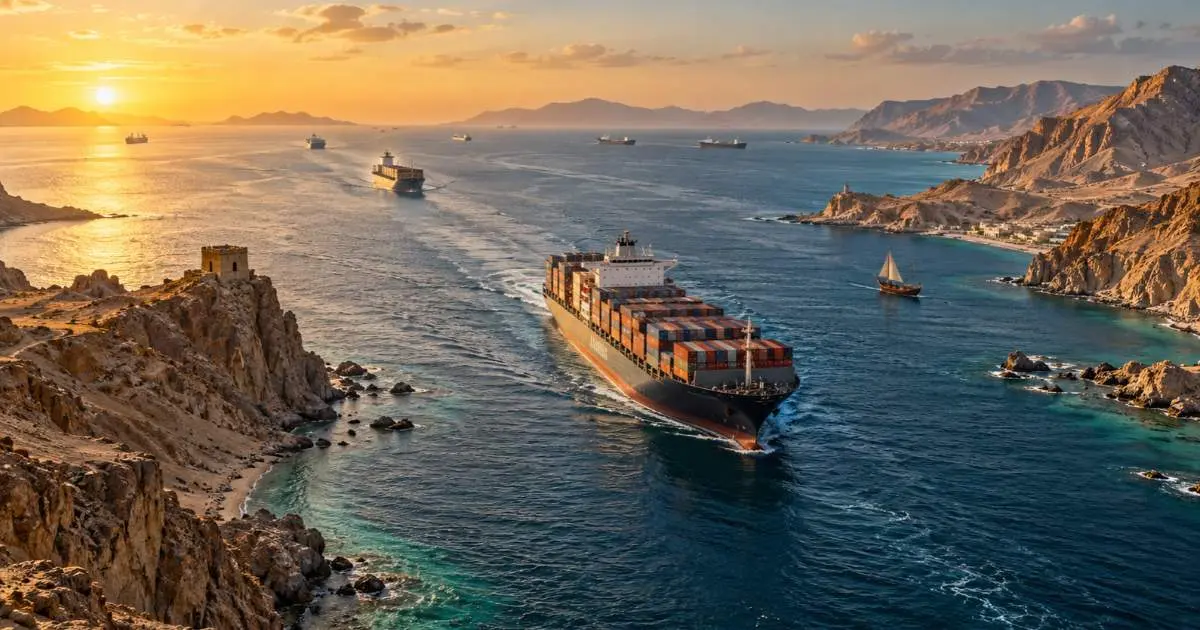
For thousands of years, the narrow sea between Arabia and Africa has carried incense, pilgrims, spices, coffee, imperial mail, oil and containers. Yet Bab el-Mandeb was not born a global chokepoint. The world made it one — through commerce, technology and political choices that turned an old passage into a place where disruption can impose costs thousands of kilometres away.
Before the World Needed a Chokepoint
On a map, Bab el-Mandeb looks like an explanation. The Red Sea narrows between Yemen and the Horn of Africa before opening into the Gulf of Aden and the Indian Ocean. Perim Island (Mayyun) divides the passage, two continents face each other across confined water, and modern strategic language seems almost inevitable: chokepoint, gateway, artery. Once warships, missiles and diverted container vessels are added to the picture, geography appears to have written the story in advance.
It did not. For most of human history, disruption in this narrow sea could not produce the kind of consequences it can produce in an industrial economy organized around the Suez Canal, energy markets, container schedules, insurance and tightly coordinated supply chains. The water was narrow, but narrowness alone did not make a crisis there capable of absorbing shipping capacity on the other side of the world. That power had to be constructed over centuries, through commercial networks, technological changes and political decisions that repeatedly altered the value of the same stretch of sea.
Bab el-Mandeb is often described as though it has possessed a fixed quantity of strategic importance since antiquity, waiting for successive empires to discover it. In reality, its significance has repeatedly risen, fallen and changed form as commodities shifted, ports prospered or declined, technologies altered the economics of distance, and states decided which routes they wanted to protect or dominate. Geography created the strait. Networks made it a chokepoint. Political power helped determine which networks would be built, protected and fought over. The three forces are inseparable, but they are not the same.
Long before anyone spoke of global supply chains, the Red Sea already connected economic worlds. Ancient South Arabia exported aromatics and participated in trading systems linking Arabia, northeastern Africa and the wider Indian Ocean. Ports along the African shore connected inland regions to maritime exchange, while traffic from Egypt and the Mediterranean reached southward. The Periplus of the Erythraean Sea, written in the first century CE, describes a commercial environment stretching across the Red Sea and Indian Ocean in which ivory, aromatics, textiles, metals and other goods moved between ports separated by enormous distances.
The sea was therefore already a corridor, but a corridor and a chokepoint are not identical. A corridor becomes something more consequential when enough value is organized around its continuity, when interruption produces costs elsewhere, and when alternative routes become sufficiently inferior that access itself acquires leverage. Ancient trade could make ports rich and rulers interested in controlling them without making the southern entrance to the Red Sea a pressure point for an integrated world economy. The history of Bab el-Mandeb is largely the history of those additional conditions accumulating.
Aksum and the kingdoms of South Arabia belong to this story, but not because they prove that Bab el-Mandeb was already the modern strategic object we know today. Their history demonstrates something subtler: the water between Africa and Arabia did not create two isolated political worlds. Trade, diplomacy, migration, religion and military intervention repeatedly crossed it, and Aksumite power at times extended into South Arabia. The detailed struggle for authority across the Red Sea belongs to the history of Aksum and Yemen; for Bab el-Mandeb, the essential point is that the shores on either side of the passage could already become components of a shared political and economic space.
A Sea of Pilgrims, Merchants and Rivals
The rise of Islam transformed the human geography of the Red Sea without creating its commercial importance from nothing. The Hijaz became the destination of pilgrimage from an expanding Muslim world, while Egypt, Yemen, the Horn of Africa and ports farther into the Indian Ocean were joined by movements that were simultaneously religious, commercial and political. Ships carried spices and textiles, but also pilgrims, scholars, officials, letters and ideas. The sea acquired significance not only because of what could be sold through it, but because institutions and communities increasingly depended on movement across it.
That history also complicates the habit of treating trade routes as the products of whoever later dominated them militarily. Arab, African, Persian and Indian merchants had created dense commercial relationships across the western Indian Ocean long before European fleets entered it in force. Political authorities taxed, protected and sometimes interfered with that commerce, but much of its infrastructure consisted of merchant knowledge: winds, credit, languages, trusted intermediaries and ports connected by repeated exchange. A route could be politically fragmented and still commercially coherent.
The Portuguese arrival in the Indian Ocean at the end of the fifteenth century changed the strategic calculation because it introduced something different: an all-water European route around southern Africa. When Vasco da Gama reached India in 1498, the voyage did not simply add Portuguese merchants to an existing system. It demonstrated that Europe could reach the Indian Ocean while avoiding the Red Sea and the eastern Mediterranean, threatening established commercial interests and altering the strategic value of both.
The response was political as well as commercial. Portuguese power attempted to use armed shipping and fortified positions to reshape Indian Ocean commerce, while rulers whose interests were tied to older routes did not passively wait for markets to decide the outcome. Mamluk and later Ottoman authorities regarded Portuguese expansion as a strategic problem, while Ottoman control of Egypt and parts of the Red Sea littoral gave Istanbul reasons to protect pilgrimage routes, regional commerce and access to the Indian Ocean. The Cape route weakened the relative advantage of the Red Sea without making it irrelevant, because states and merchant communities continued trying to preserve, redirect or recover the value that flowed through it.
The Cape of Good Hope enters the history of Bab el-Mandeb from far outside the Red Sea itself. Its importance lies precisely in that distance: a route need not be nearby to alter the strategic value of a chokepoint. Once a credible alternative exists, the question is no longer whether traffic can avoid the strait, but what avoidance costs and who is capable of bearing that cost. That calculation will return repeatedly in the centuries that follow.
Mocha Before Oil
Few places illustrate the instability of commercial geography better than Mocha, the Yemeni port whose name became inseparable from coffee. By the seventeenth century, Yemeni coffee was entering expanding international markets through Red Sea and Indian Ocean networks, and Mocha became one of the names through which distant consumers encountered it. Its fame eventually travelled farther than the commercial supremacy of the port itself, surviving in the vocabulary of coffee long after the economic system that had elevated the city began to change.
Yet coffee did not make Mocha in isolation. The port belonged to a much broader commercial environment in which Indian textiles, spices, metals, aromatics, provisions and other goods circulated alongside Yemeni coffee. Arab and Indian merchants operated there with European trading companies, and Gujarati commercial networks were especially important. To describe Mocha merely as the place from which Europeans obtained coffee would reverse the historical perspective: Europeans were participants entering a Red Sea and Indian Ocean system that already possessed its own merchants, capital, routes and centres of gravity.
Political authority mattered here too. Ports do not exist outside taxation, security, jurisdiction and the decisions of rulers who can encourage trade, extract from it or make it dangerous. The fortunes of Mocha were shaped not only by consumer demand but by the political conditions of Yemen, competition among trading interests and the changing relationship between the Red Sea and alternative maritime routes. Commercial networks can produce wealth, but political order helps determine where that wealth can safely accumulate.
Mocha eventually lost much of the position that had made its name globally recognizable. Coffee cultivation spread beyond Yemen, competing suppliers appeared, political circumstances changed and other ports gained at its expense. The coastline had not moved, and the entrance to the Red Sea remained where it had always been, but the network around the port had changed. Ports are often described as though they possess importance when, in practice, much of that importance is borrowed from systems that can eventually reorganize elsewhere.
Mocha therefore belongs in the history of Bab el-Mandeb for more than the romance of coffee. Its rise and decline warn against treating strategic geography as a permanent natural resource. A place can remain physically unchanged while commerce, technology and political power redistribute the value once concentrated there. The same principle that diminished Mocha would later magnify the importance of nearby Aden and, eventually, the strait itself.
The Machine That Made Geography Matter More
Steam power appears at first to offer an escape from geography. Sailors had always depended on winds and seasons; steam promised greater control over time, regularity and direction. But the early steamship carried a new dependency with it: coal. A vessel that no longer depended on favourable winds depended instead on a chain of places where fuel could be obtained reliably, turning certain harbours from useful stops into strategic infrastructure.
Aden became increasingly important within that transformation. Britain seized the port in 1839, during an era when British policymakers and the East India Company were deeply concerned with communications and access between Europe and India. The seizure had immediate local and imperial causes, but Aden’s later importance cannot be separated from the spread of steam navigation, coaling networks and the value of a harbour positioned near the southern entrance to the Red Sea. Over time, it became a major British imperial position from which maritime communications could be supplied, watched and defended. Britain also occupied Perim Island in 1857 and established a lighthouse there in 1861, extending its presence into Bab el-Mandeb itself.
This was not the invisible hand of commerce discovering a convenient harbour and automatically producing empire around it. British policymakers wanted reliable communications with India, naval access and facilities capable of supporting an expanding imperial system. Merchants had economic reasons to prefer faster routes, engineers had technological solutions, and the state had strategic reasons to secure the infrastructure on which those routes increasingly depended. Technology and political ambition reinforced one another.
Steam therefore did not abolish distance. It changed the price structure of distance and, in doing so, made some locations more valuable than they had been before. That pattern survives far beyond the age of coal, because technologies that promise freedom from old constraints often create new concentrations of dependence on ports, fuel systems, canals, cables, pipelines, repair facilities and communications infrastructure. Efficiency removes some frictions by making other nodes harder to do without.
The history of Aden also exposes the limits of any explanation based purely on network economics. A shipping company may calculate costs, but it cannot by itself annex a harbour, police a sea lane or maintain an imperial garrison. Once commercial routes become important enough, governments begin treating the infrastructure around them as questions of security and power. The network creates interests, while political authorities decide how far they are willing to go to defend, control or expand them.
The Canal That Changed a Strait Hundreds of Miles Away
The opening of the Suez Canal in November 1869 changed the meaning of Bab el-Mandeb more profoundly than almost anything constructed beside the strait itself. By connecting the Mediterranean and Red Sea directly for maritime traffic, Suez shortened the relationship between European markets and the Indian Ocean. The distance between Yemen and Africa did not change by a metre, yet the strategic meaning of that distance changed because an artificial canal in Egypt had reorganized the network around it. An intervention far to the north transformed the value of natural geography far to the south.
Suez was not an act of geography. It was a political, financial and engineering project built through concessions granted by the Egyptian ruler, foreign capital, massive labour and competing imperial interests. Britain had initially viewed the project with suspicion, but after the canal opened and its strategic importance became clearer, British policy adjusted rapidly; the British government purchased Khedive Ismail’s shares in the canal company in 1875, and Britain occupied Egypt in 1882. The canal shortened voyages, but it also became entangled with debt, sovereignty, imperial communications and the struggle to control the route to India.
That history prevents the network from becoming another invisible force in our explanation. The shorter route was economically attractive, but governments helped make it politically usable, defended it, fought over it and treated control of its infrastructure as a national interest. When Egypt’s President Gamal Abdel Nasser nationalized the Suez Canal Company in 1956, Britain and France joined Israel in a military intervention against Egypt. The confrontation was not simply about ships passing through a canal; it was also about sovereignty, imperial decline, regional power and control over strategic infrastructure.
Suez created a new geographical chain. Ships travelling between the Mediterranean and the Indian Ocean through the canal had to use the Red Sea, which meant passing Bab el-Mandeb at its southern end. Suez did not create the strait; it created a new dependency upon it. An engineered passage in northern Egypt increased the strategic value of natural water hundreds of miles away because the two had become components of the same route.
Once that route became ordinary, the economics changed again. The efficient route stopped feeling like an advantage and became the baseline around which shipping schedules, fuel calculations, fleet deployment and trade patterns could be organized. The Cape did not disappear; it became the more expensive alternative waiting in the background. Whenever politics or war made the preferred route unavailable, that hidden difference in cost became visible.
The closure of the Suez Canal after the June 1967 war demonstrated the point with unusual clarity. Navigation remained suspended until 1975, forcing traffic that would otherwise have used the canal to adapt to a world in which the shortcut had vanished. Ships could still travel between Europe and Asia, but many had to travel farther, while vessel design and trade patterns adjusted during the long closure. A route can therefore be strategically important without being physically irreplaceable: what matters is the price imposed when the network must reorganize around its absence.
From Coal to Oil to the Container
Coal made refuelling stations strategically important; oil altered both the fuel system and the cargo system. The twentieth century increasingly connected the Red Sea to energy flows between the Persian Gulf, Europe and other markets, while the expansion of tanker fleets increased the economic significance of reliable maritime passage. Bab el-Mandeb was no longer only part of a route along which merchants moved goods. It had become one component in energy systems whose interruptions could affect prices, refinery schedules and industrial economies far from the Arabian Peninsula.
Oil also made the relationship between commerce and state power harder to separate. Governments protected shipping, cultivated relations with producing states, maintained naval forces and built strategic reserves and pipelines partly because energy dependence could translate transport disruption into political vulnerability. Some infrastructure was deliberately designed to reduce exposure to particular maritime routes, but such alternatives remain function-specific. An oil pipeline can bypass a vulnerability for certain energy flows without replacing the role of container shipping, just as a railway can shift some cargo without reproducing the enormous carrying capacity and flexibility of the sea.
Containerization deepened dependence in a different way. Its revolution was not merely the standardized steel box but synchronization: ports, cranes, trucks, railways, warehouses, factories, ships and retailers could be coordinated into increasingly predictable systems. Once predictable timing became economically valuable, an interruption at sea began consuming something less visible than cargo. Extra days tied up ships, containers, crews, fuel, inventory and working capital, while disruption propagated through schedules designed on the assumption that the route would function normally.
This produced a form of leverage that earlier eras possessed only in weaker form. A vessel does not have to sink for the network to suffer, and a strait does not have to be physically sealed for its economic value to become visible. Risk can be sufficient to reprice a voyage, complicate crewing, consume naval resources or persuade shipping companies that additional distance around Africa is preferable to uncertainty in the Red Sea. Modern chokepoint power often works through altered behaviour before it works through physical closure.
The Red Sea disruptions that began in late 2023 provided an unusually clear demonstration. Large volumes of shipping shifted toward the Cape of Good Hope, while flows through Bab el-Mandeb fell sharply and vessels that continued using the region faced a different security and insurance environment. The important point is not the statistics of one crisis but the behaviour of the network: danger in one confined maritime space was converted into additional distance, time, fuel use and shipping demand across routes stretching between continents. A local disturbance acquired global consequences because the network had already concentrated so much value on reliable passage.
Nothing about that response proves that Bab el-Mandeb is physically indispensable. It demonstrates something more revealing: the world can avoid it, but avoidance changes the economics of movement. When the preferred route becomes less reliable, the cost does not disappear; it is redistributed through the rest of the system. That is a more useful definition of modern chokepoint power than the dramatic image of a strait completely sealed.
The Shadow Route
The Cape of Good Hope has remained present in the modern history of Bab el-Mandeb even during periods when most relevant traffic preferred not to use it. Portuguese expansion made the Cape a competitor to older Red Sea routes, while steam and Suez later shifted the calculation strongly in favour of the shorter corridor for many Europe–Asia journeys. When war or insecurity redirected vessels around southern Africa, the alternative did not suddenly appear. It simply moved from the background of the calculation to its centre.
Calling the Cape an “alternative” can nevertheless be misleading if it suggests that alternatives possess fixed prices. They do not. The cost of diversion depends on fuel, vessel availability, insurance, congestion, port capacity, inventory requirements and the condition of other parts of the transport system. A route that is manageable when global shipping has spare capacity may become far more disruptive when ships, terminals and inventories are already under pressure.
The events of 2023 and 2024 illustrated this interaction unusually well. Drought constrained Panama Canal operations, while disruption in the Red Sea later pushed additional shipping away from Bab el-Mandeb and Suez. The two problems differed completely in cause and location, yet their overlap exposed a feature of modern logistics that disappears when chokepoints are studied one at a time. The resilience of one route depends partly on how much stress the rest of the network is already carrying.
Bab el-Mandeb should therefore be understood as one component in a system of constraints rather than as an isolated bottleneck. The economic meaning of disruption there can change according to what is happening at Suez, Panama, Hormuz, major ports or within the global container fleet. If several alternatives retain spare capacity, traffic can redistribute more easily; if multiple nodes tighten simultaneously, each disturbance increases the cost of escaping the others. The value of a chokepoint is partly determined by conditions far beyond its own shores.
This is why strategic importance cannot be measured adequately by asking what percentage of world trade normally passes through a strait. Volume matters, but vulnerability also depends on spare capacity, rerouting options, inventories, infrastructure and time. Pipelines, overland links and alternative ports can redistribute certain flows, while the Cape can absorb maritime traffic at the price of longer voyages and greater resource use. Resilience is not a single substitute route waiting on a map; it is the ability of an entire network to rearrange itself without paying an intolerable price.
Who Actually Made Bab el-Mandeb Powerful?
Once the history is seen this way, an uncomfortable question follows: who made the strait powerful? Geography is an incomplete answer, but so is the language of networks if those networks are treated as self-organizing machines without governments, wars, interests or choices. Bab el-Mandeb acquired its modern significance through an interaction between commercial calculation and political will. Markets produced incentives, but states repeatedly decided which routes were worth protecting, controlling or contesting.
Engineers in Egypt cut Suez. British governments treated communications with India as an imperial interest and made Aden part of the infrastructure supporting them. Oil-consuming economies organized policy around access to energy flows, while shipping companies optimized fleets around reliable transit and manufacturers designed inventories around predictable delivery. Insurers converted danger into price, but governments supplied naval protection, negotiated access, occupied territory, built bases, sponsored infrastructure and sometimes used force because they believed the continuity of these networks served wider strategic goals.
No single authority designed the resulting system. Markets created pressures governments did not invent, technological changes opened possibilities policymakers had not foreseen, and private investment frequently preceded strategic doctrine. Yet political choices repeatedly hardened commercial convenience into strategic dependence. A route becomes more than a route when states begin spending money, accepting risks and organizing foreign policy around keeping it usable.
Djibouti offers a striking contemporary expression of that process. The small state near the southern entrance to the Red Sea hosts military facilities associated with France, the United States, Japan and China, among others, even though those countries have different strategic interests and missions. Their presence should not be collapsed into a single story of great-power rivalry, because counter-piracy, operations in the Horn of Africa, evacuation capacity, regional access and wider strategic competition all matter. What the concentration nevertheless reveals is that several distant states have independently concluded that maintaining physical capacity near this maritime corridor is worth substantial political and military investment.
The global network has therefore not priced Bab el-Mandeb only through freight rates and insurance premiums. States have built security architecture around the possibility that events near the strait can affect interests far beyond it. That does not mean military power created the trade route, nor that commerce explains every foreign base in Djibouti. It means that economic dependence eventually generates political choices about how much security, access and influence governments are willing to purchase around the geography on which they rely.
Restoring political agency also prevents the article from drifting into a new form of determinism. Political leaders do not control every consequence of the systems they inherit, but they decide whether to nationalize canals, seize ports, deploy fleets, finance alternative infrastructure, establish bases or accept dependence on particular routes. Those choices can make a network more efficient, more secure, more unequal or more brittle. They can also create vulnerabilities that later governments discover only when an adversary, a war or an accident exposes them.
The same relationship works in the opposite direction. A smaller actor near a critical route does not need to possess the economic or military weight of the states whose commerce passes nearby in order to impose costs on them. If it can make one segment of the route sufficiently risky or unreliable, much larger institutions may be forced to spend on protection, insurance, delay or diversion. The asymmetry lies less in the price of any particular weapon than in the architecture of dependence: a relatively limited disturbance can be amplified because enormous amounts of economic activity have been organized around the expectation that the route will remain usable.
That leverage should not be confused with control of global trade. Shipping companies adapt, navies intervene, states negotiate, cargoes reroute and investors search for alternatives. Persistent disruption can even accelerate the infrastructure, policies and commercial habits that reduce dependence on the route creating the problem. Chokepoint power can therefore contain the seed of its own erosion, because the ability to impose costs today can help justify the investments that make those costs easier to avoid tomorrow.
Strategic importance should also not be confused with possession of the wealth passing nearby. A ship carrying energy or manufactured goods through Bab el-Mandeb may be crucial to distant economies without transferring comparable prosperity to the communities visible from its deck. The network can assign extraordinary strategic value to a location while distributing much of the commercial gain, insurance business, financing and consumption elsewhere. Geography can place societies beside global wealth without giving them command over that wealth.
The resulting picture is neither one of geographical destiny nor of omnipotent policymakers. Nature constrains the options, markets compare their costs, technologies alter the comparison, and political actors attempt to shape the result. None of those forces operates alone, and none fully controls the system produced by their interaction. Bab el-Mandeb became what it is because their effects accumulated on top of one another over centuries.
The Price of Somewhere Else
Seen across the centuries, the most striking continuity at Bab el-Mandeb is not permanent strategic importance but repeated calculation. Merchants, rulers, empires, governments and corporations have all compared routes, risks and technologies, though they have done so for different reasons and with vastly different powers. The commodities changed from aromatics and textiles to coffee, coal, oil and containers, while the political systems changed from kingdoms and empires to nation-states and multinational corporations. What endured was the problem of deciding how much effort was justified to preserve one path rather than accept another.
The answer was never purely economic. Portugal’s Cape route challenged older commercial systems with armed power behind it, Britain turned Aden into an imperial position because communications were strategic as well as profitable, and Suez shortened distance while creating new struggles over sovereignty and control. Modern governments station military forces near maritime routes because the consequences of interruption cannot always be left to shipping companies and insurers. Markets calculate alternatives, but political power helps shape the conditions under which those alternatives exist.
Politics, however, cannot command geography out of existence. Governments can build canals, pipelines, ports and railways, but every alternative creates its own costs and dependencies. They can protect a maritime corridor, but protection itself consumes money, military capacity and diplomatic capital, while insurers, crews and vessel operators continue responding to risk. The history of Bab el-Mandeb is therefore not a story of markets defeating states or states mastering markets; it is a history of each repeatedly altering the constraints faced by the other.
A chokepoint is not defined by the absence of another route. Its power emerges when the preferred route has become sufficiently embedded in the surrounding economic and political system that abandoning it imposes significant costs, and those costs themselves vary according to the condition of the wider network. The Cape may remain open, pipelines may redirect some energy flows and overland corridors may absorb particular cargoes, but none of those options reproduces the existing system without friction. The relevant question is not whether somewhere else exists, but what must be spent, delayed, reorganized or protected in order to use it.
The map supplied the constraint, merchants supplied networks, engineers changed distances, companies turned predictability into efficiency, and political leaders repeatedly chose which routes to secure, contest or redesign. None of them created Bab el-Mandeb, but together they created the consequences that now flow from disrupting it. Its strategic importance may change again as energy systems, trade patterns, technologies and political priorities change, because the strait is permanent in a way that the systems surrounding it are not. Its power lies in the price of somewhere else.