An everyday dish can acquire a distinguished reputation while the people who sustained it remain poorly rewarded. Following the tortilla and the barbecue pit reveals how culinary recognition becomes valuable—and who can claim the proceeds.
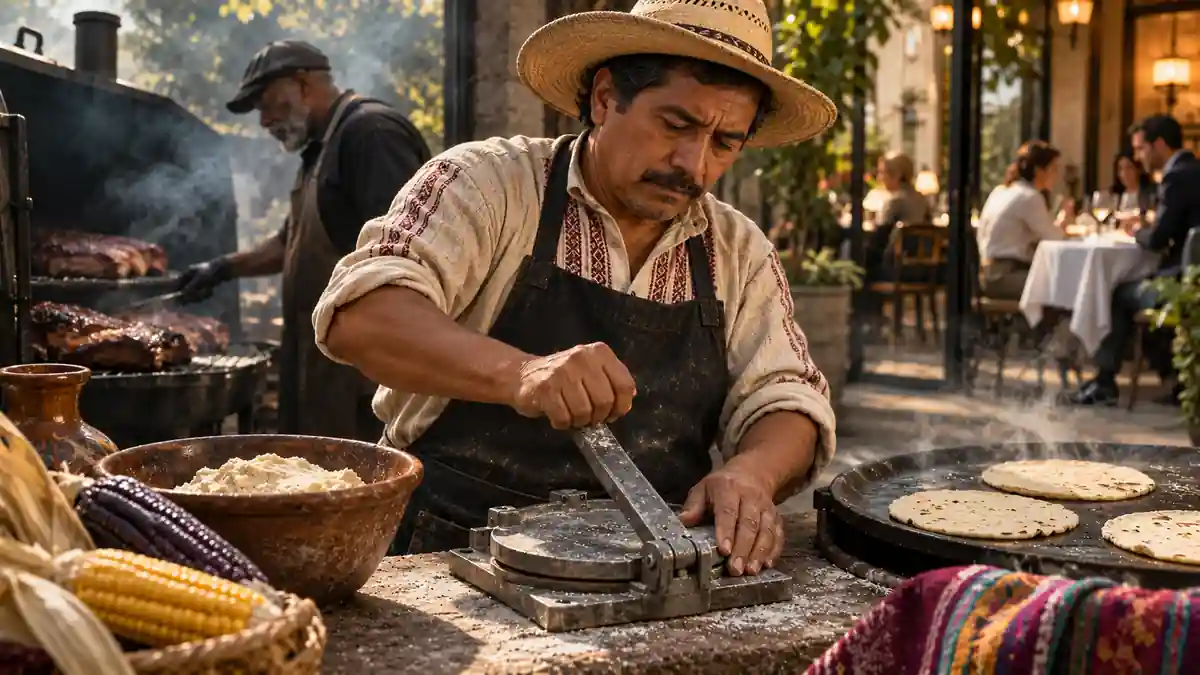
At Taquería El Califa de León in Mexico City, the equipment described by Michelin’s inspectors in 2024 included a griddle, a tortilla press and a short counter. Meat was cooked to order; corn tortillas were prepared alongside it. When the establishment received a Michelin star, the distinction recognised cooking already taking place in a setting that required little of the usual furniture of prestige. An international institution had extended its authority to a counter where customers could eat standing up.
Such moments are often narrated as the discovery of overlooked food. The language gives the newcomer an unusually important role. People who have been cooking, buying and judging the food for years become the background to somebody else’s revelation. Their knowledge enters the story when a critic, celebrated chef or guide makes it legible to another audience.
The relationship between food and social class becomes clearer when we follow what happens after recognition. A dish’s price, its cultural standing and its maker’s livelihood can change independently. A restaurant may acquire distinction through an inherited technique; a cook may gain publicity without gaining much control over the business. Equally, new recognition can allow an established practitioner to charge properly for work long treated as cheap. Mexican maize cookery and the barbecue traditions of the American South reveal these possibilities with particular force, because both contain extensive knowledge that the apparent simplicity of the finished meal can conceal.
Before the Discovery
A tortilla is easy to overlook when it arrives beneath something more expensive. It can appear to be a neutral carrier for meat, beans or salsa. A regular customer may know exactly how it should taste without knowing how to produce that result. Its preparation begins with a transformation of grain. In nixtamalisation, dried maize is cooked and steeped in an alkaline solution, commonly made with water and food-grade lime, then rinsed and ground into dough. The International Maize and Wheat Improvement Center describes how this process changes the grain’s structure and flavour, increases its calcium content and improves the availability of niacin. The everyday food incorporates a technology developed and transmitted across generations.
The cook still has decisions to make. Grain varies; cooking and grinding have to produce dough suitable for its intended use. The Food and Agriculture Organization’s Maize in Human Nutrition describes adjustments to lime and cooking time according to the condition of the maize, as well as the development of mills, tortilla-making machinery and industrial flour. This history contains both accumulated skill and efforts to reduce demanding work. Convenience answered a real need among people preparing food, including households moving from rural to urban areas.
That matters when traditional preparation becomes fashionable. A restaurant can choose a labour-intensive method and sell the result at a premium. A household cook may have performed comparable work because other people needed to eat and few alternatives were available. The physical operation can be similar while the freedom to undertake it, the recognition attached to it and the payment for it differ considerably. Culinary nostalgia tends to preserve the attractive part of this history—the patience, the handwork, the continuity—while passing quickly over who supplied the hours.
Barbecue in the American South exposes another form of expertise hidden inside a familiar meal. In a 2018 interview with Explore Parts Unknown, Rodney Scott described a whole-hog cooking process lasting about twelve hours. Wood first had to be burned into coals, which were then used to cook slowly through the night. He identified the physical demands of managing the fire and animal in summer heat, including repeated movement with a hot shovel. His preferred plate could be as straightforward as pork, vinegar-based sauce and bread.
Barbecue’s history also prevents an easy romance of humble origins. In Black Smoke: African Americans and the United States of Barbecue (2021), Adrian Miller reconstructs Black expertise, entrepreneurship and innovation within a tradition shaped by Indigenous cooking practices and subsequent cultural encounters. Much of the work was performed under slavery and later racial inequality. At the same time, skilled Black cooks developed businesses and reputations of their own. Poverty and coercion formed part of the conditions in which this knowledge travelled; they cannot be credited with the abilities of the people who worked within them.
Food and Social Class: Who Makes a Dish Distinguished?
People do not encounter food with an empty set of expectations. They arrive with assumptions about the cuisine, the neighbourhood, the cook and the amount a meal of this kind ought to cost. These expectations influence which forms of effort appear worth paying for.
Krishnendu Ray examined this hierarchy in The Ethnic Restaurateur (2016). Discussing his analysis of New York’s Zagat guides with WNYC, he showed how restaurant prices varied across cuisines and changed over time. Japanese restaurants rose substantially in the price rankings between 1986 and 2014, while Mexican and Chinese restaurants remained towards the lower end. Ray connected culinary prestige to the social position attributed to the people associated with a cuisine. His evidence concerns a particular restaurant market, but it challenges the assumption that prices simply express differences in ingredients or technical accomplishment.
A customer can enjoy a food while expecting its makers to remain inexpensive. Indeed, affection may help enforce that expectation. The cherished neighbourhood establishment is praised for generosity, informality and resistance to fashion; an increase in price can then be interpreted as a betrayal of its character. The proprietor is asked to preserve a relationship whose costs continue to change. Rent, wages and ingredients do not remain fixed because customers have fond memories.
Meanwhile, a restaurant with a different reputation may be able to explain similar work through a vocabulary of craft, provenance and authorship. Some of that explanation supplies useful information. Naming a maize variety or describing a cooking process can help diners understand a difference they would otherwise miss. But the ability to make such explanations persuasive is itself unevenly distributed. Publicists, critics, publishers and dining guides connect some kitchens to customers prepared to pay for the account.
Recognition can also arrive without a wholesale redesign. Michelin’s account of El Califa de León emphasised consistency, technical ability, meat and freshly prepared tortillas. Its inspectors found qualities worth distinguishing within the taquería’s existing form. This weakens the familiar story in which popular food must first be transformed by an inventive interpreter before it can enter serious culinary discussion.
The history of barbecue adds a sharper warning about what recognition can contain. In a 2021 conversation hosted by the Virginia Center for the Book, Miller and food historian Leni Sorensen discussed nineteenth- and early twentieth-century reporting that praised Black cooking while diminishing the cooks through caricature or incomplete names. Miller also described the movement of sought-after Black barbecuers around the country, carrying their skills into new communities. Their food could be valued, and their expertise actively recruited, within a public culture that denied them equivalent dignity.
The problem was more troubling than a failure to notice talent. People could recognise the talent and still subordinate its possessor. Better culinary history consequently requires more than adding neglected names to an otherwise unchanged account. It has to explain how customers, employers and institutions treated those people while depending on what they knew.
What the Higher Price Pays For
A higher restaurant bill is an ambiguous piece of evidence. It may finance better ingredients, adequate staffing, more space or hours of preparation. It may also pay for an address, a celebrated name and the experience of belonging to a particular dining public. These expenses and advantages can coexist within the same establishment.
The distinction becomes clearer if we follow a dish through its production. Maize is grown, purchased, processed, cooked and served. Meat passes through farming, slaughter, transport and the sustained attention of the cook. Each stage has its own costs and bargaining relationships. A final selling price combines them without disclosing how the proceeds are divided. Neither the menu’s elegance nor its modesty tells us what the worker receives.
Consider the difference between paying more for time and paying more for a story about time. A restaurant that prepares dough carefully and staffs the work properly incurs an expense. A menu that evokes generations of women making food may draw cultural value from a much longer history, including work for which those women received no separate wage. The second can help sell the first, but the connection provides no automatic route for money to return to the people invoked.
This is one reason family labour deserves attention. Relatives may prepare ingredients, cover an absent worker’s shift or keep a small establishment functioning when revenue is uncertain. Their contribution can sustain both the meal’s affordability and the business’s survival. Affection and obligation do useful economic work; neither makes the hours unlimited.
The opposite mistake is to insist that popular food remain cheap as a matter of cultural duty. If a cook must absorb rising costs to preserve the customer’s idea of authenticity, admiration becomes a constraint on earning. A tradition cannot offer a viable livelihood when its practitioners are denied permission to charge for the labour everyone claims to value. Better pay may require a higher price.
Nor does a small, informal setting necessarily represent a freely chosen aesthetic. Discussing Black-owned barbecue businesses with The Bitter Southerner in 2021, Miller connected the prevalence of takeaway operations partly to historical barriers to capital and the difficulty of maintaining dining space. A customer might experience that setting as reassuring evidence of authenticity. The operator may experience it as the business that available finance makes possible.
These distinctions give criticism something firmer to investigate than the distance between a street price and a restaurant price. The relevant questions concern who supplies the additional work, who assumes the financial risk and who can negotiate a better return. A celebrated establishment might improve those relationships; a much-loved inexpensive one might depend on exhausting them.
A Future Its Cooks Can Choose
The movement of popular food into prestigious dining creates opportunities as well as inequalities. Its outcome depends partly on whether established practitioners can participate as owners, recognised specialists and decision-makers. Publicity is more useful when the person receiving it has a business, a contractual position or another means of turning attention into durable income. For an owner, greater demand can produce a return after costs; for an employee or supplier, its benefit depends on wages, prices and the terms they can negotiate.
Rodney Scott’s recognition illustrates an important possibility. Having learned within his family’s barbecue business in Hemingway, South Carolina, he opened a Charleston restaurant in 2017 in partnership with restaurateur Nick Pihakis. In 2018, the James Beard Foundation named him Best Chef: Southeast. The award placed a practitioner of an inherited barbecue tradition within a major category of professional culinary achievement. It acknowledged the cook himself, alongside the food and establishment associated with his name.
An award cannot establish how well every worker is paid or how securely a business will survive. It can, however, widen the range of expertise that influential institutions recognise. That has consequences for whose career becomes imaginable: a person learning in a family establishment can see knowledge resembling their own treated as a professional accomplishment. The value of that recognition grows when training, finance and opportunities to own or direct a business become accessible too.
Mexican cooking offers another route through the organisation of practitioners. UNESCO’s 2010 inscription of traditional Mexican cuisine, using Michoacán as its paradigm, recognised a community-based system encompassing cultivation, preparation, ritual and collective participation. A cuisine survives through relationships among growers, traders, cooks and eaters; preserving a set of finished dishes captures only part of it.
In its 2025 account of traditional Mexican cuisine, UNESCO highlighted cooks including Celia Florián, owner of the Oaxaca restaurant Quince Letras, alongside Guillermina Ordoñez and Yara Muñoz Castillo. The account described their work in sustaining culinary knowledge and advocating fair compensation for rural producers. Here, practitioners appear as people shaping the conditions under which a cuisine continues. They have concerns about production, livelihoods and recognition that reach beyond the visitor’s encounter with a memorable meal.
That perspective changes what preservation asks of the next generation. Young cooks may want machinery, different working hours, new dishes or a business serving customers their parents never reached. Such choices can emerge from intimate knowledge of a tradition. Requiring its heirs to reproduce every demanding operation by hand risks turning cultural continuity into a permanent labour obligation, particularly for women whose work is already treated as a family resource. Equipment can remove drudgery while leaving room for judgment; practitioners need the authority to decide where that distinction lies.
There is a related responsibility for the institutions that confer prestige. A critic can name the people responsible for preparation. A chef can make a collaboration visible and remunerate it. A buyer can establish terms that allow a producer to plan beyond the next order. These actions create different relationships from a general tribute to ancestral wisdom.
The achievement worth seeking is a culinary culture in which someone can remain an ordinary working cook and still earn enough to continue. Exceptional awards will always reach relatively few people. Most tortillas will be made, and most fires tended, outside their field of attention. When a cuisine becomes fashionable, the lasting opportunity lies in improving the prospects of those everyday practitioners: the ability to maintain a kitchen, train a successor, take time away and choose what to change. A tradition has a more secure future when the people carrying it can afford to have a future of their own.
Read also:
Who Built the Monument? Slavery, Labour and the Making of Glory