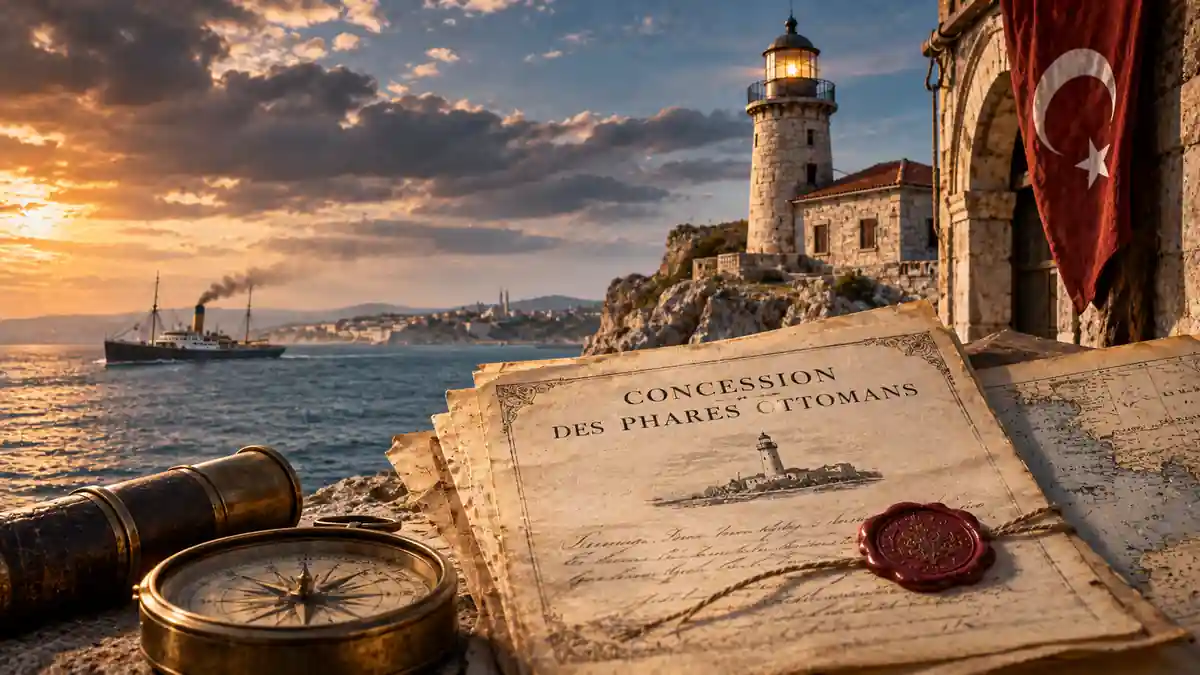
Along the former Ottoman coastline, a French company’s rights survived the transfer of territory to Greece. Behind the promise of safety at sea lay a struggle over revenue, public authority and the price of changing an inherited bargain.
On 17 March 1934, the Permanent Court of International Justice ruled on an unusual consequence of the Ottoman Empire’s retreat. Territories had passed to Greece, but the French firm Collas & Michel maintained that its lighthouse concession remained binding. The Ottoman government had renewed the contract in April 1913, extending its term from 1924 to 1949. Greece disputed the extension’s validity against it; France defended the company’s claim. In the Lighthouses Case between France and Greece, the Court upheld the agreement.
The dispute over Ottoman lighthouses exposed a difference between acquiring territory and gaining freedom over its economic administration. Greece had already taken practical control of the service and, in 1929, displaced the company from collecting its dues. What remained contested was the financial consequence of that control. Taking possession had not extinguished the rights asserted against the new administration.
The concession had begun as an answer to a practical problem: how to illuminate a vast coastline for expanding maritime traffic. Over successive renewals, it also became a source of commercial income and security for government borrowing. Its infrastructure helped ships find their way through dangerous waters. Its contracts determined where the money generated by those voyages would go.
A long concession can purchase equipment, expertise and reliable service while committing later governments to terms they did not negotiate. The history of this one turns on how those commitments were made, what sustained them after territorial change, and what a state had to pay to bring them to an end.
Building the Ottoman Lighthouses
Nineteenth-century maritime expansion demanded more than ships. A reliable route required knowledge of shoals, entrances and coastal landmarks, together with facilities that made repeated journeys possible. A lighthouse turned a dangerous point into a recognisable position. Its usefulness depended on a wider system: charts had to describe it accurately, equipment had to function and somebody had to keep the light operating.
This was infrastructure whose value travelled. The tower stood on one shore, while its benefits reached merchants, passengers, insurers and ports far away. As steam navigation expanded and commercial schedules became more demanding, reliability acquired greater economic importance. On the Red Sea route through Bab el-Mandeb, ports, charts and coastal lights helped shipping companies turn a geographical passage into a dependable commercial corridor.
The Ottoman government faced the task across extensive and varied coasts. In his 2024 thesis on the Lighthouse Administration, Umutcan Yapıcı traces the institution from a state office led by the French seafarer Marius Michel into a concessionary enterprise involving Bernard Camille Collas. The Crimean War brought Anglo-French competition in lighthouse technology into Ottoman waters. The arrangement that emerged joined an Ottoman governmental purpose to foreign expertise and commercial interests.
In 1860, Collas & Michel received the concession for developing, managing and maintaining a coastal lighting network. Following the construction period and an adjustment for delays, its initial twenty-year operating term ran from 1864. Renewals agreed in 1879 and 1894 pushed the expiry first to 1899 and then to 1924. The 1913 extension added another twenty-five years beyond that date.
The concession offered an organised service without requiring the government to build and administer every part of the enterprise directly. The company received a protected opportunity to recover expenditure and earn income. Both acquired something valuable. Their subsequent bargaining concerned how much each would receive, which duties accompanied the return and how long the arrangement would remain protected from replacement.
Ships genuinely benefited from the lights. That practical achievement explains why the concession could command support. But the service could remain necessary after the conditions under which it was financed deserved reconsideration. Maintaining illumination did not require retaining the same operator on the same terms indefinitely.
The Right to Charge the Passing Ship
A lighthouse presents an awkward commercial problem. Its light cannot easily be withheld from a vessel whose owner refuses to pay. Revenue therefore depends on an organised power to collect charges. The concession connected commercial earnings to governmental authority: the company’s valuable asset included a recognised right to demand payment.
The Ottoman treasury shared in those receipts. Under the original arrangement, the government received 22 per cent of gross revenues, leaving 78 per cent to the concessionaires before their expenses. These proportions changed with later agreements. The state was both the authority granting the concession and a beneficiary of the income it generated.
Changes in the division of revenue also accompanied changes in duties. Under the arrangements governing the period from 1899, the company no longer bore the earlier contribution towards constructing additional lights, while remaining responsible for maintaining those covered by the contract. The 1913 extension raised the governmental share to half of gross receipts and brought additional existing lights within the company’s maintenance obligations.
British correspondence from 1888 reveals how contentious the right to charge could become. Addressing a separate Collas & Michel concession for proposed lights in the Red Sea and adjoining waters, London challenged the number of lights, the charges and their proposed duration. It demanded published accounts and periodic tariff revision, arguing that foreign passing trade should pay the necessary costs of useful lighting without providing an additional fiscal return to the Ottoman treasury. The correspondence is preserved in the American diplomatic record.
Britain was defending the economics of the traffic using the route. The Ottoman government was defending an arrangement through which coastal services could generate revenue. Their disagreement concerned which interests should define a reasonable charge and whether a service used by international commerce could also support the finances of the state providing it.
Published accounts could expose excessive charges and improve scrutiny. Britain’s preferred financial principle also favoured the shipping interests that would pay. Transparency and commercial advantage could advance together. Describing a tariff as efficient did not settle who should receive the savings or whether the coastal state was entitled to a return beyond operating costs.
The Red Sea dispute was distinct from the concession later contested in Greece. It nevertheless exposes a recurring political resource: the ability to present a preferred distribution of costs as the proper meaning of a public service. A charge could be defended as the price of safety, challenged as a tax on commerce or valued as public income, depending on the position from which it was assessed.
Borrowing Against Tomorrow’s Light
An income stream can finance more than the operation producing it. If receipts are sufficiently dependable, they can support borrowing. The lighthouse system acquired a second financial life: anticipated payments from future shipping supplied security for money obtained by the government in the present.
The Permanent Court’s account records that the Ottoman government assigned its share of lighthouse receipts to lenders until principal and interest had been repaid. The 1913 renewal was associated with another loan. An agreement about the provision of light also helped arrange access to credit.
This widened the interests attached to continuity. The operator wanted to preserve the conditions of its business. Lenders wanted the pledged revenue to remain dependable. The government wanted immediate funds. An extension could satisfy those needs while committing income beyond the horizon of the officials negotiating it.
Borrowing against revenue can finance valuable public purposes. Its terms determine how much future flexibility is exchanged for present resources. When borrowing accompanies an early renewal, the transaction commits both an income stream and an opportunity to reconsider the institution producing it.
The concession was due to expire in 1924 when the Ottoman government extended it in 1913. An approaching expiry would ordinarily offer a chance to examine direct administration, alternative operators or revised charges. An early extension consumes some of that opportunity before the original period has run its course. The next government begins with a longer entitlement to negotiate around or compensate.
For the company, additional years could support investment by extending the period over which expenditure might earn a return. For the government, improved access to finance could carry a cost in later freedom of action. A renewal might make a loan easier to obtain precisely because it made the future revenue harder to redirect.
Ottoman officials were participants in constructing this arrangement. They exercised public authority to create and renew rights, receiving services and financial resources in return. Foreign influence worked through those decisions and the pressures surrounding them. The concession’s endurance cannot be explained as something imposed from outside upon a state with no purposes of its own.
A New Flag, an Old Contract
The Balkan Wars disrupted the territorial framework within which the latest renewal had been negotiated. Coastlines covered by the concession passed to Greece. Military occupation, the transfer of sovereignty and responsibility for contracts became connected questions with different legal answers.
The later dispute turned partly on Protocol XII attached to the Lausanne settlement of 1923, which addressed concessions and the succession to rights and obligations in transferred territories. Greece contested whether the 1913 extension had been validly concluded and was binding upon it. The controversy concerned the application of a negotiated legal framework, rather than a general rule that every contract necessarily survives every change of sovereignty.
Under a submission agreement concluded in 1931, France and Greece referred the validity question to the Permanent Court of International Justice and provided separately for arbitration of financial claims. France’s diplomatic support gave the company a route through which to pursue an international remedy.
The Court’s judgment of 17 March 1934 upheld the extension in principle for the relevant transferred territories. In Lighthouses in Crete and Samos, decided on 8 October 1937, it reached the corresponding conclusion for those islands and Crete’s adjacent islets, after examining their particular political status. The company’s rights survived through treaty provisions, legal argument and institutions capable of enforcing a result.
Practical control had followed a different timetable. Greece took over operation of the lighthouses concerned in May 1915, while the company continued collecting dues. On 1 January 1929, Greece displaced it from collection as well. The judgments therefore helped determine the obligations arising from changes already made.
Protecting continuity served a serious institutional purpose. Infrastructure becomes harder to finance if a territorial transfer allows an incoming authority to cancel commitments without consequence. Ships still need functioning lights after a war, and an operator needs some basis for knowing which authority will answer for an undertaking.
The concession preserved a governmental right to resume administration, conditional on compensation fixed by agreement or arbitration and paid or guaranteed before takeover. Greece could exercise public control, but the manner of doing so could create a liability. The contract did not need to prevent control absolutely to influence its cost.
Borders allocated territory; the treatment of contracts helped allocate the cost of exercising authority within it. The political map could change before the financial consequences of administering the new territory had been settled. The company’s position depended on making that unfinished account enforceable.
The Account Behind the Beam
The Franco-Hellenic Arbitral Tribunal, constituted under the 1931 agreement, delivered its award on 24 and 27 July 1956. It addressed claims concerning dues, seized receipts, operation, maintenance and the early termination of the concession. Its task was separate from the Permanent Court’s earlier determination of the extension’s validity.
The period between 1915 and 1929 exposed an unusual division. Greece operated the lights while the company retained the dues it collected. The tribunal recognised that the company had avoided operating expenditure and should reimburse costs it would otherwise have borne. The measure was not automatically whatever Greece had actually spent; it required an assessment of the company’s own corresponding obligations.
Construction, ownership, maintenance, collection and entitlement to income could thus be distributed among different parties. A vessel’s payment entered a system of duties that could not be inferred from the name on the collection office. Determining what was owed required reconstructing who had performed the work and who had been spared its expense.
The tribunal also rejected some claims. When the company asserted a monopoly as grounds for compensation over new lights built by Greece, the award found no basis for that theory in the applicable arrangements. A right to collect particular dues was not an unrestricted claim over every future improvement to the coast.
Behind these accounts lay repeated work: supplying fuel and equipment, transporting provisions, paying personnel and repairing exposed structures. The network’s income depended on services that had to keep functioning through war and administrative change. Financial claims could endure in documents, but the safety offered to ships had to be renewed through daily performance.
The existence of a functioning lighthouse could not establish that every surrounding charge was justified. Equally, expenditure by Greece did not make every cost recoverable from the company. The tribunal had to distinguish among contractual duties, wartime damage and improvements undertaken by the state. Neither side’s general claim to have sustained the service resolved the individual accounts.
Taking Back the Light
The Turkish and Greek paths diverged. In Turkey, the government purchased the lighthouse administration and assigned it to Denizbank on 1 January 1938, according to the Directorate General of Coastal Safety’s institutional history. Incorporation into national administration came well after the republic’s establishment in 1923.
İsmail Köse’s 2024 study of lighthouse concessions and passage fees places that recovery within a longer struggle over services in the Turkish Straits. The process extended into the period following the Montreux Convention of 1936. Authority over strategic waters involved acquiring and reorganising the institutions through which those waters were administered.
The Greek arbitration addressed a different course. In examining the 1929 takeover, the tribunal found that Greece had not first paid or guaranteed the compensation required by the concession. The company was consequently entitled to compensation for being deprived of the remaining twenty years of its term. The award set out an approach to valuation involving expected net returns, with further calculation dependent on financial questions still requiring resolution.
Compensation concerned the value of the contractual position, including its income, rather than simply the residual value of towers and equipment. A government recovering the service could therefore face a bill for the future earnings attached to it. The physical infrastructure and the price of ending the concession were not the same asset.
This was the force of the extension made in 1913. It had added years of entitlement beyond 1924; those years became part of the compensation question when Greece took over in 1929. A decision made before the Ottoman Empire’s dissolution helped determine what another government would owe after it.
The original arrangements had contemplated an ending. The 1879 agreement expressly retained the government’s power to resume administration, subject to the payment or guarantee of compensation. A further clause provided for inspection near expiry and a guarantee covering necessary repairs. The contracts contained instruments for protecting both the concessionaires’ rights and the condition of the service returned to public hands.
For governments entering such bargains, the relevant provisions belong at the beginning: duration, tariff revision, maintenance standards, revenue pledges and the basis of compensation. Together they determine whether later authorities can adapt a service when needs change, and whether doing so requires paying for rights created decades earlier.
The Ottoman lighthouse concession made coasts safer and turned maritime movement into dependable revenue. Officials used that income, lenders relied on it, the company defended it and adjudicators determined which claims survived territorial change. Practical achievement and political constraint developed through the same arrangement.
A government can obtain equipment, expertise and money while leaving its successors a substantial price for changing course. That price may protect investment genuinely made; it may also preserve the value of an early extension long after its immediate financial purpose has been served. The renewal’s benefits and its restrictions need not fall upon the same government or generation.
The empire’s disappearance did not settle those accounts. Greece could administer the coast while owing compensation for the terms on which it had taken control; Turkey could bring the service into national administration through purchase. Sovereignty supplied the authority to act. The inherited bargain helped determine what acting would cost.