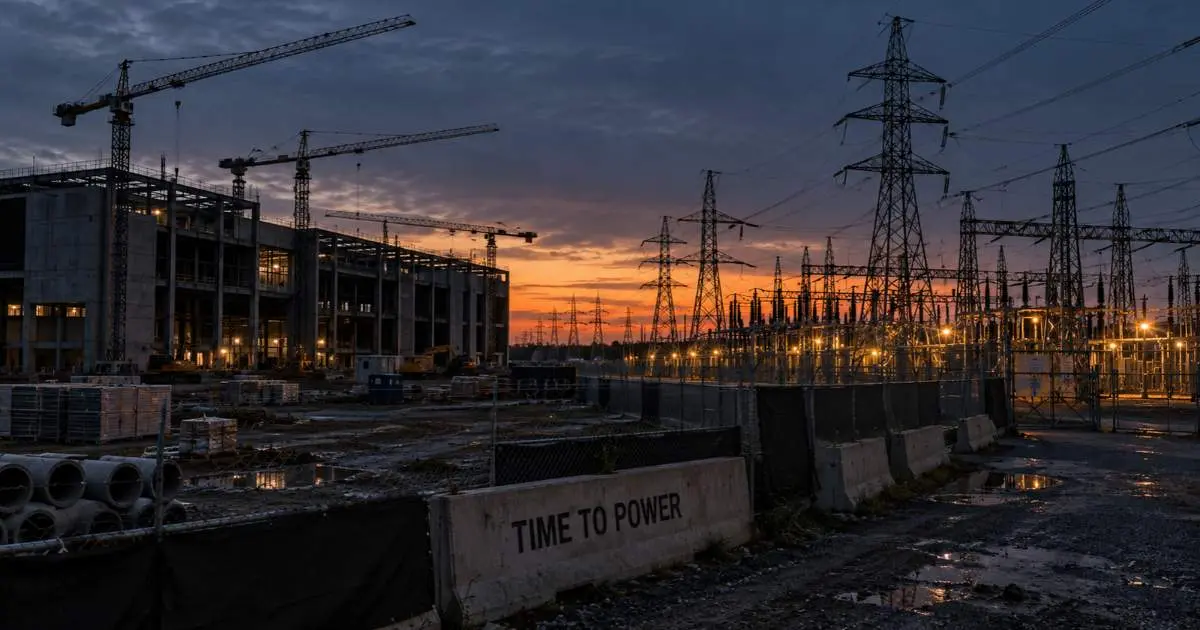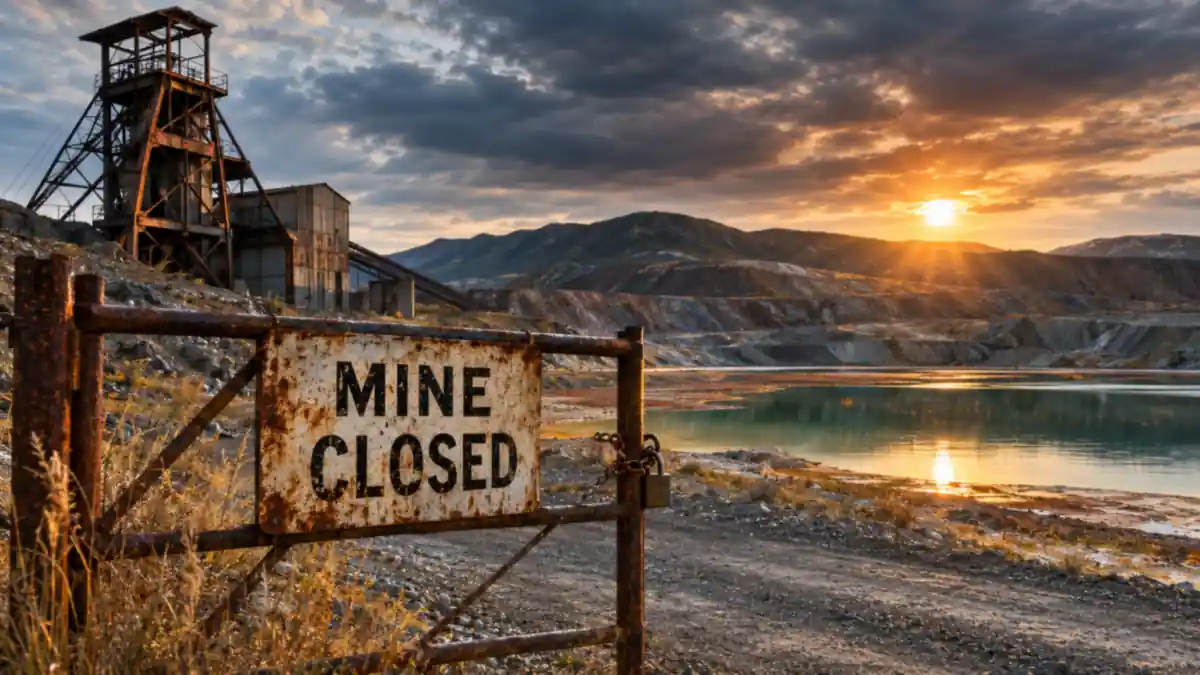
Mining can end for the company while continuing to govern the lives of everyone around it. The terms of departure reveal how much of an industry’s apparent success depends on obligations left behind.
At Giant Mine, near Yellowknife in Canada’s Northwest Territories, extracting gold created a task with no agreed finishing date. The roasting process used to release the metal produced approximately 237,000 tonnes of arsenic trioxide waste, stored underground. The Canadian government selected a method that would freeze the waste chambers and surrounding rock to isolate the material from groundwater. Yet containment would still require water treatment and monitoring. The chosen remedy could reduce the danger without giving the government a date on which it could simply walk away.
The commercial and public histories separated before extraction finally stopped. When Royal Oak Mines entered receivership in 1999, the courts transferred the property to Canada. The government subsequently sold it to Miramar, preserving employment and retaining an experienced operator. Under the sale arrangement, Canada retained responsibility for the mine’s existing environmental condition, including its underground arsenic. Continued production and responsibility for inherited contamination had become distinct undertakings.
Mine closure costs expose this division with unusual clarity. A project has a production schedule, owners and a financial structure. Its consequences can outlive all three. Investors can sell, companies can reorganise and an operation can cease to meet its commercial purpose. The surrounding population still needs usable land, safe water and a livelihood.
A company’s departure may involve discharging its duties, transferring them to a properly funded successor or leaving obligations that nobody can effectively enforce against it. Those departures have very different consequences for the people who remain. The terms of exit determine how much money, work and risk will accompany the mine into its next phase.
The Last Shipment Is Not the End
“Closed” brings together several events that can occur years apart. Extraction stops. Buildings and equipment are removed. Shafts are secured. Land is rehabilitated. Regulators decide whether obligations have been met and whether an operator can relinquish responsibility. Some sites continue to require treatment and supervision after the initial restoration works are complete.
In “Towards a Positive Legacy”, published online in Mineral Economics in 2022, R. Anthony Hodge and Henry Brehaut describe post-closure as an ongoing phase of treatment, monitoring, assessment and adjustment. Mining can expose sulphide minerals to conditions that generate contaminated drainage, leaving a site in need of treatment long after extraction has stopped. The extent of control available depends on the processes and conditions at that site.
The different stages receive unequal political attention. A last shift, a locked gate and a departing workforce are visible events. Whether a treatment system has adequate funding for its operating life is harder to capture. Public attention can move elsewhere while officials and contractors are still establishing the arrangements on which long-term protection will depend.
Local economic life has another timetable. A town may have organised its housing, skills, transport and public services around a large employer. Once that employer departs, the infrastructure remains in a place whose principal source of income has disappeared. A road built to serve extraction does not automatically connect residents to a different economy.
In their 2024 article “What Is Good Mine Closure?”, Anna Littleboy, Lochner Marais and Thomas Baumgartl identify a recurring imbalance: companies’ early planning for closure has seldom been matched by preparation and participation among local institutions. Decisions about rehabilitation and future land use can consequently advance before those institutions have the information, staff or authority needed to influence them.
Residents encounter the results through practical questions: whether a fenced site will reopen, whether water can be used safely, whether buildings can accommodate other businesses, and whether maintaining public services will require higher charges on a shrinking population. These questions need to enter closure planning while there is still time and money to act on the answers.
Who Can Leave the Balance Sheet?
The allocation of responsibility begins before the gates close. A company can sell assets, divide operations among subsidiaries or transfer liabilities into a business with a different financial capacity. The resulting structure helps determine who will still be available when an obligation falls due.
In their 2019 Stanford Law Review article “Bankruptcy as Bailout”, Joshua Macey and Jackson Salovaara examined how American coal companies used restructuring and insolvency to shed environmental and retiree obligations. Their account of Patriot Coal followed assets and liabilities originating with Peabody and Arch through a successor company that entered bankruptcy in 2012 and again in 2015. Separating productive assets from burdensome commitments could undermine protections established outside bankruptcy law.
A transfer can leave the restoration obligation intact while placing it with an owner whose ability to pay depends on optimistic production forecasts or commodity prices. Regulators assessing the sale need to examine the buyer’s resources, the funds reserved for work that will produce no mining revenue, and the arrangements that would survive a business failure. Otherwise, approval can rest on the same commercial expectations whose collapse would leave the restoration unfunded.
Regulatory intervention can change the outcome. Macey and Salovaara record that, during Patriot’s second bankruptcy, Blackhawk ultimately accepted reclamation duties for the assets it purchased after state regulators objected. Insisting that an attractive asset carry its associated obligations had practical force. The outcome also directs attention towards less desirable sites left outside such transactions.
The wider problem has long been recognised by public auditors. In testimony on hardrock mining in 2006, the US Government Accountability Office explained that the disappearance of responsible businesses through liquidation or dissolution had left contamination for others, typically government, to address. Recovering payment becomes difficult once the business has been dissolved or its remaining assets distributed.
The sale price of a mine can therefore tell an incomplete story. A low price may reflect a depleted resource or poor prospects. It may also accompany a transfer whose success depends on somebody else eventually funding the aftermath. The terms governing restoration, guarantees and access to funds belong alongside the purchase price in any assessment of what the buyer has acquired and what the seller has escaped.
The Work That Remains
A contaminated site requiring continuing treatment becomes a source of necessary work. Electricity must be purchased, equipment maintained, samples analysed and failures detected. Engineers retire; contractors change; institutions lose records. Each generation must retain enough knowledge to understand why the system exists and what would happen if it stopped.
A post-mining treatment system cannot readily be withdrawn when demand falls. It may be needed to prevent groundwater contamination or to manage water accumulating in underground workings, regardless of the locality’s other priorities. Its operating budget competes with other uses of money and skills, but an interruption can expose people to consequences they cannot simply postpone.
Describing this as a cleanup bill understates the institutional burden. Construction is followed by recruitment, procurement, record-keeping and responses to changing conditions. Even a well-funded installation can become ineffective if responsibility for operating it is unclear or if the knowledge needed to interpret its measurements is lost.
Repair work can provide valuable skills and income. Its economic benefit, however, does not establish that the damage generating the work was acceptable. A town should not have to retain a hazard to retain a payroll. Employment plans need to consider what workers could do beyond the continuing management of the former mine.
At Giant Mine, the remediation project’s 2022–23 annual report records a Community Benefits Agreement with the Yellowknives Dene First Nation, alongside work incorporating Indigenous knowledge and future land-use aspirations. The site lies within the First Nation’s traditional territory. Decisions about its aftermath concern access to land, cultural relationships and future uses as well as the operation of treatment equipment.
Moving away can mean surrendering access to community, history and territory. Remaining can bring years of restrictions associated with the former industrial use. Local participation matters because residents and rights holders have interests extending beyond the standard against which a contractor’s work will be certified. They need a role in deciding which uses should become possible and which restrictions remain acceptable.
Closed to the Company, Open to Necessity
Jerada, in eastern Morocco, reveals another way an industry can continue after its formal ending. A 2023 study in Minerals describes the closure of the industrial coal mine in 2001, following rising costs and declining competitiveness. Coal remained underground. Local workers continued extracting deposits through artisanal operations after the industrial operator withdrew.
The consequences became internationally visible after two brothers died in a coal pit in December 2017. Reporting in January 2019, Agence France-Presse described protests demanding economic alternatives to dangerous informal mining. It also reported government measures to seal shafts, issue exceptional licences and support development projects. Authorities faced an immediate safety problem in a town where households still depended on coal.
A deposit can cease to justify industrial production while retaining value under a different scale and organisation of work. Smaller operations use different equipment, incur different expenses and pursue remaining deposits differently. Part of their apparent viability can also come from workers personally bearing dangers that a properly regulated operation would have to prevent or finance.
Research on Jerada’s mining cooperatives, based on fieldwork between 2018 and 2021, traces attempts to formalise this activity after the protests. Changing its legal organisation still left questions about working conditions, access to markets and the economic dependence sustaining extraction. A licence or cooperative structure could alter how the work was organised without supplying households with another source of income.
Sealing a dangerous opening addresses an immediate threat. Unless economic alternatives improve, workers may seek another opening or develop new workings. Safety enforcement and employment policy therefore have to operate together; otherwise, securing one shaft can displace the danger rather than end the activity.
Mine Closure Costs and the Price of Exit
Revenue arrives during production. Some obligations must be met later, when the resource no longer generates the income expected to finance them. If provision is inadequate, the project’s apparent profitability partly reflects costs that someone else will have to absorb.
Future expenditure can be recognised yet receive less weight in a present calculation. Discounting expresses a future payment in today’s money. Over long periods, assumptions about investment returns, treatment costs and the duration of care can substantially change the amount considered necessary now. A provision that looks sufficient under one set of assumptions may leave a large shortfall under another.
The financing arrangement must specify how a shortfall will be met if returns disappoint or maintenance costs rise. Further contributions from the owner, payments by a guarantor and public intervention place the burden on different parties. Where no dependable source covers the gap, the treatment programme itself is exposed to cuts or interruption.
A provision recorded in company accounts, an enforceable guarantee and funds reserved beyond the operator’s immediate reach offer different forms of protection. Their value depends on whether resources will be available when needed, including when the mining business itself is in difficulty. An arrangement relying chiefly on continuing profits can fail at the moment falling revenue makes closure unavoidable.
There is also a difference between the cost of specified works and the full consequences for a community. Restoring a slope does not replace lost employment. Treating water does not automatically restore every former use of land. The distinction between who receives a bill and who ultimately bears its cost becomes tangible where financial accounts can be settled while households continue absorbing losses.
Responsibility becomes clearer through specific questions: which harms followed from the operation, which duties were promised, which risks were foreseeable and which decisions transferred them? Governments must also answer for what they authorised and the safeguards they required while revenue was still being earned. Company duties, public planning and wider economic change overlap without becoming interchangeable obligations.
At closure, shareholders may obtain release from an investment while the locality acquires a long commitment to repair. The financial account should identify the resources accompanying that commitment, including who will cover a shortfall. Without them, a commercial exit can depend on future public expenditure or on deterioration that has yet to appear in anyone’s budget.
Financing the Ability to Finish
Germany’s former hard-coal regions offer a different institutional response. RAG-Stiftung, established in 2007, began financing defined continuing obligations in 2019, following the end of German hard-coal production in December 2018.
Those duties concern water: managing pit water, pumping surface water from areas affected by subsidence, and purifying and monitoring groundwater at certain former industrial sites. The foundation distinguishes these continuing tasks from finite inherited liabilities, for which RAG has separate financial provisions.
The financing is supported by an investment portfolio that includes industrial holdings and diversified assets. Returns are intended to sustain the foundation’s purpose beyond the life of mining operations. The arrangement establishes an institution whose financial responsibilities continue after extraction has ceased.
It also identifies a public backstop. The 2007 legacy agreement provided guarantees from North Rhine-Westphalia and Saarland, with federal participation, if the foundation’s assets proved insufficient to meet the perpetual obligations. The investment structure was designed to relieve taxpayers, but it did not remove the public sector from the ultimate allocation of risk.
A guarantee can protect communities against financial failure while leaving a contingent obligation on public finances. Scrutiny must therefore cover the adequacy of industry-funded assets, the conditions under which public support becomes payable and the authority able to require corrective action before a shortfall becomes an emergency.
Funding also has to support technical capacity. Operators need trained staff, reliable equipment and records that remain usable through institutional changes. Investment performance, rising costs and changing treatment requirements need continuing review, with clear responsibility for explaining deficiencies and correcting them.
These requirements should govern permission to leave. Funds reserved for closure should be protected from diversion to other business uses, and transfers should depend on the successor’s demonstrated capacity to meet the obligations it receives. Cost estimates need periodic independent review while production still generates revenue. Indigenous rights holders and affected communities must also have an effective role in deciding acceptable future land uses, with access to the information and expertise needed to challenge proposals. A funded treatment plant can protect a community’s water without giving that community a meaningful say over the land around it.
Beyond the site, public institutions and employers have to address the economic transition. Usable land, adaptable infrastructure and access to other occupations determine whether residents can build livelihoods outside extraction. A technically managed mine can still sit inside a town losing its tax base, services and younger population.
The right to remain matters as much as the ability to leave. Residents need opportunities to pursue another occupation without abandoning their community. Those who move face different questions, including the value of homes affected by the industrial legacy and the costs of relocation. These consequences need to inform transition planning before departures become the only available response.
Long-term care is not, by itself, evidence of evasion. A company can meet its responsibilities by financing an enduring institution that performs work its own commercial life cannot accommodate. The failure occurs when departure severs the obligation from adequate resources, enforceable responsibility or a meaningful voice for those exposed to the consequences.
At the beginning of a project, investors ask whether the deposit can support an operation. The corresponding public question is whether the operation can support a responsible ending. Where owners leave without securing that ending, their exit is paid for through other people’s taxes, constrained livelihoods or exposure to harm. The mine may have ceased producing, but part of its cost remains unsettled.
Read also:
Who Pays for Other People’s Resilience?