Peace treaties can end hostilities, but they cannot settle the meaning of lives lost in war. As former enemies become partners, governments inherit both the responsibility to honour past sacrifices and the temptation to make those sacrifices endorse the political present. The history of reconciliation is also a history of those who resist that claim.
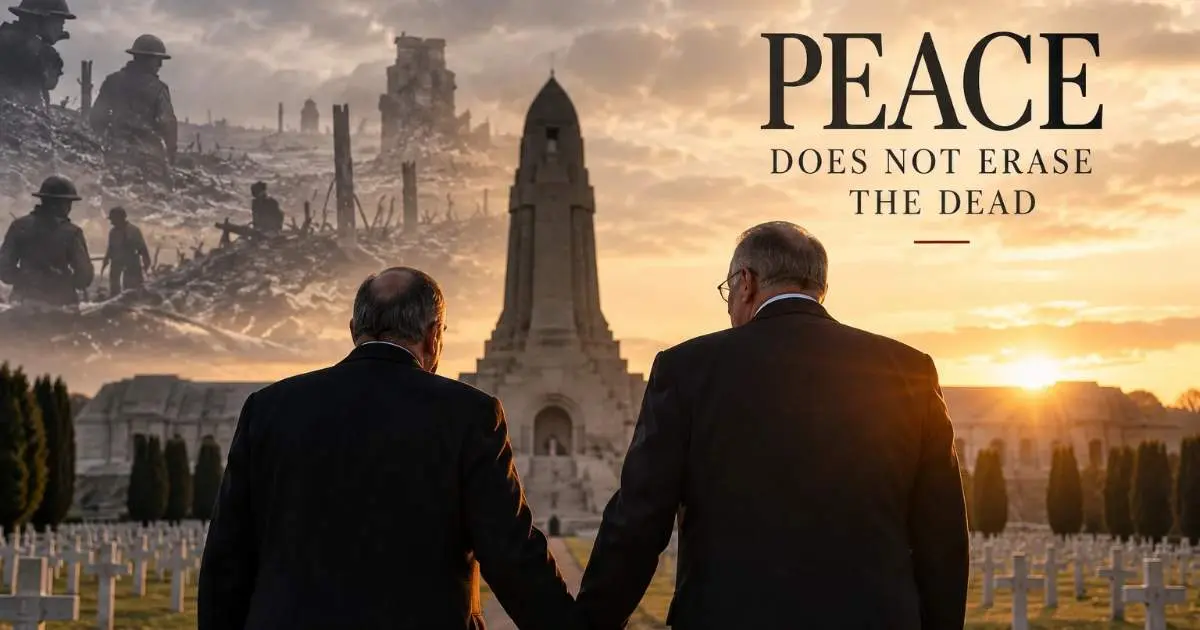
On 22 September 1984, François Mitterrand and Helmut Kohl stood before the ossuary at Douaumont, near Verdun, and held hands. The French president and the West German chancellor had come to a landscape inseparable from the slaughter of the First World War. Their gesture would become one of the defining images of European reconciliation. Yet its setting mattered as much as the gesture itself: the representatives of two states were making friendship visible among the remains of men whose deaths had once sustained the language of national enmity. The ceremony did not remove the graves from politics. It gave them a different political purpose.
There is no reason to begrudge that purpose. A Europe capable of reconciliation was an achievement, and a joint act of mourning could honour the dead more generously than another rehearsal of hostility. The difficulty begins when we ask who may decide what such deaths now mean. Governments negotiate treaties, but they also offer accounts of sacrifice: why it was necessary, what it accomplished, which obligations it leaves behind. When a former enemy becomes a partner, these accounts must accommodate a future that wartime language often excluded. The resulting dispute concerns more than the accuracy of remembrance. It concerns whether respect for the dead grants political leaders the authority to settle arguments that the dead can no longer enter.
The Making of a Former Enemy
France and Germany offer a particularly powerful example because their reconciliation required far more than a change of diplomatic vocabulary. The wars of 1870–71, 1914–18 and 1939–45 belonged to different political orders and arose from different circumstances; treating them as episodes in an uninterrupted quarrel between two timeless national characters would reproduce the mythology that reconciliation helped dismantle. Nor was the Federal Republic simply Hitler’s Germany with a revised foreign policy. Nazi Germany had been defeated and occupied. The West German state established in 1949 rested on a new constitutional order, while Germany itself remained divided. Any account of the subsequent partnership has to take those transformations seriously.
The emerging Cold War created powerful incentives for cooperation, but incentives alone could not guarantee that another generation would avoid war. Robert Schuman’s declaration of 9 May 1950 therefore proposed a material intervention: French and German coal and steel production would be placed under a common authority, within an arrangement open to other European countries. The industries that had helped furnish the means of war would become the basis of a shared institution. The treaty establishing the European Coal and Steel Community was signed in April 1951 and entered into force in July 1952. Peace was being built into the organisation of economic power, rather than entrusted entirely to the goodwill of whoever next held office.
Other arrangements followed. West Germany joined NATO in 1955; the Élysée Treaty of January 1963 formalised Franco-German consultation and cooperation, including in defence, education and youth affairs. These were distinct projects, shaped by strategic calculations as well as the desire to overcome the past. Together with exchanges beyond government, they gave partnership practices and constituencies that could outlast an individual leader. By the time Mitterrand and Kohl stood at Douaumont, their countries had shared institutions for decades. The famous photograph records an important stage in making an established relationship emotionally intelligible; it does not capture the instant at which hostility became peace.
That gap between an institutional agreement and a convincing public account of the past deserves attention. An alliance can function before former enemies agree on how to mourn together. Trade, military planning and ministerial consultation require commitments that can be written down; public recognition involves loyalties that cannot be transferred by signature. Verdun offered a setting in which leaders could acknowledge suffering on both sides without explaining every difference between the wars their countries had fought. That made the gesture possible and moving. It also left unresolved a harder problem: how far could a language of common loss travel into a history containing occupation, persecution and organised extermination?
What Peace Does to Sacrifice
Much of this difficulty arises because commemoration joins together three judgments that need to remain distinguishable. One concerns the person who died: a life, a family, an act of courage, perhaps a conscript with very little choice. Another concerns the war: its purposes, conduct and consequences, and the decisions that exposed people to death. The third concerns the future: what relations the living should have with those once fought. Respect for a person does not settle the second judgment, and neither judgment automatically settles the third. A defensible war need not establish an obligation of permanent hostility. An indefensible war need not make every bereaved family unworthy of compassion.
Mitterrand addressed this problem explicitly at the Normandy commemorations of June 1984, a few months before the handclasp at Verdun. He described the wartime enemy as the regime, system and ideology that had taken possession of Germany, and acknowledged the German resistance. This account gave political form to a real distinction between the Nazi state and a later democratic partner. It allowed recognition of a former enemy’s dead to coexist with honour for those who had fought Nazism. The formulation was also a choice about how to tell the history: the regime became the central object of judgment, while national identity ceased to carry an accusation into the future. It offered reconciliation a basis more demanding than the suggestion that everyone had suffered and should move on.
Governments have a stake in joining those judgments, because respect for sacrifice lends political decisions an authority they would otherwise have to earn. A ceremony usually offers a compressed explanation, more reassuring than an inquiry into competing motives or avoidable losses. The phrase “not in vain” can mean that a person’s courage deserves remembrance, that a military objective was justified, or that a later settlement has redeemed the cost. Those meanings are far from interchangeable. Once they merge, a dispute over policy can be presented as an insult to the dead. Leaders acquire protection from criticism through the suffering of people who may have had no meaningful influence over the decisions being defended.
Peace creates both an opportunity and a temptation within this arrangement. It can release the living from an inherited obligation to hate, allowing them to recognise humanity across a former front. It can also invite a government to present its latest policy as the fulfilment of sacrifices made under quite different expectations. Such an interpretation may be persuasive: the security of future generations can give a defensible meaning to an earlier struggle. It remains an interpretation, however, rather than something that a battlefield has authorised. The dead cannot collectively approve a treaty, disapprove it, or confer ownership of their intentions on a successor administration.
There is no honest alternative in which the past keeps one fixed meaning forever. Historical knowledge changes, testimony emerges, and a society can come to understand an earlier war more fully. The issue is the freedom to examine the relationship between sacrifice and policy. A veteran may support reconciliation while disputing the ceremony chosen to represent it; a bereaved family may honour a relative while questioning the command that sent them into danger. These positions do not become contradictions merely because a government prefers a simpler account. A public capable of holding them together has more room for both historical judgment and peace.
The Past Friendship Tried to Edit
The conflict between a useful partnership and an inconvenient past became unusually concrete in 1956, when Alain Resnais’s Night and Fog was removed from the official competition at Cannes. The documentary confronted the Nazi concentration-camp system through archival material and footage of its aftermath, with a text by Jean Cayrol, a survivor of Mauthausen. West German diplomatic intervention helped bring about its exclusion. The stated concern was that showing the film would damage Germany’s relations with other countries and stir hostility towards Germans. French authorities accommodated the objection; following the controversy, the film was shown outside the competition.
Yet the diplomatic intervention was not the film’s first encounter with censorship. French authorities had already objected to an archival photograph showing a French gendarme at the Pithiviers internment camp, one of the sites involved in the deportation of Jews from France. His distinctive uniform made French participation visible within a history that postwar national remembrance often preferred to associate primarily with German responsibility. The film’s producers were pressed to alter the image, and the gendarme’s recognisable képi was ultimately concealed behind a painted beam. The alteration did not change the historical fact, but it made evidence of French involvement less immediately visible to the audience.
The two interventions exposed different political sensitivities around the same film. West German officials feared that confronting Nazi crimes on an international stage might damage the standing of a democratic Germany seeking acceptance among its neighbours. French authorities had reason to fear a different consequence: that viewers would be reminded of the part played by French institutions in persecution and deportation. Neither concern required denying the existence of the camps. Both involved decisions about which aspects of their history could be made visible without disturbing a more convenient account of the present.
A documentary could be treated as unsuitable for a prestigious international occasion because its visibility might disturb a developing relationship. A uniform could be hidden because its visibility disturbed a national narrative. These were different forms of interference, but each placed political conditions on the public encounter with historical evidence. The record itself was not erased, while its presentation and access to an influential public stage became subject to institutional convenience. Governments did not need to command everyone to forget if they could make difficult remembrance appear either misleading or untimely.
The German objection met resistance in France and West Germany. In the Frankfurter Allgemeine Zeitung, Karl Korn criticised the intervention, stressing that the film did not equate an entire people with the perpetrators of camp crimes. Cayrol likewise challenged a measure that obstructed a common protest against the extermination of human beings. Their position exposed a flaw in the diplomatic defence: if the new Germany was genuinely different from the Nazi state, evidence of Nazi crimes need not constitute an attack on it. Refusing that distinction made the past more dangerous to the present than it needed to be. The critics were defending the possibility of solidarity grounded in recognition, rather than demanding the perpetuation of national hatred.
The controversy therefore belongs inside the history of reconciliation, not outside it as an embarrassing interruption. It reveals rival ways of making friendship possible. One sought to manage the exposure of painful history; another insisted that honest exposure could establish the moral basis of a new relationship. The earlier French censorship added another complication: the governments seeking reconciliation were not necessarily free of their own reasons to manage what the public remembered. The outcome also demonstrates that neither government could simply dictate the meaning of the past to its citizens. Journalists, writers and survivors contested the terms under which cooperation would proceed. They identified a condition that remains relevant wherever states invoke peace to discourage scrutiny: a relationship becomes weaker when its participants must continually protect it from established facts.
Bitburg and the Limits of Shared Mourning
Nearly three decades later, the argument returned in a more explosive form. On 5 May 1985, Ronald Reagan and Kohl visited a military cemetery at Bitburg that contained the graves of Waffen-SS members. Reagan also visited Bergen-Belsen that morning, and his subsequent speech acknowledged the evil of Nazism while presenting the American alliance with democratic West Germany as evidence that wartime sacrifices had served a lasting purpose. He asked that German military dead be mourned as human beings destroyed by a vicious ideology. The visit brought into one ceremony claims that could each seem reasonable in isolation, but whose combination raised a serious question about what official honour was being extended, and to whom.
There were real reasons to resist a blanket judgment on everyone buried in a German military cemetery. Individual responsibility cannot reliably be established from a headstone; age, coercion, conduct and opportunity mattered. Families had lost people whose lives could not be reduced to the purposes of the regime they served. Yet acknowledging those complications did not settle the appropriateness of this particular presidential visit. A private act of grief and an international ceremony carry different kinds of authority. When the American president joined the German chancellor at a site containing Waffen-SS graves, the ceremony risked obscuring the difference between compassion for a dead individual and public recognition of military service under a criminal regime.
Kohl’s brother had been killed at eighteen; his own sons were soldiers in the postwar army. Defending Bitburg in TIME, he asked what young West German servicemen should think if the wartime dead were remembered without due respect. He linked the dispute to contemporary conscripts’ sacrifices and West Germany’s defence of the Western alliance. He was asking the old graves to help sustain the confidence of a new army, whose political order and obligations were profoundly different from those under which the buried men had served.
The Holocaust survivor Elie Wiesel rejected the chosen ceremony without rejecting that partnership. Receiving the Congressional Gold Medal at the White House on 19 April, he explicitly supported reconciliation with Germans and rejected collective guilt for their children. His objection concerned a cemetery containing SS graves. “Your place is with the victims of the SS,” he told Reagan. Those positions belonged together: citizens of postwar Germany could be free of inherited guilt while the history of Nazi institutions remained indispensable to deciding whom a state ceremony should honour. Wiesel’s intervention denied the premise that a friend must demonstrate friendship by accepting whatever symbolic recognition another government requests.
A different possibility became visible when François Hollande and German president Joachim Gauck visited Oradour-sur-Glane in September 2013. The site commemorates the civilians massacred by a Waffen-SS unit in June 1944, and survivors participated in the visit. Hollande’s speech made acknowledgment of the atrocity a foundation of reconciliation. That ceremony did not need to distribute responsibility evenly to allow both presidents to stand there. It could recognise the descendants of former enemies as partners precisely because the historical crime remained identifiable. Bitburg and Oradour show why shared mourning cannot be assessed simply by counting the nationalities present: its moral force depends on what the occasion allows participants to acknowledge.
Peace Without a Shared Victory
Egypt’s October 1973 war produced a different relationship between sacrifice and peace. Six years after Israel occupied Sinai, Egyptian forces crossed the Suez Canal and breached the fortified line on its eastern bank. The crossing altered the military and political position created by the earlier defeat, but it did not produce the complete battlefield recovery of Sinai. Israeli forces subsequently crossed to the western side of the canal, and the war ended after ceasefire resolutions and intense diplomacy. Both the significance of Egypt’s initial achievement and the limits of what the fighting secured matter to understanding the political life the war would acquire.
Anwar Sadat’s journey to Jerusalem in November 1977, the Camp David negotiations in 1978 and the treaty signed in March 1979 turned that military history towards a negotiated settlement. Israel’s principal withdrawal from Sinai was completed in 1982. In this account, war and peace could be presented as connected means of recovering territory and national standing. The soldier commemorated for crossing the canal did not have to become a figure whose achievement the treaty repudiated. Diplomacy could instead be represented as securing what the war had made possible. This was a different task from the European construction of shared mourning: the agreement did not require Egypt and Israel to describe the war as a common tragedy or to accept a common account of victory.
Sadat’s own words also complicate a simple story in which an eternal enemy suddenly became acceptable. Addressing the Knesset in 1977, he recalled an Egyptian peace initiative from February 1971, before the October war, and invoked bereavement in both Arab and Israeli families. He spoke of the mothers, wives and children for whom military loss was a human catastrophe, while arguing for a settlement that included Palestinian rights. His speech made peace an answer to death and insecurity, rather than an admission that all earlier Egyptian purposes had been fraudulent. Whatever judgment one reaches about his settlement, its origins cannot be explained by assuming that he had always regarded negotiations as an unthinkable betrayal.
The war’s official meaning survived successive presidencies through deliberate work on commemoration. In State, Memory, and Egypt’s Victory in the 1973 War, Mustafa Menshawy examines its construction and reconstruction under Sadat, Hosni Mubarak and their successors, drawing on material including newspaper archives, textbooks and memorials. In October 2025, more than half a century after the fighting, President Abdel Fattah el-Sisi again invoked Sadat as the “Hero of War and Peace”. The title accommodates a change of policy within a continuing account of national achievement. A leader can honour the war while endorsing peace with the state against which it was fought; neither commitment has to disqualify the other.
Such continuity has a political value extending beyond relations with Israel. It allows successive leaders to inherit the prestige of a military achievement without inheriting an obligation to resume the war. But a battlefield achievement establishes no permanent right to exercise political power. The courage of soldiers crossing the canal cannot certify the judgment of every later commander, or settle the proper role of the army in civilian life. Citizens should be able to honour that courage, assess the treaty and examine contemporary authority as distinct acts of judgment. Where criticism of present power is made to resemble contempt for wartime sacrifice, an institution is claiming a mandate far larger than the achievement being commemorated.
The regional consequences prevent this story from ending comfortably at the return of territory. The Camp David framework included proposals concerning Palestinian self-government, but the bilateral treaty did not deliver a comprehensive settlement of the Palestinian question. The distance between the ambitions announced before the negotiations and the agreement ultimately secured deserves particular attention. Speaking before the Israeli Knesset in November 1977, Sadat declared: “I have not come here for a separate agreement between Egypt and Israel.” He warned that peace between Egypt and Israel alone could not establish lasting justice and security in the region while the Palestinian question remained unresolved.
Yet the treaty signed in March 1979 was a bilateral agreement between Egypt and Israel, while the parallel framework concerning Palestinian autonomy failed to produce the broader settlement that had been envisaged. That outcome does not establish that Sadat had secretly intended a separate peace from the beginning, nor does it erase the diplomatic significance of recovering Sinai through negotiation. It reveals a difficulty inherent in political transitions from war to peace: the settlement that governments can achieve may be narrower than the future they invoked to justify seeking it. The promises made during reconciliation become part of its history, and they remain open to judgment even when the treaty itself endures.
Critics of Egypt’s course cannot therefore be understood simply as mourners unable to relinquish hatred; their objections could concern whose security and political rights the peace did, or did not, secure. A settlement can end war between two states while leaving other people exposed to unresolved conflict. Egyptian sacrifice could acquire a persuasive national meaning without supplying a complete regional justification. The distinction matters whenever the success of a treaty is used to close discussion of the people beyond its protections.
A Reconciliation with Borders
In occupied Japan, the United States oversaw demilitarisation, political reform and the creation of a new constitutional order. As the Cold War intensified, American priorities shifted towards economic recovery and Japan’s strategic position in Asia; the occupation’s “reverse course” gave reconstruction and resistance to communism increasing weight. The peace treaty signed in September 1951 entered into force in April 1952. The later partnership emerged from this combination of transformation and strategy. Recognising the strategic calculations does not make the institutional changes imaginary. It does, however, help explain why two governments could establish a durable relationship long before they had found a mutually acceptable way to revisit its most painful sites.
The commemorative language developed on a much longer timetable. Barack Obama’s visit to Hiroshima in May 2016 and Shinzo Abe’s visit to Pearl Harbor that December occurred more than six decades after the peace treaty. At Hiroshima, Obama mourned those killed by the atomic bomb and spoke about the responsibilities created by nuclear weapons. At Pearl Harbor, Abe offered condolences to those who had died in the Japanese attack and affirmed the value of reconciliation. Neither visit delivered a new apology for the act commemorated. An alliance that had long functioned through institutions and strategic commitments could now be represented through reciprocal acts of recognition, without its leaders resolving every historical dispute that surrounded the sites.
It is possible to value that achievement without mistaking it for historical adjudication. A leader’s presence can acknowledge suffering, and a carefully chosen speech can permit descendants of former enemies to hear something previously difficult to say. Such ceremonies cannot by themselves determine whether a military decision was justified, settle responsibility for the conduct of a war, or satisfy every claim for redress. Their strength lies partly in their limited scope. The problem appears when their emotional success is treated as evidence that the wider history has been settled, or when those still asking uncomfortable questions are said to threaten a reconciliation that supposedly speaks for everyone.
At Hiroshima, Obama explicitly named Korean victims and American prisoners of war alongside Japanese civilians. His acknowledgment widened the circle of remembrance beyond the two countries whose leaders stood there. Recognition in a speech nevertheless gives affected communities something different from influence over the terms of a bilateral relationship. The United States and Japan could construct a compelling account of friendship while disputes involving Japan’s imperial rule and wars in Asia remained unresolved for others. Historical-memory disputes involving China and Korea have their own domestic politics, evidence and claims; they cannot be disposed of by a successful ceremony elsewhere. A peace celebrated by two governments acquires no automatic authority to decide how everyone touched by their history must remember it.
Earlier Japanese apologies add another distinction to this history. Official statements by Tomiichi Murayama in 1995 and Junichiro Koizumi in 2005 expressed remorse and apology for colonial rule and aggression; Abe’s 2015 statement reaffirmed earlier government positions while resisting the idea that future generations should be destined to apologise indefinitely. No child acquires personal guilt by nationality. Political institutions nevertheless retain responsibilities that outlast individual officeholders: preserving evidence, recognising victims and addressing claims concerning their predecessors. The end of inherited guilt cannot sensibly require the end of institutional accountability. A bilateral reconciliation may help fulfil some of those responsibilities, but it cannot authorise two governments to declare the concerns of other affected people obsolete.
Those Who Keep the Graves
Governments are prominent actors in these histories, but they are not the only people capable of changing the meaning of a former enemy’s death. At Cowra in Australia, Japanese prisoners attempted a mass breakout in August 1944. More than two hundred Japanese prisoners and four Australian servicemen died. In the following years, local members of the Returned and Services League tended the Japanese graves, and a formal Japanese war cemetery was established in 1964. Remembrance developed through local care as well as official arrangements. The people maintaining the cemetery did not need a comprehensive agreement about Japan’s war to recognise a duty towards those buried near them.
There is a different kind of authority in tending a grave. It can rest on proximity, repeated work and knowledge of a particular place, rather than on the power to give a national account of events. Cowra’s history does not establish that every veteran welcomed reconciliation or that care for enemy graves was free of disagreement. It does show that human recognition could acquire substance outside a summit or presidential speech. A grave could be maintained without making its occupant’s cause admirable; a former adversary’s family could be treated with dignity without requiring the abandonment of historical judgment. These practices helped create a relationship that governments could recognise and develop.
Even the organisation of burial can change who has access to that relationship. In Burying the Enemy, the historian Tim Grady examines the care of German graves in Britain and British graves in Germany, including local connections later disrupted when remains were concentrated in military cemeteries. Consolidation can provide permanent care and make collective remembrance possible. It can also move a grave away from the people who had tended it and place its story within a more standard national framework. Neither consequence proves a malign intention. Together they reveal that decisions about location, custody and presentation affect whose experience becomes visible, even when an institution acts in the name of respectful preservation.
Families and veterans, for their part, do not possess a single interpretation waiting to be recovered by a more sensitive government. Some may welcome an act of reconciliation that others experience as erasure. A relative may insist on the justice of the cause, dispute it, or have little interest in turning private loss into any public lesson. Historians can establish what happened without resolving every moral attachment to it. These differences make it especially important to resist the claim that any speaker has obtained a collective mandate from the dead. A government may organise a ceremony, but it should remain possible to question its account of sacrifice without forfeiting one’s standing as a citizen or one’s right to mourn.
That freedom gives remembrance a practical relationship with the lives still at risk. If honouring a soldier requires accepting every decision that exposed them to danger, mistakes become harder to identify and repeat more easily. If accepting peace requires forgetting who was persecuted, recognition becomes a reward for silence. Conversely, if loyalty to the dead demands perpetual hostility, another generation inherits a duty to suffer for a policy it did not choose. Each of these claims turns an obligation of remembrance into a restriction on judgment. The useful question is what the living may examine after the wreaths have been laid: the purposes of the war, the conduct of institutions, the terms of the peace, and the costs still borne by those outside it.
The handclasp at Douaumont remains moving because it suggests that descendants need not obey every antagonism they inherit. Its promise can endure without making the past less exacting. The dead can be honoured while military decisions are investigated, an alliance can be welcomed while a proposed ceremony is opposed, and former enemies can share a future while responsibility for an atrocity remains unequal. A peace capable of sustaining those distinctions offers something more durable than an official story in which every sacrifice leads conveniently to the present. It gives the living room to care for the dead, learn from the history that killed them, and decide how much of that history they are willing to repeat.