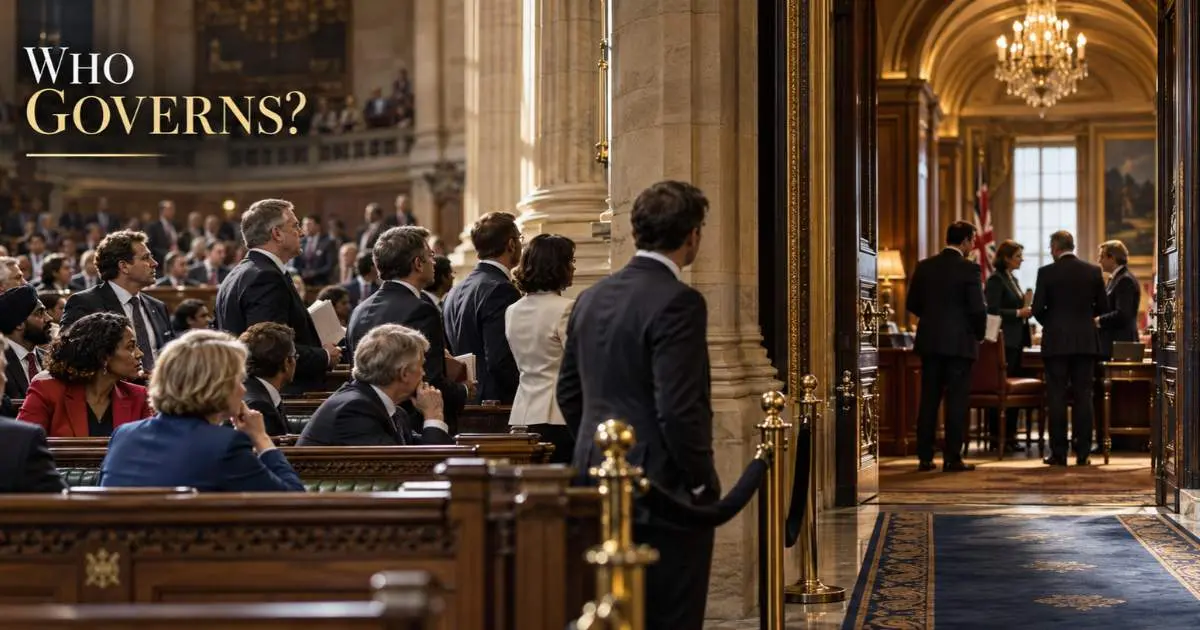
Elections decide who enters parliament. They do not decide who can enter government. Between the ballot box and executive power lies a second, largely invisible political boundary — one that can defend democratic norms while quietly reshaping coalition arithmetic, bargaining power and the meaning of opposition.
The Governing Perimeter: Who Can Turn Parliamentary Seats Into Power?
Election night gives democracy the appearance of completion. Votes are counted, seats are allocated, coloured maps appear on television screens, and commentators begin speaking as though the distribution of political power has been revealed. In a parliamentary system, however, the election has settled only the first question: who has representation. It has not settled the second, which may prove just as important: which combinations of those representatives will be treated as legitimate, tolerable or politically possible foundations for a government.
That second question produces a political map that is rarely printed beside the electoral one. Two parties may possess the same number of seats yet occupy radically different positions within it. One can be welcomed by several potential partners and therefore become indispensable to government formation, while another can command a large bloc of voters but be regarded by every plausible governing party as unacceptable. Both sit in the same parliament, vote on the same legislation and possess the same formal status as elected representatives, yet their seats do not enter coalition calculations in the same way.
The difference is not a defect hidden inside parliamentary democracy. Parties are not obliged to govern with one another simply because voters elected them, and a parliament in which every party could compel every other party into coalition would scarcely be democratic. Political programmes, constitutional commitments, history, personal trust and judgments about whether another party respects democratic rules all legitimately shape coalition choices. Once those choices become durable, however, especially when several parties collectively refuse to govern with one competitor, they create something more consequential than a preference: a governing perimeter, the informal boundary separating parties that can realistically participate in government from those that can win seats but remain outside coalition power. The boundary concerns access to executive coalitions, not the entirety of political influence: parties excluded from cabinet office may still shape legislation, influence government policy or determine whether a government survives.
The governing perimeter is not written into the constitution. It has no fixed threshold, judge or electoral commission, and it may be defended as a moral principle in one country while being treated as ordinary coalition strategy in another. Yet it can transform the meaning of an election because parliamentary democracy translates votes into power twice: first when votes become seats, and again when seats are converted into a viable government. We scrutinize the first translation obsessively; the second often takes place through party congresses, private negotiations, inherited taboos and political promises that receive far less scrutiny.
Majority Compression: What Happens When Coalition Options Shrink?
The arithmetic is deceptively simple. Imagine a parliament of 100 seats in which 51 are required for a majority. If every party is potentially available for coalition bargaining, governments can in principle be assembled from the full chamber. Now imagine that parties holding 30 seats are excluded by all the others from government formation: the constitutional threshold remains 51, no vote has been erased and no seat has vanished, yet those seeking a government without the excluded bloc must now find 51 seats from the remaining 70.
Formally, nothing has changed. Politically, a great deal has. A majority that represents 51 per cent of parliament now requires almost 73 per cent of the seats inside the politically acceptable pool, which can turn previously optional partners into necessary ones. Former rivals may need one another, ideological distances inside governments may widen, and a small party can discover that its bargaining position is much larger than its vote share suggests.
A useful name for this effect is majority compression. Majority compression occurs when the legal majority threshold stays unchanged while the number of coalition-eligible seats shrinks. This is not a universal mathematical law of parliamentary politics: minority governments, abstention agreements, confidence-and-supply arrangements and issue-by-issue support can all soften the effect. Sweden’s long experience with minority cabinets, for example, shows that governments can survive without conventional majority coalitions, but the underlying pressure remains: when some seats become unusable for executive coalition-building, the relative value of other seats can rise.
Political science has long understood that a party’s relevance cannot be measured by seat share alone. Giovanni Sartori distinguished between parties capable of joining coalitions and those whose presence could alter the direction of competition even without entering government, an insight associated with the concepts of coalition potential and blackmail potential. Later scholarship has refined those categories, but the basic point survives: a party can matter because others need it, and it can also matter because others organize themselves against it. The governing perimeter adds another layer by asking not only how much power the excluded party retains, but what its exclusion does to everybody else.
This is where the usual language of political isolation becomes misleading. A cordon sanitaire, firewall or coalition boycott sounds like a wall built around one party. In practice, the wall also rearranges the room outside it, changing the number of viable coalitions, the value of smaller partners and sometimes the ideological breadth required to assemble a government. Exclusion can therefore reduce one party’s access to office while simultaneously redistributing bargaining power among parties that remain eligible.
Political Exclusion and Government Alternation: The Italian Case
The mechanism becomes clearer once it is separated from the politics of the contemporary radical right. Post-war Italy offers a very different case, formed by different ideological fears and an international environment dominated by the Cold War. The Italian Communist Party, the PCI, was not a marginal parliamentary force: it became one of the largest communist parties in the democratic West and won 34.4 per cent of the vote in 1976, close behind Christian Democracy’s 38.7 per cent. Yet after Communist participation in the early post-war governments ended in 1947, the PCI remained outside the cabinet for the rest of the Cold War.
That exclusion cannot be reduced to ordinary coalition preference. Italy sat at the strategic frontier of the Cold War, belonged to NATO and was deeply embedded in a Western international order whose leading powers viewed Communist participation in government with profound concern. Italian parties also had their own ideological, electoral and institutional reasons for resisting a full Communist entry into executive power. The point is not to declare those reasons legitimate or illegitimate from the comfort of hindsight, but to notice what happened to the structure of competition when a party capable of winning roughly a third of the electorate remained outside the ordinary route to cabinet office.
Christian Democracy consequently became something more than a successful governing party. It occupied the centre of a system in which political alternation was constrained because the principal opposition could increase its representation dramatically without easily becoming the government. Governments changed, coalition partners changed and prime ministers changed, yet the basic perimeter around executive power proved much more durable. Parliamentary competition remained real, but the passage from opposition strength to executive replacement was narrower than the electoral map alone suggested.
The system was never perfectly sealed. After the 1976 election, the PCI abstained on crucial confidence votes, allowing Giulio Andreotti’s Christian Democratic minority government to take office, and in 1978 the Communists formally joined the parliamentary majority supporting another Andreotti cabinet while still receiving no ministerial posts. The arrangement demonstrated something that neat diagrams of inclusion and exclusion often miss: the governing perimeter can become porous. A party may be too controversial for cabinet office yet too large to ignore, producing arrangements in which it influences government survival and policy without fully crossing into government itself.
Italian history therefore exposes a broader democratic tension. Representation can expand faster than governability, allowing voters to strengthen an opposition party while leaving the path from electoral strength to executive turnover obstructed by barriers outside the ballot box. Those barriers may be grounded in constitutional fears, geopolitical constraints or anxieties about systemic change, and their justification matters. Their structural effect, however, does not disappear merely because the reasons for maintaining them are serious.
Cordon Sanitaire and Coalition Power: The Belgian Paradox
Belgium provides a different version of the mechanism. After the electoral breakthrough of Vlaams Blok in the late 1980s, five Flemish parties signed a protocol in May 1989 committing themselves not to enter political agreements with the party. The initial agreement did not survive intact: several signatories repudiated it within weeks, and the cordon sanitaire gained renewed momentum after the 1991 elections before being reinforced through further political commitments in 1992. The policy was not concealed as ordinary coalition convenience; it was articulated openly as a response to positions regarded by its supporters as incompatible with democratic principles and human rights. It subsequently became one of Europe’s most durable examples of deliberate political exclusion.
Much public debate around such arrangements asks whether the excluded party benefits electorally from victimhood or whether exclusion prevents normalization. Those are important questions, but they can obscure what happens to everybody else. If a substantial bloc of seats is removed from coalition bargaining, parties inside the governing perimeter must solve government formation with fewer combinations. In a 2006 study published in the European Journal of Political Research, Benny Geys, Bruno Heyndels and Jan Vermeir examined Flemish local coalition formation and found that commitments not to cooperate with Vlaams Blok significantly affected the likelihood of different types of coalitions being formed. The cordon therefore did not merely describe a moral relationship between mainstream parties and the far right; it altered the architecture within which mainstream parties bargained with one another.
This redistribution of leverage can run against the intuition that electoral weight and political power should rise together in a straightforward way. Suppose a small party becomes the final bridge between two larger blocs that refuse cooperation with an excluded competitor. Nothing fraudulent has happened: the small party won its seats legitimately and is entitled to negotiate with them. Yet its bargaining value can become much greater than its raw electoral weight because the alternative paths to a majority have been narrowed by political choice.
The reverse effect is equally important. A large excluded party may acquire no ministers at all while still forcing its opponents into arrangements they would otherwise reject. It can make ideological rivals govern together, encourage unusually broad coalitions or raise the price smaller parties can demand for participation. Exclusion does not abolish the excluded party’s political weight; under some conditions, it converts part of that weight from office power into system-shaping power.
That is not evidence that the excluded party secretly controls the government. Such language would turn a structural argument into conspiracy theory, because the party may hate the resulting coalition, possess no influence over its programme and be unable to obtain a single cabinet portfolio. The point is subtler: its electoral mass changes the set of options available to others. An actor can shape the geometry of political movement without directing the people moving inside it.
When Political Isolation Breaks Down: Sweden and the Cost of Exclusion
No governing perimeter is permanent. Sweden shows how a political boundary that appears stable can gradually become too costly for parts of the system to maintain. When the Sweden Democrats entered the Riksdag in 2010, the established parties initially treated them as outside normal coalition cooperation, disrupting a political order that had long been structured around two competing blocs. Neither traditional bloc could necessarily secure control while simultaneously refusing to rely on the new party.
The response was not immediate inclusion. Swedish parties experimented with minority government, cross-bloc agreements and parliamentary arrangements designed in part to prevent the Sweden Democrats from becoming pivotal. The old centre-right alliance eventually fractured under those pressures, and by 2022 mainstream parties on the right had moved far enough that a Moderate-led minority government could take office with formalized parliamentary support from the Sweden Democrats, even though the party itself remained outside the cabinet. Under the Tidö Agreement, the Sweden Democrats participated in structured policy cooperation and obtained political staff at the Government Offices. The arrangement showed that a party could remain outside ministerial office while gaining substantial influence over government policy.
That evolution reveals why political isolation is better understood as a price than as a switch that is simply on or off. A party can remain outside government while the arrangements required to exclude it become increasingly complicated. At some point, one or more mainstream parties may decide that the policy, electoral or organizational cost of continued exclusion exceeds the cost of cooperation. The threshold at which that judgment changes will differ from one political system to another because electoral rules, party traditions and the availability of minority government all matter.
Austria offers a different warning against assuming that inclusion is a purely domestic calculation. When the conservative ÖVP formed a coalition with the Freedom Party in 2000, the other fourteen EU member states restricted bilateral political contacts with Austria, while European institutions voiced concern that participation by the FPÖ could legitimize the extreme right. Whatever judgment one makes about that response, the episode demonstrated that the governing perimeter can be influenced from beyond parliament itself. A party may be electorally eligible and domestically coalitionable while international allies, neighbouring governments or institutions increase the political cost of bringing it into power.
The governing perimeter, then, is not drawn by a single hand. Voters determine parliamentary strength, parties determine whom they will negotiate with, constitutional rules shape what kind of government can survive, history influences what forms of cooperation are considered tolerable, and external actors can change the price of inclusion. Executive possibility emerges from their interaction rather than from election results alone.
Can Exclusion Strengthen Permanent Opposition?
Exclusion creates another potential asymmetry, though it should not be treated as an automatic law. Governing parties eventually collide with reality: they must fund promises, negotiate budgets, administer public services, respond to crises, compromise with partners and explain why slogans that worked in opposition cannot always survive contact with institutions. Government converts ideological certainty into trade-offs, and trade-offs have electoral costs.
A party that remains outside the governing perimeter for a long time can escape part of that test. It can condemn budgets without writing one, promise incompatible constituencies different things without having to reconcile them inside the same fiscal framework, and blame compromises on an establishment from which it is structurally absent. If nearly every other significant party eventually participates in government or supports one, the outsider may acquire an additional political asset: it can present itself as the only force untouched by responsibility for the system’s failures.
That possibility is real, but the apparently obvious prescription — let the party govern and voters will discover what it is — is not supported by any universal rule. Government can expose contradictions and impose responsibility, but it can also confer legitimacy, administrative resources, visibility and influence over institutions. Comparative research on radical-right parties has not produced a simple law according to which inclusion reliably moderates them or destroys their electoral appeal. The consequences depend on the party, the coalition, the institutions and the political environment.
Exclusion therefore confronts democratic systems with a genuine trade-off rather than a clever tactical solution. Keeping a party outside office may protect institutions from actors that other parties sincerely judge dangerous, yet it may also preserve that party’s identity as a permanent outsider and force its competitors to bear the costs of governing among themselves. Inclusion can impose responsibility and widen coalition options, but it can also normalize positions previously considered incompatible with democratic standards. Neither strategy carries a guarantee.
The error lies in pretending that exclusion removes the underlying political problem. It does not. It relocates the problem into coalition formation, opposition politics, bargaining power and the distinction between being represented and being considered fit to govern. A wall can block one path while redirecting political pressure through several others.
Representation, Government and Democratic Legitimacy Are Not the Same
Arguments about exclusion often deteriorate because two different democratic principles are treated as though one must cancel the other. Supporters of an excluded party may claim that refusing to place it in government “ignores” its voters. That is usually false: parliamentary elections award representation, not an automatic entitlement to ministerial office, and a party with the largest plurality has no democratic right to govern if other representatives can form a legitimate alternative majority.
Defenders of exclusion sometimes make the mirror-image mistake. Because an alternative coalition is constitutionally legitimate, they assume that exclusion has no democratic consequences worth discussing. That is also too simple, because a coalition can be perfectly lawful, command a parliamentary majority and still emerge from a political structure in which large portions of the electorate repeatedly strengthen parties that remain outside the governing perimeter. Legality settles whether a government may govern; it does not settle every question about how political competition evolves when access to executive office becomes persistently asymmetric.
Representation, government and democratic legitimacy overlap, but they are not identical. Representation asks whether citizens can translate votes into seats, while government formation asks whether elected actors can construct an executive capable of surviving parliament. Democratic self-defence asks yet another question: whether parties committed to constitutional democracy are obliged to cooperate with actors they believe would weaken it. Treating these as one question produces slogans; separating them reveals the real dilemma.
The distinction becomes especially important when exclusion is justified in defence of democracy itself. Liberal democracies are not required to remain indifferent toward movements that seek to hollow out independent courts, eliminate political competition or deprive minorities of basic rights. Constitutional orders may legitimately protect the rules that make future democratic choice possible, but democratic self-defence remains a political intervention with downstream effects. A wall can be justified and still cast a shadow across the system it protects.
Calling attention to that shadow is not an argument for tearing the wall down. It is an argument against pretending that the wall stands outside the political system whose incentives and possibilities it changes. Democratic defence becomes intellectually weaker, not stronger, when its costs are treated as unspeakable.
Informal Coalition Rules: The Unwritten Constitution of Government Formation
Constitutions tell us who may vote, how seats are allocated, how governments receive confidence and how they can be removed. They rarely tell us which democratically elected parties other parties should consider morally eligible for coalition. That decision belongs largely to political judgment, which means that a crucial part of executive access is governed by norms that can be powerful without possessing formal legal status.
Over time, those norms can begin to resemble an informal constitution of government formation. Politicians know which combinations will provoke internal revolt, donor withdrawal, international alarm or accusations that a democratic boundary has been crossed. Journalists learn to classify some coalitions as plausible and others as unthinkable before negotiations even begin, while voters absorb the same expectations and may cast ballots knowing that one party can realistically lead a cabinet while another, perhaps equally large, cannot.
This does not make the unwritten rule illegitimate. Political systems could not function if every norm required constitutional codification, and coalition commitments are themselves part of democratic competition. The distinction between written and informal rules matters because informal barriers are harder to see and measure: an electoral threshold of five per cent is visible before anyone votes, while a governing perimeter may change through speeches, party congress resolutions, personal promises and gradual normalization without any formal alteration to the constitutional order.
That invisibility can obscure how much power is being redistributed. When an excluded party grows, attention naturally focuses on whether the barrier will hold. Yet the more revealing question may be what holding it requires from everyone else. If former enemies must cooperate, if small bridging parties gain disproportionate leverage, if opposition becomes concentrated in the excluded bloc or if government alternation becomes more difficult, those effects are not incidental to the political arrangement; they are part of the system the arrangement helps produce.
Majority compression gives those effects a common language. It does not tell us whether an exclusion is morally right or politically wise, and it should not be used as a mathematical slogan pretending that all parliamentary systems behave alike. It identifies a recurring pressure: when moral or strategic boundaries remove coalition options, those boundaries eventually enter parliamentary arithmetic. Political principles can therefore appear downstream as cabinet size, coalition breadth, bargaining leverage and changes in the range of governments voters can realistically produce.
How Should Political Exclusion Be Measured?
A cordon sanitaire is usually judged by a straightforward criterion: did the excluded party enter government? If it did not, the policy appears to have succeeded. That measure is understandable but incomplete because it examines the boundary crossing while ignoring the political system that may have been reorganized to prevent it.
A successful exclusion policy can coexist with a growing excluded party, increasingly broad coalitions or a concentration of anti-establishment voting outside the governing perimeter. None of those outcomes proves that exclusion caused the problem; economic shocks, migration, cultural conflict, institutional distrust, leadership failures and media change may matter far more. The causal relationship must be demonstrated rather than assumed, but the systemic consequences should not be dismissed simply because the formal objective — keeping the party out of the cabinet — was achieved.
The opposite measurement error occurs when critics point to electoral growth and declare that the cordon therefore failed. Exclusion may have purposes other than reducing a party’s vote share. Its objective may be to prevent access to ministries, security services, public appointments or executive instruments that established parties believe should not be entrusted to a particular movement. A barrier can therefore fail electorally while succeeding institutionally, just as it can succeed institutionally while creating substantial coalition costs.
A serious analysis requires more than asking whether the outsider gained or lost votes. It should examine what happens to the excluded party, what happens to coalition bargaining among the included parties, what happens to the possibility of alternation in government and what happens to voters’ ability to identify a governing alternative distinct from the incumbent bloc. These effects may move in different directions at the same time, which is precisely why the politics of exclusion has no single scoreboard.
Who Decides Which Parties Are Fit to Govern?
The most uncomfortable feature of the governing perimeter is also one of its most democratic characteristics: in most parliamentary systems, nobody possesses exclusive authority to draw it. Party leaders make commitments, but members can reverse them; voters punish or reward cooperation; and electoral arithmetic can turn yesterday’s impossible coalition into tomorrow’s only workable one. Courts may define constitutional limits on parties themselves, yet ordinary coalition eligibility usually remains political rather than judicial.
That diffusion of authority protects against a single institution deciding who is “allowed” to govern. It also means that the boundary can be defended without anyone fully accepting responsibility for its systemic effects. Each party may say, reasonably, that it is merely exercising its own freedom of association, yet when several parties make the same choice over many elections, their individually legitimate decisions can collectively restructure the route from representation to executive power.
The mechanism is not peculiar to radical-right parties, nor even to Europe. Any political system in which major parliamentary actors are persistently treated as coalition-ineligible can produce a gap between the representative map and the governing map. The reasons may be democratic self-defence, ideology, religion, ethnic conflict, constitutional loyalty, foreign alignment or memories of authoritarian rule. Those reasons matter morally and historically, and comparing cases does not make them equivalent; the common mechanism lies only in what exclusion does to the set of governments that can realistically be formed.
That distinction allows a more courageous discussion than the habitual argument over whether a particular cordon should survive. A democracy may have compelling reasons to exclude a party and still owe itself an accounting of the political order that exclusion creates. If maintaining the boundary requires permanent grand coalitions, makes small parties structurally indispensable, protects the outsider from governing responsibility or makes alternation increasingly difficult, those costs should be acknowledged rather than rhetorically denied. Democratic principles are not strengthened by pretending that they are free of political consequences.
From Representation to Executive Power
Modern democracies devote enormous attention to the integrity of elections, and rightly so. We argue over district boundaries, campaign finance, voter suppression, media manipulation and electoral thresholds because the translation of citizens’ preferences into representation must remain credible. Yet the next translation — from representation into governing possibility — receives far less scrutiny even though it can determine who exercises executive power for years.
The governing perimeter gives that hidden stage a name. It is not a conspiracy, a constitutional loophole or evidence that excluded voters somehow do not count. It is the political boundary produced when parties decide that some representatives may participate fully in parliament but should not participate in the executive coalition, and that boundary may sometimes protect democratic institutions from movements hostile to their foundations. It may also become a convenient shield for established parties unwilling to confront why an excluded force continues to grow, and in practice principle and self-interest may coexist.
What cannot be sustained is the comforting idea that exclusion simply removes a party from the equation. Its seats remain, its voters remain and the majority threshold remains; what changes is the route by which everybody else must reach that threshold. The larger the excluded bloc becomes, the more consequential that altered route can become, and the more a political system may find itself organized around a party that never enters the government it helps to shape.
Parliamentary democracy therefore contains two boundaries that should never be confused. The first determines who may enter representation and is drawn through law and elections, while the second determines who can plausibly enter government and is drawn through political judgment, history, strategy and fear. A democracy may have defensible reasons for drawing that second line, but it cannot draw it without consequences. The ballot decides who enters parliament; politics still decides how much of parliament can become power.