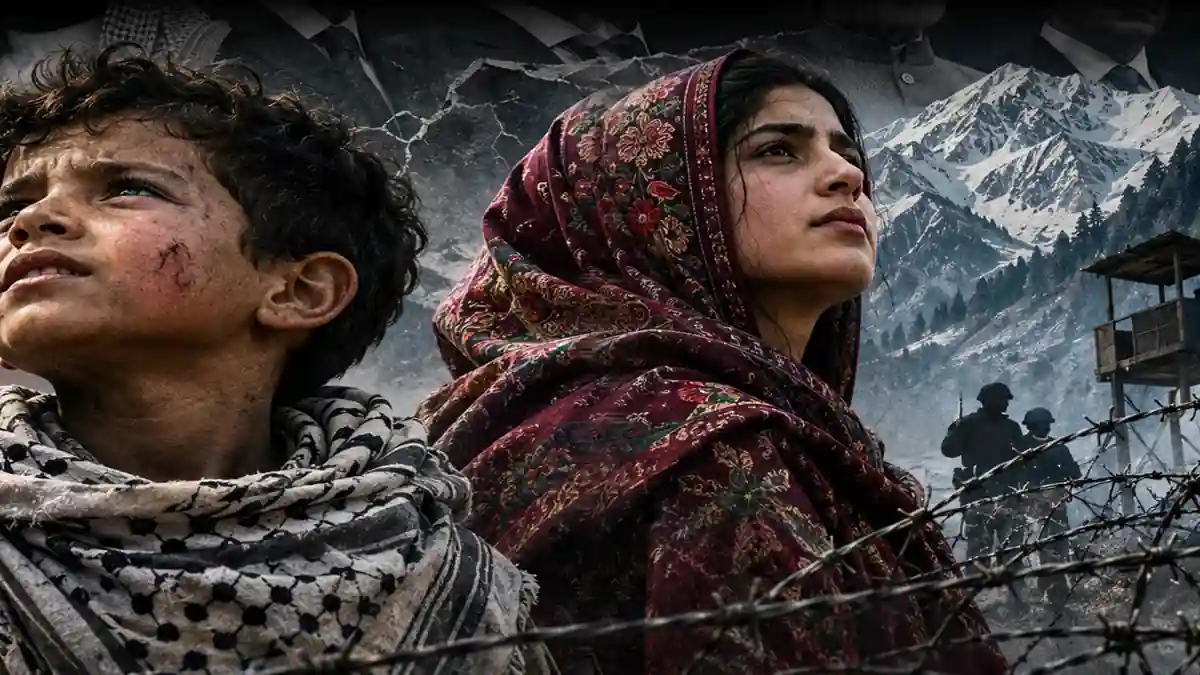
Saudi Arabia, Türkiye and Pakistan have pledged collective defence while maintaining relationships that cross their supposed strategic divisions. Gaza and Kashmir expose the question beneath these arrangements: who can turn solidarity into a commitment, who can demand that it be honoured, and who bears the cost when governments preserve their freedom to choose?
In September 2026, a journalist asked Pakistan’s Foreign Ministry whether the Makkah Joint Defence Agreement could be used to threaten Israel over an anticipated attack on Palestinians. The question connected two promises that official diplomacy usually discusses separately. Only weeks earlier, Pakistan, Saudi Arabia and Türkiye had signed an agreement treating an armed attack against one member as an attack against all three. Could that newly formalised solidarity offer protection beyond its signatories?
The spokesperson did not announce that the agreement would be invoked. Instead, he reaffirmed Pakistan’s support for Palestinian statehood, humanitarian assistance and opposition to Israeli military action. In the ministry’s published transcript, he also linked Palestine and Kashmir as enduring concerns of Pakistani foreign policy. The answer left a revealing distinction intact: the three governments had organised their own collective defence, while Palestinians remained the beneficiaries of a different set of commitments.
There was no contradiction in the agreement’s territorial scope. Palestine was not a party to it, and military escalation would not necessarily improve civilian protection. The important difference concerned the means through which a promise could become action. Governments could negotiate defined beneficiaries, coordinating bodies and procedures for their mutual security. People outside that arrangement had much less influence over how support offered in their name would be delivered.
The comparison cannot be explained through an Islamic alliance confronting an Indian–Israeli axis. Saudi Arabia maintains substantial relations with India; Türkiye pursues security objectives extending far beyond Pakistan; and India’s Gulf relationships connect energy, employment, trade and investment to its foreign policy. These overlapping interests give governments room to manoeuvre. They also allow commitments to coexist for long periods without resolving what happens when honouring one would require sacrificing another.
Gaza makes that postponement especially consequential. The issue is how governments use the influence they possess, what costs they accept and whose claims can constrain their decisions. The distinction between a promise and an obligation becomes most visible when the people depending on it cannot require the government making it to act.
The Treaty That Gave Solidarity an Institution
On 17 September 2025, Saudi Arabia and Pakistan signed a Strategic Mutual Defence Agreement, giving a more explicit form to a military relationship developed over decades. The agreement strengthened their declared commitment to mutual security. It did not, by itself, establish the operational terms of a Pakistani nuclear guarantee: possession of nuclear weapons, a defence commitment and an agreed plan for nuclear retaliation are separate matters.
The framework widened on 7 August 2026. At a summit in Makkah, Saudi Crown Prince Mohammed bin Salman, Turkish President Recep Tayyip Erdoğan and Pakistani Prime Minister Shehbaz Sharif signed the Makkah Joint Defence Agreement. The joint announcement connected collective security with historical ties, shared strategic interests, brotherhood and Islamic solidarity. Its central defensive provision identified three states whose protection was being pledged.
That limitation was essential to the arrangement. Brotherhood described a wider community of identification; the agreement specified the governments undertaking reciprocal commitments. Deterrence requires some clarity about whom a pledge protects. The political question arises when the wider vocabulary supplies legitimacy and public enthusiasm while the enforceable bargain has narrower beneficiaries.
The parties also began organising cooperation. Their foreign and defence ministers and senior military representatives convened in Istanbul on 31 August through the Strategic Political and Defence Committee. Pakistan subsequently announced plans for a secretariat in Saudi Arabia. These were identifiable institutional steps, although announcements about future machinery should not be confused with evidence that every component was already functioning.
In November 2026, Türkiye’s parliament approved the agreement by 279 votes to 119. Opposition legislators warned about involvement in regional wars; government representatives maintained that troop deployments would require separate parliamentary authorisation. The debate demonstrated that a collective-defence pledge does not remove domestic procedures or settle every operational decision in advance.
A defence treaty, a legal duty and a discretionary policy are different kinds of commitment. Duties arising under international humanitarian law do not depend on alliance membership, although their scope varies with a state’s role and conduct. The relevant questions are who can require action, which resources have been committed, what triggers a decision and what consequences follow if an undertaking is abandoned. Those questions apply to aid, economic restrictions and export licensing as well as to military arrangements.
Solidarity acquires political weight when it changes decisions that would otherwise remain entirely at the promisor’s discretion. Institutions cannot guarantee that a commitment will be honoured, but they can identify who must answer for its abandonment. People offered support without comparable procedures depend much more heavily on governments continuing to find that support expedient.
Gaza and Kashmir Are Not Interchangeable Causes
The diplomatic connection between Palestine and Kashmir predates the Makkah agreement. Pakistan has repeatedly presented both through the language of self-determination, while Türkiye has supported Pakistan’s position on Kashmir and Palestinian statehood. These connections allow governments to seek reciprocal support across disputes. They can also obscure the differences between the populations whose claims are being joined.
The Palestinian question concerns dispossession, occupation, national self-determination and the prolonged denial of sovereign statehood. Kashmir’s modern dispute emerged from the partition of British India, competing territorial claims and war. Parts of the former princely state are administered by India, Pakistan and China; the comparison here concentrates on the India–Pakistan dispute. The histories, legal instruments, political organisations and distributions of power are different, even where governments use a shared vocabulary to discuss them.
Treating Palestinians and Kashmiris as equivalent pieces in an international argument risks reproducing the problem supposedly being criticised. Palestinians have their own institutions, political claims and internal disagreements. Kashmiris are likewise divided by geography, political preference and the authorities under which they live. Neither population can be adequately represented by whichever government most frequently speaks in its name.
The UN human rights office’s 2019 report on Kashmir examined abuses and restrictions involving Indian security forces, armed groups and authorities in Pakistan-administered areas. Its concerns included civilian harm, accountability and restrictions on political freedoms. The different forms and scale of those concerns should be examined on their evidence; the existence of criticism on both sides does not make their conduct identical.
India’s removal of Jammu and Kashmir’s special constitutional status in August 2019 introduced another transformation. New Delhi defended the change through integration and development, while the UN human rights office raised concerns about restrictions preventing residents and their representatives from participating fully in debate over their future. Claims made on behalf of a territory could thus coexist with limits on the political agency of its inhabitants.
The violence of April and May 2025 exposed another danger. Gunmen killed 26 people near Pahalgam in Indian-administered Kashmir. India accused Pakistan-linked militants and launched strikes; Pakistan denied responsibility for the attack. Fighting between the two nuclear-armed states continued for four days before the ceasefire announced on 10 May. The Stimson Center’s reconstruction separates the observable sequence from competing claims about military success.
The victims of the attack, families affected by security restrictions and civilians exposed to cross-border fighting were not abstractions in a contest over strategic credibility. The legitimacy of a political cause does not excuse attacks on civilians. Nor does the conduct of armed groups extinguish governments’ obligations towards the population among whom those groups operate.
The comparison with Gaza is therefore most useful when it examines how states treat rights they claim to defend. Pakistan can invoke self-determination while facing questions about political freedoms in territory it administers. India can protect its citizens against terrorism while remaining accountable for the conduct of its security forces. Governments supporting Palestinians must likewise be assessed through their decisions and effects, rather than awarded moral authority simply for adopting the cause.
A cause does not become more just because a powerful government supports it. Its claim to justice also survives that government’s inconsistencies. The people concerned have rights that cannot be made conditional on the diplomatic usefulness of their suffering.
India and Israel: What the Weapons Relationship Reveals
India’s military partnership with Israel is often interpreted principally through its rivalry with Pakistan. That relationship is substantial, but India’s policy also includes a long history of support for Palestinians. Its official diplomatic record identifies recognition of the Palestine Liberation Organization in 1974 and the State of Palestine in 1988. Full diplomatic relations with Israel followed in 1992.
Indian assistance to Palestinians has included technical cooperation, development and educational support. These are institutional activities, not merely phrases in speeches. Their existence makes the accountability question more precise: whether one part of government can assist a population while another sustains transactions that may increase risks to that population, and what happens when evidence brings those activities into conflict.
The defence relationship continued to deepen. On 4 November 2025, Indian and Israeli officials signed a memorandum covering industrial cooperation, research, advanced technologies, artificial intelligence and cybersecurity. The Indian Ministry of Defence’s announcement described a long-standing partnership and plans for co-development and co-production. This cooperation had its own bureaucracies, technical programmes and commercial constituencies.
India has reasons to seek advanced military capabilities, including its disputes with Pakistan and China and the limitations of domestic production. Those considerations help explain procurement decisions. They do not settle every question about the consequences of sustaining a particular supplier or approving a particular export.
A separate issue concerns military goods moving in the opposite direction, from India to Israel. In July 2026, Amnesty International reported identifying at least 2,596 shipments of arms, ammunition, parts and components between 7 October 2023 and 30 November 2025. Its investigation used shipment-level trade data and identified transactions involving Israeli defence companies and Indian suppliers, including state-owned companies. Amnesty, which describes Israel’s campaign in Gaza as genocide, warned of potential complicity.
Those findings require attention to what the evidence establishes. A shipment record does not by itself prove use in a particular attack. Different goods, recipients and supply arrangements require examination. But the absence of proof linking every consignment to a specific strike cannot answer the separate question of whether credible risks should have changed licensing decisions before further supplies were authorised.
The legal distinctions matter. In 2024, the International Court of Justice ordered provisional measures in South Africa’s case against Israel under the Genocide Convention. The orders were binding on Israel; they were not a final judgment that genocide had occurred, nor did they themselves impose a general arms embargo on third states. An exporting state’s preventive duties, possible responsibility for assisting unlawful acts, and any liability of firms or individuals involve different legal tests. Applicable law and evidence—including knowledge, the goods supplied and their anticipated use—must be examined separately.
The attacks by Hamas and other armed groups against civilians on 7 October 2023 also belong within this assessment. Protecting civilians in Israel is a legitimate objective, subject to the rules governing how force is used. It cannot confer immunity on subsequent military conduct or remove the need to scrutinise the assistance through which operations are sustained.
India’s policy maintains two institutional tracks: recognition and assistance for Palestinians, and military cooperation with Israel through defence ministries, contracts and technological programmes. The existence of the first does not establish that the second has undergone adequate scrutiny. The accountability question is whether the government has identified credible risks from particular transfers and allowed those findings to constrain the contracts it is prepared to approve.
Humanitarian assistance and military cooperation cannot be treated as entries that automatically cancel each other in a moral ledger. Each decision requires assessment on its own consequences. A government cannot establish the harmlessness of one transaction by pointing to the generosity of another.
Saudi Arabia’s Two Security Relationships
Saudi Arabia’s position is more complex than a choice between Pakistan and India. Its military relationship with Pakistan long predates the agreements of 2025 and 2026, while its partnership with India has expanded through separate economic and strategic institutions. Cooperation in one relationship has not required the abandonment of the other.
During Narendra Modi’s April 2025 visit, the two governments expanded their Strategic Partnership Council to include a ministerial defence committee. The Indian Embassy’s bilateral account also records trade of approximately $41.07 billion in the 2025–26 financial year and an Indian community in Saudi Arabia numbering about 2.74 million. These relationships connect state policy to energy supplies, employment, businesses and families.
Such connections create costs that extend beyond governments. Restricting commerce can affect workers and households with little influence over foreign policy. A serious assessment must account for those consequences without treating interdependence as a blanket exemption from political choice. Governments routinely accept economic costs when they consider a security objective sufficiently important.
A Saudi government confronting an India–Pakistan crisis would therefore face several relationships at once. Its defence commitment towards Pakistan would be one part of that calculation. The agreement’s existence does not establish the response to every possible confrontation, particularly where the parties disagree about the circumstances, legal basis or appropriate scale of assistance.
Saudi policy towards Palestine offers a different instrument of leverage. In its February 2025 statement, Riyadh reiterated that diplomatic relations with Israel depended on an independent Palestinian state. With France, it also co-chaired the international conference that produced the July 2025 New York Declaration, addressing Palestinian statehood, the war in Gaza, hostages and regional security.
These initiatives should be examined as policies with possible consequences. Withholding normalisation can preserve bargaining power; international coordination can alter diplomatic incentives. Their value cannot be dismissed because they differ from military action. Equally, the announcement of a condition does not establish that it will be maintained or that it will secure the outcome its sponsors describe.
The test becomes sharper when competing offers appear. A government’s leverage depends partly on whether others believe it will withhold something valuable if its stated condition is ignored. Flexibility can increase negotiating room, but a condition that can always be exchanged for an unrelated advantage offers uncertain protection to the people whose rights supposedly justify it.
For Palestinians, the relevant outcome is whether diplomacy improves safety, strengthens political agency and advances a viable settlement. A formula can survive through years of official repetition while its practical force diminishes. Preserving the language of a commitment is different from preserving the leverage needed to enforce it.
Türkiye: When Solidarity Acquires a Cost
Türkiye provides a qualification to any argument that support for Palestine is confined to declarations. In May 2024, Ankara announced a halt to trade with Israel. Its Trade Ministry reaffirmed the policy in March 2026, rejecting allegations that ordinary bilateral commerce continued through Turkish customs and distinguishing shipments destined for Palestinians.
The announcement, its implementation and its effects are separate questions. An official statement establishes the government’s declared policy; it cannot alone resolve every dispute about indirect flows or ultimate destinations. Nor does the existence of disputed shipments prove that the restriction as a whole is fictitious. Customs records, company activity and enforcement decisions are needed to assess what changed.
The measure nevertheless identifies a relationship Ankara was prepared formally to restrict. Unlike a general condemnation, it creates decisions that exporters, importers and customs authorities can encounter. Its economic costs and its influence on Israeli policy remain matters for investigation, rather than achievements that follow automatically from the announcement.
Türkiye’s cooperation with Pakistan has developed along another track, including military training, industrial ties and reciprocal diplomatic support. Its relationship with Saudi Arabia, NATO membership and security interests elsewhere also have their own histories. Palestine can influence a government’s choices without explaining every other relationship it maintains.
That distinction helps locate the different kinds of commitment. A national trade restriction can be adjusted or reversed through domestic policy. A reciprocal defence agreement involves other governments, dedicated bodies and expectations about assistance. Both may impose costs, but they give different actors opportunities to seek implementation or challenge retreat.
The most useful assessment asks whether a measure changes the conduct that produced the harm, and what the government does when its chosen instrument proves inadequate. A costly policy may be ineffective; a less dramatic one may achieve something important. Political seriousness requires attention to results as well as a willingness to bear costs.
The Weapons Map Does Not Match the Diplomatic Map
Descriptions of two opposing camps become less convincing when tested against the supply of weapons. Military relationships differ in technological dependence, scale and the ability of suppliers to support equipment over years of operation. A defence declaration and a country’s principal source of combat aircraft represent different forms of influence.
According to SIPRI’s March 2026 assessment, China supplied 80 per cent of Pakistan’s imports of major arms during 2021–2025. Pakistan ranked fifth among recipients. India ranked second, with Russia supplying 40 per cent of its major-arms imports, a substantial decline from the previous decade. SIPRI’s figures measure the volume of major weapons transfers, not their financial value or the complete range of military components and services.
These patterns complicate the idea of a self-contained Pakistani–Turkish military alignment facing an Indian–Israeli one. Türkiye can be an important industrial and diplomatic partner without displacing China’s role in Pakistan’s supply system. Israel can be central to particular Indian capabilities while India obtains other systems elsewhere. Security relationships are organised around different functions rather than a single exclusive allegiance.
The distinction also matters during conflict. A supplier may affect access to ammunition, software, repairs or replacement systems without becoming a direct participant in hostilities. The extent of that influence depends on contracts, inventories, technical arrangements and political decisions. An import share indicates the importance of a relationship; it does not measure a supplier’s control over every operational choice.
An alliance map shows whom governments promise to assist. A supply-chain map shows whose factories, maintenance systems and permissions may be needed when equipment is used. The distance between the two maps is often where strategic dependence becomes visible.
That dependence can also constrain the promises an alliance can fulfil. A government may undertake an obligation whose execution requires equipment or support obtained from a state outside the agreement. The credibility of the pledge consequently rests partly on relationships that its ceremonial language leaves unmentioned.
The Interests That Make a Clean Division Impossible
A state can possess several powerful relationships without being able to mobilise all of them in the same crisis. Ambiguity preserves bargaining room while threats remain general. It becomes harder to maintain when a partner requests a particular deployment, a supplier withholds a capability or a commercial counterpart demands reassurance.
The Makkah agreement may strengthen deterrence and practical defence cooperation while its members retain other partnerships. Those relationships can become sources of restraint, but they can also produce conflicting expectations. The test is how governments decide which obligations apply when their interests diverge, and what procedures make that decision accountable.
Gaza and Kashmir expose different sides of this problem. In South Asia, closer defence commitments raise questions about crisis management between nuclear-armed rivals. In Gaza, solidarity raises questions about whether governments will use available influence to protect rights and civilians. The relevant policy cannot be identical in every case, but governments must explain the consequences of the choices they make.
Gaza as the Measure of Political Responsibility
Geopolitical discussion can turn Gaza into a symbol through which governments arrange their reputations. Support for Palestine becomes evidence of a state’s regional alignment, religious identity or opposition to a rival. Such considerations may explain diplomatic behaviour, but they do not establish what that behaviour achieves for Palestinians.
The human consequences require more specific measures. In its September 2026 situation report, OCHA described continuing attacks, displacement and inadequate access to shelter, safe water and sanitation despite the ceasefire announced in October 2025. The report illustrates why reducing warfare and restoring the conditions for ordinary life are related but separate tasks.
A government may contribute to a ceasefire, reconstruction or humanitarian funding, and each can have measurable value. Civilian protection, access to essential services and the ability of Palestinians to determine their political future involve different responsibilities. Progress in one field cannot automatically be presented as fulfilment in all the others.
The New York Declaration attempted to connect several of these objectives within a wider diplomatic framework. Its breadth was significant, but the history of declarations on Palestine also exposes the limits of formulation. Describing a desired outcome does not establish which actor will bear a cost for preventing it, or how those affected can demand implementation.
Some responsibilities exist independently of political solidarity. International humanitarian law does not require civilians to belong to an ally before its protections apply. States’ duties differ according to their involvement and the applicable law, but economic preference cannot simply suspend those duties. Arms exports, humanitarian access and assistance to unlawful conduct therefore require scrutiny beyond whether a government has promised to defend Palestinians.
The relevant instruments include diplomatic recognition, economic restrictions, arms-export controls, legal proceedings, humanitarian funding and negotiations. Their value depends on their design, implementation and effects. An assessment must identify what each government could lawfully do, what it chose to do and what changed for the people whose rights it invoked.
There is an asymmetry in how governments account for the costs. Lost contracts, disrupted trade and diplomatic friction are visible within the institutions making the decision. Harm suffered by civilians elsewhere can remain outside the accounts through which the policy is evaluated. A choice may consequently appear prudent in the capital where it is adopted while imposing severe costs on people who had no part in making it.
Strategic ambiguity is easier to preserve when its immediate human cost falls elsewhere. For Palestinians facing destruction and displacement, changes in diplomatic language matter when they alter access, security or political prospects. For Kashmiris, the escalation of competing national claims can likewise make life more precarious even when governments describe their actions as necessary for national dignity.
The people concerned should not have to demonstrate the strategic usefulness of their rights. Their claims to civilian protection and political representation exist independently of whether a regional alliance finds them convenient. Solidarity becomes a question of responsibility when governments’ choices affect those rights, rather than merely the reputations of the governments offering support.
When Promises Meet Their Cost
The enduring issue concerns the unequal political strength of different promises. Security commitments between states can acquire negotiating bodies, financing and procedures through which members seek action. Commitments to vulnerable populations may remain dependent on diplomatic initiatives and governments those populations cannot directly hold accountable. The difference is not an unavoidable consequence of choosing diplomacy over war; it concerns how much discretion the promisor retains, and how little influence the beneficiary possesses.
A declaration tells us what a government wishes to be associated with. The decisions it is prepared to finance, restrict, defend or abandon reveal the weight it gives that association. Gaza exposes the distance between the two because the consequences of delay and inconsistency fall on people whose protection cannot wait for a convenient alignment of interests. The deepest inequality in strategic solidarity is that powerful states can negotiate the price of keeping their promises, while the people invoking those promises often have no voice in setting that price.