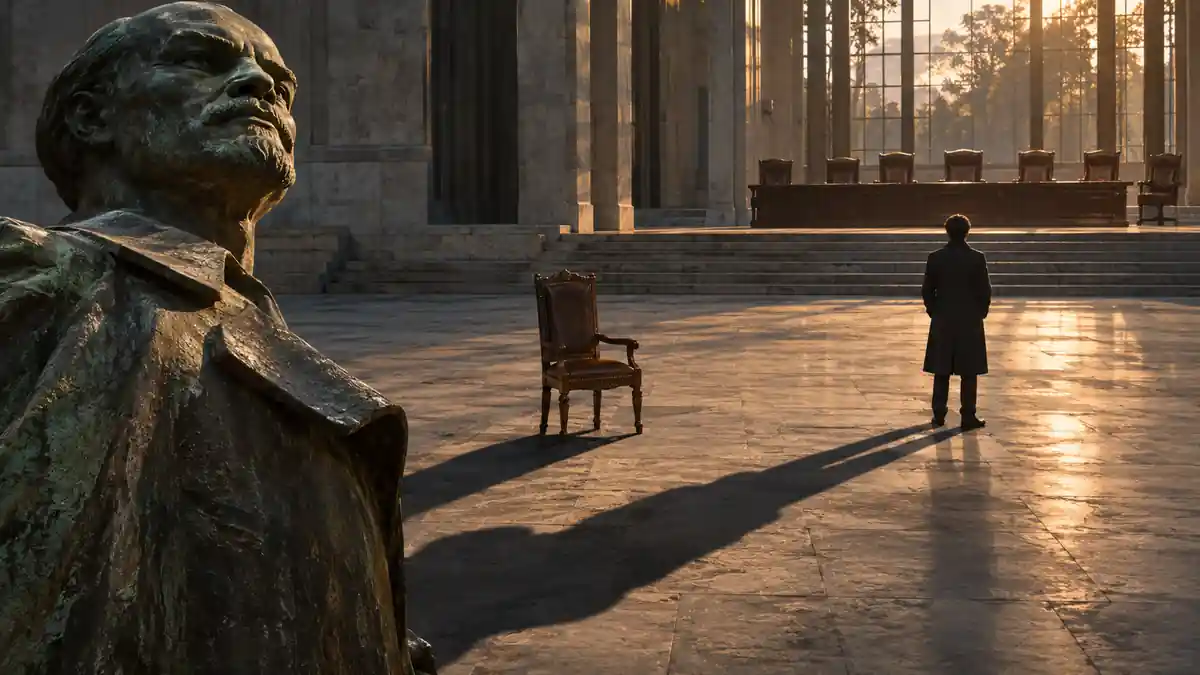
A founder who needs capable successors but punishes their independence can manufacture the crisis used to justify continued rule. Preparing others to lead requires sharing authority before departure—and accepting that the project’s future cannot remain the founder’s personal possession.
Leadership succession becomes a trap when a founder demands initiative from the people around him while making independence dangerous. A deputy who waits for instructions appears too weak to inherit; one who develops a following begins to look like a rival. The organisation needs someone capable of taking over, but its leader keeps restricting the means through which that person could emerge. The succession crisis begins long before the office becomes vacant.
When the founder eventually declares that nobody else is ready, the claim may describe a condition he helped create. Experienced colleagues have been marginalised, consequential decisions reserved for his approval and advancement made dependent on personal allegiance. What appears at the end as an unfortunate shortage of talent can be the accumulated result of choices that protected the incumbent.
This is more than a failure to select a worthy heir. It concerns a leader’s willingness to let others acquire authority while that authority can still inconvenience him. A project cannot become independent merely because its founder sincerely wishes it a long life. Other people must be allowed to make decisions, build confidence, learn from mistakes and question the person who made the enterprise possible.
The obligation is especially demanding for leaders who claim to serve a public cause. They must distinguish the protection of that cause from the protection of their own position. Their achievement does not excuse leaving everyone else unprepared. It makes the refusal to prepare them harder to defend.
The Authority an Office Cannot Carry
A successor can inherit a title, a budget and an administrative apparatus. The experience that made the founder credible is harder to transfer: the campaign fought, the risk taken, the settlement negotiated, the moment when an apparently impossible ambition became plausible. Appointment confers jurisdiction without necessarily reproducing the relationship through which followers came to believe.
Max Weber’s account of charismatic authority in Economy and Society locates charisma within this relationship of recognition. It is not simply an impressive personality possessed in isolation; followers treat someone as exceptionally qualified to lead. Continuing that authority raises questions about how it becomes attached to offices, traditions, hereditary claims or procedures. Officials and supporters also have interests in preserving the community and securing their positions within it.
Succession therefore involves more than a founder and an heir. Officials need assurances about their careers, financiers about access, regional leaders about influence and supporters about promises made. The founder may reconcile these expectations through personal intervention. After departure, arrangements that looked institutional can reveal themselves as relationships whose indispensable guarantor is gone.
Anne Meng’s “Ruling Parties in Authoritarian Regimes: Rethinking Institutional Strength,” published in the British Journal of Political Science, examines this problem through dictatorships from 1946 to 2008. Her findings show how frequently ruling parties failed to remain in power beyond the departure of the regime’s first leader. Longevity under one ruler could conceal limited organisational autonomy.
The measure concerns continued rule, not continued existence. Losing office and disappearing are different outcomes, particularly in a democracy. An authoritarian organisation may manage succession smoothly while denying its population political freedom; a democratic movement may lose an election while helping preserve constitutional government. Organisational survival, fidelity to a defensible purpose and service to the public require separate judgements.
Leadership Succession: The Deputy Who Must Not Become a Rival
A deputy needs experience, confidence and decisions consequential enough to prepare them for leadership. Each achievement also provides resources that could be used against the incumbent. Preparing someone for the future changes the balance of power in the present.
Georgy Egorov and Konstantin Sonin examine this tension in their 2011 Journal of the European Economic Association article, “Dictators and Their Viziers.” Their model shows how competence can make a subordinate politically dangerous: a capable associate can assess opportunities for betrayal as well as opportunities to serve. Under the conditions they examine, a vulnerable ruler may prefer a less competent but safer subordinate.
The resulting weakness need not arise from an inability to recognise talent. A leader may recognise it perfectly and refuse to tolerate the independence accompanying it. A selection system that repeatedly rewards political harmlessness teaches people when to defer, whose approval matters and which questions threaten their careers. These are skills for surviving near concentrated power. They offer an uncertain preparation for governing without its central figure.
The capable deputy faces a corresponding trap. Success produces a following; the following invites suspicion; suspicion prompts restrictions on responsibility. Alternatively, the founder keeps several possible successors competing without allowing any to become secure. Everyone continues to need his arbitration, and uncertainty about the future strengthens his position in the present.
Credibility makes the trap harder to escape. An heir promised authority may doubt that the promise will be honoured. An incumbent may fear retaliation after retirement or the destruction of arrangements protecting allies. Postponement can serve both immediate political calculations and the founder’s attachment to office. The price of securing the leader’s present is paid by the project’s future.
In “Winning the Game of Thrones: Leadership Succession in Modern Autocracies,” published in the Journal of Conflict Resolution in 2021, Meng argues that effective arrangements must address peaceful exit and peaceful entry. Her research on African autocracies associates constitutional designation of vice-presidents with more peaceful transitions, emphasising the importance of successors possessing material resources rather than merely a promise.
A name on a succession document cannot compensate for power that remains unavailable in practice. The founder must permit authority to acquire a basis beyond personal favour. Otherwise the heir is being displayed, not prepared.
The Succession Was Already Under Way
Lenin’s final illness exposed the difference between revolutionary standing and organisational power. Stalin’s position as general secretary provided access to appointments, information and officials, while cooperation with Grigory Zinoviev and Lev Kamenev strengthened his position against Trotsky. Those advantages were not an automatically obedient machine. Historian James Harris, in Stalin: A New History, challenges assumptions of unquestioning loyalty within the appointment networks associated with Stalin’s rise.
Lenin’s Letter to the Congress, dictated in December 1922 with additions in January 1923, warned about leading personalities and the concentration of authority. On 4 January, he recommended replacing Stalin as general secretary. He also criticised Trotsky, whose prominence did not constitute an agreed right of succession. The document identified dangers without supplying a complete procedure for resolving them.
Its handling after Lenin’s death demonstrated who could shape the decision. Junya Takiguchi’s study of the Thirteenth Party Congress in 1924 describes restricted circulation and discussion, with open debate constrained and Zinoviev and Kamenev helping defend Stalin’s position. The warning was not simply unknown to every delegate. Its political effect was limited through the management of deliberation.
Lenin bore responsibility for the conditions in which this occurred. Repression of political opponents preceded his death, and the 1921 resolution on party unity, advanced by him, required organised factions to dissolve and authorised disciplinary action against factional activity. A leader who later feared concentrated authority had helped restrict the organised means of contesting it.
Stalin subsequently intensified repression through decisions for which he was responsible. Treating his rise as an alien intrusion into an otherwise accountable project nevertheless absolves the founding leadership too easily. Lenin’s successors could disregard his recommendation while competing to represent authentic Leninism. His personal preference lost force; control over his meaning became more valuable.
The Mission and the Dynasty
The relationship between Nur al-Din and Saladin presents a different difficulty: an objective can continue through the disruption of the political order intended to carry it. Nur al-Din expanded Zengid power in Syria and made resistance to the Crusader states an important source of legitimacy. Saladin rose within that world, establishing a powerful position in Egypt and increasing his independence.
When Nur al-Din died in 1174, he left a young son, al-Salih Ismail. Saladin was not an appointed heir receiving authority through an agreed transfer. As historian Eric Böhme explains in his study of Saladin’s diplomacy in 1174, the Zengid dominions began to fragment, and Saladin used the changed circumstances to extend his power into Syria, taking Damascus that October.
His consolidation involved conflict with Muslim rivals as well as warfare against the Crusader states. The victory at Hattin and recovery of Jerusalem in 1187 belonged to a longer history of mobilisation to which Nur al-Din had contributed. They cannot turn the intervening struggle retrospectively into an orderly succession plan.
From the perspective of the Zengid dynasty, Saladin’s expansion represented displacement. From the perspective of a broader campaign against the Crusader states, important ambitions continued under another ruling house. Both descriptions matter. A victorious successor can preserve part of a predecessor’s purpose while destroying the intended political settlement, and claims of fulfilment do not excuse every means used to obtain power.
The Political Life of the Dead
Personalist movements do not necessarily collapse when their founders disappear. A dead leader can remain a source of identity, grievance and hope. Successors may draw strength from preserving this attachment rather than replacing it with impersonal organisation.
Caitlin Andrews-Lee develops this argument in The Emergence and Revival of Charismatic Movements, published by Cambridge University Press in 2021. Her comparative work on Argentina and Venezuela challenges the assumption that survival requires charismatic attachment to dissolve into a stable programme or bureaucratic structure. A founder can remain politically usable long after becoming personally irreplaceable.
Her related study, “The Revival of Charisma,” published in the 2019 volume of Comparative Political Studies, used survey experiments with supporters of Peronism and Chavismo. Participants encountered hypothetical candidates combining policy achievements and symbolic connections to the founder. These cues could strengthen attachment and support, with differences between the settings. The findings identify a mechanism of appeal rather than a guarantee of electoral victory or effective government.
Symbolic continuity need not preserve policy. Andrews-Lee notes how Carlos Menem justified free-market reforms through claims about what Perón would have done in changed circumstances. The founder’s memory could authorise departure as readily as repetition, provided someone could make the interpretation persuasive.
Followers have reasons of their own for maintaining the attachment. It may express gratitude, an experience of inclusion or the memory of gains later threatened. Dismissing it as manipulation would miss why the inheritance remains convincing. Its emotional force nevertheless gives current leaders a resource they can use to shelter their own performance from scrutiny.
The problem becomes acute when a successor claims credit for embodying the founder but attributes failure to betrayal or insufficient fidelity. The movement has survived, yet responsibility for what it does becomes harder to locate. Choosing a leader and judging a government are displaced by a contest over who can speak for the dead.
Leaving While the Choice Is Still Yours
Nelson Mandela offers a different institutional setting. He was neither the founder of South Africa nor the sole author of its liberation. The African National Congress, trade unions, civic movements, other political organisations and generations of activists supplied histories and capacities that no individual could simply own.
Mandela became president in 1994 and left office in 1999 after one term. Thabo Mbeki had exercised substantial responsibility as deputy president and became president of the ANC in 1997. The Nelson Mandela Foundation’s account emphasises Mandela’s reliance on Mbeki and the cabinet for much of the practical work of governance. The successor acquired experience and organisational standing before the presidency changed hands.
Mandela’s restraint mattered because his stature could have supported an argument for remaining. The transition was incomplete; the problems were immense; his authority was exceptional. Those conditions could all have become reasons to postpone departure. Leaving denied that exceptional standing an indefinite claim on the office.
The transfer did not complete liberation or make the next government’s decisions correct. In the 2002 case Minister of Health v Treatment Action Campaign, South Africa’s Constitutional Court required the government to remove restrictions on access to nevirapine for preventing mother-to-child transmission of HIV in public facilities capable of providing it. Activists could challenge a policy pursued by the government that inherited power.
The decision was not an achievement to attribute to Mandela’s retirement. It demonstrated why succession must leave more than another leader in place. Organised citizens and courts could assert rights against the governing movement, giving the constitutional order a means of resisting failures by its own representatives.
Mandela’s departure helped establish that the office did not belong to the person most closely identified with the transition. Its public value also depended on what others remained able to do after he left. Restraint opened room; institutions and political organisation made that room consequential.
Preparing Others Means Sharing Power
The instruction to build strong institutions is inadequate until strength is defined. An organisation can possess disciplined officials, extensive branches and formidable means of enforcing obedience while remaining incapable of correcting its leadership. Administrative reach is not the same as independent judgement.
Leadership succession begins with preparing others for consequential responsibility. Deputies need decisions they can make, resources they can use and results for which they must answer. If every success belongs to the founder and every mistake proves that delegation was premature, the lesson is dependence. Leadership courses cannot overcome a working environment that punishes leadership.
Delegation also needs boundaries that survive disagreement. The founder can correct an error without treating it as evidence of disloyalty, and a deputy can be held accountable without losing every source of authority. People learn to govern through decisions with real consequences. Giving them ceremonial responsibilities while reserving every difficult choice produces familiarity with office, not preparation for it.
Knowledge must also exist outside personal confidence. Decisions need recorded reasons, agreements an existence beyond private assurances, and experience a route beyond the founder’s closest circle. Otherwise departure destroys information as well as authority. Successors receive the organisation without an adequate account of how it works.
The practical test of a council, party body or board is what happens when it reaches a conclusion the founder dislikes. Can it obtain the information needed to judge? Can its members disagree without losing their positions? Can its decision take effect? An institution allowed to discuss everything except the choices that matter is an audience with a formal name.
Nor is replacing one person with an insulated committee sufficient. A leadership coalition can reject the founder while remaining closed to everyone entitled to question its conduct. Institutional independence acquires public value through accountability, not merely through a redistribution of power among insiders.
The relevant mandate differs between a dynasty, an authoritarian party and a constitutional democracy. An orderly transfer can protect a ruling family, preserve an elite settlement or sustain citizens’ ability to replace their government. Explaining these mechanisms does not require treating their purposes as equally defensible.
For a project claiming a public mission, successors must be able to explain what they are preserving, what they are changing and why. Changed circumstances cannot excuse every abandonment, and fidelity cannot excuse demonstrable failure. The right to revise strategy must carry an obligation to justify it before people who can challenge the decision.
The Responsibility to Leave
A founder’s departure is part of governing, not merely a private event awaiting age or illness. The organisation needs time to exercise its own capacities while the founder can still assist without reclaiming every disputed decision. Waiting until participation becomes physically impossible turns preparation into emergency management.
This does not make departure a single heroic gesture. A leader can surrender the title while retaining control over appointments, money, information and the successor’s public legitimacy. The ceremony announces transition; the continuing veto prevents it. A successor expected to obtain private approval for every consequential choice has inherited responsibility without sufficient authority.
There are genuine political obstacles to exit, including fear of retaliation and uncertainty about promises made to allies. Addressing those obstacles belongs within the work of transition. They cannot justify an unlimited entitlement to rule, any more than a peaceful retirement should require permanent immunity from accountability.
The hardest admission may be that the project can remain worthwhile without remaining recognisably the founder’s in every detail. New leaders need the freedom to encounter conditions differently and reach conclusions their predecessor would reject. Their judgement can be wrong, which is why they too must face scrutiny. The alternative is not to preserve the founder’s unlimited veto over a future he cannot govern.
Where a leader repeatedly removes independent colleagues, monopolises the interpretation of principle and makes advancement conditional on allegiance, the resulting weakness is not an external misfortune. It is part of his record. The assertion that nobody can replace him cannot excuse decisions that have made replacement harder.
Earlier achievement remains real, but it does not cancel this responsibility. A person can make a project possible and later obstruct its development. Gratitude for the first contribution must not prevent judgement of the second.
A founder has prepared others to lead when they possess more than permission to repeat him. They need the authority to act, the knowledge to understand what they inherit and procedures through which their own decisions can be challenged. Succession is tested while the founder is still present, whenever another person’s justified judgement is allowed to prevail.
The institution that can only vindicate its founder may preserve a name for generations. Protecting a purpose asks more of it: the freedom to reach a justified conclusion that the founder himself would have refused.
Read also:
Reputation Laundering: When Public Trust Becomes Private Protection