Long before the Netherlands abolished slavery in Suriname, Africans who had escaped bondage and their descendants built communities the colonial government had to negotiate with. Their history reveals how freedom was sustained—and how recognition could protect a community while attempting to close it to others.
During raids on plantations in eighteenth-century Suriname, a man the colonial authorities knew as Boston Band left letters calling for peace. He had escaped slavery, could read and write English, and became an influential advocate of negotiation among the Ndyuka, one of the major groups of Maroons in Suriname. His original letters have disappeared, but Dutch translations survive in the archives of the Society of Suriname. They preserve an encounter the plantation system was designed to prevent: a formerly enslaved person addressing its governors as someone with political demands they had to consider.
The letters belonged to a struggle already being fought through settlements, cultivated land, military organisation and relationships extending beyond individual plantations. Boston was communicating on behalf of people who had made freedom a collective undertaking. The authorities could still describe them as fugitives and send soldiers against them, but they could no longer deal with them simply as missing property. In 1760, the colonial government concluded a peace treaty with the Ndyuka. Two years later, it reached an agreement with the Saamaka, also known as the Saramaka. General abolition in Suriname would not arrive until 1863.
The agreements secured an extraordinary achievement within a society organised around human ownership. They also sought to contain it. Colonial negotiators wanted the free communities to stop attacking plantations, surrender new fugitives and help suppress further resistance. Freedom had become something the authorities were prepared to recognise in particular people while continuing to deny it to others. Whether that distinction could be enforced depended on the communities whose cooperation the colony had failed to obtain through war.
A Colony Measured in Labour
Suriname occupies part of the northern coast of South America, but its colonial economy belonged to the Atlantic plantation world. Rivers connected estates to Paramaribo and to the shipping networks carrying commodities overseas. Sugar and coffee linked the labour of enslaved Africans and their descendants to merchants, creditors and consumers far beyond the colony. The interior, meanwhile, presented colonial government with a problem its commercial maps could not resolve: claiming territory did not provide the means to govern everyone living within it.
The Dutch took the colony from the English in 1667. From 1683, the chartered Society of Suriname administered it under the supervision of the Dutch States General. The Dutch West India Company, the city of Amsterdam and the Van Aerssen van Sommelsdijck family each held a third share. Colonial administration and commercial investment were closely connected, while plantation owners exercised substantial influence over local government and justice.
For this order, escape threatened several interests at once. An owner lost control over a worker whom the law treated as an asset. A plantation might lose knowledge, tools or access to information. An established free settlement offered a destination for further departures and a base from which people could return to attack the estates. Recapture and punishment therefore served purposes extending beyond the recovery of individuals: they were intended to defend the credibility of ownership itself.
The land beyond the plantations was already inhabited. Indigenous peoples had their own settlements, political relationships and histories of resistance to European expansion. Their relations with people escaping slavery varied across time and place; cooperation and conflict both formed part of the emerging frontier. A history that turns the forest into empty refuge removes its earlier inhabitants and makes the creation of Maroon communities look simpler than it was.
Nor did the plantation boundary neatly divide captivity from liberty. People escaped temporarily as well as permanently. Knowledge, food, news and relationships crossed between estates and forest settlements. Those who remained enslaved could assist people outside the plantations while pursuing their own means of survival within them. Maroon communities grew from this contested social world, drawing on connections that colonial authorities could neither fully sever nor safely ignore.
Maroons in Suriname: The Work of Staying Free
Flight solved an immediate problem of captivity while creating urgent problems of survival. People needed food, shelter, reliable information and protection against pursuit. A group capable of moving quickly might evade a patrol; a settlement containing children, older people and cultivated fields faced different demands. Freedom became durable through the construction of a common life that could survive beyond an individual escape.
The communities that emerged were historically distinct. The Ndyuka, also called the Okanisi, and the Saamaka developed their own political relationships, languages and accounts of their origins. Kinship connected households and settlements, while larger affiliations helped organise leadership and collective obligations. These arrangements drew on diverse African inheritances transformed by enslavement, plantation experience and the conditions of life in the Guianas.
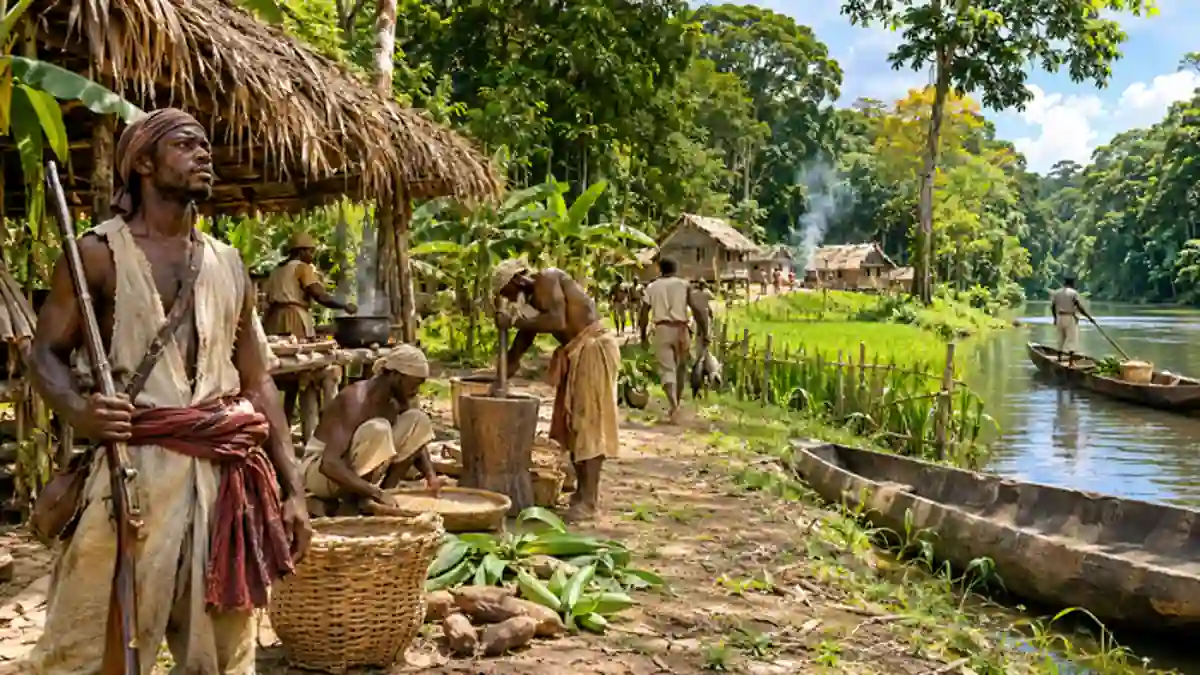
Food production was fundamental to this transformation. Raids could secure supplies, but repeated dependence on taking provisions exposed communities to danger and made the timing of survival dependent on opportunities elsewhere. Cultivation established a different relationship with the forest. Knowledge of soils, planting seasons, crops and food preparation helped turn places of concealment into places where people could remain.
Women’s labour belongs at the centre of that history. In “Maroon Women in Suriname and French Guiana: Rice, Slavery, Memory”, published in Slavery & Abolition, Tinde van Andel, Harro Maat and Nicholaas Pinas examine rice varieties carrying the names of female ancestors. Saamaka traditions associate women including Seei, Yaya and Paanza with the introduction of rice to their communities. Stories of seeds concealed during escape honour women whose contribution to survival extended far beyond the moment of departure.
The researchers distinguish those traditions from claims that can be independently demonstrated. A variety’s present name cannot establish that its seeds descend directly from a particular woman’s planting stock. Yet the conjunction of crops, names and remembered lives reveals what a military archive can leave obscure: communities understood the ability to feed themselves as an ancestral achievement worth preserving.
Later botanical research also shows a history of adaptation and exchange. Maroon farmers maintained diverse rice varieties with different qualities and uses, including ceremonial ones, and incorporated planting material obtained through subsequent contacts. These were active systems of knowledge. Their survival depended on selection, teaching and circulation, rather than the unchanged preservation of a single agricultural inheritance.
A harvest could accomplish something an escape alone could not: make it possible to remain beyond a master’s reach. That gives farming a political significance easily lost when resistance is narrated through battles. The people who preserved seeds, cultivated fields and taught children how to use them were helping determine whether the community would have to return, disperse or endure.
Collective survival also required authority. Leaders had to coordinate defence and manage relations between settlements, while communities developed procedures for resolving disputes. Studies of Maroon justice describe council deliberations, known in various forms as kuutu or krutu, through which public affairs and conflicts could be discussed. Such institutions developed over time; they should not be projected backwards as a complete system present from the first escape.
Early insecurity could also produce severe discipline. Research on Maroon legal history records the harsh treatment of some newcomers whose trustworthiness was doubted, including periods of captivity. Freedom from plantation ownership did not immediately establish equal standing within every settlement. The need to create dependable relationships under threat could strengthen leaders and expose vulnerable people to new forms of coercion.
The communities’ own histories help recover these processes. In First-Time, first published in 1983, anthropologist Richard Price placed Saamaka oral accounts alongside commentary and documentary evidence. Remembered genealogies, places, conflicts and founding ancestors carried claims about authority and territory. They preserved a political history whose categories differed from those of colonial reports. People recorded as fugitives in plantation documents could be remembered as founders within the communities they helped establish.
When the Governors Needed an Agreement
The colonial authorities repeatedly attempted to destroy that alternative social world. Expeditions sought people and settlements, but also provision grounds: the cultivated spaces that made continued independence possible. Destroying a village could scatter its inhabitants without securing lasting control over them. The military problem was therefore inseparable from the economic one. Soldiers had to reach and disable a society capable of rebuilding beyond the plantations.
Silvia de Groot’s comparative research on Suriname and Jamaica identifies several reasons why campaigns failed to secure the results colonial elites wanted. Maroon organisation and environmental knowledge mattered, as did support from people still enslaved. So did the expense of expeditions and disputes over who should bear their costs. The limits of colonial power emerged from the interaction of these factors, rather than from an intrinsically unconquerable landscape.
Plantation labour itself could generate the next confrontation. The Tempati uprising of 1757 was provoked by a proposed transfer of enslaved workers from a timber operation to a sugar plantation. As Marcel van der Linden explains in his history of the Okanisi, timber work allowed conditions and degrees of movement that the workers expected to lose under the more closely supervised sugar regime. Their resistance developed into armed conflict, and insurgents subsequently joined the Ndyuka.
This episode makes the struggle more specific than a timeless opposition between Europeans and forest rebels. People were defending relationships, working conditions and places they knew, within a system that allowed someone else to order their removal. The plantation owner’s asserted right to reorganise labour helped create the force that would contest his control.
Boston Band operated within these circumstances as a political intermediary. Frank Dragtenstein’s study of his correspondence, Alles voor de vrede, recovers the role of letters written between 1757 and 1763. Boston had lived in Jamaica before coming to Suriname, and the peace reached between British authorities and Jamaican Maroons in 1739 furnished a precedent known during the negotiations. Information about what another community had achieved travelled through the same Atlantic world that transported people into slavery.
The colonial government had reasons to listen. A letter from Governor Wigbold Crommelin in September 1759 presented peace as necessary to save the colony from disaster. That was an official assessment of danger, rather than proof that the plantation economy was about to collapse. It nevertheless reveals how far the governing calculation had moved. Negotiation had become a means of protecting an order that military campaigns could not adequately secure.
Boston’s literacy gave him unusual access to the documentary record, but the agreement cannot be explained through his abilities alone. Letters gained force from the communities behind them: people able to continue fighting, refuse terms and sustain themselves outside plantation discipline. The correspondence translated an existing capacity into demands colonial officials could receive.
Recognition with Conditions
The Ndyuka agreement was concluded on 10 October 1760; the Saamaka treaty followed on 19 September 1762. They established peace with communities whose continued freedom and internal organisation the colonial authorities now had to accommodate. These arrangements were neither general emancipation nor recognition of modern sovereign states. They were negotiated settlements inside an unequal political order, with scope for sharply different understandings of what had been secured.
The surviving Sranan version of the Saamaka treaty, edited and translated into English by Jacques Arends and Margot van den Berg, records proposed conditions and attributed responses. Its provisions sought information about villages and leaders, restricted relocation and prohibited alliances directed against the colonists. The agreement also demanded the return of new fugitives, with payments for their capture, and children from leading families as guarantees of compliance.
The document exposes the ambition behind the bargain. Colonial officials were attempting to make previously elusive communities more identifiable and to enlist their authority in limiting future escape. A settlement could secure protection against renewed enslavement for its inhabitants while undertaking obligations towards the system from which they had broken away. Recognition could protect an existing freedom while restricting who might join it.
Language formed part of the negotiation. The Sranan text provided a medium through which the terms could be communicated beyond Dutch, although Sranan was not the Saamaka’s own language. Its recorded responses bring the interlocutors into view, while remaining a document transmitted through colonial mediation. It preserves a negotiated encounter without providing unfiltered access to everything either side understood.
The arrangements concerning goods also admitted different political meanings. Colonial officials could describe deliveries as presents, expressing generosity or patronage. Communities could understand them as obligations secured through their struggle. The same transaction could be represented as a reward bestowed from above or a payment owed between parties whose agreement had become necessary.
These differences mattered because much remained unsettled after the ceremonies. A governor’s claim to supervise a community did not establish the practical ability to do so. Equally, a community’s understanding of its freedom did not remove the pressure created by threatened expeditions, restricted movement or dependence on particular supplies. The peace established a relationship in which these issues would be contested repeatedly.
The People Outside the Agreement
The requirement to return fugitives was the clearest attempt to convert collective freedom into a boundary. The colonial government wanted a person’s arrival in a Maroon settlement to stop being a route out of slavery. It was trying to turn communities founded through escape into authorities responsible for deciding which further escapes would fail.
The obligation did produce captures and returns, but implementation never matched the simplicity of the written demand. De Groot’s research documents recurrent colonial complaints about limited cooperation. Communities found ways to evade or narrow their obligations, while disagreements arose over the treatment of particular people. Those failures of enforcement are essential to assessing what the treaties actually did.
The Ndyuka asserted distinctions the plantation system would not have allowed them to make. According to the history examined by van der Linden, they indicated in 1761 that people driven out by cruel treatment would not be surrendered. After four people returned by the Ndyuka were executed in Paramaribo in 1762, the community protested and refused further returns if executions continued.
This was a challenge to the colony’s treatment of fugitives, but it was also a limited one. Preventing an execution did not necessarily prevent a person’s restoration to slavery. The returned individual could remain exposed to ownership, sale and punishment. Understanding the Ndyuka’s objections requires recognising both the resistance they represented and the protections they did not secure.
For someone approaching a settlement, these distinctions could determine an entire future. The decision to offer refuge, demand labour, expel or surrender a newcomer belonged to people who possessed a freedom the newcomer was still seeking. Their shared history of oppression created powerful reasons for solidarity, but it did not guarantee agreement over the risks and obligations of providing it.
Conflict between Maroon communities further unsettles the image of a single movement acting with one purpose. The Ndyuka and the Aluku, also known as the Boni, could maintain relationships and later fight one another. Treaty status, territorial interests, access to routes and security could divide communities whose members all confronted the legacies of enslavement. Colonial policy operated through those divisions, without exercising complete control over their development.
The agreements thus reveal a particular form of colonial adaptation. The authorities accepted limits on their ability to reclaim some people and sought assistance in preventing others from escaping. Their success depended on cooperation they could not reliably compel. Treaties reduced important threats to the plantation order while leaving it exposed to decisions made beyond its effective reach.
The people making those decisions remained answerable for their consequences. Returning a fugitive cannot be made harmless by describing the pressures surrounding the choice. But those pressures also explain why recognition did not produce an uncomplicated division between liberation and collaboration. The colony had created incentives through which the protection of one community could place another person in danger.
A Freedom That Could Trade
Peace allowed different possibilities for economic and political life, even as it introduced new channels of intervention. Communities could cultivate, exchange goods and negotiate without every encounter carrying the same immediate prospect of war. Leaders also acquired responsibilities for maintaining relationships with colonial authorities, which could place them between external demands and the expectations of their own people.
Colonial representatives known as postholders were stationed among Maroon communities to maintain contact and monitor compliance. Their presence supplied information and a possible means of pressure, but their position did not amount to effective government of the settlements. Communities could also use them to communicate demands. An office intended to extend colonial influence became part of a relationship whose direction the authorities could not fully determine.
Economic contact similarly escaped a simple equation between trade and subordination. People needed tools, weapons and other manufactured goods, but exchange could support an independent household economy rather than dissolve it. The political question concerned the terms of access: whether a community could obtain what it required while retaining control over its labour, residence and internal affairs.
The nineteenth century brought a revealing shift in official priorities. In her archival study of Ndyuka migration between 1845 and 1863, de Groot traces attempts to manage people travelling and settling near plantation districts. Authorities initially sought to send them back to their interior communities. Trade and connections with enslaved people made their presence troubling to plantation owners.
Later, the government tried to direct these movements towards economic integration, hoping timber trading and additional labour would benefit the colony. In 1856, restrictions on the numbers permitted to trade and the kinds of goods they could exchange were lifted, although movement remained subject to a pass system. Official encouragement replaced some earlier efforts at exclusion.
The change exposed the economic purpose of regulation. Keeping free people apart from the plantations could protect slavery when their presence encouraged departures or unauthorised exchange. Bringing them into closer contact could serve colonial interests when their labour became desirable. The authorities’ preferred distance between the communities shifted with the uses they hoped to make of them.
Maroons, meanwhile, pursued opportunities on terms that did not consistently satisfy those expectations. De Groot describes people travelling to earn money or acquire supplies and then returning to their communities. Their economic relationships could be extensive without amounting to acceptance of plantation employment as a permanent condition of life. Access to land, households and an alternative source of subsistence helped make departure from a particular job possible.
That capacity gives their freedom a material meaning. A person may be legally entitled to refuse work yet possess no means to survive the refusal. The Maroon settlements had created places to which people could return, supported by cultivated land, social relationships and authority outside the employer’s control. Their autonomy rested partly on maintaining those conditions through the changes peace itself made possible.
Beyond the Date of Emancipation
On 1 July 1863, the Netherlands abolished slavery in Suriname and its Caribbean colonies. The change ended legal ownership of people, but the Surinamese settlement continued to protect plantation interests. Former owners received compensation; those emerging from slavery did not receive comparable payment for the labour and lives taken from them.
For many emancipated adults, freedom was also qualified by ten years of state supervision. People between fifteen and sixty were required to enter labour contracts, in a system intended to prevent a mass departure from plantation work. This regime lasted until 1873. Abolition and the ability to exercise control over one’s working life therefore had different timetables.
The Maroon treaties had preceded this transition by a century, but their communities followed a distinct path. They had won recognition for a collective existence established outside the plantations. Those emancipated in 1863 were being released into a regulated labour system whose designers feared what they would do if allowed to leave. In both cases, colonial authorities attempted to preserve command over movement and work while acknowledging a change in legal status.
The comparison should not obscure the people who remained enslaved. Maroon history cannot supply a verdict that those who escaped possessed more courage or a stronger desire for freedom. Opportunities varied with circumstances, relationships and obligations. People caring for relatives, lacking assistance or facing capture made decisions under conditions whose severity is not measured by whether they reached a forest settlement.
Nor can Maroon resistance alone explain general abolition. The eventual decision emerged through interacting pressures, including resistance, abolitionism, international developments and economic interests. The survival of free communities nevertheless demonstrates how much political life existed outside the chronology of legislation. Long before emancipation was proclaimed, people had already constructed forms of freedom that governors tried first to destroy, then to recognise, regulate and recruit.
Their achievement is larger than the signature of a treaty. It includes the work of making places habitable, transmitting knowledge, raising children, settling disputes and maintaining relationships through danger. Women remembered through rice varieties belong within that account alongside letter writers and military leaders. Without the means to sustain life, the freedom defended in battle could not have endured across generations.
The history of Maroons in Suriname makes it impossible to treat freedom as a single event delivered at the moment an authority acknowledges it. The settlements existed before their recognition; the obligations attached to recognition remained contested; legal abolition later arrived with further restrictions on labour. At each stage, the decisive issue was how much control people could exercise over the conditions of their own lives.
The colonial archive preserves the moment officials accepted that they had to negotiate. The histories cultivated within the communities preserve a longer achievement: making it possible to live without returning to the plantation. A government could recognise that freedom, bargain over it and try to contain it. The people who sustained it had already begun deciding what their lives would be for.
Read also:
The Kingdom of Kongo: Sovereignty in a World That Traded People