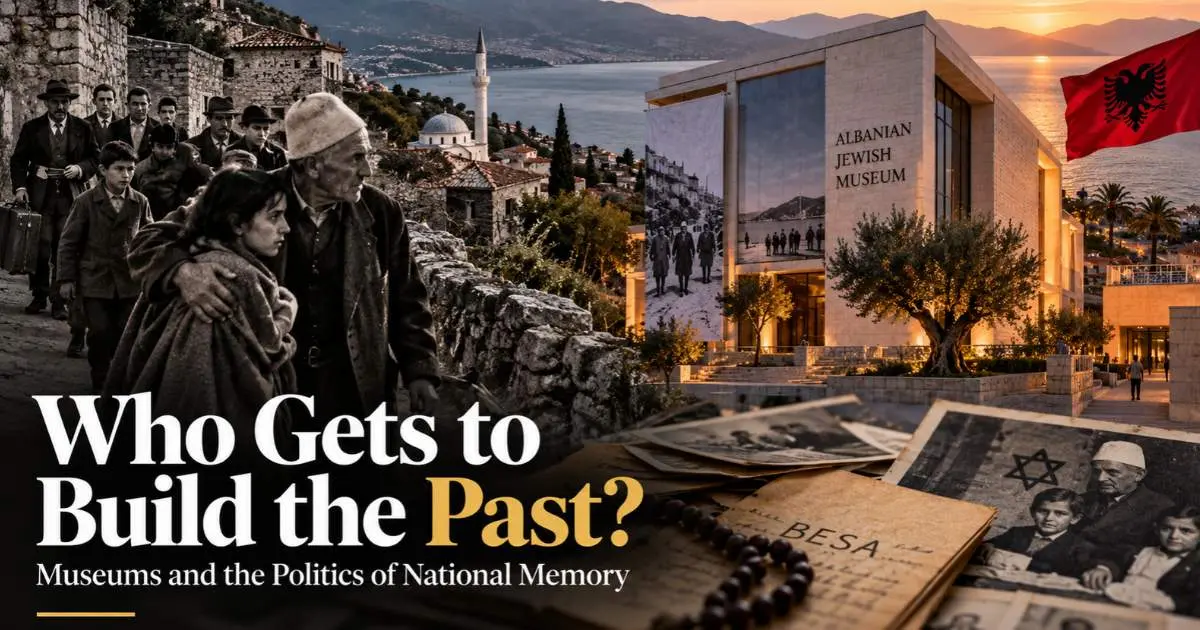
Memory infrastructure gives the past a durable public life: buildings, archives, staff and the means to teach another generation. A museum project in Albania reveals how preserving history also distributes authority over what remains visible—and whose choices become part of a nation’s image.
At a municipal council meeting in Vlorë on 13 March 2024, officials explained that the proposed Albanian Jewish Museum would occupy a building next to the city’s Ethnographic Museum. The properties were separately registered, and the existing museum, associated with the patriotic organisation Klubi Labëria, would not become the Jewish museum.
The minutes then recorded a different concern. Councillor Atird Hoxha objected to the Ethnographic Museum being left outside the restoration works, pointing to the condition in which valuable historical objects remained. Another councillor acknowledged the concern while reiterating that the existing museum’s property was not included in the new project. The distinction between the buildings was clear; the question of investment in the older institution remained open.
The Albanian-American Development Foundation’s published description of the Jewish museum listed a financial commitment of $6.5 million. It presented the project as a cultural institution, a tourist destination and part of the revitalisation of Vlorë’s historic centre. Its scope encompassed Jewish life in Albania over the centuries, including the people who found refuge there during the Holocaust and the Albanians who helped protect them.
A subsequent ministerial statement in 2026 said that the foundation had approved funding to prepare restoration plans for the Ethnographic Museum. That announcement concerned the preparation of a project, rather than the completion of restoration. The record establishes neither that funding the Jewish museum deprived its neighbour of money nor that the earlier objection caused the later commitment. It does show that approving a new institution and sustaining existing heritage involved distinct decisions, stages and assurances.
A history becomes easier to encounter when someone can secure a site, assemble records, employ specialists and keep an institution open. Those arrangements distribute more than attention. They help decide which parts of the past remain accessible to people who have no family connection to them, and which depend on someone already knowing where to look.
A small community and a history across centuries
Jewish life in the territory of present-day Albania long predates the twentieth century. Sephardic Jews settled in Ottoman lands after their expulsion from the Iberian Peninsula, and Vlorë developed a notable Jewish presence. The museum’s stated historical scope extends across centuries, with wartime refuge and rescue forming a particularly consequential part of that longer relationship.
The United States Holocaust Memorial Museum estimates Albania’s Jewish population in 1937 at approximately 200. That snapshot cannot stand for Jewish life across several centuries or for everyone who would later seek safety in the country. Refugees began arriving after Hitler’s rise to power in 1933; Yad Vashem describes hundreds entering Albania from elsewhere in Europe. A population estimate belongs to its date, while a museum may examine lives and movements extending far beyond it.
Fascist Italy occupied Albania in 1939, and German occupation followed in 1943. Families, officials and local networks sheltered Jews, provided food, helped arrange false identities and resisted efforts to expose them. Yad Vashem records the survival of almost all local Jews and refugees in Albania proper during the German occupation, with an exception involving members of one family.
That account needs a geographical boundary. The United States Holocaust Memorial Museum records Jewish deaths separately in Albanian-annexed Kosovo, where the wartime experience was sharply different. The record of rescue within Albania’s pre-war borders cannot be extended to every territory attached to occupied Albania during the conflict. Historical courage becomes more intelligible when its circumstances and limits remain visible.
The rescue story is also a history of the surrounding society. The people who sheltered Jews made decisions under occupation, drawing on relationships, beliefs and practical opportunities that differed from household to household. Understanding those decisions requires attention to the rescuers as well as to the people whose survival depended on them.
The Muslim society inside the rescue story
Wartime Albania was a Muslim-majority European society with substantial Christian communities. Yad Vashem foregrounds this dimension in its exhibition Besa: A Code of Honor—Muslim Albanians Who Rescued Jews During the Holocaust. Christian Albanians also participated in rescue, while friendship, anti-fascism, local loyalties, compassion and Besa, the Albanian code of honour associated with keeping one’s word, shaped individual decisions.
Nuro Hoxha, a teacher in Vlorë, sheltered Jewish families after the German occupation. In testimony preserved by Yad Vashem, his son Sazan remembered him as a religious Muslim and linked the family’s protection of Jews to “Besa, friendship and the holy Koran.” Religious belief was part of the explanation the family gave for its conduct.
In another testimony, Lime Balla recalled that her village’s inhabitants were Muslims and that the Jewish refugees they sheltered were under their Besa. Her account places rescue within a community’s understanding of obligation and hospitality. Such testimony supports a precise historical claim: Islamic belief belonged to the moral world of some rescuers, alongside other commitments through which they understood their responsibilities.
These accounts do not establish a single religious explanation for Albania’s wartime record. Claiming rescue as an exclusively Islamic achievement would erase Christian rescuers and flatten the variety of motives preserved in the evidence. Removing Islamic conviction where the testimony gives it weight would distort the record in another direction.
The word “humanism” does not itself erase religious motivation. Sazan Hoxha’s testimony uses that language alongside Muslim devotion, friendship and the Quran. The test is whether a museum preserves the relationships between these motives, allowing individuals to explain themselves rather than translating every account into the same general claim of tolerance.
The stories complicate accounts that reduce Muslim-Jewish relations to an inherited conflict. They record people responding to persecution through moral languages that crossed faith, friendship and national custom. Their value lies in recovering those choices in sufficient detail that later generations can understand how protection became possible.
When memory infrastructure takes shape
Memory infrastructure consists of the material and organisational support that makes a past repeatedly accessible: collections, catalogues, buildings, trained staff, translation, educational programmes and dependable funding. A history can possess enormous significance while lacking several of these supports. Its visibility then depends more heavily on relatives, volunteers, individual researchers or people whose own lives connect them to it.
An institution changes those conditions of encounter. A child can discover the history on a school visit; a tourist can enter without prior knowledge; a researcher can consult records gathered and organised by others. Teachers can return to prepared materials, and journalists can find people authorised to explain a collection. The work of remembering becomes less dependent on each visitor first undertaking a private search.
The Vlorë project shows how such capacity is assembled. AADF worked with Albanian public authorities and the Jewish community, while an international competition selected a design by Kimmel Eshkolot Architects. Cultural preservation met urban redevelopment, professional expertise and tourism. Each participant supplied something the project needed, from funding and permissions to historical knowledge and architectural design.
Its subject connected a local history with international networks of Jewish history and Holocaust remembrance. The rescue narrative also offered Albania a way to present an admired part of its past abroad. Preservation, education, tourism and cultural diplomacy could therefore reinforce one another within the same project. A history with substantial local importance might still struggle to assemble that particular alignment of interests.
Those contributions do not all confer the same kind of authority. Financing a building, approving a site, interpreting testimony and deciding how collections may be studied are different activities. Examining a museum’s power requires following these decisions through the institutions that make them, rather than treating the nationality of a donor or architect as an explanation in itself.
Nor does a construction project settle the question of endurance. A project budget and the income needed to keep an institution functioning over decades are different matters. Records must be conserved, catalogues maintained, staff replaced and exhibitions reconsidered as research develops. A building gives a history a public address; maintaining its usefulness requires continuing work.
The same history, a different capacity to survive
A smaller museum in Berat makes that dependence on continuity especially clear. Simon Vrusho, an Orthodox Christian researcher, opened the Solomon Museum in 2018 after collecting documents, photographs and accounts of Jewish life in Albania. He supported the institution with his pension and small donations left by visitors.
After his death in February 2019, its future became uncertain. Reporting by Agence France-Presse brought the problem to the attention of French-Albanian businessman Gazmend Toska, who financed the museum and its relocation to larger premises. It reopened in September that year.
The contrast shows how uneven resources can be within the preservation of the same history. In Berat, continuity depended on a founder’s pension and a successor benefactor; the larger Vlorë project brought together a foundation, public authorities and professional partners. The history did not become more deserving when a new donor arrived in Berat. Its chances of remaining publicly accessible changed.
Who gets to make memory permanent?
Museums turn interpretations into institutions with employees, premises, partners and expectations of continuity. Before a visitor reads an exhibition label, decisions have already been made about which project can acquire these things. Historical importance does not automatically produce an organisation capable of securing them.
That creates advantages which can accumulate. A project with recognised partners may find it easier to attract further support; a collection that is already catalogued can be used by researchers whose work draws more attention to it. A smaller archive may contain equally significant evidence but lack the staff or translations that would allow outsiders to discover its value. Visibility can help secure the resources that produce further visibility.
The resulting questions concern the design of memory infrastructure as much as the generosity that makes it possible. Who appoints the director? What protects scholarly independence? Who controls access to the records, and what opportunities exist to challenge an interpretation or correct an error? These are questions to investigate in a particular institution, rather than answers that can be inferred from the existence of private funding.
Public authority also has to be examined through the powers it actually exercises. A municipality may control a property, a ministry may approve a heritage intervention, and a foundation may finance its development. Local residents, historians and minority communities can possess knowledge essential to the project without holding the same decision-making rights. Participation in a consultation does not, by itself, reveal how much influence a participant has over the outcome.
Memory inequality can grow without censorship. An uncatalogued archive may remain legally accessible while being practically unusable; testimony in an untranslated language may reach few people beyond those who already share it. Over decades, differences in staffing, conservation and teaching can separate histories that remain equally lawful to discuss. The absence of censorship does not supply the means of public remembrance.
A museum can preserve history and build a national image
AADF’s description of the Vlorë museum explicitly connected it to Albania’s traditions of solidarity and humanism. The institution was therefore intended to look in two directions: towards Jewish lives, refuge and survival, and towards the country whose response to persecution would become better known. The same project could preserve evidence and contribute to a national image.
The difficulty begins when commemoration becomes a certificate of inherited virtue. Muslims and Christians who sheltered Jews under occupation made choices in particular circumstances and accepted particular risks. Their descendants do not automatically inherit their courage, and later governments cannot turn those decisions into permanent evidence of national goodness.
A serious museum can celebrate Nuro Hoxha without implying that every Albanian shared his courage. It can explain Besa without treating a cultural tradition as a guarantee of conduct, and recognise Islamic conviction without making it the sole cause of rescue. Jewish survivors’ accounts belong alongside rescuers’ testimony and administrative records, preserving the experiences of people whose lives must not become mere illustrations of another society’s virtue.
The treatment of context is therefore an important test. Visitors should be able to distinguish the established Jewish community from refugees who arrived at different moments, and Albania’s pre-war territory from the changing geography of occupation. Individual rescuers should retain their own stated motives. Evidence about rescue should remain open to questions about its conditions and limits, rather than being sealed inside an account of timeless national character.
These standards apply to an exhibition’s content, not simply to the language of a project announcement. The planning materials establish what an institution says it intends to do; its displays, archives and educational work reveal how those intentions are carried out. Preserving the ability to examine that difference is part of historical accountability.
A false claim can conceal a legitimate question
The later controversy over Klubi Labëria shows how easily separate disputes can become entangled. In 2026, claims circulated that the Jewish museum was replacing the historic building associated with the patriotic organisation founded in 1908. The municipal record from 2024 identified two separate properties, a distinction also supported by the project documentation and reporting by the Albanian outlet Amfora. An existing record had failed to prevent a false claim from shaping public argument.
Correcting that claim does not settle every issue concerning construction beside a protected monument. Residents can reasonably ask about conservation, public space, access, the treatment of neighbouring buildings and the terms under which decisions were made. They can ask what support existing institutions receive as a prominent new project develops. Those questions require evidence about plans, allocations and implementation.
The earlier council objection concerning the Ethnographic Museum illustrates the difference. It addressed investment in an existing institution rather than the supposed conversion of one building into another. The later announcement of support for restoration planning also belongs in the account, allowing readers to follow changes in policy without mistaking an announced intention for a completed result.
Concern for heritage does not validate unsupported claims about Jews or Israelis taking over a city. Equally, prejudice expressed within a controversy does not make every question about land use or public priorities illegitimate. Arguments should be tested through what they assert and the evidence offered for them, rather than accepted or rejected as an indivisible political package.
Memory has stakeholders, but it should not have an absolute owner. Governments possess legal powers over public institutions; donors can make projects possible; local communities bring knowledge and attachment; historians contribute evidentiary discipline; minorities preserve experiences majorities may have overlooked. None of these forms of standing should become a monopoly over meaning. The strongest institution can preserve evidence while remaining open to argument about it.
The past has its own political economy
The politics of memory concerns both what societies say about the past and what they make available for others to discover. These are connected decisions, but they cannot be reduced to the same task. Permission to tell a story leaves unanswered who can conserve its documents, translate its testimony, teach it in schools or keep a place open where strangers encounter it.
Memory infrastructure helps shape whether a history can travel beyond those already committed to preserving it. Its distribution can be examined through budgets, property decisions, appointments, access policies and the continuity of educational work. Following those arrangements gives criticism something more substantial to investigate than the visibility of a museum alone.
The Albanian Jewish Museum’s subject deserves preservation across its full historical scope. The evidence of refuge and rescue includes choices by Muslims and Christians, Jewish experiences of danger and survival, and relationships that cannot be understood through the conflicts of a later period alone. Its significance also makes it important to examine how an institution selects and presents that evidence.
The experience in Berat adds another measure of success. Preserving a history should not require each generation to depend on the survival of an exceptional individual or the arrival of a new benefactor. Supporting the people who gather and maintain evidence, including those working outside prominent institutions, is part of giving remembrance a durable public life.
A society concerned with historical justice should therefore ask more than whether a particular museum tells the truth. It should ask which histories possess the means to become museums, and how institutions can remain accessible, useful and capable of correction. That question directs attention towards the arrangements through which some pasts remain easy to encounter while others become difficult to recover.
Money cannot change what happened, but it can build the institutions through which what happened remains visible. Political recognition cannot manufacture courage retrospectively, but it can decide which acts of courage become internationally known. A museum cannot own the past, but it can give one part of the past an address, a staff and a future.
The task is not to deny any community that future. It is to understand why so many others have never been given one.