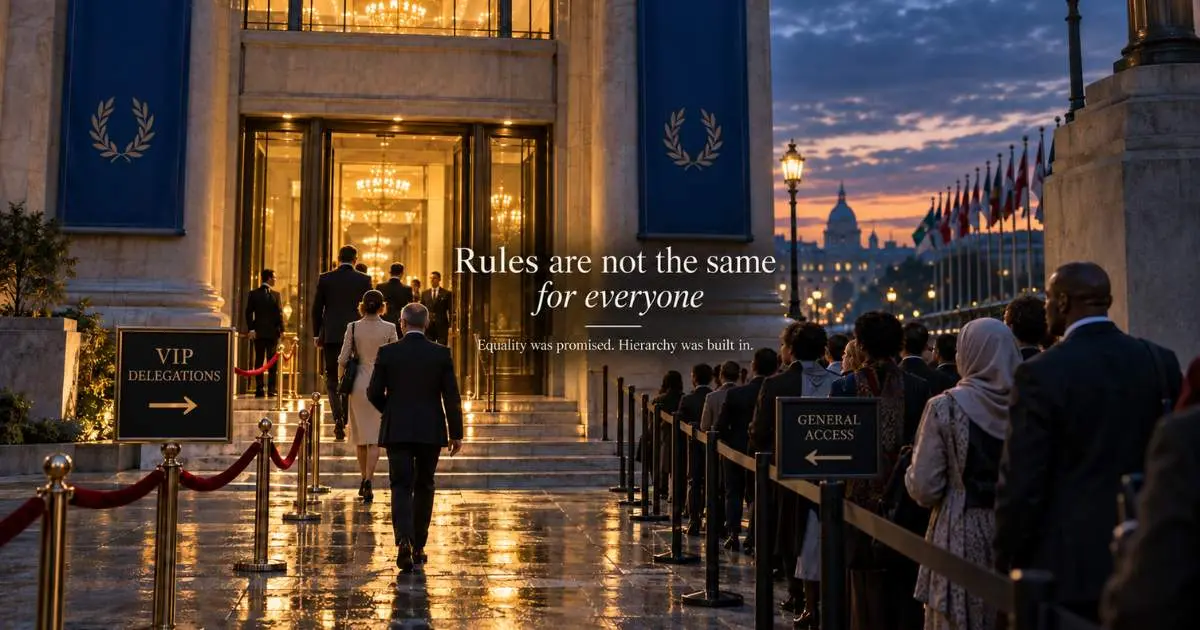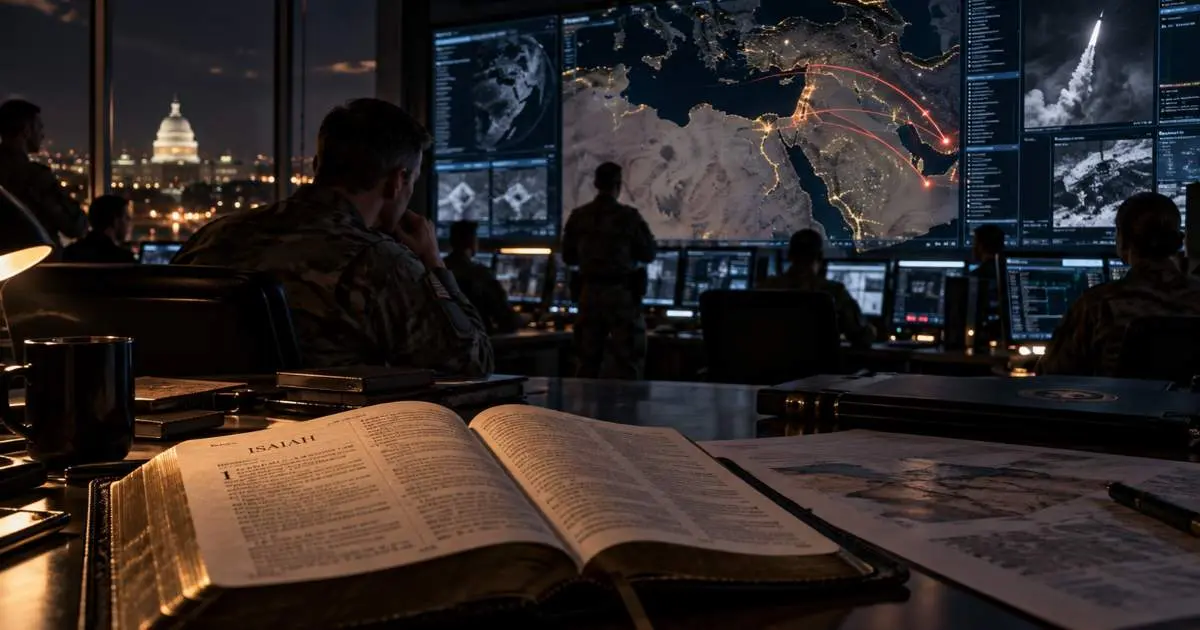
Political leaders may understand history through faith, but linking prophecy and war must not place military decisions beyond challenge. When a conflict becomes part of a sacred destiny, what happens to the institutions that must still be able to say: this judgment is wrong, this sacrifice is unnecessary, this war can end?
“Here I Am. Send Me.”
Near the end of his September 30, 2026 address to American military personnel at Quantico, U.S. Defense Secretary Pete Hegseth moved from policy announcements to something older than the republic he served. He invoked the sixth chapter of Isaiah, where the prophet responds to God’s call with the words, “Here I am. Send me.” Hegseth then carried the phrase through a compressed history of American warfare: send me to fight the Redcoats, send me to fight the communists, send me to fight the Islamists. The speech continued in the language of the warrior: service members were “set apart,” comfortable inside violence so civilians could live peacefully, with lethality as their calling card and victory as the acceptable end state.
In the same speech, Hegseth reminded those listening that they had sworn an oath to the Constitution. The religious vocabulary and the constitutional vocabulary occupied the same address. His use of Isaiah concerned a willingness to answer a calling; it was not itself a prediction about the end of the world. Nor does the quotation establish that a particular military decision was made on religious grounds.
The coexistence nevertheless raises a question that reaches beyond the speaker. A senior official can understand his vocation through faith while exercising power through institutions that must require reasons other people can examine without sharing that faith. Personal conviction may help explain why someone serves. It cannot, by itself, establish what that person is entitled to order others to do.
Between conviction and command stand legal authority, professional judgment, evidence and the possibility that yesterday’s assessment may prove wrong tomorrow. Democratic government depends on those restraints being strong enough to prevent a belief held with absolute personal certainty from becoming an order merely because the person holding it possesses power. The difficulty becomes sharper when religious language supplies an account of what history must ultimately become.
Religion and war have met throughout American history, often quite openly. The enduring question concerns the work religious language performs near institutions capable of irreversible violence. A call to service, a declaration of national righteousness and a prediction of the final struggle between good and evil can all invoke God while making very different demands upon politics.
America Has Heard God Before
Any argument that begins with the idea that religion has suddenly entered American politics will fail historically. Presidents have prayed publicly, invoked providence, quoted scripture and asked God to bless the United States. Abraham Lincoln interpreted the Civil War through a profound religious vocabulary while acknowledging the limits of human knowledge of divine purposes. Franklin Roosevelt led the country in prayer during the Normandy landings. Ronald Reagan described America in biblical imagery. George W. Bush framed the struggle after September 11 through an explicit opposition between good and evil while insisting that the United States was not at war with Islam.
Bush went further in his second inaugural address in 2005. He linked American security with the global advance of liberty, referred to human beings as bearing the image of their Maker and described history as having a visible direction associated with liberty and its divine Author. Yet the same speech explicitly rejected the idea that Americans should think of themselves as a chosen nation whose political preferences simply revealed God’s will.
This is part of what scholars have long called American civil religion: a vocabulary in which national history, sacrifice, providence and moral purpose borrow religious forms without necessarily turning government into a church. “God bless America” is not the same proposition as “the Antichrist may already be among us.” Saying that a country should pursue justice because justice is morally right makes a different claim from placing a contemporary geopolitical conflict inside a timetable of sacred history.
Religious rhetoric performs several distinct functions. A public official may pray, attend church or explain that faith shapes his character. Civil religion presents God as witness to a national project. Moral absolutism casts political opponents or foreign enemies as representatives of good and evil. Eschatological language introduces the Antichrist, the end times and a history whose destination has already been disclosed through revelation.
A democracy can contain all these forms of belief and expression, but their political implications differ. Treating every reference to God as evidence of theocracy makes it harder to recognise when familiar religious language begins to carry a different claim to authority. The issue is what the vocabulary is being asked to justify.
When the End Times Become Ordinary Political Language
Vice President JD Vance brought these distinctions into public view during an August 31, 2026 conversation on the Bryce Crawford podcast. He described a fascination with end-times theology dating back to childhood, while saying that he did not know whether humanity was living in the end times. He also warned that concentrating too much on the subject could be spiritually harmful, drawing attention instead to his responsibilities towards his wife, his children and the people he served.
Within that conversation, Vance said he would not be shocked if the Antichrist were already alive. He spoke about doing as much of “God’s work” as possible and accepting the end times if they came, while also welcoming the possibility that this work would leave a better world long after his death. These remarks did not describe a political programme intended to produce an apocalypse. They combined speculation about sacred history with an explicit acknowledgment of uncertainty and an emphasis on ordinary responsibilities.
Their political significance begins with the familiarity of the language. The vice president of the United States could discuss the Antichrist and the possible approach of the end times without needing to explain the concepts to much of his audience. They belong to a religious vocabulary that remains socially intelligible in America even among people who reject its premises.
A 2022 Pew Research Center survey of more than 10,000 U.S. adults found that 39 percent believed humanity was living in the end times. The figure rose to 63 percent among evangelical Protestants. Fifty-five percent of American adults said Jesus would someday return to Earth, including 92 percent of evangelical Protestants. These findings describe attitudes measured in 2022; they establish the breadth of such beliefs without telling us how respondents would judge a particular war.
Belief in Christ’s return does not translate into a uniform foreign policy. Christian traditions disagree sharply over prophecy, the meaning of biblical texts and the legitimacy of identifying contemporary events with apocalyptic predictions. Expecting a second coming does not in itself imply support for war, still less a desire for governments to accelerate history.
The political question arises when this theological vocabulary helps frame choices about the world in which governments must act. Language helps define which compromises appear shameful, which sacrifices appear necessary and which enemies appear capable of changing. Once an opponent has become part of a sacred drama, the meaning of defeating him can quietly change.
The Bargaining Problem of Sacred History
Wars fought over ordinary interests can be terrible, but interests possess one useful property: they can change. A government may decide that a port, buffer zone, sanctions regime or military objective is worth a certain cost and later decide that it is not. Diplomacy depends on some measure of this flexibility. Negotiators exchange territory, guarantees, prisoners, access, recognition, sanctions relief, security arrangements or money because the parties may value these things differently and revise what they are prepared to accept.
Sacred values can resist that logic. Research by Jeremy Ginges, Scott Atran and their colleagues, published in 2007, examined responses to proposed compromises among Israelis and Palestinians. For participants who treated the issue at stake as sacred, adding material incentives sometimes increased outrage and opposition. What appeared to an outside negotiator as an improved offer could be received as an invitation to sell something that should never have been for sale.
A 2010 study concerning Iran’s nuclear programme found a related effect among respondents who treated nuclear energy as a sacred value: economic benefits could make a proposed compromise less acceptable. The researchers did not find the same effect in their separate nuclear-weapons experiment. Such findings identify a possible bargaining mechanism under particular conditions, rather than a rule governing every dispute involving national pride or religion.
The political risk appears when an objective moves from the category of interest into the category of inviolable duty. A disputed territory may be strategically valuable, but a promised land is harder to exchange. A hostile government may be dangerous, but an incarnation of cosmic evil is harder to bargain with. A war can be stopped when its price exceeds its gains; a sacred mission can interpret the price itself as proof of the need for greater sacrifice.
Even then, peace need not become impossible. The Israeli-Palestinian research found that symbolic concessions by an adversary concerning its own sacred commitments could reduce opposition where material inducements failed. Recognition and reciprocal sacrifice may change the meaning of a proposed agreement. The negotiator has to understand what a concession would signify to those making it, rather than assume that a larger material reward will overcome every refusal.
When prophecy and war meet, revelation can give history direction as well as moral meaning. When leaders regard the future as open, they have reason to ask what their actions are producing. When they interpret events through a divinely disclosed destination, contrary outcomes can become confirmations of the same account: escalation shows prophecy unfolding, setbacks test the faithful, and resistance demonstrates that evil is resisting defeat. A belief can then become politically difficult to correct because events that might otherwise count against it are absorbed into its explanation.
This is the bargaining problem of sacred history. It does not require a leader to announce that God ordered a bombing. It begins when the range of alternatives considered legitimate narrows because one outcome appears to be written into the moral structure of history itself. The practical question is whether any development could still persuade those exercising power that their chosen course should change.
The Middle East Is Not an Empty Stage for Someone Else’s Prophecy
Several political traditions attach sacred meaning to the same Middle Eastern geography. Within Israel, biblical attachment to the land does not automatically determine government policy, and society remains deeply divided over religion, territory, war and the future of the Palestinians. Yet religious-nationalist politicians have exercised substantial influence within government. Reuters reported in August 2026 that Finance Minister Bezalel Smotrich’s Religious Zionism movement grounded Jewish claims to territory between the Jordan River and the Mediterranean Sea in the Bible. Smotrich also advocated extending Israeli sovereignty over the occupied West Bank while opposing Palestinian statehood.
Itamar Ben-Gvir has similarly brought religion, sovereignty and war together in highly symbolic spaces. In October 2025, he prayed at the Al-Aqsa Mosque compound—known to Jews as the Temple Mount—while calling for “complete victory” in Gaza, challenging the long-standing arrangement under which Muslims worship there while non-Muslims may visit. These positions represent particular currents within Israeli politics, just as Vance’s remarks cannot stand for American Christianity as a whole.
Iran, meanwhile, is formally an Islamic republic whose institutions draw upon religious accounts of sacrifice, martyrdom and resistance. Islamist movements elsewhere have also used revelation and sacred history to legitimise violence. A claim to religious authority deserves scrutiny wherever it helps justify coercion; its political consequences do not become harmless when its scripture changes.
The comparison requires attention to differences in institutions, military capabilities and the relationship between religion and government. Nor does every invocation of scripture have the same proximity to command authority. What can be compared is the process by which sacred narratives convert disputes over policy into disputes over destiny.
The people living in these territories are more plural than the narratives imposed upon them. An Iranian family under bombardment does not acquire a role in Christian eschatology because an American politician interprets history through that lens. A secular Israeli is not automatically committed to a minister’s biblical territorial vision. A Palestinian Muslim or Christian does not become a supporting figure in another society’s prophecy simply because Jerusalem occupies a place in it.
People with armies can tell stories about history; people beneath those armies must live with the consequences even when they do not believe the story. Their interests, rights and political choices remain their own. A prophetic interpretation cannot legitimately erase them by assigning their country or their suffering a purpose in someone else’s account of the future.
The Firewall Between Faith and Command
American constitutional government does not require leaders to leave religion at home. The First Amendment protects religious exercise while restraining government from establishing religion, and Article VI prohibits religious tests for federal office. Public authority is therefore not supposed to depend on belonging to the correct faith. The protection of belief and the limits on government are parts of the same constitutional arrangement.
The military makes the tension sharper because hierarchy changes the meaning of speech. A general speaking about religion to a subordinate is not simply one citizen talking to another. Rank carries authority, career consequences and an expectation of obedience. Commanders possess religious freedom, but the exercise of that freedom can affect people who are not equally free to leave the room, disagree openly or disregard the speaker.
The Air Force’s 2023 standards of conduct addressed this problem by requiring leaders to balance religious exercise with the prohibition on government establishment of religion. They warned against religious discrimination or preferential treatment and required leaders to ensure that personal religious expression would not reasonably be associated with their governmental role. Such rules recognise that an expression of belief acquires a different weight when the speaker controls assignments, evaluations or advancement.
The firewall between faith and command rests on that difference in authority. It protects the subordinate’s freedom as well as the commander’s. Beyond religion, the same principle places limits on the use of office to advance partisan loyalty, personal ideology or private vendettas: coercive public power requires reasons that belong to the office, rather than convictions that belong only to the officeholder.
Hegseth’s invocation of both Isaiah and the Constitution illustrates why the boundary cannot be assessed merely by counting religious references. The practical test comes when a leader’s sense of mission meets an objection that requires a change of course. Intelligence may undermine the case for escalation, commanders may judge an operation unworkable, or diplomacy may offer a settlement that falls short of the leader’s moral ambitions.
A constitutional system must leave those objections capable of affecting the decision. “God wants this” cannot resolve a dispute over lawful authority, military feasibility or the consequences of an attack. Institutions earn their place between conviction and force by retaining the power to delay, revise or prevent an action whose author remains certain that it is right.
A Real War Makes the Question Less Theoretical
The religious rhetoric of 2026 accompanied an actual military conflict. On February 28, the United States and Israel launched major strikes against Iran, which responded with attacks against Israel, U.S. forces and targets elsewhere in the region. This chronology does not establish that religious belief caused the operations. It explains why the standards by which force is justified had consequences beyond political speech.
Article 2(4) of the UN Charter prohibits the threat or use of force against states within the terms of the Charter, while Article 51 recognises the inherent right of individual or collective self-defence if an armed attack occurs. In a March 10 letter to the Security Council, the United States described its operations as necessary and proportionate acts of self-defence. That notification stated the American government’s legal position; it did not settle the legality of the strikes.
The UN secretary-general condemned both the U.S.-Israeli strikes and Iran’s subsequent retaliation, calling for respect for the Charter and an end to escalation. The International Commission of Jurists, an independent legal organisation, concluded that the initial U.S.-Israeli attacks were unlawful. The disagreement concerns the facts and legal conditions under which states may use force. It cannot be resolved by declaring one side righteous or assigning its opponent a place in a religious account of evil.
Isaiah is not an additional article of the UN Charter. A biblical interpretation cannot create a right to use force that international law does not otherwise recognise, just as an Islamic theological claim by Iran could not do so. Religious conviction may inform a leader’s moral outlook, but it supplies no exemption from the legal standards governing the act.
When governments kill across borders, they owe the world arguments that can be examined without first accepting their theology. Evidence of a threat can be challenged, necessity and proportionality disputed, and intelligence shown to be wrong. Strategic assumptions can fail even when those making them acted sincerely. These forms of reasoning leave room for a judgment to be corrected.
A claim of prophetic authority creates a different problem because its ultimate source lies beyond the competence of the institutions asked to act upon it. A court cannot establish that a president has correctly identified the place of a war in sacred history; a military intelligence assessment cannot authenticate a divine timetable. Government must be able to reach a decision without pretending that it has settled either question.
Certainty Is Not the Same as Faith
Religious people possess no monopoly on political absolutism. Secular ideologies have sacralised nations, races, revolutions and classes, describing history as inevitable, enemies as irredeemable and sacrifice as necessary. Movements that rejected religion have also placed their account of the future beyond challenge. Nothing in the absence of religious belief guarantees humility.
A leader may hold a deep conviction while accepting that intelligence is incomplete, chosen means may fail, the law prohibits certain actions and an opponent possesses legitimate interests. Another may hold no religious belief and still treat an ideology as a truth beyond evidence. Political restraint depends on the continued ability to acknowledge error and on institutions capable of requiring a response to it. Sacred certainty becomes politically consequential when “you may be wrong” becomes harder to say, or safer to ignore.
The research on sacred values also helps explain why a society cannot simply abolish absolute commitments. People protect country, justice, honour and religion because some things should not be sold to the highest bidder. Political communities need principles that survive inconvenience. The danger comes when every element of a conflict acquires that status, leaving no distinction between the principle to be defended and the policy through which leaders propose to defend it.
A society may regard national survival as non-negotiable while negotiating borders. It may regard human dignity as sacred while bargaining over sanctions. A religious believer may consider faith absolute while regarding a military timetable as entirely fallible. The ability to make those distinctions keeps moral seriousness compatible with political judgment; prophecy becomes especially potent when it collapses them.
The Person Who Does Not Share the Revelation
Public power must also answer to people who do not share the convictions of those exercising it. An American service member may be Christian, Jewish, Muslim, Hindu, atheist or uncertain. The citizen paying for a military operation may regard the Bible as revelation, literature or neither. The Iranian civilian whose city lies beneath American aircraft may understand sacred history in terms entirely different from those invoked by an American cabinet official.
A constitutional democracy does not solve such disagreements by deciding which theology is true. It creates political arrangements through which people who disagree about ultimate truth can nevertheless share a state. In questions of war, this has a practical meaning: a person should not need to share the president’s religion to understand why the country is going to war.
A soldier should not have to accept the defence secretary’s interpretation of Isaiah to understand the mission for which that soldier may be asked to die. An adversary should not need to defeat an American theology before negotiating an American policy. Whatever the participants believe about the final destination of history, an agreement requires room for them to decide what happens next.
The same principle applies elsewhere. Israeli citizens should be able to debate borders without first settling the theological meaning of ancient scripture. Iranians should be able to debate nuclear policy or war without accepting the clerical establishment’s religious account of resistance. Palestinians should not have their political future reduced to a supporting role in either Jewish or Christian sacred history.
The person who does not share the prophecy is the best test of whether the distance is still intact. If a policy can be justified to that person through law, evidence, security, interests and publicly contestable moral argument, faith may coexist with state power without replacing it. If the final answer becomes that history has already been written and the leader understands the script, democratic argument has reached a boundary it cannot cross.
The Distance
The institutions that stand between prophecy and war exist because human beings are capable of being sincerely, morally and catastrophically certain. Law requires an account of authority and responsibility. Professional scrutiny subjects a proposed operation to judgments its author may dislike. Diplomacy forces leaders to encounter people whose understanding of history differs from their own, while negotiation leaves open the possibility that an enemy today may become a party to an agreement tomorrow. None of these institutions can determine whether a prophecy is true, and prophecy cannot be allowed to do their work for them.
The distance between prophecy and the missile is filled by everything politics has built to make power answerable before it becomes irreversible. The danger does not begin when a leader believes that history has a sacred meaning; it begins when the institutions around that leader cease to require that missiles be justified by something more contestable than his certainty about what that meaning is.
In an age when weapons can cross borders in minutes and leaders can speak to millions in seconds, that distance may look frustratingly slow. It is meant to be. The time required for law, evidence, dissent, negotiation and second thoughts is not an obstacle standing between conviction and action. It is the space in which politics remains politics before someone turns belief into fire.