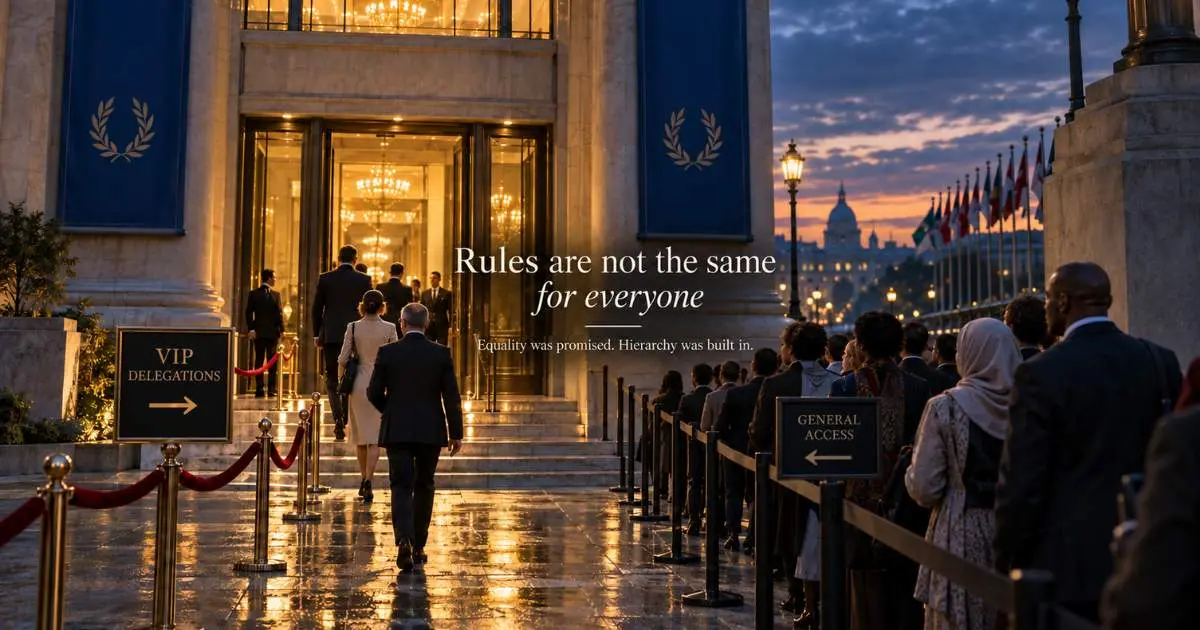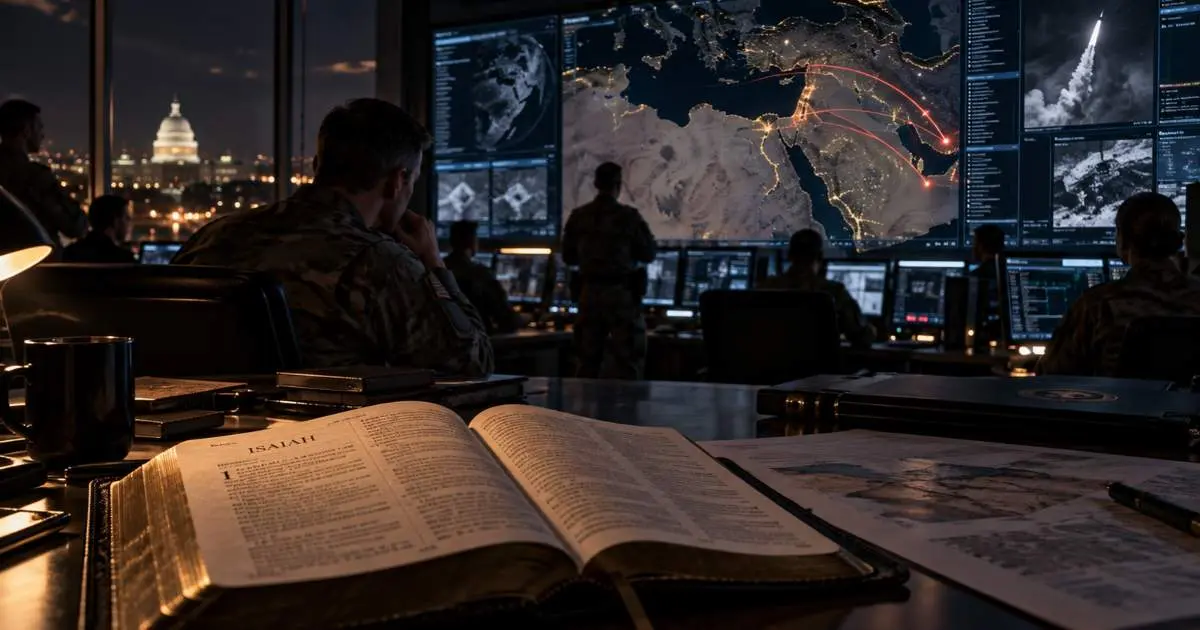
At a moment when Washington is again weighing military action against Iran, senior American officials are speaking openly about Isaiah, the Antichrist and the end times. The question is not whether political leaders are entitled to believe. It is what must remain between private revelation and public force.
“Here I Am. Send Me.”
Near the end of a recent address to American military personnel, U.S. Defense Secretary Pete Hegseth moved from policy announcements to something older than the republic he serves. He invoked the sixth chapter of Isaiah, where the prophet responds to God’s call with the words, “Here I am. Send me.” Hegseth then carried the phrase through a compressed history of American warfare: send me to fight the Redcoats, send me to fight the communists, send me to fight the Islamists. The speech continued in the language of the warrior: service members were “set apart,” comfortable inside violence so civilians could live peacefully, with lethality as their calling card and victory as the acceptable end state.
It would be easy to extract those lines, place them beside images of aircraft carriers moving toward the Middle East and declare that prophecy now commands the American military. That would be dramatic, and it would also claim more than the evidence can support. In the same speech, Hegseth reminded those listening that they had sworn an oath to the Constitution. The religious vocabulary and the constitutional vocabulary did not appear in separate speeches; they occupied the same one.
That coexistence is more interesting than the simpler accusation. The question is not whether Hegseth secretly receives his orders from Isaiah, for which there is no evidence. Nor is it whether a Christian may lead an armed force in a constitutional democracy. The harder question begins precisely because both claims can be true at once: a senior official can understand his vocation through faith while exercising power through institutions that are supposed to require reasons larger than his faith.
There has always been a distance between those two things. Inside that distance sit the Constitution, Congress, military law, professional command structures, intelligence assessments, civilian oversight, international law, strategy, evidence, dissent and the possibility that yesterday’s judgment may prove wrong tomorrow. Modern democratic government depends on that space being large enough to prevent a conviction held with absolute personal certainty from becoming an order merely because the person holding it possesses authority.
Religion and war have met throughout American history, often quite openly. What makes the present moment worth examining is not that a leader has mentioned God. It is that language about divine mission, biblical enemies and the end of history is appearing near institutions capable of making decisions whose consequences cannot be recalled once the missile leaves the launcher.
America Has Heard God Before
Any argument that begins with the idea that religion has suddenly entered American politics will fail historically. It never left.
Presidents have prayed publicly, invoked providence, quoted scripture and ended speeches by asking God to bless the United States. Abraham Lincoln interpreted the Civil War through a profound religious vocabulary without claiming privileged access to God’s intentions. Franklin Roosevelt led the country in prayer during the Normandy landings. Ronald Reagan described America in almost biblical images. George W. Bush repeatedly framed the post-September 11 struggle in moral language, including an explicit opposition between good and evil, while at the same time insisting that the United States was not at war with Islam.
Bush went further in his second inaugural address. He linked American security with the global advance of liberty, referred to human beings as bearing the image of their Maker and described history as having a visible direction associated with liberty and its divine Author. Yet the same speech explicitly rejected the idea that Americans should think of themselves as a chosen nation whose political preferences simply revealed God’s will.
This is part of what scholars have long called American civil religion: a vocabulary in which national history, sacrifice, providence and moral purpose borrow religious forms without necessarily turning government into a church. “God bless America” is not the same proposition as “the Antichrist may already be among us.” Saying that a country should pursue justice because justice is morally right is not the same thing as placing a contemporary geopolitical conflict inside a timetable of sacred history.
The distinction is essential because religious rhetoric exists on a spectrum. At one end lies personal belief: a public official prays, attends church or explains that faith shapes his character. Further along lies civil religion, in which God appears as witness to a national project. Beyond that comes moral absolutism, where political opponents or foreign enemies are cast as representatives of good and evil. A further step is eschatological language: the Antichrist, the end times, prophecy and a history whose destination has already been disclosed through revelation.
A democracy can contain all four. The political implications, however, are not identical.
That is why treating every reference to God as evidence of theocracy is intellectually lazy. It also makes it harder to recognise the moment when familiar religious language crosses into a different category. The issue is not the volume of religious vocabulary but the work that vocabulary is being asked to perform.
When the End Times Become Ordinary Political Language
Vice President JD Vance has made that problem unusually visible.
In an August 2026 conversation on a Christian podcast, Vance said he had been fascinated by end-times theology since childhood. He said he would not be shocked if humanity were living in the end times and spoke about doing as much of “God’s work” as possible, adding that if this led to the end times, that was “okay,” while immediately adding that it would also be good if the result were a better world that endured long after his death. He has also spoken about the possibility that the Antichrist could already be alive. The full context matters: Vance did not say that his political programme was designed to cause an apocalypse, and he acknowledged uncertainty about whether the end times were near at all.
The significance of the remarks lies elsewhere. The vice president of the United States can discuss the Antichrist and the possible approach of the end times without needing to explain the concepts to a large part of the audience. They belong to a religious language that remains socially intelligible in America even when many Americans reject it.
A 2022 Pew Research Center survey of more than 10,000 U.S. adults found that 39 percent believed humanity was living in the end times. The figure rose to 63 percent among evangelical Protestants. Fifty-five percent of American adults said Jesus would someday return to Earth, including 92 percent of evangelical Protestants. Those figures are not a measure of opinion in 2026 and should not be treated as one, but they establish that eschatological belief was far from an exotic fringe phenomenon in the United States.
Even that requires care. Believing that Christ will return is not equivalent to wanting nuclear war, supporting a particular Middle Eastern policy or believing that politicians should accelerate history. Christian traditions disagree sharply over prophecy, the meaning of biblical texts and whether attempts to identify contemporary events with apocalyptic predictions are legitimate. Millions of religious Americans who believe in a second coming would reject the notion that governments should act to hasten it.
The political question is therefore not what Christians believe about the end of the world. It is what happens when a concept that belongs to theology migrates into the vocabulary of people who must make decisions about this world.
That migration matters because political language does not merely describe reality. It helps define which choices appear honourable, which compromises appear shameful, which enemies appear temporary and which appear metaphysical. Once an opponent has become part of a sacred drama, the meaning of defeating him can quietly change.
The Bargaining Problem of Sacred History
Wars fought over ordinary interests can be terrible, but interests possess one useful property: they can change.
A government may decide that a port, buffer zone, sanctions regime or military objective is worth a certain cost and later decide that it is not. Diplomacy depends on this flexibility. Negotiators exchange territory, guarantees, prisoners, access, recognition, sanctions relief, security arrangements or money because political interests can usually be translated into things that can be traded.
Sacred values behave differently.
Research by Jeremy Ginges, Scott Atran and others has found that when people regard an issue as sacred rather than material, conventional bargaining can become less effective. In studies involving Israelis and Palestinians, material incentives offered in exchange for compromising sacred values sometimes increased outrage and resistance rather than reducing them. Related research involving Iran found similar problems when issues tied to national and moral identity were treated as if they were ordinary transactions. Sacred values are not exclusively religious; nationalism, honour, territory, justice and collective identity can all become non-negotiable in similar ways.
That offers a more useful way to think about prophecy in politics than simply asking whether a leader is devout. The political risk appears when an objective moves from the category of interest into the category of duty. A disputed territory may be strategically valuable, but a promised land is harder to exchange. A hostile government may be dangerous, but an incarnation of cosmic evil is harder to bargain with. A war can be stopped when its price exceeds its gains; a sacred mission can interpret the price itself as proof of the need for greater sacrifice.
This does not mean sacred values make peace impossible. Research in the same field has found that symbolic recognition and gestures of respect toward an adversary’s sacred values can sometimes make compromise easier where material inducements fail. The mechanism is therefore not “religion causes endless war.” It is subtler: when political objectives become morally non-fungible, the logic by which bargaining normally works changes.
Prophecy adds another element because it can give history not only moral meaning but direction. If history is imagined as open, leaders must continually ask what their actions are producing. If history is imagined as moving toward a divinely disclosed destination, events can instead be interpreted as confirmation. Escalation may demonstrate that prophecy is unfolding; setbacks may demonstrate that faith is being tested; resistance may confirm that evil is resisting defeat.
This is the bargaining problem of sacred history. It does not require a leader to announce that God ordered a bombing. It begins earlier, when the conceptual space in which alternatives are evaluated becomes narrower because one outcome appears not merely preferable but written into the moral structure of history itself.
The Middle East Is Not an Empty Stage for Someone Else’s Prophecy
The problem becomes more concrete in the Middle East because several political traditions operating there attach sacred meaning to the same geography.
Within Israel, biblical attachment to the land does not automatically determine government policy, and Israeli society remains deeply divided over religion, territory, war and the future of the Palestinians. Yet religious-nationalist politicians have become important participants in government. Reuters reported in 2026 that Finance Minister Bezalel Smotrich’s Religious Zionism movement grounds Jewish claims to territory between the Jordan River and the Mediterranean Sea in the Bible; Smotrich has also advocated policies aimed at extending Israeli sovereignty over the occupied West Bank, while opposing Palestinian statehood.
Itamar Ben-Gvir has similarly fused religion, sovereignty and war in highly symbolic spaces. In 2025 he prayed at the Al-Aqsa Mosque compound—known to Jews as the Temple Mount—while calling for “complete victory” in Gaza, challenging a long-standing arrangement governing worship at one of the most sensitive religious sites in the region. These positions represent particular currents within Israeli politics, not “what Jews believe,” just as Vance’s remarks cannot stand for American Christianity as a whole.
Iran, meanwhile, is formally an Islamic republic whose institutions have their own religious vocabulary of sacrifice, martyrdom and resistance. Islamist movements elsewhere have likewise used revelation and sacred history to legitimise violence. The phenomenon does not become harmless when its scripture changes. A serious standard must work in Tehran, Jerusalem and Washington alike.
But symmetry should not become a substitute for analysis. These states do not possess identical institutions, military capabilities, political systems or relationships with religion. Nor does every invocation of scripture have the same proximity to actual command authority. The useful comparison is narrower: across different political traditions, sacred narratives can convert disputes over policy into disputes over destiny.
The people living inside those territories are more plural than the narratives imposed upon them. An Iranian family under bombardment does not become part of Christian eschatology because an American politician interprets history through that lens. A secular Israeli is not automatically committed to the biblical territorial vision of a religious-nationalist minister. A Palestinian Muslim or Christian does not become a symbolic figure in another society’s prophecy simply because Jerusalem occupies a place in that prophecy.
This is where the human cost of sacred certainty becomes visible. People with armies can tell stories about history; people beneath those armies are required to live inside the consequences even when they do not believe the story.
The Firewall Between Faith and Command
American constitutional government does not require leaders to leave religion at home. The First Amendment protects religious exercise while restraining the government from establishing religion, and the Constitution prohibits religious tests for public office. A secular state in the American sense is therefore not a state populated by secular people; it is a state in which public authority is not supposed to depend upon belonging to the correct faith.
The military makes the tension sharper because hierarchy changes the meaning of speech. A general speaking about religion to a subordinate is not simply one citizen talking to another citizen. Rank carries authority, career consequences and an expectation of obedience, which is why U.S. military guidance has repeatedly recognised that commanders enjoy religious freedom while also bearing special responsibility not to make their personal faith appear to be the institution’s official faith.
Air Force guidance has warned that words or actions by superiors should not reasonably appear to constitute official religious endorsement, and senior Air Force officials have acknowledged that strongly expressed faith by commanders can place subordinates in uncomfortable positions even where coercion is not intended. Military legal analysis has similarly noted that what appears to be personal religious expression can take on a different character when rank and command authority enter the room.
This is the firewall between faith and command. It is not hostility to religion. It is the recognition that a private conviction gains a different political weight when held by somebody whose words help shape institutional purpose and whose orders others are legally obliged to obey.
The same firewall operates beyond religion. Military officers are not supposed to convert partisan loyalty, personal ideology or private vendettas into the basis of lawful command either. The democratic principle is larger than secularism: coercive public power requires reasons that belong to the office, not merely convictions that belong to the officeholder.
That makes Hegseth’s speech worth examining without pretending it proves a theocratic military policy. He invoked Isaiah and a chain of historical enemies, but he also invoked the Constitution. The unresolved question is what happens when those two languages point in different directions.
If intelligence says a war cannot achieve its aims, if diplomacy offers an imperfect settlement, if Congress objects, if allies withdraw support, if commanders judge escalation strategically unsound, what kind of argument carries the greatest weight? A constitutional system is designed so that “God wants this” cannot settle that dispute. The distance between prophecy and the missile consists largely of institutions built to ensure that no single person gets to answer the question alone.
A Real War Makes the Question Less Theoretical
This would be an interesting debate in peacetime. The United States is not in peacetime with Iran.
The current conflict began on February 28, 2026, when the United States and Israel launched major strikes against Iran; Iran responded with attacks against Israel, U.S. forces and targets elsewhere in the region. The fighting has since moved through periods of escalation, ceasefire and renewed confrontation. As of early October, Washington is again increasing its military presence in the Middle East, including thousands of additional troops and a third aircraft carrier, while President Donald Trump has publicly left open the possibility of renewed attacks if negotiations fail.
The legal question is separate from the theological one and should remain separate. Article 2 of the UN Charter prohibits the threat or use of force against another state except within the legal framework of the Charter, while Article 51 preserves the inherent right of individual or collective self-defence when an armed attack occurs. The United States formally notified the Security Council that its February operations were undertaken in self-defence and described them as necessary and proportionate; UN officials, while calling for de-escalation and respect for the Charter, emphasised the general prohibition on the use of force. Other legal organisations have rejected the American justification and described the initial attacks as unlawful.
The sequence of events is therefore clear: U.S. and Israeli strikes opened the February 28 round of direct hostilities, and Iran retaliated. Whether the first strikes qualified legally as permissible self-defence is a contested legal question, not something that can be settled by calling one side righteous or wicked. The word “aggression” carries legal as well as political implications and should not be inferred merely from a leader’s religious language.
That distinction is exactly why prophecy matters politically but cannot supply legal legitimacy. Isaiah is not an additional article of the UN Charter. A biblical interpretation cannot create a right to use force that international law does not otherwise recognise, just as an Islamic theological claim by Iran could not do so.
When governments kill across borders, they owe the world arguments that can be examined without first accepting their theology. Evidence of threat can be challenged. Claims of necessity can be tested. Proportionality can be disputed. Intelligence can be wrong. Strategic assumptions can fail. Legal arguments can be rejected by courts, governments and scholars.
Prophecy works differently. Its authority depends precisely on a source that cannot be audited by the institutions asked to act upon it.
The distinction between those forms of reasoning is not a technical curiosity. It may be one of the most important distances a modern state has to preserve.
Certainty Is Not the Same as Faith
There is an obvious danger in this argument: it could become a disguised claim that religious people are uniquely incapable of restraint.
History offers too much evidence against that proposition. Secular ideologies have sacralised nations, races, revolutions and classes with consequences as absolute as any theology. Political movements that rejected religion have described history as inevitable, enemies as irredeemable and sacrifice as morally necessary. Nothing in atheism guarantees humility.
The relevant distinction is therefore not believer versus non-believer. It is between conviction and corrigibility.
A leader may believe deeply that a policy is right while accepting that the intelligence may be incomplete, the means may fail, the law may prohibit certain actions and the opponent may possess legitimate interests. Another leader may hold no religious belief whatsoever and still treat his ideology as a truth beyond evidence. Political restraint depends less on the absence of conviction than on the continued existence of mechanisms capable of saying: you may be wrong.
Sacred certainty becomes politically consequential when that sentence becomes harder to utter.
This is why the research on sacred values matters. People protect values such as country, justice, honour and religion precisely because some things should not simply be sold to the highest bidder. Political communities could not exist if every principle had a price. The problem comes when every element of a conflict acquires that status, leaving no distinction between the principle that must be defended and the policy through which leaders currently propose to defend it.
A society may regard national survival as non-negotiable while negotiating borders. It may regard human dignity as sacred while bargaining over sanctions. A religious believer may consider faith absolute while regarding a military timetable as entirely fallible. The ability to make those distinctions is what keeps moral seriousness from becoming political rigidity.
Prophecy becomes especially potent when it collapses them.
The Person Who Does Not Share the Revelation
There is another reason public power needs reasons that exceed private conviction: the people governed by that power do not share a single metaphysics.
An American service member may be Christian, Jewish, Muslim, Hindu, atheist or uncertain. The citizen paying for a military operation may regard the Bible as revelation, literature or neither. The Iranian civilian whose city lies beneath American aircraft may inhabit a theological universe entirely different from the one invoked by an American cabinet official.
A constitutional democracy does not solve this disagreement by deciding which theology is true. It creates political forms through which people who disagree about ultimate truth can nevertheless share a state.
That arrangement is often described rather bloodlessly as pluralism. In questions of war, it is more tangible than that. It means that a person should not need to share the president’s religion to understand why his country is going to war. A soldier should not have to accept his secretary’s interpretation of Isaiah to understand the mission for which he may be asked to die. An adversary should not need to defeat an American theology before negotiating an American policy.
The same principle applies elsewhere. Israeli citizens should be able to debate borders without first settling the theological meaning of ancient scripture. Iranians should be able to debate nuclear policy or war without accepting the clerical establishment’s religious account of resistance. Palestinians should not have their political future reduced to a supporting role in either Jewish or Christian sacred history.
The person who does not share the prophecy is the best test of whether the distance is still intact.
If the policy can be justified to that person through law, evidence, security, interests and publicly contestable moral argument, faith may coexist with state power without replacing it. If the final answer becomes that history has already been written and the leader merely understands the script, democratic argument has reached a boundary it cannot cross.
The Distance
The disturbing element in contemporary religious rhetoric is therefore not the fact that powerful people believe in God. America has produced presidents of profound faith, generals who prayed before battle and political movements shaped by religious conviction. A democracy capable of accommodating religion should not demand spiritual emptiness from public officials.
Nor does the available evidence establish that JD Vance’s interest in the end times caused an American military decision, or that Pete Hegseth’s reading of Isaiah produced a particular strike plan. Making either claim would convert an important question into an accusation we cannot prove. The evidence shows something narrower: eschatological vocabulary is being spoken openly at high levels of American political life while the country is engaged in an unresolved war and considering further uses of force.
That is enough to make the boundary worth watching.
The institutions between conviction and coercion exist because human beings are capable of being sincerely, morally and catastrophically certain. Constitutions slow them down. Laws demand categories and evidence. Military professionalism separates orders from revelation. Diplomacy forces leaders to encounter people whose account of history is different from their own. Negotiation leaves open the possibility that an enemy today may be the party to an agreement tomorrow.
None of those institutions can determine whether a prophecy is true. That is precisely why prophecy cannot be allowed to do their work for them.
The distance between prophecy and the missile is filled by everything politics has built to make power answerable before it becomes irreversible. The danger does not begin when a leader believes that history has a sacred meaning; it begins when the institutions around that leader cease to require that missiles be justified by something more contestable than his certainty about what that meaning is.
In an age when weapons can cross borders in minutes and leaders can speak to millions in seconds, that distance may look frustratingly slow. It is meant to be. The time required for law, evidence, dissent, negotiation and second thoughts is not an obstacle standing between conviction and action. It is the space in which politics remains politics before someone turns belief into fire.