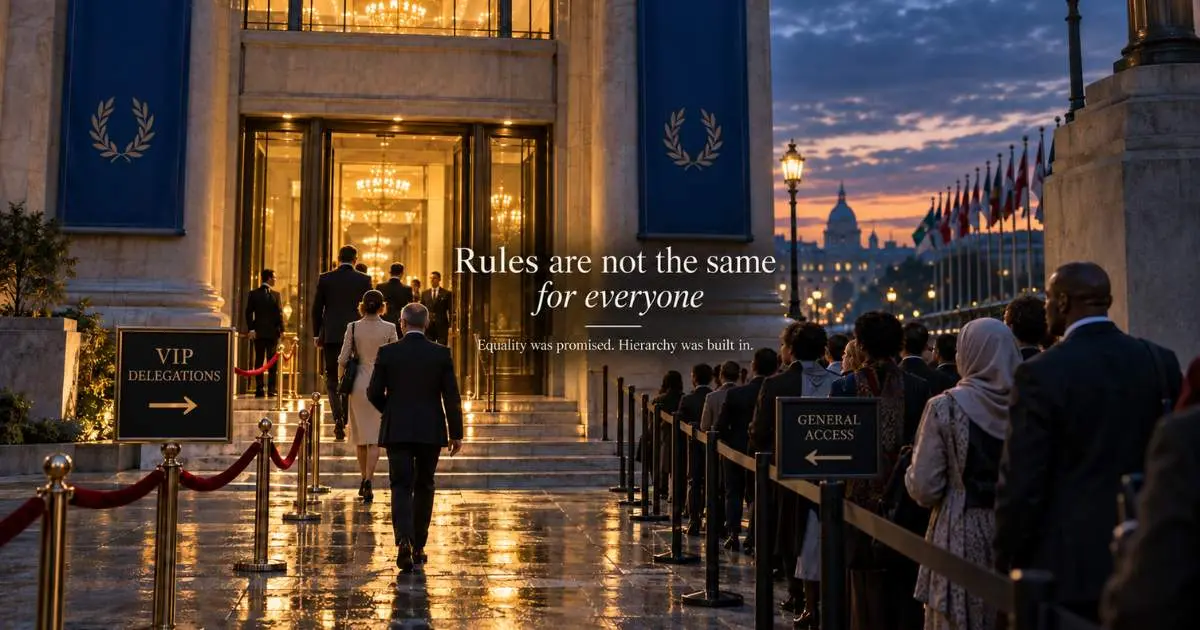
UN Security Council reform reveals how wider participation can coexist with permanent privilege—and how correcting one inequality can entrench another. Decolonisation transformed the United Nations: its membership, its agenda and the coalitions that made its decisions. Yet the authority to revise its founding bargain remained unequally distributed.
On 11 March 1965, McGeorge Bundy sent President Lyndon Johnson a memorandum about problems facing the United Nations. Among them was a proposed enlargement of the Security Council, already approved by the General Assembly but still awaiting sufficient national ratifications. Bundy reported that the Soviet Union had reversed its position, “primarily because of Afro/Asian pressure”. He also warned that Washington risked bearing exclusive blame for delaying the amendments if it failed to move them forward. Governments admitted to an institution designed largely without them were making obstruction politically expensive.
The episode complicates a familiar account of the UN as an organisation frozen in 1945. Its rules could change, and recently independent countries helped change them. The enlargement that took effect in 1965 altered the arithmetic of the Council’s decisions, increasing the votes that even a united group of permanent members needed from elected members. But it left a different power intact: every permanent member’s ratification was still required before an amendment to the Charter could enter into force.
The reform exposed a division of authority that still runs through the organisation. States could reshape the agenda and the standards by which conduct was judged; they could gain seats and become more necessary to a decision; and they could possess a privileged right to prevent the rules themselves from changing. Decolonisation transformed the first two forms of authority much more than the third. Its unfinished character, in this institutional sense, lies in the distance between becoming a participant and acquiring equal standing in deciding how permanent privilege may be revised. The five permanent members have different histories and conflicting interests; the argument concerns the constitutional protection they share, rather than a single colonial project attributed to all of them.
The Price of Bringing Power Inside
The founders of the United Nations were negotiating with governments whose cooperation could determine whether collective security existed beyond the text of a treaty. During the war, Franklin Roosevelt envisaged the United States, Britain, the Soviet Union and China as the principal enforcers of peace. Plans developed at Dumbarton Oaks in 1944 and the voting arrangements negotiated at Yalta in 1945 connected a general organisation of states to a council with specially protected powers. France joined the permanent category in the settlement completed at San Francisco. This was a bargain assembled through wartime diplomacy, with the prevention of another catastrophic conflict as its overriding justification.
There was a practical argument behind the inequality. An institution dependent on states for military capacity, finance and implementation could not assume that a vote would compel the strongest governments to act against interests they considered vital. The veto assured them that collective enforcement decisions would not be adopted over their opposition. Its defenders could therefore present privilege as part of the price of keeping indispensable powers inside a common framework. The question was never simply whether equal votes were more attractive in principle; it was whether an organisation denied their cooperation could perform the functions assigned to it.
That bargain did not exempt the permanent members from the Charter’s obligations. The prohibition on unlawful force and the duty to fulfil commitments in good faith applied to them too. A veto can obstruct a collective response to unlawful conduct without making the conduct lawful. The resulting problem is an asymmetry in the institution’s ability to respond, embedded within a treaty that also affirms the sovereign equality of its members.
Explaining the bargain’s origin does not establish the necessity of preserving every part of it indefinitely. The need to secure cooperation, the appropriate scope of a guarantee and the conditions under which that guarantee may be revised are separate questions. A safeguard negotiated to make an organisation possible can later protect arrangements that weaken its authority. For the states emerging from colonial rule, this was also a problem of sequence: they entered after the founding terms had been settled, and would have to organise from within the institution to alter them.
Independence Learns the Arithmetic
The new members did more than enlarge the audience for speeches. They changed the political work the organisation could perform. On 14 December 1960, the General Assembly adopted Resolution 1514, the Declaration on the Granting of Independence to Colonial Countries and Peoples. Its adopted text came from an Asian-African initiative eventually sponsored by 43 delegations, following an earlier Soviet proposal. The declaration affirmed the right of peoples to self-determination and rejected inadequate preparedness as a justification for delaying independence. It helped challenge the claim that colonial powers could determine when subject peoples were ready to govern themselves.
Independence struggles and shifts in international power made that declaration possible; the declaration, in turn, supplied an authoritative language through which further claims could be advanced. Decolonisation was changing both who belonged to the organisation and what counted as a defensible position within it. As Adom Getachew shows in Worldmaking after Empire, important African and Caribbean anticolonial thinkers understood national independence as part of a larger effort to transform international hierarchy. Their projects included regional federation and changes to the economic order. Those ambitions varied, but they expose the inadequacy of treating admission to existing institutions as the complete political meaning of liberation.
The effort to enlarge the Security Council brought that ambition into a precise institutional dispute. On 17 December 1963, through Resolution 1991 A (XVIII), the General Assembly adopted amendments raising Council membership from eleven to fifteen and the affirmative votes required for decisions from seven to nine. The Soviet Union and France voted against the enlargement; the United States and Britain abstained. China, then represented by the Republic of China, supported it. All five eventually ratified the amendments, which entered into force on 31 August 1965. Opposition in the Assembly had not predetermined what governments would do when faced with the political consequences of withholding ratification.
The change redistributed some decision-making power. If all five permanent members voted in favour, the old Council required two affirmative votes from its six elected members. The enlarged Council required four from its ten. The permanent members could still prevent a substantive decision, but could not produce one by themselves; their need for support from elected members had increased. That gave more governments a consequential part in negotiations over the decisions eventually put to a vote. The reform changed participation in the exercise of authority, even as it preserved the permanent seats and the veto.
The American defence of ratification made the bargain explicit. In his April 1965 message to the Senate, Johnson argued for improved representation while assuring legislators that the amendments would “fully protect the basic interests of the Permanent Members”. The administration openly presented adaptation and preservation as compatible achievements. Newly independent states had secured a real change through pressure and negotiation, within a settlement that continued to protect another category of power.
The Consent Behind UN Security Council Reform
The veto usually appears as a hand raised against a draft resolution. Article 27 governs this familiar form of obstruction: substantive Council decisions require the necessary affirmative votes without a negative vote from a permanent member. A permanent member’s abstention does not, under established practice, prevent adoption. Procedural decisions are not subject to that veto, while the Charter requires a party to a dispute to abstain on specified peaceful-settlement decisions. Even inside the Council, permanent membership does not confer an unrestricted right to stop everything the institution might do.
Article 108 protects a different position. An amendment must first be adopted by two-thirds of the General Assembly’s members. It must then be ratified, through national constitutional procedures, by two-thirds of the UN’s members, including every permanent member of the Security Council. Adoption and ratification are separate stages. Support expressed in New York is not a substitute for completing the required process in national capitals. A permanent member can therefore prevent an amendment from entering into force by withholding ratification, even when the necessary majority elsewhere has been secured.
The alternative review procedure does not remove that final requirement. Under Article 109, a Charter review conference can be convened with support from two-thirds of the General Assembly and any nine Council members, without the agreement of all five permanent members. But alterations recommended by the conference still need ratification by two-thirds of the membership, including all the permanent members. The route to opening a formal reconsideration is more accessible than the route to making its outcome binding. That difference leaves room for political mobilisation while preserving the permanent members’ final protection against changes to the Charter.
The organisation can still develop through the use of existing powers, changes in practice and mechanisms established without a Charter amendment. Article 108 also cannot explain every failed reform proposal: rival candidates, incompatible models and insufficient support may stop a proposal long before ratification becomes relevant. It establishes an unequal bargaining position at the end of the process, where most members must assemble a sufficiently large coalition to change the text and each permanent member retains an individually indispensable consent. The political cost of withholding that consent can rise, as the history of enlargement demonstrates. But a campaign that persuades a government to ratify achieves a victory within the arrangement; a rule allowing ratification to proceed without it would alter the arrangement itself.
What a Majority Can Build
Accounts that locate all meaningful authority in the Security Council obscure how much the General Assembly can do. It approves the organisation’s budget and apportions its expenses, elects the Council’s non-permanent members and can establish subsidiary organs needed for its functions. Within its Charter responsibilities, it commissions work, organises institutions and allocates resources. These are decisions with practical and institutional consequences, not simply expressions of world opinion. A majority that controls an appropriation or establishes a functioning body has exercised a different kind of authority from one that merely endorses a declaration.
The Assembly’s role in accountability offers a concrete example. In December 2016, it created the International, Impartial and Independent Mechanism for Syria, tasked with collecting and analysing evidence and preparing files to assist competent courts investigating serious international crimes. The mechanism does not itself prosecute or deliver judgments. Its value lies in work that can make prosecutions elsewhere possible: preserving material, developing evidence and supporting judicial authorities. Establishing that capacity was an institutional intervention, with consequences extending beyond the Assembly chamber.
The legal boundary remains important. The Assembly’s broad powers to discuss peace and security and recommend measures do not amount to the Council’s authority to impose mandatory enforcement measures under the Charter. The Uniting for Peace procedure, adopted in 1950, provides a route for Assembly consideration when the Council is blocked; it does not automatically transfer those enforcement powers. Equally, a Council resolution’s legal effect depends on its content and Charter basis. Treating every Assembly resolution as legally empty, or every Council resolution as identically binding, confuses institutional location with the authority actually exercised.
For smaller states, this creates opportunities as well as frustration. They may be unable to secure a binding response through the Council yet still organise evidence, sustain an issue on the international agenda or establish machinery that other institutions can use. Those achievements can affect later action, even when they do not compel the government whose behaviour prompted them. Their significance should be judged through what they make possible, rather than inflated into a substitute for powers they do not possess. The history of decolonisation is partly a history of states learning to use such openings.
The Dispute Among the Excluded
Once reform is examined as a distribution of different powers, agreement that the Council should be more representative becomes less conclusive than it sounds. Governments can agree on the inadequacy of the existing arrangement while seeking substantially different successors. They may disagree about whether equality means enlarging the permanent category, abolishing its privileges or making access to influential seats renewable. Each answer creates a different relationship between authority, continuity and the possibility of replacement.
The African position makes the inequality of status particularly clear. The Ezulwini Consensus and subsequent African Union positions oppose the veto in principle while demanding its extension to new permanent members for as long as it exists. The African Group’s 2026 model seeks at least two permanent seats and five elected seats for Africa. This is a coherent objection to being offered membership permanently inferior to that enjoyed by existing permanent members. Accepting lesser rights could institutionalise the very distinction that the demand for equal status seeks to overcome.
Yet equality within the permanent category and equality across the organisation point towards different outcomes. Extending the veto would remove a hierarchy between old and new permanent members while leaving, and enlarging, the hierarchy between permanent and elected members. A reform can correct a serious geographical injustice while preserving a constitutional principle whose effects will continue to be contested by those outside the enlarged category.
The G4—Brazil, Germany, India and Japan—also advocates expansion in both permanent and elected membership. In a January 2025 statement, it envisaged new permanent members refraining from exercising the veto pending a decision during a later review. Uniting for Consensus, whose members include Italy, Pakistan, the Republic of Korea and Mexico, reiterated its opposition to additional permanent seats in September 2026, favouring enlargement of the elected category, including longer-term rotating seats. These are negotiating positions, not agreed changes to the Charter. They offer competing answers to whether durable influence requires permanent national possession of a seat.
Regional representation introduces another set of choices. The African Group envisages selection by the African Union followed by election in the General Assembly. But a seat allocated to a state because it comes from an underrepresented region is not, for that reason alone, a seat controlled by the region. The relevant arrangements must establish who chooses its occupant, whose instructions it follows and whether it can be replaced. A national government can bring regional experience into the Council while remaining answerable principally to its own authorities. The label on a seat cannot resolve the political relationship behind it.
There is also a constitutional consequence that debates about the veto can overlook. If new permanent members were added while Article 108 retained its existing requirement without an exception, their ratifications would also become necessary for future amendments under that article—even if they did not acquire the Article 27 veto over Council decisions. That is a conditional reading of the present wording, not a prediction about every reform model; the actual amendment could address it differently. It means that withholding one form of veto does not, by itself, establish that permanent membership carries no additional power to obstruct future constitutional change.
The competing proposals deserve scrutiny without an artificial equalisation of responsibility. A coalition struggling to agree on its preferred alternative occupies a different position from a state already holding an indispensable ratification. Disagreement among those seeking reform can delay change; permanent members possess an additional legal protection against a proposal that survives that disagreement. The existence of interests on every side does not make the powers on every side equivalent. It makes it necessary to identify which interests are backed by which institutional rights.
What the Realists Still Have to Prove
The strongest defence of the existing arrangement begins with a genuine constraint: institutions cannot implement decisions using authority alone. Governments supply troops, money, access, logistical capacity and cooperation with enforcement. A majority cannot vote those resources into existence, and a more representative Council would still face the question of who will act when action becomes costly. An organisation that systematically ignores the interests of the powers capable of frustrating its work risks becoming ineffective in a different way.
Yet that argument must establish more than the necessity of cooperation. It must explain why cooperation requires the particular guarantees in question, why those guarantees need to remain permanent and why their alteration must depend on each beneficiary’s ratification. Those propositions do not follow automatically from one another. Military and economic capacity can justify paying close attention to a government’s position without resolving how its institutional privileges should be designed. The practical need to negotiate with power leaves open the constitutional terms of that negotiation.
There is an additional difficulty in invoking contemporary geopolitical realities to justify new permanent seats. If representation should track a changing distribution of influence, the arrangement must explain how it will accommodate the next change. A settlement can improve its fit with the present while making revision harder in the future. Permanence relieves its beneficiaries of the need to keep demonstrating that the original case for their exceptional status remains persuasive. The argument from changing circumstances becomes incomplete when it ends with guarantees designed to survive further changes.
Nor can sovereign equality resolve every problem of representation. States differ enormously in population, and their governments differ in accountability to the people they claim to represent. Equal votes among governments are not the same thing as equal political influence among human beings. Increasing Africa’s or Latin America’s institutional weight could correct a major imbalance without creating a world parliament or ensuring that citizens can discipline their international representatives. Those are distinct questions of justice, and the strength of one claim should not be made to depend on pretending it answers all the others.
Effectiveness also requires a more careful test than counting seats. A larger Council might find agreement more difficult, but it might also draw on wider knowledge, secure greater acceptance or obtain cooperation that a narrower body lacks. Adding veto holders and adding elected members need not have the same effect on its decisions. The outcome depends on the voting rules, the distribution of responsibilities and the working arrangements that accompany enlargement. A serious defence of reform must examine those consequences; a serious defence of the status quo must allow that legitimacy can contribute to the capacity to act.
The Reform After the Reform
A proposal for UN Security Council reform should therefore be read partly as a set of instructions for future disagreements. Its seat allocations show who will participate, while its voting thresholds show whose support will be needed and which combinations of members can prevent a decision. Its arrangements for selection and replacement show what accountability is available. Its amendment provisions determine whether the resulting distribution can be revisited without every newly privileged government’s consent. These details reveal more than a general promise to make the Council reflect the world.
Change can also be evaluated at a smaller scale. On 26 April 2022, the General Assembly adopted Resolution 76/262, providing for an Assembly debate within ten working days after a permanent member casts a veto, unless the Assembly is meeting in an emergency special session on the same situation. The resolution does not overturn the veto or oblige its author to accept the blocked proposal. It establishes a regular forum in which the wider membership can contest the situation and the use of obstruction. Its achievement lies in widening scrutiny, with its significance dependent on what governments subsequently do with that opportunity.
The gain can be specified without confusing scrutiny with a power to reverse the decision. A voluntary promise of restraint must likewise be distinguished from a binding alteration of voting rules. Longer elected terms require attention to the conditions of renewal: genuine competition offers a possibility of replacement that effectively guaranteed reelection would erode. Reform need not abolish every inequality to be consequential, but its achievements should be described through the powers actually transferred and the opportunities that remain available to others.
Promises of a future review require the same discipline. A scheduled meeting can reopen discussion without guaranteeing that any change will follow. Its value depends on who can initiate it, what can be reconsidered, how decisions are reached and what ratifications will still be necessary. If a review merely returns a disputed privilege to the beneficiaries whose approval was already indispensable, it has preserved an opportunity to negotiate rather than secured an outcome. Governments accepting a compromise should know which of those things they have obtained.
The states seeking a different Council are negotiating both for themselves and for governments that will inherit the settlement after another transformation of world politics. Their exclusion gives them good reason to demand a place; it also gives them experience of what permanent protection can cost everyone outside it. When they reach an agreement, the decisive evidence of its ambition will be in the provisions governing the next revision. Those provisions will show whether tomorrow’s dissatisfied majority has gained a more usable route to change, or simply a longer list of governments whose permission it must obtain.