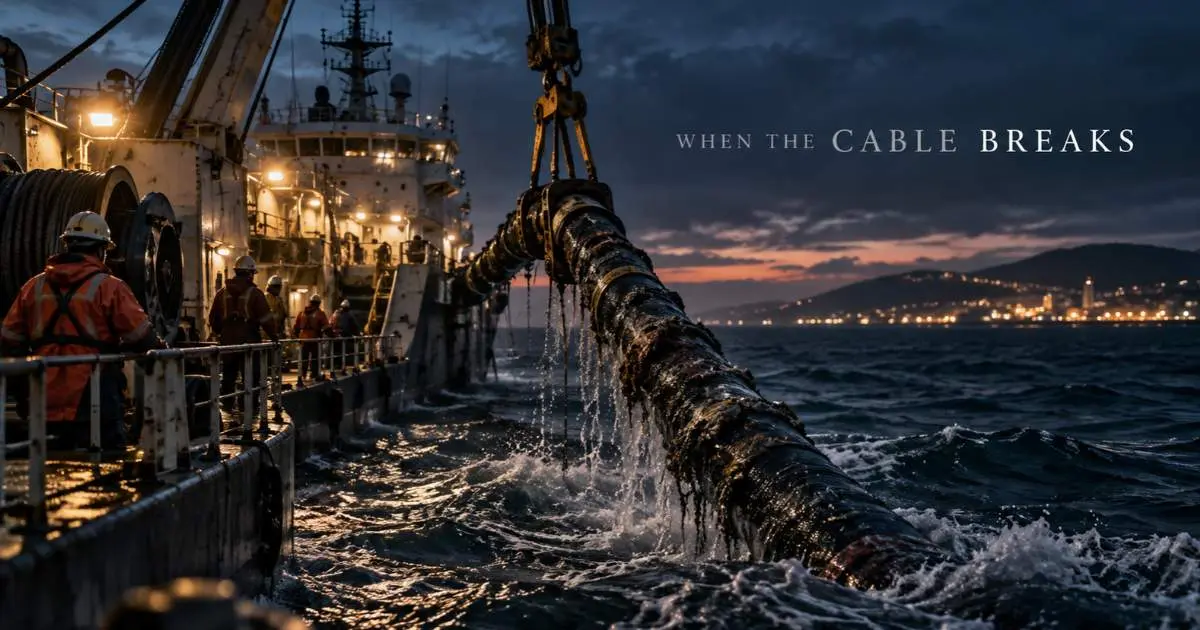
Governments are learning to watch the ships that might damage the cables carrying the world’s data. The less glamorous question begins after the cut: who has the vessel, the spare cable, the permission, the protected sea lane and the authority to decide which broken connection gets repaired first?
Everyone Is Watching the Saboteur
In the spring of 2026, British, Norwegian and American forces tracked Russian undersea activity near Svalbard, where fibre-optic cables link the Arctic archipelago to mainland Norway and support communications connected to satellite infrastructure. Western officials later told Reuters that they believed a specialist Russian undersea unit had been testing techniques that could be used against sensitive cables. Nothing was cut, and Russia has denied accusations that it plans to sabotage NATO infrastructure. The episode nevertheless fitted an increasingly familiar European story: strategic cables lie on the seabed, adversaries know where they are, and governments have begun treating some of the ships and submarines moving around them as potential national-security threats.
That story is real, but it can distort the problem. The International Cable Protection Committee estimates that submarine telecommunications cables suffer roughly 150 to 200 faults worldwide in an ordinary year. Around 70 to 80 per cent are caused not by hostile intelligence services but by accidental human activity, especially fishing gear and anchors. The global system already lives with cable failure; what keeps the internet functioning is not the absence of breaks but an industrial repair system that most users never see.
This changes the strategic question. Protecting every kilometre of cable is impossible, and even an exceptionally successful security regime cannot eliminate storms, landslides, equipment faults, careless anchoring or deliberate attack. A network that expects never to be damaged is not resilient. What matters after prevention fails is how quickly traffic can be rerouted, how quickly a repair can begin, and whether enough repair capacity remains available when several failures occur at once.
Security policy has been slower to notice that distinction than the cable industry itself. Public debate gravitates toward the moment of sabotage because it contains an identifiable antagonist. Repair is mostly cranes, permits, spare cable, weather forecasts, contracts and engineers waiting for a ship to reach the correct coordinates. Yet if the strategic objective of attacking infrastructure is to deny its service, the duration of the outage matters at least as much as the act that caused it. A country able to restore an essential connection in days presents a different target from one that needs weeks, even when the physical damage is identical.
What Happens After the Screen Goes Dark
A submarine fibre cable is difficult to repair precisely because so much of it is inaccessible. Once operators identify the approximate location of a fault, traffic may be diverted through other cables if alternative capacity exists. A specialized ship is then mobilized, sails to the area, locates the damaged section, retrieves the cable from the seabed, removes the defective portion, joins in replacement cable, tests the system and returns it to the sea. In deep water the cable may be lying several kilometres below the vessel.
None of those stages happens at internet speed. International Telecommunication Union guidance puts typical repair time for a damaged wet-plant section at roughly one to three weeks, with the actual duration depending on fault location, depth, vessel availability, cause of damage and weather. In 2025, representatives of the British cable industry told Parliament that a mid-Atlantic repair might involve roughly a week simply to reach the fault before the work itself was completed, while bad weather could turn a two-week operation into something considerably longer.
Those estimates reveal something peculiar about the physical foundations of the digital economy. Data can cross an ocean in milliseconds, but restoring the infrastructure that carries it can depend on whether a suitable ship is available, whether the sea is calm enough to work, whether replacement cable is already stored nearby and whether officials have issued the necessary permissions. The cloud moves at the speed of light until somebody has to repair it with a ship.
Redundancy normally hides this from the public. A broken cable does not automatically mean that a country loses internet access, because large networks are designed with alternative routes and operators can move traffic. The problem changes when several cables are damaged together, when a region has few alternative connections, or when spare capacity is already under pressure. The ITU’s 2026 international work on cable resilience singled out geographical concentration and dependence on small numbers of cable systems as particular vulnerabilities for small island developing states, least-developed countries and other underserved regions.
For London, Singapore or New York, resilience can mean moving traffic across a dense international network. For a small island whose international connectivity depends on one or two systems, the same word can mean waiting for a vessel. Maps show where cables go; they rarely show how quickly each route can be restored.
The Fleet Nobody Talks About
The world has invested lavishly in the infrastructure that creates data. Hyperscale data centres are expanding, artificial-intelligence systems are increasing demand for computing and transmission capacity, and technology companies are financing new submarine routes across oceans. The industrial system responsible for repairing those routes is considerably less fashionable.
TeleGeography’s work on the cable-maintenance industry estimates that roughly 65 per cent of existing maintenance vessels will reach the end of their expected operating life within the next fifteen years. Most are converted second-hand ships rather than vessels originally designed around modern cable-maintenance requirements, while the amount of cable they are expected to support continues to grow. TeleGeography and Infra-Analytics estimate that by 2040 the industry will need at least fifteen new ships simply to replace ageing vessels, with additional capacity required in Asia, and put the investment needed merely to maintain current service levels at roughly $3 billion.
In the survey behind that research, more than 72 per cent of network operators identified vessel availability and response time as leading considerations when choosing maintenance arrangements, while only 34 per cent placed price among their primary considerations. That is unusually revealing for an industry built around expensive specialist ships: when a cable is already broken, the cheap repair vessel that arrives too late is not particularly cheap.
The Atlantic Cable Maintenance and Repair Agreement illustrates the model that has developed. Founded in 1965 as a cooperative arrangement, ACMA currently maintains three dedicated cable ships based in Portland in Britain, Brest in France and Curaçao. Members share access to repair capacity rather than each keeping a vessel idle for an unpredictable failure. ACMA says its contracted ships can be loaded with the necessary spares and prepared to sail within 24 hours after a call-out.
In peacetime, the logic is compelling. A specialist ship is expensive to build, crew and keep ready, while cable faults are irregular. Pooling capacity spreads the cost across operators and regions instead of forcing every owner to maintain its own fleet. The weakness appears only when a system optimized around ordinary failure is asked to cope with extraordinary concentration of failures.
British parliamentary evidence made this unusually concrete. One industry witness described three cable ships available under the Atlantic maintenance arrangement and observed that, with three simultaneous breaks, each ship could be assigned to one. The fourth break is where waiting begins. With multiple cuts to the same cable, or several faults in the same region, available repair capacity can be consumed quickly.
That is the point at which the repair fleet stops looking like a technical support service and starts looking like strategic infrastructure.
The Internet Has a Repair Queue
When several cables fail, somebody has to decide which one is repaired first. The answer is less centralized than many governments might assume.
Representatives of ACMA and other cable operators told the British Parliament that, under ordinary maintenance arrangements, a full cable break would normally receive high priority and that owners coordinate among themselves when several repairs compete for attention. The sequence can be changed by agreement. A route serving an island with only one connection may be moved ahead of another fault that appears larger on paper because the consequences of waiting are more severe. During a 2016 incident near the Isles of Scilly, three damaged cables led operators to mobilize several ships in parallel.
The mechanism works because the owners have decades of experience managing faults cooperatively. It is also a system designed primarily around restoring networks rather than executing national-security priorities. Asked in 2025 whether the British government currently had a role in deciding which cable should be repaired first when several were disrupted, an ACMA representative answered that it did not, while adding that the industry would be open to discussing such arrangements. Separate written evidence to Parliament was even more direct: repair vessels are limited, and government does not normally determine the priority order because that is agreed within the sector.
Under normal conditions, there is nothing obviously wrong with that. The cable owners know the condition of their networks, their traffic and the alternatives available. A geopolitical crisis introduces a different set of values. The cable carrying the largest volume of commercial traffic may not be the cable a defence ministry, island government or emergency service considers most important.
At that point the repair queue becomes political without ceasing to be contractual. The difficult question is not whether governments should seize control of the industry, but whether they have decided in advance what should happen when the commercial order of repair and the strategic order of repair diverge.
Sovereignty Meets the Permit Office
Even a vessel ready to sail cannot simply lower its equipment wherever it chooses. Cable repairs can require interaction with maritime authorities, port administrations, customs agencies and coastal states, depending on the location and circumstances of the operation. The legal geography changes as the ship moves from ports and territorial waters into exclusive economic zones and the high seas.
In August 2026, the International Cable Protection Committee published a global comparison of repair commencement times using anonymized data from maintenance agreements and repair authorities. Its purpose was unusually explicit: to help the industry engage governments and regulators on reducing unnecessary permitting delays that slow the restoration of critical international communications infrastructure. The report did not identify individual countries or cable systems, but the decision to produce it says something important about where repair time can be lost.
This is the unglamorous edge of digital sovereignty. Politicians can speak about domestic cloud capacity, secure data centres and strategic autonomy, yet restoration of an international cable can still depend on administrative processes designed for normal maritime operations. Security planners naturally imagine infrastructure failure as a technical emergency; sometimes the next obstacle is an authorization sitting on somebody’s desk.
Efficient permitting does not mean suspending environmental, navigational or sovereign controls. Cable ships work on seabeds through which other infrastructure passes, and governments have legitimate reasons to regulate what vessels do in their waters. The relevant question is whether those governments have procedures that distinguish an ordinary commercial application from restoration of infrastructure they themselves classify as critical.
That distinction becomes more important when damage is deliberate. A permitting delay after an accidental anchor strike may be expensive. The same delay after a coordinated attack extends the effect sought by whoever caused the damage.
Then the Repair Ship Enters a War Zone
Peacetime cable maintenance also rests on an assumption that rarely has to be stated: the repair ship can reach the fault and remain there long enough to work. That assumption becomes less comfortable once infrastructure is deliberately targeted.
A cable ship is large, relatively slow and engaged in predictable work at a known location. During the British parliamentary inquiry into undersea cables, maritime experts pointed out that navies are used to protecting high-value military units, but cable vessels do not routinely train to work under naval protection. Once a cable has been deliberately cut, an adversary already knows approximately where the repair operation will eventually have to take place.
Commercial maintenance agreements were not designed to solve that problem. A company can contract for a ship and crew. It cannot independently guarantee freedom of navigation through a contested sea, clear mines, deter a submarine or provide military escort. In those circumstances, a repair operation crosses quietly from private infrastructure management into state power.
The economics cross with it. Commercially rational spare capacity is calculated against the normal frequency of faults. Keeping additional ships and crews available for a low-probability war scenario is a different proposition, especially when the assets may remain idle for long periods. That tension appears repeatedly in parliamentary and industry evidence: there are vessels available for expected levels of maintenance, but governments that want additional assurance for exceptional national emergencies may eventually have to pay for capacity the ordinary market has little reason to maintain.
This is not peculiar to submarine cables. States routinely rediscover that infrastructure optimized for efficiency in normal times may lack the surplus capacity they wish existed during emergencies. Strategic oil reserves, military transport fleets, spare electricity generation and medical stockpiles are all attempts to buy resilience that everyday markets would otherwise regard as underused. Cable repair is beginning to enter the same conversation.
Europe Starts Buying Time
European policy has begun moving in that direction. In June 2026, the European Commission announced €5.8 million for the first two Regional Cable Hubs, in the Baltic and Mediterranean, and opened a €40 million call specifically intended to increase European submarine-cable repair capacity. Its wider cable-security programme also calls for an EU Cable Vessels Reserve intended to shorten repair times.
The amounts are modest compared with defence procurement or semiconductor programmes, but the policy logic is more interesting than the sums. The Commission now treats response and recovery as part of cable deterrence, arguing that faster restoration makes infrastructure more resilient and reduces the usefulness of sabotage. That changes the meaning of “defending” a cable. Defence no longer ends with detecting a suspicious ship or preventing an anchor from dragging across a route; it extends into the days after prevention has failed.
This is a more realistic response to the scale of the problem. The ICPC describes a global telecommunications network of roughly 500 cable systems extending across about 1.8 million kilometres. Continuous physical protection of every route is impossible. Governments can monitor chokepoints, protect landing sites and investigate suspicious maritime activity, but a network this large will always contain stretches of seabed that are difficult to watch continuously.
A repair reserve does not eliminate vulnerability. It changes the expected return on an attack. If traffic can be shifted quickly and a damaged cable restored before disruption becomes economically or politically severe, the saboteur may have achieved less than intended. Resilience becomes a form of deterrence by denial rather than punishment.
The European initiative also amounts to a quiet judgment on the limits of the existing market. Commercial maintenance arrangements work well for the pattern of failures around which they evolved. Governments are now asking what additional capacity would be needed if failures were geographically concentrated, politically motivated or deliberately timed to occur together. That is a different problem from ordinary maintenance, even when the same engineers and ships eventually perform the repair.
The Private Machinery of National Resilience
Much of this infrastructure remains privately owned or operated. Britain has stated openly that its subsea telecommunications cables are generally private infrastructure and that cable owners fund maintenance through regional arrangements such as ACMA and other commercial agreements. The repair chain can therefore involve a private cable owner, a cooperative maintenance organization, a third-party vessel operator, equipment stored in another port and permits issued by several public authorities before the physical repair even begins.
That is not inherently a defect. International specialization has allowed the cable system to expand without requiring every coastal state or telecommunications company to reproduce an expensive maritime industry independently. The question becomes more difficult when political language implies a degree of sovereign control that the operational chain does not provide.
A government may classify a cable as critical national infrastructure without owning it. The cable owner may have guaranteed access to a maintenance agreement without owning a ship. The ship may be operated by a foreign company and based in another country, while spare equipment sits at a depot elsewhere. None of these arrangements is unusual until several states want the same scarce capability at once.
British witnesses described a functioning cooperative culture in which owners can negotiate the order of repairs, and there is no evidence that ordinary maintenance routinely descends into interstate competition. But peacetime cooperation does not answer every wartime question. A government may consider a relatively small route strategically indispensable even when industry metrics give another system priority, while a foreign government may have exactly the same view of a different break.
This is where the fashionable language of “digital sovereignty” starts to look incomplete. Controlling data-protection rules, attracting data centres or mapping the cables landing on a coastline does not necessarily give a state meaningful control over the time between a break and restored service. What might be called repair sovereignty is more practical than ideological: the ability to influence enough of the restoration chain that strategically important connectivity can be recovered when normal commercial assumptions no longer hold.
It does not require every country to own a cable ship. It does require governments to know which parts of the chain they actually control and which parts they merely assume will be available.
Not Every Country Owns the Same Clock
A highly connected economy can lose a cable and barely notice because traffic shifts elsewhere. The global network was built with substantial redundancy precisely because faults are routine, which is why headlines suggesting that a single ship or submarine could simply “turn off the internet” are usually misleading.
The distribution of redundancy is much less reassuring. The ITU’s 2026 resilience work highlighted countries dependent on small numbers of systems, particularly small island developing states, least-developed countries and underserved regions. For these places, an outage that would amount to a routing inconvenience elsewhere can affect banking, government services, education, healthcare and ordinary communication.
The difference is not theoretical. Evidence given to the British Parliament about island connectivity showed how quickly an isolated cable failure can spill into the rest of daily life. On Tiree in Scotland, a cable fault following Storm Amy in October 2025 contributed to disruption of broadband, mobile communications, card payments and other services, while satellite connectivity was used as part of the emergency response. Full cable restoration took weeks rather than days. By contrast, evidence from the Faroe Islands stressed how a second cable system allowed connectivity to continue when another route was disrupted.
The repair industry already recognizes that a small cable can matter more than its traffic statistics suggest. In parliamentary evidence, ACMA’s chairman described how a route serving an island with only one connection could be moved ahead in the repair order because the consequences of delay were disproportionate. This is a human judgment embedded inside a technical network: a lower-capacity cable may be more urgent than a busier one because there is nowhere else for the traffic to go.
Global connectivity is often discussed as though every connection joins the same internet on roughly equal terms. Physically, countries inhabit very different networks of alternatives. A route is resilient not because a line exists on a map, but because another route exists when the first fails and because somebody can reach the damaged one before temporary disruption becomes prolonged dependence.
Who Owns the Repair Clock?
The security debate around undersea cables will probably remain dominated by sabotage. It is an irresistible story: obscure ships, seabed infrastructure, naval intelligence, Russia, China, NATO and a network on which modern economies depend. Governments have legitimate reasons to investigate suspicious activity, strengthen maritime surveillance and make deliberate interference harder.
But whoever cuts a cable controls only the beginning of the outage. After that, another system takes over. Network operators reroute traffic where they can. Engineers locate the fault. A maintenance arrangement determines which vessel is available. Spare cable has to be loaded. Authorities issue permissions. Weather imposes its own timetable, owners negotiate priority, and in a serious crisis governments may discover that the ordinary queue does not match their strategic priorities.
These decisions rarely appear in discussions of national power because they look administrative. That is often where infrastructure power hides. The official signing the permit, the depot holding the spare cable and the maintenance agreement deciding which fault receives a ship can matter more to the duration of an outage than the sophistication of the system that detected the attack.
Read also:
The War for Continuity: The Hidden Logic of Space Warfare
Europe’s recent investment in repair capacity is significant for this reason. The money is not large enough to remake the global cable industry, but the policy shift is clear: time to restoration is becoming a strategic variable rather than a technical afterthought. Once governments begin thinking that way, the cable ship looks different. So does the port where it waits and the contract that decides where it sails.
The internet is usually described through abstractions—cloud, cyberspace, bandwidth, platforms, artificial intelligence. Its failures are much more physical. Ships leave ports, crews wait for weather, cable is pulled from the seabed and somebody decides which broken line matters most.
The states best prepared for an age of infrastructure competition will not be those that believe every break can be prevented. They will be those that know which failures they can absorb, which connections they cannot afford to lose, and how quickly they can turn damage on the seabed back into an ordinary line on a network diagram. Sabotage asks who can cut the internet; the more revealing measure of power may be who controls the clock that starts ticking afterward.