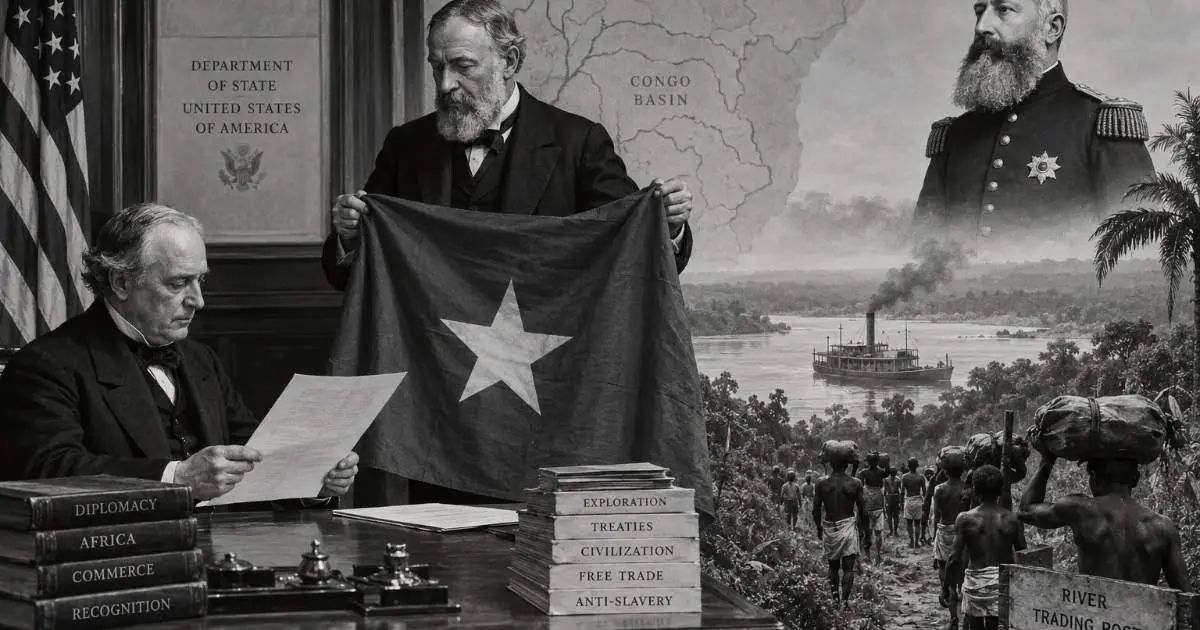
In 1884, Washington recognized the flag of a “friendly government” in the Congo. Months later, the U.S. State Department acknowledged that the political entity behind that flag did not yet exist. That contradiction reveals something larger than an overlooked episode in American diplomacy: international recognition does not always certify an existing reality. Sometimes it helps create one.
The Day Washington Recognized a Flag
On 22 April 1884, an unusual diplomatic transaction took place in Washington. Henry Shelton Sanford, a former United States minister to Belgium, appeared on behalf of the International Association of the Congo and submitted a declaration to Secretary of State Frederick T. Frelinghuysen. The Association announced that it had acquired territory through treaties with what it called the “legitimate sovereigns” of the Congo basin, promised free commerce and equal treatment for foreign traders, pledged opposition to the slave trade, and identified its emblem: a blue flag bearing a golden star. Frelinghuysen, acting with presidential authority and following the Senate’s advice, responded that American officials would recognize that flag as the flag of a “friendly Government.”
The formulation was cautious. President Chester A. Arthur later told Congress that he had avoided prejudging competing territorial claims in the region. Washington was not yet formally recognizing a sovereign Congo state in the sense that it would do the following year. The distinction matters because the story becomes more revealing, not less, once it is preserved: the United States gave an unfinished political project a significant attribute of international legitimacy while deliberately withholding judgment on some of the territorial questions beneath it.
Then came the sentence that makes the episode extraordinary. On 12 December 1884, the same State Department wrote to its commercial agent in the Congo explaining that he had not been formally accredited to the government of the so-called Congo states because, in Washington’s own words, those states “as a political entity, did not exist.” His designation, the department clarified, had been geographical rather than political.
The chronology is difficult to dismiss as diplomatic trivia. In April, a flag had been recognized as belonging to a friendly government. In December, the State Department acknowledged that the political entity represented by that government did not yet exist. Between those statements lies a neglected mechanism of empire: before Leopold II could rule a recognized state in Central Africa, his project had to become legible to governments that could help treat it as one.
The blue flag therefore matters for more than symbolism. Flags ordinarily appear to follow sovereignty: a state exists, then its emblem represents it. In the Congo, the sequence was partially reversed. A symbol of government entered diplomatic circulation while the state behind it was still being assembled.
A State Taking Shape Inside an Association
Leopold II did not begin by announcing that he intended to become the sovereign of an enormous African territory. The institutional genealogy was deliberately more respectable and, at first, more ambiguous. A geographical conference convened in Brussels in 1876 produced the International African Association, whose stated aims included scientific exploration, opening routes into Central Africa, and suppressing the slave trade. Leopold became its president, and national committees were established in several countries, including the United States.
The structures changed names and functions as Leopold’s ambitions developed. After Henry Morton Stanley’s trans-African journeys brought the Congo River dramatically into European and American consciousness, Stanley was recruited for work connected to Leopold’s project. American commercial agent William P. Tisdel later reported that a supposedly modest committee for studying the Upper Congo had expanded far beyond that remit: territory had been acquired, stations established, steamers placed on the river, and an administrative structure was emerging. By late 1884 Tisdel was already telling Washington that the Association intended to establish a political government.
The temptation, knowing what came later, is to flatten this history into a perfectly scripted deception from the beginning. That would replace one myth with another. Institutions evolved, interests converged, and Leopold’s purposes became more clearly territorial over time. What can be established is that a project advertised through the languages of philanthropy, exploration, anti-slavery and commerce gradually accumulated the material components of rule: territory, posts, transport, personnel, agreements, administration and a flag.
That gradual transformation was politically useful. A king announcing a private African empire would have confronted one set of reactions. An international association promising scientific work, humanitarian improvement and commercial openness could attract a different coalition of sympathizers, investors, officials and intermediaries. The Association did not have to conceal every political ambition; it needed to make those ambitions compatible with interests other governments could recognize as legitimate.
By 1884, the project could present itself to Washington not as Belgium extending colonial sovereignty, but as an ostensibly international enterprise opening Central Africa to commerce while suppressing slavery. The distinction would prove enormously valuable to Leopold, who would eventually become sovereign of the Congo in his personal capacity rather than simply annexing it as a Belgian possession.
Who Had the Right to Give the Congo Away?
The American declaration contained a phrase that did a remarkable amount of political work. The Association claimed that, through treaties with the “legitimate sovereigns” of the Congo and adjacent territories, land had been ceded for the benefit of the free states under its supervision. The State Department’s own reporting subsequently listed 394 treaties concluded by Association agents with chiefs across multiple districts.
To nineteenth-century European diplomacy, these documents could be converted into evidence of territorial title. Yet that process raises a question more fundamental than whether a particular signature or mark was technically obtained: what precisely had been transferred, and according to whose concept of political authority? A local ruler could possess powers over trade, land use, tribute or relations with neighboring communities without possessing the European conception of absolute territorial sovereignty that colonial diplomacy wanted the treaty to convey.
There is evidence that deception occurred. Belgium’s Royal Museum for Central Africa states that Kongo chiefs were often misled when signing treaties that Europeans interpreted as cessions of sovereignty. George Washington Williams would later make even more severe allegations about the techniques used by Stanley’s agents. But historical precision requires resisting the opposite simplification as well: hundreds of agreements cannot all be reconstructed as identical encounters, and African political structures across the vast Congo basin were neither uniform nor passive.
The deeper issue is structural. The international system gave European-written documents a second life that may have been radically larger than the political acts understood locally. A compact made near a river or settlement could travel to Brussels, Washington or Berlin and reappear as evidence for authority over territory on a continental scale. What mattered internationally was not only consent, but who possessed the institutions capable of translating consent into recognized sovereignty.
This is where the missing Congolese perspective changes the article’s meaning. European powers were asking whether Leopold’s Association had acquired sufficient title to be treated as a political authority. The more prior question—whether local communities understood themselves to have transferred the kind of sovereignty Europeans claimed to receive—did not carry equal weight in the diplomatic system deciding the outcome.
The imbalance was not simply military. It was interpretive. One side increasingly possessed the power to determine what the document meant after it had crossed from an African political setting into European international law.
The Brokers of Recognition
Leopold needed more than explorers and treaties. He needed translators between worlds: people who could make his African project intelligible to foreign governments, commercial interests and public opinion. Henry Shelton Sanford was exceptionally well placed for that work.
Sanford had served as the United States minister in Brussels during the administrations of Abraham Lincoln and Andrew Johnson. He later sat on the executive committee associated with Leopold’s African enterprise, and in Washington it was Sanford who formally signed the Association’s April 1884 declaration. Historical scholarship on his role describes him as a significant advocate for American recognition of the Association’s flag.
His importance lies less in biography than in the political space he occupied. He was neither simply an American official nor simply a private businessman acting outside diplomacy. He knew Washington, knew Leopold and understood how the Association’s claims could be presented in a vocabulary attractive to the United States: non-interference in European rivalries, commercial equality, anti-slavery and access to a potentially enormous market.
Later events make that overlap between diplomacy and commerce even more visible. In 1886 Sanford established the Sanford Exploring Expedition to develop trade on the Upper Congo, benefiting from concessions granted by Leopold’s new state. His enterprise founded commercial settlements and attempted to operate steamers beyond the Congo cataracts before financial difficulties eventually led it into a Belgian commercial organization. None of this proves that Sanford’s earlier advocacy was merely a disguised plan for personal enrichment; the chronology does not justify that conclusion. It does show how easily humanitarian, diplomatic and commercial networks could occupy the same institutional ecosystem.
Stanley performed a different function. His journeys, stations and agreements transformed maps and reports into infrastructure on the ground. Tisdel’s report to Washington described an Association with dozens of stations, steamers, European personnel and more than a thousand African laborers and police, while portraying Stanley’s work as having opened enormous stretches of navigable river to future commerce.
Sanford helped make the project diplomatically readable; Stanley helped make it materially plausible. Neither man alone created the Congo state. Together with Leopold’s financing, local intermediaries, European negotiations and the growing network of stations and treaties, they contributed to the appearance of something increasingly capable of being recognized as government.
Empire is often narrated from the moment a flag is planted. Here, the more revealing history lies in the people who persuaded others that the flag already meant something.
Humanitarian Language, Commercial Eyes
The April declaration offered Washington a remarkably compatible package. The Association pledged to suppress the slave trade. It promised that foreigners could buy, sell and lease property, establish commercial houses and trade under equal conditions. It renounced discriminatory privileges between nationalities and, at that stage, promised not to impose customs duties on imported goods.
The American response praised the Association’s “humane and benevolent purposes.” Yet the instructions sent a few months later to the American commercial agent leave little doubt that Washington was also looking at the Congo as a market. The State Department ordered him to investigate political administration, taxation, shipping charges and commercial conditions; identify what products the inhabitants needed; determine which American manufactures might sell there; and help secure what it explicitly called the United States’ “proper share” of Congo commerce.
There is no need to expose a hidden commercial motive behind a humanitarian mask, because the documents place both motives openly beside each other. That is more historically interesting. Nineteenth-century officials did not necessarily experience commerce, civilization and humanitarian reform as contradictory projects; free trade itself could be presented as a civilizing mechanism.
Tisdel’s reporting illustrates the fusion vividly. He described existing exports of rubber, ivory, palm oil and other commodities, noted that large quantities of rubber already reached American buyers indirectly through Rotterdam, and complained that the manufactured goods exchanged in Africa could often be supplied by American producers instead. His imagination then moved from existing commerce to the vast market supposedly waiting to be created inland.
The language now sounds startling because it converts millions of people into future consumers almost as quickly as it describes them as beneficiaries of civilization. But it would be a mistake to treat that language merely as hypocrisy. The more consequential point is that the moral promise and the commercial promise reinforced one another. Free trade made the project appear less like an exclusive colonial seizure; anti-slavery gave it moral purpose; international access reassured governments that Leopold’s gains need not automatically become their commercial loss.
This helps explain why the American decision made sense inside the assumptions of the period. Washington was not being asked to finance a Belgian colonial conquest. It was being invited to endorse a political experiment that presented itself as open rather than monopolistic, humanitarian rather than predatory, and commercially accessible rather than reserved for a rival empire.
The eventual tragedy was not that everyone in 1884 secretly knew these promises were false. It was that promises could acquire diplomatic value long before the institutions capable of enforcing them existed.
First to Recognize the Flag, Not Alone in Making the State
The American role has to be stated strongly enough to matter and narrowly enough to remain true. The United States was the first power to recognize the Association’s flag in the manner later celebrated by Leopold and President Grover Cleveland. It did not, however, single-handedly create the Congo Free State, nor did the April 1884 act amount to full recognition of the sovereign state that would emerge in 1885.
This distinction also corrects a familiar shorthand about the Berlin Conference. Popular retellings often make it sound as though European powers gathered around a table, drew the Congo on a map and formally handed it to Leopold. The actual process was more dispersed. Leopold’s Association pursued bilateral recognition and boundary arrangements while the Berlin Conference established rules concerning commerce, navigation and future territorial claims; by the time the Independent State of the Congo emerged, its international position rested on a web of recognitions and agreements rather than on a single ceremonial grant from Berlin. Even the United States later insisted that its recognition of Congo sovereignty was legally distinct from the Berlin General Act.
Timing nevertheless gave the April decision significance. Washington’s recognition came months before the Berlin Conference assembled. For an organization trying to prove that it should be treated as something more than a private enterprise, the willingness of an established state to recognize its flag as that of a friendly government was politically useful evidence that the transformation had already begun.
Other powers were essential. By August 1885 Britain, the Netherlands, Germany, France and Italy were among governments sending responses to Leopold in his new capacity, while other recognitions followed. On 11 September, President Cleveland formally recognized the Independent State of the Congo, with Secretary of State Thomas Bayard describing the act as recognition of its sovereign status.
The United States therefore belongs in this history neither as innocent spectator nor as principal architect. It was an early legitimizer. The word helped in the title is doing necessary work.
That narrower claim is also the more disturbing one. International systems rarely create political orders through a single dramatic decision. Legitimacy accumulates. One government recognizes a flag; another settles a boundary; another receives an emissary; postal arrangements are established; courts appear; treaties are exchanged; eventually the provisional begins to look normal.
By then, the question is no longer whether the entity exists. The international system has begun behaving as if it does.
When Recognition Helps Create What It Recognizes
Recognition is often described as though it were a diplomatic photograph: a government looks at an existing political reality and records what it sees. The Congo episode exposes the limits of that metaphor.
In 1884, American officials themselves were uncertain what exactly existed in the Congo. They recognized the flag while declining to settle competing territorial claims. They dispatched a commercial agent but later emphasized that he had not been accredited to an actual Congo government because such a political entity did not yet exist. Less than a year later, the same evolving organization was taking on the institutional grammar of sovereignty.
By late 1885, the transformation was visible in mundane administrative details. The new state notified governments of its borders and neutrality, organized departments, prepared courts and a postal service, and issued regulations governing land claims. These steps were not decorative. They made the state increasingly capable of performing the routines by which other states recognized one another.
This is the article’s central distinction: recognition can be both declarative and constitutive. It can acknowledge a power that already exists, but under some conditions it can also help that power consolidate the status it claims. The April declaration did not manufacture Leopold’s stations, troops, money or treaties. It did something different: it helped move those scattered elements across the threshold from private undertaking toward internationally intelligible authority.
That is why the flag mattered. It gave other governments an object to recognize before every underlying question had been resolved. The Association could now point not only to what it claimed in Africa, but to how it had been treated abroad.
There was an asymmetry hidden inside this process. The international system could evaluate whether a flag had been recognized, whether an emissary had been received, whether commercial equality had been promised and whether another European government accepted a boundary. It was far less capable—or less interested—in verifying, village by village and treaty by treaty, what political consent beneath those claims actually meant.
Leopold’s achievement was therefore not simply conquest. It was the conversion of disparate forms of control into diplomatic legibility. Once the project could be read by other states as a state, each additional act of recognition made the next act easier.
The Promise and the Regime That Followed
Knowing the later history makes it tempting to read every statement from 1884 as cynical preparation for atrocity. The evidence does not require that interpretation. It requires something more unsettling: governments can participate in legitimizing political arrangements without knowing the institutions those arrangements will become.
The system that developed under Leopold was radically different from the benign commercial order imagined in the early declarations. The Congo Free State appropriated enormous areas categorized as vacant land, granted concessions, and built an extractive economy around ivory and especially rubber. Forced labor, punitive expeditions, imprisonment, killings, displacement and other forms of coercion accompanied extraction in multiple regions. Belgium’s Royal Museum for Central Africa describes the resulting demographic damage as enormous while also warning that precise victim totals cannot be established with confidence.
The mechanism evolved over time. It would therefore be inaccurate to project the mature rubber regime of the 1890s backward onto every decision made in 1884. That distinction is precisely why the recognition story matters. Washington endorsed a set of declared purposes and an emerging political structure; what followed demonstrated how weakly those promises constrained the sovereign power that international recognition helped consolidate.
By the early twentieth century, the contradiction was no longer hidden. Investigations and missionary reports documented severe abuses, and even Leopold’s own commission of inquiry produced findings concerning mistreatment serious enough to damage the regime politically. In 1908, an American diplomatic assessment concluded that conditions in the Congo had developed in ways that had been “neither contemplated nor anticipated” when the state was brought into existence. Belgium annexed the territory later that year, ending Leopold’s personal state.
That sentence from 1908 is almost an epitaph for the optimism of 1884. The problem was not merely that later rulers violated earlier promises. It was that the machinery of international legitimacy had been much better at processing promises than at guaranteeing what would happen after sovereignty was secured.
Then Another American Went to the Congo
Six years after Sanford signed the declaration in Washington, another American entered the story from an entirely different direction.
George Washington Williams was a Black American historian, minister, journalist and former Ohio legislator whose work had already helped establish him as a pioneering historian of African American life. He traveled to the Congo in 1890 after having encountered the favorable claims surrounding Leopold’s project. What he saw changed his judgment profoundly.
From Stanley Falls in July 1890, Williams addressed an open letter directly to Leopold. He accused the Congo administration of deception, arbitrary violence, forced labor and other abuses, challenged the legitimacy of some of Stanley’s treaty-making, and called for international investigation. His language was not the detached vocabulary of a later scholar looking backward. It was an indictment written while the state was still young, by a visitor confronting the gap between its international reputation and conditions he believed he had witnessed.
Williams matters because he prevents “America” from becoming a convenient historical character with one mind. The government that recognized the flag, Sanford who represented Leopold’s Association, commercial interests looking for markets, and Williams condemning the resulting regime were all American, but they occupied radically different positions in relation to the Congo.
That plurality should not be converted into a redemptive story in which one American simply corrected another American mistake. Williams did not erase the earlier recognition, nor did his denunciation immediately end the system. His presence reveals something more useful: states, societies and even national political cultures do not encounter empire through a single consciousness.
He also exposes the limitations of recognition as knowledge. In Washington, officials had received declarations, maps, commercial reports and assurances about civilization and anti-slavery. Williams traveled through the territory and claimed that another reality existed beneath the paperwork. The difference was not merely moral courage versus moral failure; it was also the difference between seeing a state through the documents by which it sought recognition and seeing the exercise of authority from inside the territory it claimed to govern.
The Congo had become internationally legible before it had become internationally understood.
The Flag Before the State
The easy lesson from this history would be that Leopold deceived the world. There is truth in the role of propaganda, misrepresentation and calculated presentation, but that explanation is too comfortable because it places the failure almost entirely inside one man’s intentions.
The more difficult lesson concerns the international order that surrounded him. Governments needed categories through which to process an unfamiliar political project. The Association offered recognizable ones: treaties, sovereign chiefs, free trade, suppression of slavery, equal commercial access, administration and a flag. Washington could endorse those attributes while expressly reserving judgment on unresolved territorial questions. The pieces did not have to be complete for the process of legitimation to begin.
And once it began, legitimacy was cumulative. Recognition by the United States did not make Leopold sovereign over the Congo. European diplomacy did not manufacture every local relationship his agents claimed. The Berlin Conference did not simply hand him a country. Yet these separate actions helped transform an unstable collection of expeditions, stations, treaties, promises and private financing into something governments could increasingly address as a sovereign political fact.
The Congolese communities whose territories were being converted into that fact occupied a profoundly different position. Their agreements entered an international legal language they did not control; their political systems were interpreted through categories fashioned elsewhere; and the meaning attached to their consent could expand dramatically once it reached European and American diplomacy. Recognition amplified the claims of the actor best equipped to make itself recognizable.
This is what makes 22 April 1884 worth recovering. The most revealing object in the room was not a map of the future Congo, nor a royal decree establishing a colonial regime. It was a flag presented by a private association and accepted by a foreign government as the emblem of a friendly authority.
Months later, Washington admitted that the political entity behind it did not yet exist. Yet the flag already did, the recognition already did, the commercial expectations already did, and the diplomatic precedent already did.
Leopold still needed money, men, treaties, European accommodation, territorial control and eventually coercive power. America did not create his Congo. But it helped provide something an unfinished imperial project needed before it could fully become a state: the willingness of another state to behave, however cautiously, as though the transformation had already begun.
That is the uncomfortable power of recognition. It does not merely place a seal on political reality after reality has been made. Sometimes, by deciding what deserves to be treated as real, it becomes one of the forces that make it so.