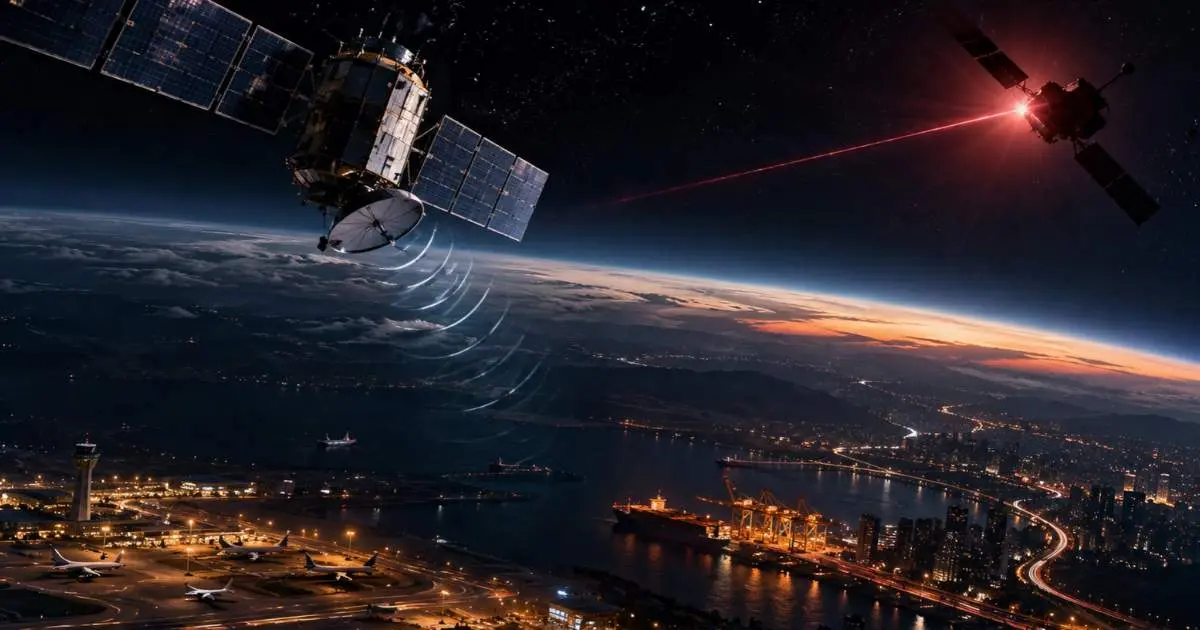
The next major conflict in space may be remembered less for satellites destroyed than for services that suddenly became unreliable. Navigation, communications, intelligence and timing now tie events in orbit to decisions on Earth so tightly that the decisive measure of space power is changing: not simply who can strike above the atmosphere, but who can keep functioning after someone does.
What Washington Actually Announced
On 14 September 2026, US Air Force Secretary Troy Meink told the Air, Space and Cyber Conference that the Space Force now had “on-orbit space control weapons” capable of defending American forces against hostile action. He declined to describe them. There was no disclosure of how many existed, where they operated, whether they could physically damage another spacecraft or whether their effects were reversible. Even so, it was the Pentagon’s most explicit public acknowledgment to date that the United States had weapons for space control already operating in orbit.
The temptation is to hear “space weapons” and imagine that an old science-fiction threshold has finally been crossed. In one sense, it has. Yet the picture of an armed satellite hunting another satellite is also a distraction from what has been changing for years. Space has supported military operations since long before the creation of the US Space Force, and several governments have developed ways of disrupting spacecraft, their signals or the infrastructure that serves them. The more interesting change is that the systems below have become so dependent on the systems above that disabling a service can now matter more than destroying the machine that provides it.
A modern military can lose access to satellite communications while the communications satellite remains intact. A navigation constellation can continue circling Earth while receivers below are fed interference or false signals. An imaging spacecraft may remain perfectly functional while a cyberattack prevents the information it collects from reaching the people who need it. In each case, the expensive object in orbit survives and the military problem still appears on the ground.
This is a less cinematic idea of space warfare, but it is closer to the strategic problem governments are actually preparing for. The object of the contest is increasingly not possession of satellites for its own sake. It is the continuity of the services that those satellites make possible.
The Target Is Often the Service
GPS is a useful place to begin because most people think they know what it does. A phone displays a location, a driver follows a route, an aircraft or ship checks its position. Yet the GPS signal contains something just as important and far less visible: time. Atomic clocks aboard the satellites allow receivers to synchronize with extreme precision, and that timing is used by telecommunications networks, electricity infrastructure and financial systems as well as by navigation.
The military dependence is broader still. Positioning and timing support precision weapons and distributed operations; satellites carry communications over enormous distances, provide weather information, observe territory, detect missile launches and feed intelligence systems. None of these functions requires a civilian standing on the street to notice that space is involved. Their success lies partly in becoming ordinary.
The vulnerability follows the same path. If a military operation assumes reliable positioning, reliable communications and rapid access to imagery, those assumptions become things an adversary can attack. The useful question is no longer merely how many satellites a state possesses, because numbers can disguise fragility. An impressive constellation may still depend on exposed ground stations, vulnerable software, scarce launch capacity, a small number of critical links or commercial suppliers whose services were never designed to be unconditional instruments of state power.
There is a peculiar strategic reversal here. Space systems were built to remove friction from activity on Earth: to make targeting more precise, communications more immediate, markets more synchronized and infrastructure easier to coordinate. The better they became at doing that, the more damaging their absence could become. Modernization did not simply add capability; it created dependencies whose importance is often visible only when they fail.
That is the part of the emerging arms race that weapon counts do not capture. The United States can develop an orbital system capable of threatening another satellite, while China can develop a comparable capability and Russia can field powerful electronic warfare systems. But if one side can keep operating through disruption and the other cannot, the balance may be decided somewhere other than the place where the weapons themselves are located.
A Space Attack That Never Touched Space
The opening hours of Russia’s full-scale invasion of Ukraine provided an early example of how misleading the geography can be. About an hour before Russian forces entered Ukraine on 24 February 2022, a cyberattack hit Viasat’s KA-SAT satellite network. The European Union later attributed the operation to Russia and said it caused communication outages in Ukraine while also affecting users in several EU member states. The spacecraft itself did not need to be destroyed; access to the satellite service was disrupted through the network that made it usable.
That episode is easy to classify as cyberwarfare, and technically it was. Strategically, however, the classification is less satisfying. The target was a satellite communications system; the point of the attack was to deny connectivity; the consequences were experienced on Earth. Calling it “cyber” explains the method but can obscure the system being contested.
Much the same is true of jamming. A sufficiently powerful transmitter can interfere with satellite navigation or communications without going anywhere near the satellite. Spoofing can be subtler, supplying receivers with counterfeit signals so that a system reports a false position or time. In an environment where precision is itself a military advantage, corrupted certainty can sometimes be more dangerous than no signal at all. Secure World Foundation’s 2026 assessment records continuing development of counterspace capabilities across thirteen countries and divides them into five broad groups: co-orbital systems, direct-ascent weapons, electronic warfare, directed energy and cyber capabilities. Its most revealing observation is not the breadth of research but the pattern of actual use: in active conflicts, the counterspace capabilities being employed have so far been non-destructive.
That pattern should not be mistaken for evidence that destructive weapons have lost their purpose. States retain them because physical destruction can provide a decisive option and because the capability itself contributes to deterrence. But destruction has disadvantages that become more important as orbit grows crowded and dependence grows global. The more states value space, the more reason they have to attack it carefully.
The Problem With Blowing Things Up
A satellite hit at orbital velocity does not fall politely out of the sky. It can fragment into debris travelling fast enough to damage or destroy other spacecraft, including those belonging to states that had nothing to do with the original confrontation. Secure World Foundation calculates that counterspace testing by the United States, the Soviet Union or Russia, China and India produced 6,904 catalogued debris objects, with 2,773 still in orbit at the cutoff for its 2026 report.
Those numbers complicate the familiar logic of destroying an enemy asset. A tank wreck remains approximately where it was destroyed. Orbital debris keeps moving, potentially crossing paths with military, scientific and commercial systems again and again. The military value of a successful interception therefore comes with a cost that can spread across time, ownership and national borders.
The political response has moved further than the law. In December 2022, the UN General Assembly adopted a resolution calling on states not to conduct destructive direct-ascent anti-satellite missile tests. The vote was 155 in favour, nine against and nine abstentions, a striking level of support but not the creation of a binding universal prohibition.
For a military planner, the attraction of a jammer, cyber operation or temporary sensor disruption is obvious by comparison. The effect can be limited, reversed or repeated. Nothing needs to explode, and no debris cloud is left behind. The ambiguity can also be valuable: the target may understand that something is wrong without immediately knowing whether it has suffered a deliberate attack, how extensive the attack is or what level of response the attacker expects.
This is where the popular image of space warfare becomes least useful. The more usable forms of counterspace power may be precisely those least likely to produce footage of a spacecraft breaking apart.
When the Battlefield Belongs to a Company
The second complication does not come from physics but from ownership. Space systems that once would have belonged almost automatically to governments are now increasingly supplied by commercial companies. Communications, Earth observation, launch services and data products can be bought rather than built, giving militaries access to large constellations and rapid innovation without having to own every element of the infrastructure.
The US Space Force has not hidden its intentions here. Its commercial strategy calls for government, allied and private capabilities to be combined in hybrid architectures. In June 2026, the director of Space Systems Command’s Commercial Space Office put the point more sharply, writing that without commercial dual-use technologies the United States could not maintain space superiority or win a conflict in space.
That is an extraordinary sentence when considered outside the language of procurement. A core military function is being designed on the assumption that privately owned infrastructure will remain available during crisis and war. The benefits are substantial: commercial networks can add scale, distribute risk and replace the old model in which an adversary could focus on a small number of exquisite government satellites. They also introduce a different category of dependency.
Ukraine has provided the most visible laboratory. Satellite communications supplied by SpaceX became deeply embedded in Ukrainian battlefield connectivity after the Russian invasion. By 2026, the dependence had produced an inversion few strategists would have predicted a decade earlier: Ukraine and SpaceX were cooperating to identify authorized Starlink terminals and block terminals that Kyiv said Russian forces were using without authorization. Ukrainian officials reported serious disruption to Russian communications after the unauthorized connections were disabled, although Reuters could not independently verify the full scale of the effect.
The point is not that a technology company has somehow replaced the state. It has not. Governments still determine war aims, command armed forces and possess coercive powers that private firms do not. But a commercial operator can now control technical permissions that matter on a battlefield: which terminal connects, where service is available, which user is authorized, which data flows and under what contractual conditions.
Britain offers a less improvised version of the same development. In September 2026, Reuters reported that the UK had spent nearly $40 million on SpaceX satellite services and had become the first country outside the United States publicly known to use Starshield, SpaceX’s military-focused service, alongside Starlink. The British decision does not make the country uniquely dependent on an American company, but it shows that commercial integration is moving from emergency wartime expedient to normal defence architecture.
This is one of the places where the language of “resilience” deserves scrutiny. Commercial integration can make military systems more resilient by giving them more providers, more satellites and more routes around failure. Yet resilience bought from an external supplier remains a relationship, not a physical law. Contracts, corporate policy, export controls, ownership, network design and political relations sit inside the architecture alongside antennas and spacecraft.
The question becomes especially difficult when the same infrastructure serves civilians. Satellite networks can carry military communications while connecting households, ships, hospitals or businesses. Earth-observation systems may sell products to armed forces and agricultural customers from the same constellation. The International Committee of the Red Cross warns that many contemporary space systems are dual-use and that disruption can carry consequences for essential civilian services. Under international humanitarian law, commercial ownership does not immunize a system from attack, but military use does not automatically make an entire commercial satellite network a lawful target either; the usual rules governing military objectives, proportionality and precautions still apply.
A future space conflict will therefore not divide itself neatly into military satellites on one side of an orbital map and harmless civilian ones on the other. The networks have already grown through one another.
The Advantage of an Attack That Is Hard to Name
Physical destruction at least offers clarity. A satellite explodes, tracking systems observe the event, fragments appear in orbit and governments begin the work of attribution. The less destructive tools create a different strategic problem because the victim may first have to determine whether an attack has occurred at all.
A receiver losing GPS could be experiencing jamming, equipment failure or interference from another source. A satellite whose sensor performs strangely may have been dazzled deliberately or may have suffered a technical fault. A spacecraft approaching another spacecraft could be conducting inspection, demonstrating rendezvous technology, gathering intelligence or positioning itself for something more aggressive. Rendezvous and proximity operations have legitimate uses in servicing, refuelling and debris removal; the manoeuvring ability that makes those activities possible can also have military value.
This uncertainty is sometimes treated as an inconvenience surrounding the weapon. In practice, it can be part of the weapon’s usefulness. Temporary interference gives a state room to impose costs without creating the unmistakable political moment produced by a missile strike. The victim must decide not only who is responsible but whether the event justifies escalation, whether the interference is localized or part of a campaign, and how much evidence can safely be made public.
The problem resembles cyber conflict, although the space environment adds another layer. A cyber operation against equipment in one country may disrupt a satellite owned by a company in another, whose service is being used by a military in a third. A radio-frequency attack can spill across borders. A dual-use constellation may carry both military and civilian traffic. Even the location of the attack becomes a complicated question: the malicious code may be on Earth, the vulnerable link may pass through orbit and the military consequence may occur hundreds of kilometres away.
That gives states an incentive to invest in sensors and intelligence capable of answering a question that sounds simpler than it is: what happened? Space situational awareness was once associated mainly with tracking objects and avoiding collisions. In a contested environment, it also becomes part of deterrence. A state that cannot identify interference convincingly has fewer options for imposing a cost on whoever caused it.
Meink’s announcement is interesting in this context because secrecy is doing two jobs at once. Washington wants potential adversaries to know that the Space Force possesses on-orbit capabilities, while withholding enough detail to protect those capabilities and preserve uncertainty. That is a familiar principle of deterrence. In space, however, it unfolds in a domain already saturated with ambiguity about what satellites can do and how apparently ordinary manoeuvres should be interpreted.
The Law Did Not Anticipate This Version of the Problem
The Outer Space Treaty of 1967 was drafted under the pressure of the Cold War, and Article IV reflects the anxieties of that moment. It prohibits putting nuclear weapons or other weapons of mass destruction into Earth orbit or stationing them in outer space, and it bars military bases, fortifications, weapons tests and military manoeuvres on the Moon and other celestial bodies. It does not establish a general prohibition on all conventional weapons in Earth orbit.
That fact is often converted into the dramatic claim that space is largely lawless. The description is misleading. The UN Charter remains relevant to the use of force, and the law of armed conflict does not stop at the atmosphere. The ICRC’s position is that international humanitarian law constrains military operations involving space systems, including non-kinetic operations that disable them, and that foreseeable harm to civilians must be considered when systems with civilian functions are targeted.
The awkwardness lies elsewhere. Much of the public vocabulary of arms control was built around identifiable objects: a nuclear weapon, a missile, a military installation, a destructive test. Contemporary counterspace operations increasingly target qualities rather than objects—availability, accuracy, trust and access. The satellite can remain in orbit while the service is denied. A sensor can continue functioning while being prevented from seeing what matters. A communications system can exist physically while its users are locked out.
This makes “weapon” a less useful category than it once appeared. A servicing satellite may have peaceful and military applications. A cyber exploit is not a spacecraft at all. A commercial network can become operationally significant to an armed force without having been built as a weapon system. The legal rules do not disappear because the technology is ambiguous, but the factual judgments required to apply them become harder.
Military bureaucracies adapt faster than treaties because they do not need universal agreement to change vocabulary. Terms such as “space control”, “resilience”, “protection” and “dynamic space operations” now sit naturally inside strategy documents and procurement debates. Each describes a legitimate operational concern. Taken together, however, they can make a profound militarization of the orbital environment sound like an ordinary modernization programme.
That is not evidence of deception; bureaucracies routinely normalize new capabilities by turning them into programmes, requirements and budget lines. It is precisely why the language deserves attention. A capability does not become strategically modest because its acquisition document sounds administrative.
Europe Discovers That Satellites Are the Easy Part
European governments have been spending heavily on military space, and Russia’s war against Ukraine has made the political case easier. The International Institute for Strategic Studies estimated in March 2026 that European countries were planning at least $109 billion in space-capability investment through 2030. Yet IISS also identified enduring gaps in areas including launch, missile warning, intelligence and surveillance, and sophisticated space situational awareness; it estimated that fuller European operational autonomy would require at least another $25 billion in procurement and could not be fielded before 2040.
The figures are revealing mainly because of what they fail to buy. A country can finance an advanced satellite and still lack independent launch capacity, sufficient ground infrastructure, trained personnel, protected data links or a way to replace the spacecraft quickly after a loss. Europe’s difficulty is amplified by its institutional structure: the European Union, the European Space Agency, NATO and national governments cooperate extensively, but they are not one organization with one budget, one chain of command or one set of strategic priorities.
For decades, European reliance on American capability could reasonably be described as alliance burden-sharing. Much of it still can. The question changes when a capability has no realistic substitute at the moment it is needed. Dependence among allies can be efficient; dependence without an alternative can also become leverage, even when nobody intends to use it that way.
Launch is the clearest example. Losing satellites in a prolonged conflict is one problem; being unable to replace them on the necessary timetable is another. IISS has consequently highlighted assured access to space as a central European concern rather than a technical afterthought. A state that owns spacecraft but cannot regenerate the service after attrition has purchased assets without fully purchasing continuity.
The same test can be applied elsewhere. China’s rapid expansion of national space capability reduces some forms of dependence while creating a much larger architecture Beijing must now protect. The United States can draw on unmatched commercial scale and launch capacity, but the integration of private systems introduces relationships that military planners must manage rather than command outright. Russia has demonstrated the strategic value of electronic and cyber methods that can threaten space-enabled services without requiring symmetrical investment in every category of orbital hardware. The architectures differ because the states differ; the underlying problem does not.
What Power Looks Like When the Sky Becomes Unreliable
For most of the space age, technological sophistication was associated with gaining access to capabilities others lacked. The satellite could see farther, communicate beyond the horizon, warn earlier or guide more precisely. Space conferred advantage by making uncertainty smaller.
A serious conflict between technologically capable states would reverse part of that logic. Both sides would know where the other depends on orbital services, and both would have incentives to make those services less dependable. Navigation might work in one area and become unreliable in another. A network might shift between military and commercial providers. Imagery might arrive through a different constellation after a sensor is disabled. Commanders could be forced to distinguish real degradation from deliberate deception while operations were already under way.
In that environment, the most impressive system on a procurement slide may not be the most useful system in a war. Redundancy, replacement, terrestrial backups, alternative navigation, protected ground stations and the ability to operate with incomplete information begin to acquire the value once reserved for exquisite performance. Training people to fight without perfect access to space becomes as relevant as giving them more access in peacetime.
This is the change hidden behind the discussion of orbital weapons. The United States may indeed possess spacecraft that can interfere with an adversary’s systems, and rival powers are building or researching their own counterspace capabilities. Yet the offensive side of the equation is only half of the contest. A state that can disable ten enemy satellites but loses the ability to coordinate its own forces after three of its services are disrupted may discover that an impressive counterspace arsenal did not produce space superiority.
Read also:
Who Repairs the Internet? The Hidden Power Behind Undersea Cables
The more revealing measure is endurance. Can a military communicate after its preferred network is denied? Can a government still distribute trusted time and positioning when satellite navigation is contested? Can intelligence be collected through another provider, an allied system or a different sensor? Can lost capacity be launched again quickly enough to matter? And when a commercial service suddenly becomes essential, who actually has the authority to guarantee that it remains available?
These questions are less dramatic than images of missiles rising toward orbit. They are also much closer to where the competition is heading. Space power is moving from the ability to exploit an uncontested environment toward the ability to preserve useful function in a contested one.
The first great contest for space may therefore be decided by something surprisingly terrestrial: which side can absorb uncertainty without allowing it to spread through the systems below. Not every satellite will need to be destroyed. Not every attack will be visible. Some may never be publicly acknowledged while they are happening.
A war fought through orbit would still be a war about power on Earth. The countries best prepared for it will not necessarily be those that have placed the most weapons above the atmosphere, but those that have understood what their economies, militaries and institutions can no longer do without them—and have built ways to continue when the answer arrives under pressure.