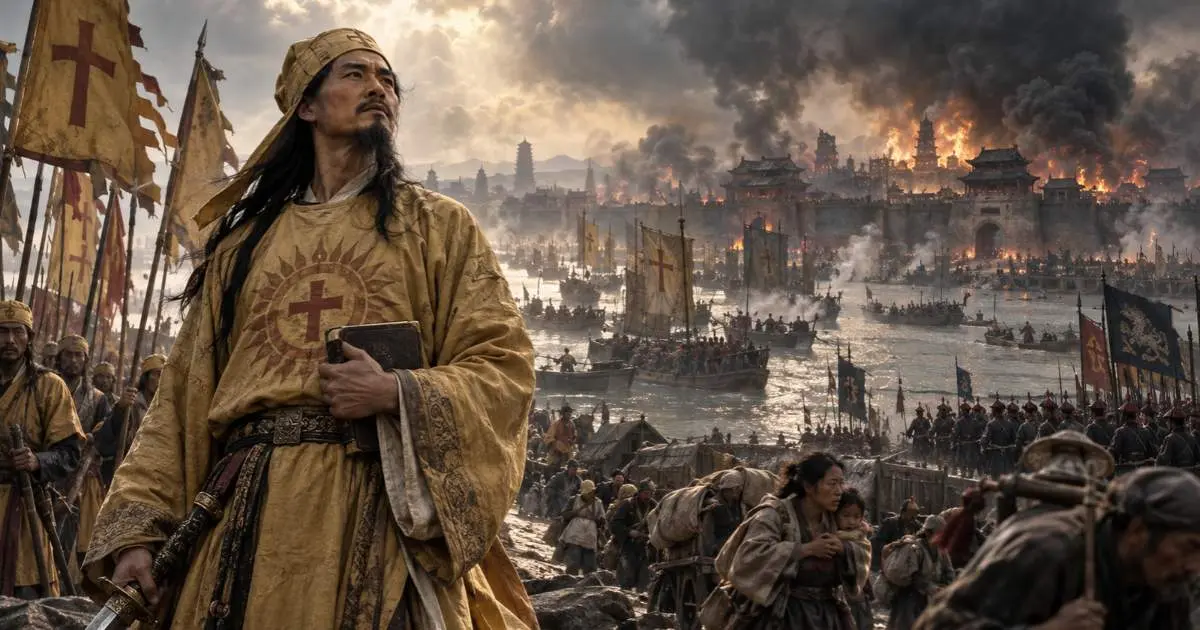
In the 1850s, a failed Chinese examination candidate who believed he was the younger brother of Jesus built a rival kingdom, captured Nanjing and challenged the Qing dynasty for control of China. The Taiping Rebellion became one of the deadliest civil wars in history—and forced the empire that survived it to change how it raised armies, collected money and exercised power.
China Before the Explosion
The Taiping Rebellion is tempting to explain through one extraordinary biography. Hong Xiuquan failed the imperial examinations, experienced visions, came to believe that he belonged to the heavenly family of Jesus Christ, gathered followers and nearly brought down one of the largest empires on earth. Every part of that story is remarkable, but none of it by itself explains why a private revelation became a civil war.
The China into which the Taiping movement erupted had been under strain for decades. Population had expanded dramatically during the eighteenth and early nineteenth centuries, while cultivable land and the reach of local administration had not grown at the same pace. In many regions, competition over land, water and employment sharpened, migration pushed communities into closer and sometimes violent contact, and officials found themselves responsible for populations far larger than the institutions around them had originally been designed to manage.
Guangxi, where the movement took root, was particularly combustible. Hakka migrant communities lived alongside longer-established populations commonly called Punti, and tensions over land, resources and local influence could erupt into fighting. The Hakka were not a revolutionary class waiting for a prophet, and the Taiping movement cannot be reduced to an ethnic uprising, but Hong himself came from a Hakka family and many early supporters were drawn from communities for whom insecurity was an everyday reality rather than an abstract condition.
The dynasty ruling this strained society was itself politically vulnerable in new ways. The Qing were Manchu rulers governing an enormous multi-ethnic empire in which Han Chinese officials occupied much of the civil bureaucracy, so the political order cannot be reduced to a permanent Manchu-versus-Han conflict. Yet anti-Manchu rhetoric could still be mobilised during crisis, and the Taiping leadership would eventually portray the ruling house not merely as ineffective but as alien, illegitimate and spiritually corrupt.
Foreign military defeat then damaged part of the aura surrounding imperial power. Britain defeated the Qing in the First Opium War, and the Treaty of Nanjing in 1842 forced open treaty ports, imposed a large indemnity and ceded Hong Kong. Foreign merchants, diplomats and missionaries gained a larger presence on the coast, trade patterns shifted, Western military superiority had been demonstrated publicly, and Christian literature circulated through Chinese networks more widely than before.
One such tract eventually reached Hong Xiuquan, but its importance lay in the society into which it arrived as much as in the words it contained. Visions do not create revolutions simply because they are vivid, nor does religious literature automatically become a political programme. They become historically dangerous when people living under very different pressures can recognise their own grievances inside the world those visions describe.
The Failed Scholar Who Found His Place in Heaven
Hong originally wanted something far less revolutionary than a heavenly kingdom. He wanted to pass the imperial civil-service examinations, one of the most prestigious routes into official life for an educated man without great family power. The system could reward talent, but it was also brutally competitive, and candidates could spend years mastering classical texts and literary forms only to fail repeatedly.
Hong did exactly that. After another failure in 1837, he suffered a severe illness accompanied by intense visions in which he later said he had been taken to heaven, met an authoritative father figure and an elder brother, received a sword and been commanded to destroy demons. At the time, he did not fully understand what the experience meant.
Earlier, Hong had received a Christian tract associated with Liang Fa, one of the most important early Chinese Protestant evangelists. He apparently paid little attention to it at first, but after another examination failure in 1843 he reread the text and interpreted his old visions through its biblical language. The heavenly father became God, the elder brother became Jesus, and Hong concluded that he himself was God’s younger son and therefore the younger brother of Jesus, entrusted with a divine mission to cleanse the world.
This was not conventional Protestant Christianity transported intact into China. Hong encountered Christianity through translated texts, his own visions and a Chinese religious landscape already filled with ideas about heaven, cosmic order, moral rule and dynastic legitimacy. The resulting faith became a hybrid system in which biblical concepts, indigenous assumptions, apocalyptic expectation and Hong’s personal authority could no longer be neatly separated.
Hong and his allies condemned practices they regarded as idolatrous and began destroying religious images. Feng Yunshan, an early associate and gifted organiser, helped build a community of God Worshippers in Guangxi, while other charismatic leaders developed sacred authority of their own. Yang Xiuqing, a former charcoal worker who became one of the movement’s most powerful figures, claimed on certain occasions to speak with the voice of God the Father, while Xiao Chaogui was associated with messages attributed to Jesus.
To later readers, the theology can sound increasingly bizarre. To believers inside the movement, however, it gave suffering a coherent explanation: the dynasty had lost heavenly legitimacy, social disorder possessed spiritual meaning, the existing religious world had been corrupted, and ordinary people could join a divine struggle that promised not merely better government but a transformed moral universe. Hong’s personal failure had also been inverted, because the examination system that repeatedly told him he was unworthy to enter the governing elite had been replaced by a theology telling him that the governing order itself was unworthy to survive.
Why Did People Follow Him?
Religious conviction was central to the Taiping movement, but converts did not leave their social lives behind when they joined it. They brought disputes over land, insecurity, poverty, local loyalties, ethnic tensions and resentment toward officials into a community that offered both spiritual meaning and practical solidarity. The movement’s strength came partly from its ability to fuse those different experiences into a single moral universe.
The God Worshippers developed networks of mutual protection in regions where local violence mattered. They condemned opium, gambling, prostitution, alcohol abuse and practices they considered idolatrous, while demanding discipline and creating a strong internal identity. For marginal or insecure communities, membership could mean entering something that looked increasingly like an alternative authority rather than simply joining a religious sect.
The movement also radicalised politically. Hong’s religious enemies and the Qing state gradually merged into the same moral framework, while Manchu rulers were portrayed as demonic usurpers rather than merely bad administrators. Overthrowing the dynasty therefore became part of a cosmic struggle in which political rebellion and sacred purification reinforced one another.
By 1850, clashes with local opponents and Qing forces were pushing the community toward open war. In January 1851, at Jintian in Guangxi, Hong proclaimed the Heavenly Kingdom of Great Peace—Taiping Tianguo—with himself as Heavenly King. The transformation from religious movement to army was rapid, but it was not simply a descent into chaos.
Taiping forces developed disciplined units, elaborate command structures and a powerful collective identity. Families sometimes moved with the armies, recruits joined as the rebellion advanced, and others were absorbed amid the dislocation of war. Qing forces repeatedly failed to destroy them, allowing the Taiping to break through encirclements, push northward and enter the river systems connecting southern and central China.
Within two years, a movement born among religious converts in Guangxi had become a military force capable of threatening the political structure of the empire itself. The speed of that transformation explains why the Taiping cannot be understood merely as a peasant disturbance that grew unusually large. By 1853, they had begun to resemble an alternative state.
Nanjing Falls
The speed of the Taiping advance is easy to underestimate in hindsight because we know the rebellion eventually failed. In the early 1850s, failure was not obvious, and the movement looked capable of becoming a new dynasty. Qing armies had repeatedly failed to stop it, while the rebels continued to move through central China with an energy that alarmed officials far beyond Guangxi.
In March 1853, Taiping forces captured Nanjing, one of China’s great historic cities and a former Ming capital. Its position on the Yangtze gave it enormous economic and strategic value, and Hong renamed it Tianjing—the Heavenly Capital. The city became the centre of a rival state that now possessed territory, institutions and a court of its own.
The seizure of Nanjing transformed the war. The Taiping minted money, issued decrees, administered examinations and attempted to regulate social and religious life, while Hong lived as a sacred monarch surrounded by ritual and hierarchy. Powerful lieutenants held royal titles beneath him, giving the movement the appearance not merely of insurgency but of a dynasty in formation.
The Taiping also continued campaigning. A Northern Expedition was launched toward Beijing in an extraordinarily ambitious attempt to strike the heart of Qing rule, and its forces penetrated deep into northern China before reaching the region around Tianjin. Distance, winter, weak supply lines and Qing resistance eventually overwhelmed the expedition, which was isolated and destroyed after failing to reach the imperial capital.
Other armies fought along the Yangtze and through central China, where control of river cities, grain routes and provincial centres became essential to the survival of the Heavenly Kingdom. The rebellion was no longer a single march toward Beijing but a sprawling civil war across some of the richest and most densely populated parts of the empire. The failure of the northern campaign therefore carried enormous consequences: Nanjing had given the Taiping a state, while the survival of Beijing left two governments claiming that the other had no right to rule.
For more than a decade, China would have an imperial capital in the north and a Heavenly Capital on the Yangtze. That fact alone captures how close the Taiping Rebellion came to becoming something far larger than a defeated uprising. The Qing dynasty survived, but for years it did so while confronting a rival political order inside the empire.
What Kind of Kingdom Were the Taiping Building?
The Taiping state was radical enough to inspire later revolutionaries and coercive enough to resist romanticisation. Its famous 1853 land programme imagined an agrarian order in which land would be allocated according to household size, with men and women counted in the distribution, while surplus production would flow into collective stores. The programme envisioned a moral economy in which extreme inequality would be suppressed and economic life subordinated to the religious community.
On paper, this was remarkable. In practice, the Heavenly Kingdom never possessed the administrative reach required to remake property relations across its territory according to the programme, and the realities of war quickly forced compromises. Taiping authorities still needed taxes, grain, administrators and local intermediaries capable of extracting resources from communities that had not been reconstructed according to revolutionary theory.
The gap between ideology and government became especially visible in the countryside. In some areas, landlords continued collecting rents and interacting with the new regime, while elsewhere Taiping officials tried to bypass them and collect directly from cultivators. Practices varied between counties and over time, revealing a state that had proclaimed a radically different agrarian order while negotiating with institutions it had promised to transcend.
That tension tells us more than the simple conclusion that the land programme failed. Revolutions can write a new society on paper quickly, but armies still need food, administrators need records and governments require revenue before the social order has been remade. The Taiping experience became an early example of a recurring revolutionary problem: ideology may abolish an institution in theory long before the state discovers how to function without it.
The movement’s policies toward women were equally complicated. Taiping ideology opposed foot-binding and prostitution and formally recognised women in certain systems of land allocation, while women performed labour for the regime and some sources describe organised female military or quasi-military units, particularly in earlier phases of the movement. These policies challenged practices deeply embedded in nineteenth-century society, but they did not produce anything resembling modern gender equality.
Strict segregation between men and women was enforced during parts of the movement’s history, at times even separating married couples. Elite practice could differ considerably from the austerity expected of ordinary followers, and political and military authority remained overwhelmingly male. The Heavenly Kingdom could therefore attack forms of female subordination while simultaneously constructing new forms of religious and social discipline.
Religion penetrated public life even more deeply. Confucian, Buddhist and Daoist institutions could be attacked as false worship, temples and statues were destroyed, Christian-derived commandments were rewritten for the Taiping order, and opium, gambling and various forms of sexual behaviour were prohibited. Hymns and religious instruction became instruments of government, making spiritual conformity part of the political architecture of the new state.
The assault on established religion also produced cultural destruction whose significance cannot be captured by the neutral phrase “iconoclasm.” Temples and academies were damaged or destroyed across areas touched by the war, while classical texts and local collections disappeared in the upheaval. The attack on Confucian institutions alienated many members of the educated gentry for whom those institutions were not simply places of worship but part of the structure of scholarship, local authority and social order.
Their resistance to the Taiping cannot be explained solely as defence of “Chinese civilisation,” because property, status, security and local political power also mattered. Yet the cultural attack helped transform educated elites into determined enemies who could be mobilised by Qing loyalists. A movement that wanted to destroy the old order was discovering that the old order was not merely a government in Beijing; it was embedded in temples, schools, examination culture, family structures and networks of local prestige.
Nanjing’s famous Porcelain Tower became one of the war’s most symbolic casualties. The fifteenth-century pagoda had been celebrated by foreign visitors and was among the most recognisable monuments in China, but it was destroyed during Taiping rule in 1856. Accounts differ over the immediate reasons, including military considerations and internal conflict, so assigning a single motive would go beyond the evidence, but the loss became part of the wider destruction surrounding the revolutionary capital.
The Taiping Kingdom was therefore not simply Christian, communist, nationalist, egalitarian or millenarian. Each label captures one feature and distorts several others, because this was a revolutionary theocracy trying to build a new moral and political world while governing through coercion, improvisation and permanent war. Its contradictions were produced not at the margins of the project but at the point where revelation had to become administration.
The Revolution Turns on Itself
Capturing Nanjing gave the Taiping leadership a capital, but it also created a court in which sacred authority and political ambition could no longer be easily separated. Hong increasingly withdrew into the world of the Heavenly King, while enormous practical power accumulated around Yang Xiuqing, the Eastern King. Yang’s claimed ability to speak with the voice of God created an especially dangerous arrangement because he could issue commands not merely as a senior official but as the mouthpiece of Hong’s heavenly father.
For a time, this structure reinforced the movement’s leadership. Eventually it threatened Hong himself, and in 1856 the conflict erupted in what became known as the Tianjing Incident. Hong summoned Wei Changhui and other commanders back to the capital, Yang Xiuqing and large numbers of his followers were massacred, and the killing then widened until Hong himself ordered Wei executed.
Shi Dakai, another important commander, survived the crisis but later departed with forces of his own after members of his family and political circle had been caught in the bloodshed. The leadership that had conquered Nanjing had begun consuming itself, yet the Taiping did not collapse immediately. They recovered enough military strength to remain dangerous and even broke through major Qing positions near Nanjing in 1860.
The massacre nevertheless damaged command, trust and legitimacy at precisely the moment when the war was becoming more demanding. Foreign intervention and Qing military adaptation would matter enormously in the eventual defeat, but neither explains the outcome on its own. The Taiping state also suffered from court rivalries, succession tensions and the difficulty of building durable institutions around charismatic religious authority.
The crisis exposed a weakness that had been present inside the movement from the beginning. A state in which claims to divine communication could confer political power had no easy mechanism for resolving disagreement once leaders began using sacred authority against one another. The Heavenly Kingdom had survived Qing armies more easily than it survived the question of who could legitimately speak for heaven.
Hong Rengan and the Future the Taiping Never Built
The political imagination of the Taiping did not freeze after the catastrophe of 1856. One of its most intriguing reform programmes emerged during the movement’s later years, when Hong Rengan, Hong Xiuquan’s cousin and an early associate of the God Worshippers, finally reached Nanjing. He had spent years outside Taiping territory, including time in Hong Kong where he encountered Protestant missionaries and Western institutions more directly than most Taiping leaders had.
Hong Xiuquan promoted him rapidly, and Hong Rengan brought a different vocabulary of reform into the Heavenly Capital. His New Treatise on Aids to Administration proposed ideas involving banks, railways, steam transport, mining, patents, newspapers and institutional learning from technologically stronger foreign societies. He even envisaged modern banking arrangements capable of issuing notes and extending credit.
It would be easy to make too much of this document. Most of Hong Rengan’s proposals were never implemented, and a programme written by one senior leader cannot tell us what a victorious Taiping state would actually have become. The movement was fighting for survival, its administration remained unstable and military commanders had more immediate concerns than constructing a new economic order.
His significance lies elsewhere. Hong Rengan shows that at least part of the Taiping leadership had begun looking beyond its original religious and agrarian programme and asking why foreign societies possessed stronger technologies and institutions. The rebels who had begun by condemning an old moral world were now confronting the practical question of how a Chinese state could compete in a nineteenth-century international system increasingly shaped by industrial and financial power.
Officials on the Qing side were beginning to ask similar questions. Taiping reformers imagined banks and railways while Qing officials experimented with foreign weapons, shipbuilding, military training and new ways of financing war. The enemies disagreed over who should rule China, but both were being pushed toward the conclusion that inherited institutions were no longer sufficient for the world confronting them.
The Taiping would disappear before Hong Rengan’s ideas could become much more than proposals. The Qing would survive long enough to pursue its own, more cautious programme of adaptation, and that difference would shape the next phase of Chinese history.
The Qing Had to Rebuild the Machinery of Survival
The most durable transformation produced by the war occurred not inside the Heavenly Capital but within the state trying to destroy it. The Qing entered the crisis with established military institutions, including the Banner forces and the Green Standard Army, but those structures proved unable to suppress a rebellion capable of moving across provinces, maintaining large armies and governing a capital of its own. The court therefore turned increasingly toward regional mobilisation.
Zeng Guofan, a scholar-official from Hunan, became one of the decisive figures in that transformation. He built the Xiang Army through networks of local recruitment, provincial elites, personal loyalty and commanders tied more closely to one another than soldiers in the older imperial structure. Its strength rested not simply on tactics but on a different social organisation of military power.
The solution worked, but it also changed who possessed the capacity to wage war. Beijing had survived by allowing powerful officials outside the traditional central military framework to raise armies on the scale the crisis demanded, while Zeng’s forces became indispensable to the dynasty. Li Hongzhang later developed the Huai Army through related networks, and Zuo Zongtang emerged from the same wider world of provincial mobilisation.
Armies required money, and the fiscal consequences were just as important. Taiping occupation and devastation disrupted established revenues from some of the empire’s richest regions while military expenditure soared, encouraging the Qing to expand emergency revenue mechanisms such as lijin, a system of commercial transit taxation collected through provincial networks. Foreign customs revenues also became increasingly important within the changing fiscal structure.
These measures were not merely temporary accounting devices. Provincial officials acquired greater capacity to raise and retain resources for military and administrative purposes, even though the Qing state remained an empire with significant central powers and some new revenue institutions could strengthen the centre as well. What changed was the balance: wartime survival had made provincial military and fiscal networks more important than they had been before the rebellion.
Officials forged in civil war then became central figures in the Self-Strengthening movement. Zeng Guofan, Li Hongzhang and others supported arsenals, shipyards, foreign-language education, military technology and selected industrial ventures, not because they intended to Westernise China wholesale but because they had learned that survival required capabilities the old order did not possess. The Taiping Rebellion did not create this reform movement by itself, yet it produced men, institutions and habits of mobilisation that became part of its foundation.
The state that eventually retook Nanjing was therefore not merely stronger than the state that had lost control of central China. Its armies, fiscal arrangements and regional power structures had changed under pressure. The Qing preserved the dynasty partly by altering the machinery through which the dynasty preserved itself.
An Empire Burning on Several Fronts
Even that transformation cannot be attributed to the Taiping alone because the Qing were not fighting one existential war. The Nian rebellion devastated parts of northern China, while the Panthay Rebellion in Yunnan began in 1856 and developed into a long conflict centred on Muslim communities under the leadership associated with Du Wenxiu. In the northwest, large Muslim uprisings beginning in 1862—often grouped in older English-language histories under the label Dungan Revolt—continued well after the Taiping capital had fallen.
These conflicts were not branches of one coordinated revolutionary movement. Their origins differed, their local politics differed and their participants did not share a single programme, but from Beijing they formed part of the same burden of imperial survival. The dynasty was attempting to suppress large-scale rebellions across widely separated regions while preserving authority over an empire of extraordinary size.
Foreign war compounded the crisis. Between 1856 and 1860, Britain and France fought the Qing in the Second Opium War, eventually reaching Beijing and forcing further concessions from the dynasty. At points during the same broad emergency, the Qing were therefore facing a rival state in Nanjing, a major insurgency in northern China, regional wars in the southwest and northwest, and foreign armies capable of entering the imperial capital.
This overlapping crisis is why it would be misleading to describe the Taiping Rebellion as the single event that modernised or decentralised China. Foreign military defeat demonstrated the power of industrial weapons and naval organisation, the Taiping exposed the failure of established military structures to defeat a massive internal challenger, and other rebellions extended the need for regional mobilisation across the empire. The Taiping were the largest internal rupture in a broader crisis that forced the Qing to learn different lessons from different enemies.
Why Christian Powers Helped Destroy a “Christian” Rebellion
The Christian language of the Heavenly Kingdom produced one of the strangest diplomatic problems of the nineteenth century. Western missionaries and officials initially had reasons to be curious because a massive Chinese rebellion worshipped God, honoured Jesus, condemned idols and circulated versions of biblical texts. Some foreign Christians wondered whether they were witnessing the beginning of an extraordinary religious transformation inside China.
Direct contact complicated those hopes. Hong’s claim to be the younger brother of Jesus, the movement’s revisions of scripture and its highly unorthodox theology were unacceptable to missionaries who had imagined the Taiping as a form of Protestant awakening. The more foreigners learned about the Heavenly Kingdom, the harder it became to fit the movement into familiar Christian categories.
Governments approached the question differently. British, French and other foreign interests wanted access to Chinese markets, security in treaty ports and an authority capable of enforcing the commercial agreements Western powers had extracted from the Qing. They had fought the dynasty to obtain those agreements, but that did not mean they wanted it replaced by a revolutionary state whose policies, military movements and capacity to protect trade were difficult to predict.
By the early 1860s, the interests of Western powers and Qing officials increasingly overlapped around Shanghai and the lower Yangtze. Stability, treaty rights and commerce mattered more than the fact that the Taiping used Christian language, while Shanghai had become both a Chinese city and a rapidly expanding centre of foreign commercial power. Refugees poured into it as Taiping armies approached the region, turning the city into a place where the civil war and the treaty-port system collided.
The most famous military expression of this cooperation was the Ever-Victorious Army. Primarily composed of Chinese soldiers but organised and commanded under foreign officers, it was associated first with the American Frederick Townsend Ward and later with the British officer Charles Gordon. It helped defend the Shanghai region and recover cities from Taiping control.
Its fame can distort the scale of the conflict if foreign officers are allowed to dominate the story. The decisive burden of defeating the Taiping fell on Chinese armies, particularly the regional forces built by Zeng Guofan, Li Hongzhang and their allies, while foreign weapons, officers and military support mattered most in particular theatres. The civil war was not won for the Qing by a small group of Europeans, even though foreign intervention altered the balance in strategically important places.
The diplomatic irony remains revealing. Christian powers did not ultimately choose the movement that sounded more Christian; they increasingly supported the political order that made their treaty and commercial interests more predictable. Religious affinity had entered a contest with strategic interest, and strategic interest proved easier to calculate.
How a War of Millions Was Actually Fought
The enormous death toll of the Taiping Rebellion can become almost meaningless when reduced to a number. Understanding the catastrophe requires looking at the way the war moved through cities, food systems and civilian populations. Much of the killing occurred far from the image of two armies meeting cleanly on a battlefield.
Sieges and control of river routes were central to the conflict. Cities could be surrounded for months while armies cut supply lines, farmland was abandoned or destroyed, grain networks broke down, refugees crowded into safer areas and disease followed mass displacement. Hunger could become a military instrument without appearing in any formal doctrine as such.
Anqing, upstream from Nanjing, illustrates the brutality. Zeng Guofan’s forces treated the city as a strategic key to the Yangtze and subjected it to a prolonged siege before it fell in 1861. Mass killing followed the capture, turning the conquest into more than a battlefield victory and demonstrating what could happen to cities identified closely with the rebellion.
The pattern appeared elsewhere in different forms. Taiping forces committed massacres during their own conquests, including killings directed at Manchu communities, while Qing-aligned armies carried out large-scale reprisals when cities were retaken. Civilians could therefore find themselves trapped between armies whose political and religious visions made entire communities vulnerable to being classified as part of the enemy.
Zeng Guofan’s younger brother, Zeng Guoquan, commanded the forces that eventually encircled Nanjing and acquired a particularly brutal reputation in later memory. Labels such as “Zeng the Butcher” should be used cautiously because later accounts do not always apply them consistently, but the broader association of the Zeng forces with severe violence was rooted in the realities of the campaigns they fought. The final sieges were wars of attrition in which civilians could be destroyed along with the military structures sustaining the city.
This is how a civil war becomes a demographic catastrophe without every death occurring in combat. Starvation, disease, flight, destroyed agriculture, broken markets, massacres and prolonged siege conditions multiplied the effects of battlefield violence. The commonly cited death toll therefore describes a social collapse as much as a sequence of military engagements.
The Road Back to Nanjing
By the early 1860s, the Taiping could still field formidable armies, but the strategic map was closing around them. The Yangtze had become crucial because control of its cities and supply routes shaped the survival of the Heavenly Kingdom. Zeng Guofan’s forces advanced methodically, seeking to break the network supporting Nanjing rather than rushing into a premature assault on the capital.
The fall of Anqing in 1861 was a major turning point. It strengthened Qing control upstream and tightened pressure on the Taiping centre, while fighting continued fiercely in Jiangsu and Zhejiang as Taiping commanders tried to preserve access to wealthy territory and threaten Shanghai. Li Xiucheng, the Loyal King, remained one of the most capable Taiping commanders, but the circumstances around him were deteriorating.
Qing regional armies had become more effective, foreign-backed forces constrained Taiping operations around Shanghai, and the leadership had never fully recovered from the bloodshed of 1856. Suzhou fell in 1863, while around Nanjing Zeng Guoquan tightened the siege and food became increasingly scarce. The revolutionary state that had once moved rapidly across central China was now trapped inside the city that had symbolised its transformation from rebellion into government.
Hong Xiuquan died in June 1864, shortly before the final assault. The precise cause remains disputed enough that it should not be narrated with false certainty, since later accounts have emphasised illness, starvation conditions and other explanations. What is certain is that Hong did not live to witness the destruction of his capital.
On 19 July 1864, Qing forces broke into Nanjing. The fall was followed by extensive killing, looting and destruction, while the Heavenly Capital that had stood for eleven years ceased to exist as the centre of an alternative state. Hong’s young son briefly inherited his title, and Taiping remnants continued fighting elsewhere, but the political project capable of challenging the Qing for control of China had been destroyed.
The dynasty had regained the city that mattered most, yet the victory could not restore the political world that had existed before the war. The armies that entered Nanjing, the officials who commanded them and the fiscal machinery that had sustained them were themselves products of the crisis. The end of the Heavenly Kingdom therefore closed one chapter while revealing how much the surviving state had already changed.
How Many People Died?
The figure most often associated with the Taiping Rebellion is around twenty million deaths, while some estimates extend toward thirty million or more. No number should be presented with the confidence of a modern casualty count because nineteenth-century population records cannot distinguish cleanly between those killed in combat, massacred after cities fell, starved when food systems collapsed, died of disease or disappeared from registers after migration. Some recorded demographic losses reflected flight as well as death.
The uncertainty does not make the catastrophe less extraordinary. It means that the number should be understood as an estimate of scale rather than a precise total. Even at the lower end of commonly cited estimates, the Taiping Rebellion belongs among the most destructive civil conflicts of the nineteenth century.
The war tore through some of the richest parts of China. Agricultural systems were damaged, towns emptied, markets disrupted and families scattered, while Nanjing and the lower Yangtze became both military objectives and landscapes of civilian survival. Disease and famine multiplied the effects of combat, and reconstruction continued long after armies had moved on.
Population recovery, the rebuilding of farmland and the restoration of local institutions took years or decades in some regions. The war had changed not merely who governed a territory but who remained there to be governed, and that demographic disruption became part of its long afterlife. A conflict can end politically in a single year while continuing socially in empty villages, broken families and altered patterns of settlement.
Comparison with the American Civil War can help an English-speaking reader grasp the scale, but it can also mislead if turned into a competition in suffering. The two conflicts overlapped historically yet differed enormously in geography, institutions and the quality of surviving demographic evidence. What the contrast reveals is not which war was “worse,” but how easily an event measured in tens of millions can remain peripheral to another society’s understanding of the nineteenth century.
Victory Changed the Winner
The most misleading summary of 1864 would be that the Qing crushed the rebellion and restored order. The rebellion was crushed, but the old order was not restored intact, because the war had demonstrated that the central military establishment could fail catastrophically and that regional armies could become indispensable. Zeng Guofan later disbanded much of his own force, yet the organisational model created during the crisis did not disappear.
Regional military leadership remained important in later Qing campaigns, while officials who had learned to mobilise troops outside older structures continued to carry political weight. Fiscal change was equally consequential because the expansion of lijin and the growing importance of commercial and customs revenues altered the financial landscape of the empire. Provincial authorities acquired greater control over resources needed for military and administrative purposes even though the centre retained substantial powers and later reforms could strengthen particular central institutions.
The officials forged by these crises then became central figures in Self-Strengthening. Zeng Guofan, Li Hongzhang and others supported arsenals, shipyards, translations, foreign-language education and the acquisition of Western military technology, not because they intended to abandon the Qing order but because they wanted to preserve it with capabilities the dynasty now knew it lacked. The movement was driven by foreign pressure as well as domestic rebellion, and treating the Taiping as its sole cause would exaggerate the connection.
The stronger claim is more precise. The rebellion exposed which parts of the Qing system could no longer defend the empire, while the response produced regional armies, new fiscal practices and technological experimentation that changed the conditions under which late-Qing politics would develop. The dynasty survived by adopting instruments that altered the relationship between central authority, provincial power, military organisation and revenue.
There is no straight line from Zeng Guofan to the warlords of the twentieth century, and drawing one would flatten half a century of subsequent history. Foreign wars, further rebellions, reform programmes, the Sino-Japanese War, the Boxer crisis and the New Policies all transformed the political order again. Yet the post-Taiping Qing began that later history from a different institutional position than the dynasty that had first confronted Hong’s followers in Guangxi.
The Rebellion’s Second Life
Military defeat did not fix the meaning of the Taiping Rebellion forever. Later revolutionaries could look back at Hong Xiuquan very differently from Qing officials who had treated him as a monstrous rebel, while nineteenth-century religious claims could be detached from their original setting and reused for twentieth-century political purposes. Historical movements often acquire second lives when later generations select the parts they need.
Sun Yat-sen, who became a leading figure in the revolution that overthrew the Qing in 1911, admired Hong in his youth and was associated in early accounts with the idea of becoming a “second Hong Xiuquan.” The attraction lay less in Hong’s theology than in the precedent of an anti-Qing challenger who had mobilised large numbers of Chinese against Manchu rule. A rebellion condemned as treason by one political order could therefore be remembered as a precursor by those trying to overthrow the same dynasty decades later.
Twentieth-century communist historiography performed another transformation. Marxist interpretations placed the Taiping within a longer history of peasant rebellion and class struggle, emphasising its attack on the old social order and its agrarian programme, and this revolutionary reading became especially influential under Mao. The complexity of the nineteenth-century Heavenly Kingdom did not always fit comfortably inside that framework.
The actual Taiping state contained religious absolutism, hierarchy, coercion and economic compromises that sat uneasily beside a clean narrative of progressive peasant revolution. Just as some missionaries had once tried to recognise a Christian awakening inside the movement, later political traditions could find revolutionary ancestors by emphasising the parts of the past that spoke most clearly to their own present. Hong failed to found a lasting dynasty, but he remained available as a symbol long after his kingdom had disappeared.
Why Is a War This Large Less Familiar Outside China?
There is no serious basis for claiming that the Taiping Rebellion was deliberately erased from Western history. Nineteenth-century newspapers covered it, missionaries wrote about it, diplomats encountered it and foreign soldiers participated in parts of the war. Historians of China have long treated it as a central event.
The gap lies between specialist historical importance and popular historical memory. English-language education naturally gives disproportionate attention to events connected directly to national narratives—the American Civil War in the United States, Victorian imperial politics in Britain and European revolutions in European curricula. The Taiping Rebellion belongs to a Chinese historical sequence that requires unfamiliar names, unfamiliar geography and considerable explanation before its significance becomes intuitive to an outside reader.
It also resists the simplified moral structure that helps some historical events travel easily. The Qing were simultaneously an empire under foreign attack and a regime capable of severe repression, while the Taiping challenged genuine injustices and oppressive customs but also created an authoritarian religious state capable of terrible violence. Western powers fought the Qing and then cooperated with it against the Taiping, while Christian missionaries encountered a movement filled with biblical language and nevertheless rejected much of its theology.
The story therefore refuses to keep its actors in convenient roles, which may be one reason it is easier to study than to compress into a familiar popular narrative. That complexity is also precisely why the Taiping Rebellion deserves wider attention. Religious revolution, imperial crisis, social reform, foreign intervention, mass violence and state transformation did not occur as separate stories; they collided inside the same war.
The War the Qing Won—and Could Not Undo
Hong Xiuquan began as a man trying to enter the Qing system. The system rejected him repeatedly, and he eventually came to believe that heaven had appointed him to destroy it. His biography remains astonishing, but the scale of what followed matters more than the strangeness of the claim that made him famous.
Hong’s theology became part of a movement capable of conquering Nanjing, governing millions of people, sending armies toward Beijing and forcing one of the world’s great empires into a prolonged struggle for survival. The Taiping did not build the society their proclamations described, because their agrarian ideals collided with the need to collect taxes through existing structures, their promises concerning women coexisted with severe hierarchy, and their attack on the old cultural order destroyed religious and scholarly institutions alongside the political structures they wanted to replace.
Their leaders also turned violently against one another, while the state became increasingly dependent on commanders trying to hold together a political order under siege. By the time Qing forces entered Nanjing, the Heavenly Kingdom had already been weakened by internal conflict, military setbacks and the inability to turn revolutionary proclamations into durable institutions. Its destruction was therefore the result of both external pressure and internal failure.
The Qing victory was equally complicated. The dynasty survived, but not because its old institutions proved strong enough; it survived by building armies through regional networks, expanding new fiscal mechanisms, empowering officials whose authority rested increasingly on provincial resources and becoming more willing to borrow foreign military and technological knowledge. Other rebellions and Western wars were essential parts of that transformation, so the Taiping should not be made responsible for every change that followed.
No internal challenge, however, forced the Qing to confront the weaknesses of its old order on a comparable scale. The rebellion revealed how much political survival could depend on institutions that the central state had not previously intended to empower so extensively. By defeating the Taiping, the dynasty preserved itself while altering the conditions under which it would govern the rest of the nineteenth century.
Judging the rebellion only by the fate of the Heavenly Kingdom therefore misses part of its significance. Revolutions normally appear successful when they seize the state and failures when they are crushed, but a regime can defeat its enemies militarily while absorbing the institutional consequences of having nearly been defeated by them. Hong never became ruler of China, Nanjing was retaken and the Heavenly Kingdom disappeared, yet the surviving empire relied on different armies, different revenue streams and a different balance between central and regional power than the empire that had first confronted Hong’s followers in Guangxi.
The Taiping failed to create the China they imagined. Their challenge helped make the China that existed before them impossible to restore.