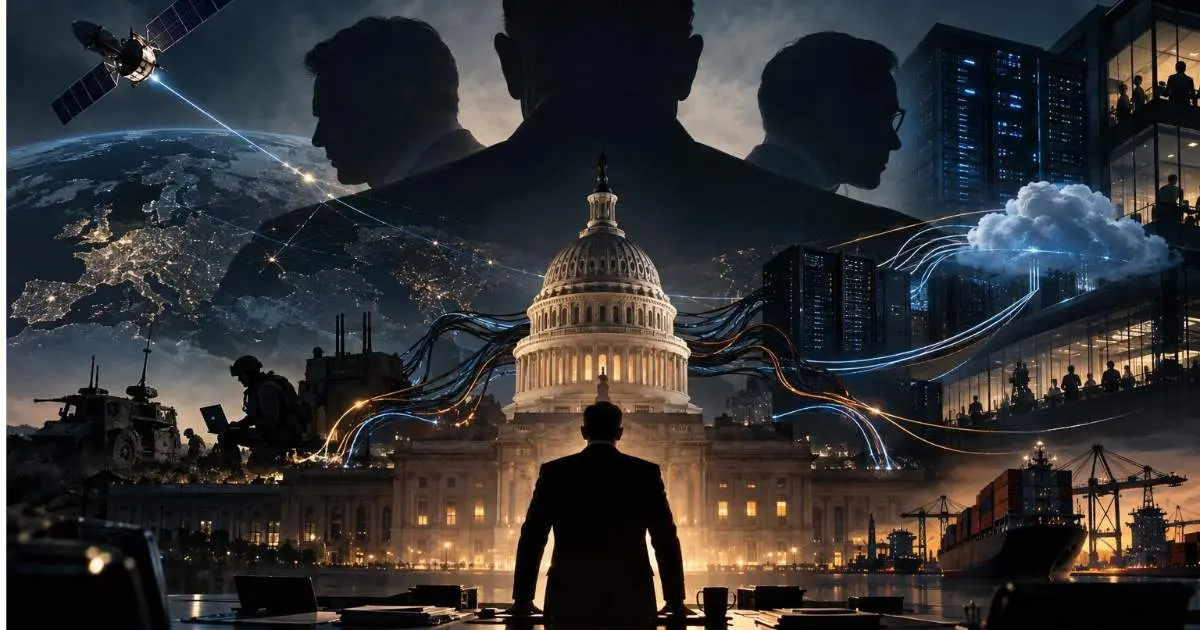
The modern state still writes laws, raises armies and claims sovereignty. Yet more of the capacity that makes those powers usable now sits inside private companies, contractors, data centres, satellite networks and technical systems the state does not fully control. The result is not necessarily a hidden government behind the government. It may be something harder to see: a political order in which public and private power have become dependent enough on one another to pressure, protect and sometimes constrain each other.
The Button the State Does Not Own
Imagine a government at war. It controls its armed forces, writes its own laws and is recognised internationally as sovereign. Yet part of its battlefield communications depends on satellites belonging to a private company headquartered abroad. That company can alter coverage, change technical conditions or restrict particular uses; it can also find itself subject to orders from its own government. Nothing about this arrangement formally abolishes the sovereignty of the state fighting the war. But one of the systems through which that sovereignty becomes usable belongs to somebody else.
Ukraine turned this problem from theory into strategic reality. Starlink became deeply embedded in Ukrainian military and civilian communications after Russia’s full-scale invasion, while European governments later confronted the difficulty of replacing it quickly. In 2025, Reuters examined the possibility of substituting Eutelsat’s OneWeb service and found that the central problem was not simply money but time, scale and operational capacity: Europe could finance alternatives, but it could not instantly reproduce the constellation, terminals and battlefield integration Ukraine already relied upon.
The concern reaches well beyond Ukraine. European governments increasingly speak of digital sovereignty because regulatory authority over national territory no longer guarantees control over the technological systems operating within it. German Chancellor Friedrich Merz said in 2025 that Europe remained far too dependent on American software and needed greater control over its digital infrastructure. In October 2026, Nokia and ICEYE announced a satellite partnership aimed explicitly at allowing governments to own and control satellites, ground systems and terminals. Sovereignty itself had become part of the product being sold.
None of this requires secrecy. Contracts are signed, services purchased, companies publish accounts, regulators issue rules and governments announce partnerships. Yet underneath these ordinary transactions lies a political change that is easy to miss. A state can possess the legal authority to make a decision while lacking the technical ability to carry it out without the cooperation of a private actor.
The familiar claim that “Big Tech is becoming as powerful as states” does not quite capture the problem. Corporations have not replaced governments, which still possess taxation, prosecution, licensing, sanctions, export controls and lawful coercion. What has changed is that governments increasingly exercise their authority through systems they do not wholly own, while the companies operating those systems depend in turn on governments for contracts, permissions, protection and market access. Sovereignty has not simply moved from one side to the other. Power has become entangled.
Why the “Deep State” Story Is So Attractive
The phrase “deep state” survives because it begins with an observation that is partly true: visible institutions do not explain every source of political power.
Presidents do not personally write every policy. Intelligence agencies possess information elected officials may never see in full. Permanent bureaucracies outlast governments. Defence contractors build systems on which military strategy depends. Banks, technology companies, lobbyists, lawyers, consultants, donors and media owners possess forms of access and influence unavailable to ordinary citizens. Informal relationships coexist with formal authority, and the boundary between the two is often difficult to see from outside.
From those facts comes an understandable temptation. If so much power sits outside public view, perhaps somebody must be coordinating it.
That final step changes the nature of the explanation. A hidden organisation directing politics from behind the curtain is easier to imagine than a system composed of overlapping institutions whose interests sometimes align and sometimes collide. A conspiracy gives power a headquarters, a hierarchy and an author. Real political economies can be more fragmented and, in an important sense, more unsettling: actors can produce durable patterns of power without anyone commanding the whole.
Political science has a less dramatic vocabulary for part of this phenomenon. Scholars have long distinguished lobbying from the structural power businesses possess because governments depend on private investment, employment and economic activity. Research on what has been called institutional business power goes further, examining what happens when governments delegate important public functions to private providers and subsequently become dependent on those providers continuing to perform them.
That dependence can deepen almost unnoticed. When governments outsource infrastructure or expertise, they may gradually lose the personnel, knowledge and institutional capacity required to reproduce it. A procurement decision made because a private provider is faster or better today can therefore alter the bargaining relationship years later. The public sees a company receiving government money and assumes that the state holds the stronger hand; the company sees a government relying on a service it cannot easily replace. Neither perspective tells the whole story.
When the Contractor Becomes Part of the State’s Nervous System
Private contractors are hardly a modern invention. Governments bought ships, weapons, roads, uniforms and food for armies centuries before anyone imagined cloud computing. The important change lies not simply in outsourcing, but in the kind of function being outsourced and what happens after the supplier becomes embedded inside it.
SpaceX offers an unusually clear example. The company has become deeply involved in American civil, military and intelligence infrastructure through launch services, satellite communications and national-security work. During the public rupture between Donald Trump and Elon Musk in 2025, Reuters reported that the White House ordered a review of roughly $22 billion in SpaceX government contracts. Yet the same reporting described how difficult some SpaceX capabilities would be for the government to replace. The episode exposed both sides of the relationship at once: Washington could scrutinise contracts and exercise regulatory power over the company, while parts of the American state had come to rely heavily on what that company could do.
The Pentagon’s launch programme shows the scale of that integration. In April 2025, SpaceX, United Launch Alliance and Blue Origin received contracts worth a combined $13.5 billion to launch sensitive national-security satellites through 2029, with SpaceX receiving the largest share. This was not a private company displacing the state. It was something less theatrical and more consequential: privately developed capacity becoming part of the machinery through which the state performs functions it considers essential.
Cloud computing offers another version of the same relationship. Microsoft, Amazon and Google have become important suppliers to the U.S. government as federal agencies expand their use of commercial cloud and artificial-intelligence systems. Defence technology pushes the boundary further still. In October 2026, Reuters reported that autonomous surveillance systems used on the U.S. southern border were feeding real-time information into software networks associated with Palantir and Anduril. The significance is not merely that governments buy technology from businesses; governments have always bought things. It is that commercial code, infrastructure and expertise increasingly sit inside the processes through which the state sees, communicates and decides.
At that point, “contractor” begins to describe the legal relationship better than the political one. A company can remain entirely private while its code forms part of battlefield awareness, its satellites carry military communications and its engineers understand systems the bureaucracy cannot readily reproduce. A commercial disruption then stops being merely a procurement problem. It becomes a problem of state capacity.
The Private Veto
A different kind of power emerges from that dependence, one less visible than lobbying because it may never require anyone to lobby at all. It can be understood as a private veto.
This is not a constitutional veto. A chief executive does not acquire the legal authority to overrule parliament, a president or a defence ministry. The veto is operational. It appears when the state retains the right to decide but an external provider controls something necessary to turn the decision into action.
That suggests a useful separation between legal sovereignty and operational sovereignty. The first concerns recognised authority: who is entitled to decide. The second concerns execution: whether the decision can be implemented without requiring the discretionary cooperation of somebody outside the formal sovereign chain.
The gap can appear in very different places. A government may possess unquestioned legal authority to conduct a military operation while depending on commercial satellite communications. It may administer hospitals, taxation or public records through cloud systems governed partly by contracts and foreign jurisdictions. It may regulate artificial intelligence while depending on foreign companies for the chips, computing infrastructure and advanced models on which its own institutions increasingly rely.
This helps explain why digital sovereignty has moved from technical conferences into national strategy. In 2026, the European Commission advanced measures intended to reduce reliance on foreign technology in sensitive sectors, including cloud and AI infrastructure, amid concern about dependence in areas such as defence, healthcare, banking and energy. The issue is not simply whether European governments can regulate foreign providers. They plainly can. The harder question is what happens when the systems being regulated have also become systems the regulator needs.
The private veto becomes politically significant when replacement is slow. If one supplier can be exchanged for another tomorrow, dependence remains manageable. If replacement requires years of investment, new satellites, engineers, security certifications, data migration or entire supply chains, the balance changes even if no company ever threatens anyone. A state capable of replacing a provider in five years but dependent on its service tonight possesses a very different kind of freedom from a state that can switch by morning. Time itself enters the architecture of sovereignty.
The State Has Leverage Too
The picture becomes distorted if the state is cast as a helpless captive of technology companies. Governments possess tools corporations do not, and many of them are backed by law.
They can investigate companies, block mergers, revoke licences, change procurement rules, restrict exports, deny access to contracts, impose sanctions and prosecute misconduct. The United States can determine whether advanced technologies may be sold to particular countries. The European Union can impose rules on foreign platforms seeking access to its enormous market. National-security reviews can stop investments before they happen.
Companies that appear powerful enough to challenge governments are themselves built inside legal and political systems. Space firms require licences, spectrum and often government contracts. Defence companies depend on procurement budgets. Semiconductor producers operate inside export-control regimes. Banks require access to regulated financial networks. Technology firms need electricity, land, intellectual-property protection, courts and enforceable contracts. The infrastructure company on which the state depends is rarely independent of the state in return.
The Trump–Musk dispute made this reciprocity unusually visible. The administration could review SpaceX contracts and potentially impose costs on Musk’s companies, but the practical difficulty of replacing some SpaceX capabilities constrained how casually that leverage could be exercised. Neither fact cancels the other. A state may possess immense legal power over a company and still hesitate because using that power aggressively would damage capabilities the state itself values.
This is why “capture” can sometimes be an inadequate description. A company may prevail in one regulatory conflict and lose the next. A government may depend on a provider while retaining the capacity to threaten its business model. The balance depends on what each side controls, how replaceable it is and how long each can tolerate separation. Mutual dependence does not eliminate conflict; it changes the price of winning it.
The Power of Being Difficult to Replace
Conventional maps of political power are poorly designed for this world. They colour territory according to states, while organisational charts place presidents, ministers and generals inside public hierarchies and chief executives inside private ones. The visual grammar suggests separate boxes. Infrastructure pays little attention to those boundaries.
A satellite network can be privately owned, publicly regulated, commercially financed and militarily indispensable at the same time. A cloud platform may serve banks, hospitals, intelligence agencies and ordinary consumers through the same technological ecosystem. A cybersecurity company may protect government departments and corporations while accumulating knowledge of threats neither could observe alone. The political significance of these systems does not arise because they are private, but because some become difficult to substitute.
That is where leverage accumulates. Control of a replaceable component produces a contract; control of something that cannot be replaced during a crisis produces bargaining power. The difference can often be measured less by ownership than by the time, money and disruption required to leave.
Europe’s Starlink dilemma illustrated the point. The question was never merely whether another satellite operator existed. It was whether an alternative could be deployed quickly enough, at sufficient scale and with the capabilities already integrated into Ukrainian operations. A replacement that arrives after the crisis has passed is not a replacement in the political moment that matters.
The same logic reaches far beyond satellites. A government tied to a cloud architecture it cannot migrate quickly, software only a particular contractor fully understands or an AI ecosystem centred on a handful of foreign providers has not surrendered sovereignty in the old territorial sense. What it has accumulated are switching costs around sovereignty. Dependence can look like convenience for years because its real price is revealed only when someone tries to leave.
Where Secrets Enter the Picture
Structural dependence requires no hidden misconduct. Yet politics contains another kind of leverage that cannot be dismissed simply because conspiracy theories exaggerate it: information about people.
Secrets have always had political value. Intelligence services collect compromising information because vulnerability can alter behaviour. Political operatives search for damaging records, journalists cultivate confidential sources, lawyers use discovery and governments classify information because knowledge itself can change the balance between actors. Powerful institutions are staffed by human beings, and wealth or office does not make those human beings immune to debt, embarrassment, legal exposure, ambition or fear.
This is part of what gives the Jeffrey Epstein scandal its extraordinary hold over the public imagination. Epstein moved through networks containing wealthy and influential people, and subsequent investigations have raised legitimate questions about access, accountability and the relationships surrounding him. Those questions deserve investigation precisely because the documented story is serious enough without embellishment. A name in an address book, photograph, flight record or social relationship does not by itself establish participation in Epstein’s crimes, much less demonstrate a coordinated blackmail architecture controlling government.
In September 2026, the U.S. House Oversight Committee voted unanimously to recommend holding billionaire Leon Black in contempt of Congress after he declined to comply with subpoenas in its Epstein investigation. Reuters reported that Black had previously paid Epstein $158 million for tax and estate-planning services; Black has denied knowledge of Epstein’s criminal conduct or involvement in abuse. These are substantial facts. They justify scrutiny of relationships and conduct, but they do not establish the existence of a hidden organisation directing the American state.
The same evidentiary rule must apply to claims that political leaders are controlled by unreleased Epstein material. Association is not blackmail. Compromising information is not proof that somebody used it. A mechanism may be plausible without a particular allegation being true, and serious analysis collapses when that difference is ignored.
The opposite mistake is to conclude that because many conspiracy theories are unsupported, personal vulnerability is politically irrelevant. Financial conflicts, hidden debts, undisclosed relationships, legal exposure, corruption, sexual misconduct and classified information can all become sources of leverage; intelligence services have exploited such weaknesses for generations. The intellectually defensible position lies between credulity and ridicule. Secrets can create power, but the existence of secrets does not mean they all belong to one master.
The Mistake Conspiracy Thinking Makes
The idea of a “deep state” often begins with something worth examining: formal democracy does not display every source of influence. Its conceptual error comes later, when a network is turned into a single actor.
Consider how power can converge without central command. A defence contractor wants contracts, a military bureaucracy wants reliable equipment, legislators want employment and investment in their constituencies, investors want returns, security officials want technological advantage, and technology firms want favourable regulation and access to public markets. Former officials move into private employment; executives sometimes move into government. None of this requires a secret committee to produce stable alliances of interest.
Nor is such alignment automatically corrupt. Governments employ contractors because private organisations may genuinely possess expertise, scale or technology that the public sector lacks. The political problem begins when outsourcing changes the distribution of power faster than institutions of accountability adapt to it.
A badly performing ordinary supplier can be dismissed and replaced. A provider becomes politically different when the government has gradually lost the capacity to perform the same function itself. The possibility of termination still exists on paper, but exercising it becomes expensive, slow or dangerous. Dependence has generated leverage without a threat ever being spoken.
This is why searching for a hidden sovereign can obscure the more revealing investigation. Instead of asking which invisible group secretly controls the state, ask which relationships have become too costly to break. That question can be tested against contracts, market concentration, procurement records, technical architecture, switching costs and institutional capacity. It replaces an unknowable master plan with evidence about how power actually travels.
From Lobbying to Dependency
Corporate political power is still commonly imagined through lobbying because lobbying is visible. Money is spent, meetings can be counted, regulatory campaigns leave records and politicians can be questioned about access.
Dependency is harder to see because the infrastructure makes its argument silently. A public official does not need a corporate representative to explain what would happen if an indispensable system stopped functioning. If hospitals, military units, payment networks or government departments rely on a platform, the consequences of disruption are already present in the policymaker’s calculations. Influence occurs before anyone enters the room.
That is different from ordinary persuasion. A company may seek favourable rules through lobbying, donations or advocacy. It occupies another position when government itself must anticipate the consequences of damaging that company because the public sector relies on what it provides. The first form of power tries to change the state’s mind. The second changes the environment in which the state is able to choose.
Digital systems can make this dependence self-reinforcing. As more agencies adopt a platform, more employees are trained around it. As more data accumulates, migration becomes harder. Applications are built around the existing architecture, security procedures adapt to it, and institutional knowledge begins to assume its continued presence. No dramatic moment announces that a convenient supplier has become difficult to leave. The change becomes visible only when exit is attempted. By then, what looked like procurement has acquired geopolitical consequences.
Mutual Leverage Is Not Equal Leverage
There is a danger in the language of mutual dependence itself: it can suggest equality where none exists. A small state negotiating with a global technology company does not possess the bargaining power of the United States negotiating with the same company. A start-up dependent on a Pentagon contract does not confront Washington from the same position as a corporation whose systems are already embedded across government. A company may control critical infrastructure yet remain vulnerable to a state capable of excluding it from its largest market or subjecting its executives to criminal law.
The relevant balance therefore has to be examined relationship by relationship. What matters is not merely who needs whom, but how urgently, with what alternatives and at what cost. A useful measure of power is how long each side can survive separation before the damage becomes intolerable.
This is particularly important for middle powers and states dependent on infrastructure headquartered abroad. Europe has formidable regulatory capacity and one of the world’s largest markets, yet European leaders openly worry about reliance on American software, cloud infrastructure and AI. The tension is not contradictory. Regulation can constrain a provider without making the regulator technologically independent of it.
The geography of corporate headquarters matters for another reason. A company based in a superpower does not thereby become an agent of that government, but it remains subject to that government’s jurisdiction. Export controls, sanctions, licensing requirements, intelligence law and national-security obligations can turn dependence on a foreign company into indirect exposure to the political system surrounding it.
A government purchasing essential technology from abroad is therefore entering two relationships at once: one with the company selling the service and another, less direct but potentially decisive, with the state under whose laws that company exists.
A Better Sovereignty Test
Debates about technological sovereignty often collapse into the question of ownership. That is too crude. States routinely use things they do not own without surrendering meaningful political control, just as alliances create dependencies without abolishing sovereignty. Complete technological self-sufficiency is neither realistic nor necessarily desirable.
What matters is the character of the dependence. A government should know whether an essential function can continue if its provider refuses service, whether the underlying system can be inspected sufficiently to understand its vulnerabilities, how long migration to an alternative would take, which jurisdiction ultimately governs the relationship and whether the public sector still retains enough knowledge to rebuild capacity if circumstances require it. These are not arguments for nationalising every satellite, cloud platform or AI model. They are ways of distinguishing ordinary interdependence from strategic dependence.
Seen this way, sovereignty is not a single possession that a country either has or loses. A state may enjoy substantial autonomy in energy, rely heavily on foreign cloud infrastructure, remain vulnerable in satellite communications and exercise enormous power through its financial system. The pattern varies sector by sector.
The strategic danger is therefore not dependence itself but unexamined dependence on a function whose interruption would become a national crisis. Private innovation and international specialisation can make states richer and more capable; attempting to reproduce every technology domestically could waste resources while creating new weaknesses. The political problem begins when a government cannot say with confidence which providers it could lose and which have quietly become indispensable.
The State Behind the State
So where, in this picture, is the state behind the state? The search may be misleading because it assumes that hidden power must reproduce the architecture of visible government: a centre, a hierarchy and somebody ultimately in command.
Modern power often looks less like a second state than a web of asymmetric dependencies. Governments possess law, taxation, intelligence, coercion and regulatory authority. Corporations possess capital, infrastructure, technical expertise and control over systems that may be difficult to replace. Financial institutions mediate credit and payment networks. Contractors perform functions once associated more directly with public institutions. The people moving through these worlds carry relationships, information, ambitions and vulnerabilities with them.
Sometimes their interests coincide. Sometimes they fight. Sometimes institutions protect relationships that benefit them without anyone designing the larger outcome. Sometimes actual misconduct occurs and should be investigated on its own evidence rather than absorbed into a theory capable of explaining everything and therefore proving nothing.
Looking at power this way makes it less mysterious rather than more. The relevant questions become concrete: who controls the satellite link, who owns the cloud, who awards the contract, who writes the export licence, who possesses a credible substitute, who has information capable of changing another actor’s behaviour, and which relationships have become too expensive to abandon?
Answers can often be found in places far less exciting than a secret room: procurement documents, corporate disclosures, infrastructure maps, lobbying records, court files, parliamentary investigations, technical standards and market concentration. The absence of a single hidden author does not make the resulting power less consequential. It makes tracing the dependencies more important.
When Everyone Has Something the Others Need
The system becomes most difficult to read when several kinds of leverage overlap. A company can depend on government contracts while controlling infrastructure the government needs. Its executives can depend on regulators while possessing access ordinary citizens lack. Officials can rely on private technical expertise while retaining investigative authority over the people providing it. Investors need policy stability while governments need investment. Personal information, legal exposure or reputational vulnerability can be layered onto all of these relationships.
This is where the imagination gravitates toward blackmail because blackmail offers a clean hierarchy: one person has the file and another obeys. Real influence can be less explicit. Institutions anticipate consequences. Executives avoid unnecessary exposure. Governments hesitate before creating conflicts with suppliers they cannot quickly replace. Lawyers advise caution, regulators preserve relationships they may need later, and companies cooperate with authorities they also lobby against. No threat has to be spoken for actors to understand what rupture would cost.
That does not permit analysts to infer hidden coercion whenever a powerful person behaves unexpectedly. It does suggest that power should be studied not only through formal commands but through dependencies and vulnerabilities that shape what actors regard as possible before a command is ever issued.
The point is not to replace official naivety with conspiratorial certainty. It is to recognise that formal authority and effective freedom of action are no longer always located in the same place.
Sovereignty After the Illusion of Separation
The twentieth-century imagination of power encouraged neat categories: the state governed, companies traded, intelligence agencies collected secrets, armies fought and citizens voted. Those categories were never entirely accurate, but technological infrastructure has made their boundaries increasingly difficult to sustain.
A satellite company can become part of a war. A cloud provider can become part of public administration. A software firm can become part of military perception. A private database can shape state decisions, while a regulator can determine whether a company is permitted to sell its most important technology abroad. Public authority and private capacity now meet inside systems that neither side entirely controls alone.
This does not make democracy an illusion. It means democratic accountability has to follow power into places where older institutions did not expect to find it. Knowing who holds office remains essential, but it is no longer enough. We also need to know whose cooperation is required before the officeholder’s decision can become real.
That shift changes the question at the centre of political analysis. “Who rules?” assumes that power ultimately settles somewhere. In a system of fragmented capacity, the more revealing question may be who can stop whom from acting, and for how long?
Follow that question and much of what appears mysterious begins to acquire a visible structure. The state retains law, coercion and formal authority; a company may hold infrastructure; a regulator controls permission; a contractor holds expertise; an intelligence service possesses information. None necessarily owns the whole machine, and the balance can change from one crisis to the next.
The state behind the state, then, may not be a state at all. It may be the accumulated architecture of dependencies through which modern government has learned to operate: contracts that cannot quickly be cancelled, platforms that cannot quickly be replaced, expertise that has migrated outside public institutions, foreign jurisdictions that surround domestic capabilities, and relationships whose value becomes clearest when somebody threatens to break them.
There is no need to invent a secret sovereign to take that architecture seriously. The more unsettling possibility is that no single actor is fully sovereign over it. Power survives in the seams between institutions, and those seams become visible precisely when one actor tries to act without the others.