Protests can cross borders without their grievances crossing with them. What travels is often something less visible: a tactic, an expectation, a demonstration that normal life can be interrupted. The greater danger for governments begins when separate local frustrations stop looking separate at all.
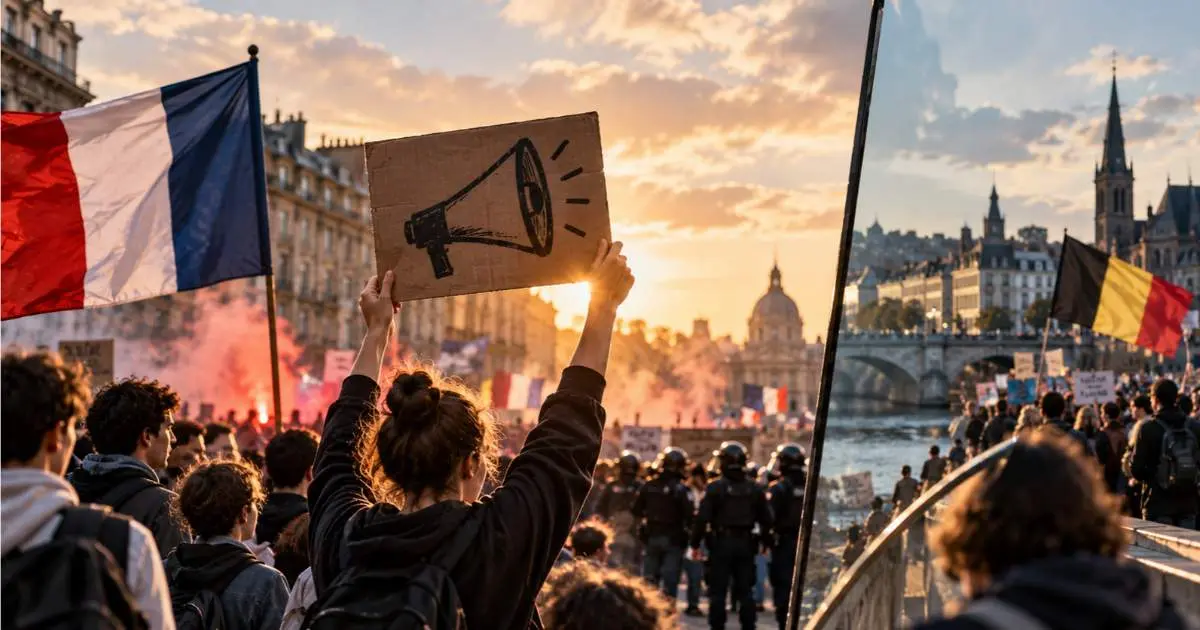
In the autumn of 2026, unrest in France once again produced images that seemed instantly familiar: students mobilising, workers striking, transport disrupted, police deployed, streets becoming political stages. Across the border in Belgium, demonstrations involving students and teachers in Liège created an obvious temptation to draw a line between the two countries. France was convulsing; Belgium was protesting; Europe, perhaps, was catching something.
The temptation is understandable, but the chronology complicates it. Belgian education grievances did not suddenly materialise because French protesters took to the streets. Teachers, students and unions had their own disputes over reforms, funding, workloads and the direction of public education. Similar caution applies whenever unrest appears to jump from one country to another. A protest may provide an example without providing the grievance, and two demonstrations that resemble each other may have arrived at the street through entirely different political histories.
Yet dismissing cross-border influence because the grievances are local makes the opposite mistake. Political contagion does not require people in two countries to want the same thing. It requires something more portable than a demand: a repertoire of action, an expectation about what disruption can achieve, or simply the discovery that conduct which looked implausible yesterday has become imaginable today. The grievance can remain stubbornly local even while the possibility of acting upon it travels.
That distinction changes how protest waves should be understood. The important question is not simply whether unrest is spreading. It is what, exactly, is spreading.
The grievance stays home. The possibility travels.
The language of contagion is dangerous because it can make protesters sound like carriers of a political disease. Governments have often found such metaphors convenient: unrest arrives from abroad, agitators import disorder, foreign ideas infect an otherwise stable society. Sometimes foreign organisations really do provide money, training, ideological material or logistical assistance, and those connections should be investigated when evidence supports them. But most cross-border protest influence requires nothing so organised.
People watch one another. They see which tactics attract attention, which occupations last, which strikes impose costs, how police respond, whether governments retreat and whether previously passive groups join. Digital media has accelerated that observation dramatically, but the mechanism is older than the smartphone. Demonstrations, strikes, boycotts, occupations and slogans have crossed borders for generations because political action is partly learned behaviour.
What moves between societies can therefore be surprisingly thin. Protesters in one country do not need to adopt another movement’s programme. They may borrow a march format, a blockade, a symbol, a way of using universities, a method of coordinating through professional networks or merely the expectation that disruption is possible. Sometimes participants communicate directly, but in many cases the transferable element is a repertoire, an expectation, a feeling that action which seemed implausible yesterday has become imaginable today. Political permission can travel farther than political programmes because people can learn that resistance is possible without agreeing on what the resistance should ultimately achieve.
This is why political contagion is often misunderstood when analysts search for identical slogans or organisational links. The more consequential transmission may occur before movements resemble one another ideologically. A successful disruption elsewhere can alter the perceived cost of remaining passive at home. It does not create the domestic grievance, but it can change the moment at which people decide that the grievance is worth acting upon.
What 1968 actually teaches
Whenever unrest expands in France, May 1968 waits nearby as a ready-made analogy. Students confront police, barricades appear, schools or universities become centres of mobilisation, and commentators begin searching old photographs for visual confirmation that history has returned. The comparison is seductive precisely because 1968 has become an image as much as an event, but that image can obscure the feature that made the crisis politically extraordinary.
Barricades did not make 1968 exceptional. France had experienced street confrontation before, just as students had protested before. The decisive development was that a conflict centred initially on students and universities stopped remaining confined to that social world. Workers entered the crisis, factories were occupied, strikes spread through transport and industry, and what had looked like one category of grievance became entangled with another. At its height, the strike wave involved millions of workers and placed the French state under a kind of pressure that no student revolt could have generated on its own.
The useful lesson of 1968 is therefore not that modern protesters may imitate its aesthetics. It is that political danger changes when separate arenas of dissatisfaction begin to synchronise. Students do not need to become workers, workers do not need to adopt every student demand, and neither group needs to share a complete ideological programme. What matters is that grievances previously contained within different institutions begin reinforcing one another in time and political meaning.
This distinction also explains why comparisons with 1968 are usually premature. A dramatic confrontation outside a university can dominate television while remaining politically containable. A transport strike can paralyse movement without producing a wider challenge to political legitimacy. A teachers’ protest can be large while remaining sectoral. The threshold changes when participants start recognising other conflicts as expressions of something they believe is also happening to them.
That is more difficult to measure than crowd size, but it may matter more. Governments know how to negotiate with sectors because sectors have ministries, unions, budgets and defined demands. A crisis becomes less manageable when the boundaries that normally separate those negotiations begin to weaken.
Sparks travel. Combustibility does not.
Cross-border protest is often discussed through the metaphor of a spark: one demonstration ignites another, which ignites another, until unrest appears to move across a map. The metaphor captures speed but conceals the most important condition. A spark matters only where something is already capable of burning.
France cannot manufacture Belgian anger about Belgian education policy. A protest in Paris cannot create dissatisfaction with a school reform in Liège that already has its own history, institutions and political actors. Nor can a viral image from one country explain why workers elsewhere are dissatisfied with pensions, wages, staffing levels or public services. The local structure of grievance remains indispensable.
This is why combustibility may be more useful than contagion alone. Societies accumulate frustrations long before those frustrations become visible in the street. Public institutions deteriorate unevenly, reforms redistribute costs, professional groups lose confidence, younger generations revise their expectations, and fiscal choices create winners who may barely notice their gains and losers who experience the change every working day. Much of this can remain politically compartmentalised for years.
An external protest can alter that equilibrium without causing the underlying problem. It can demonstrate that disruption attracts attention, that a government can be pressured, that another occupational group has abandoned patience or that the boundary between dissatisfaction and collective action is less formidable than it appeared. The imported element is not the fuel. It is information about what might happen if somebody lights it.
This distinction is important because it avoids two convenient political stories. The first blames foreign agitation for unrest that domestic institutions helped create. The second treats every protest as an entirely isolated expression of local conditions and ignores the way political behaviour is learned across borders. Both can be wrong simultaneously. Sparks can travel, while combustibility remains local, and understanding a protest wave requires examining both sides of that relationship rather than choosing one.
The Revolt of Maintenance
There is another reason why the imagery of 1968 can mislead. Many of the great protest movements associated with the post-war decades emerged during periods in which expectations were expanding. Universities were growing, younger generations were challenging inherited authority, workers demanded a larger share of prosperity, women contested established social roles, colonial orders were collapsing and political imagination frequently pointed toward worlds that did not yet exist. The language of revolt was often a language of transformation.
A different kind of grievance has become increasingly visible across mature states. Teachers protest because schools cannot absorb another reform or another reduction in resources. Health workers warn that staffing models are becoming unsustainable. Rail workers, civil servants, pensioners and local authorities resist changes that they believe will make existing systems function worse. Citizens encounter institutions that still exist, still collect taxes and still promise services, but appear progressively less capable of delivering the normality for which those institutions were built.
This can be understood as the Revolt of Maintenance. Its political energy comes not primarily from demanding a radically new society but from the perception that the existing one is failing to maintain its own promises. The demand is often less “give us a new world” than “make this one work as it was supposed to.” That difference matters because maintenance grievances can emerge in societies that appear comparatively stable, wealthy and institutionally mature. Their source is not necessarily revolutionary aspiration; it may be the widening distance between institutional expectations and institutional performance.
The concept should not be romanticised. Some demands framed as preserving public services may protect professional advantages, resist necessary reforms or shift costs onto other groups. Governments also face genuine demographic, fiscal and technological constraints, and not every unpopular reform represents institutional decay. But the political pattern remains important because people often experience the state through the reliability of ordinary systems rather than through constitutional abstractions. A functioning classroom, hospital, train, pension office or local service is one of the places where political legitimacy becomes tangible.
When several such systems become contested at once, apparently unrelated disputes can acquire a common language. A teacher worried about classroom conditions and a nurse worried about staffing do not have the same grievance, yet both may come to believe that they are confronting the same governing habit: promises maintained rhetorically while the capacity to fulfil them is gradually reduced. At that point, maintenance itself can become a political identity.
The fiscal state is where separate grievances can meet
Many contemporary disputes eventually arrive at the same institution even when they begin elsewhere: the budget. Education reform, hospital staffing, transport subsidies, pensions, public-sector wages, housing support and local government finance may involve different ministries and constituencies, but fiscal constraint can place them inside a shared argument over what the state can still afford and who will absorb the adjustment.
This creates the possibility of political convergence without creating identical interests. A teacher opposing education cuts may sympathise with a health worker resisting staff reductions, but both programmes still compete for public resources. Pensioners and younger workers may agree that public services are deteriorating while disagreeing sharply over taxation and intergenerational distribution. A broad coalition can therefore emerge emotionally before it exists materially.
That tension is central to understanding whether protest synchronization will last. Shared anger can create a crowd; it cannot by itself create a settlement. Governments may survive broad unrest by exploiting precisely these differences, negotiating separately with sectors, granting concessions to one constituency or persuading another that somebody else’s demand will ultimately be paid from its pocket. The fiscal state is therefore both a meeting place for grievances and a machine for separating them again.
This is one reason protest waves can look more unified from a distance than they feel from within. Photographs compress different motives into one street. Political language compresses them further into phrases such as “anti-government protests” or “social unrest.” Yet the durability of a movement depends on whether participants can move from recognising a common source of dissatisfaction to accepting some common distribution of costs, risks and priorities.
Naming a protest can change the protest
Political movements rarely arrive with stable identities. Journalists, governments, unions, activists and opponents begin naming them almost immediately: student revolt, anti-austerity movement, pension protest, anti-government uprising, riots, resistance, general strike. These labels appear descriptive, but they also influence who believes the movement belongs to them.
A protest defined as a teachers’ dispute invites one kind of participant. A protest understood as a defence of public services invites another. If it becomes framed as opposition to an entire government, people who share the original grievance but not the wider political objective may withdraw, while groups with little connection to the initial dispute may join. Movements therefore evolve not only through recruitment but through classification.
Governments participate in this struggle over meaning because containment is partly semantic. If unrest can be kept inside the category of a sectoral dispute, it can usually be directed toward a ministry, bargaining table or technical reform. If protesters succeed in persuading other groups that the issue represents a wider failure of governance, the political audience expands. The conflict ceases to be solely about the policy that first brought people into the street.
This is also why analysts should resist naming movements too quickly. Early stages can be deceptive. A demonstration may broaden, fragment, radicalise, institutionalise or disappear. The same people may understand their participation differently after a week of strikes than they did on the first day. Classification is therefore not merely a journalistic problem; it is part of the sequence through which a movement discovers what it is.
Violence can expand a movement or imprison it
Street violence occupies a disproportionate place in coverage because it produces the most dramatic images: fire, broken glass, riot police, injuries, arrests and confrontation. Those images can alter a protest’s trajectory, but not in a predictable direction. Repression perceived as excessive can widen sympathy for protesters, while violence associated with demonstrators can narrow a coalition and allow the government to redefine a political dispute as a problem of public order.
The consequences depend partly on who is believed to have crossed a legitimate boundary first, but also on the social breadth of the movement before violence occurs. A movement already embedded across professions and communities may absorb episodes of disorder without losing its central political meaning. A narrower movement can become trapped by them, especially when spectacular confrontations displace the grievance that originally mobilised participants.
This creates a strategic asymmetry. Governments possess institutions specifically designed to manage disorder; protest movements often depend on moral legitimacy and voluntary participation. Once the political argument moves entirely onto terrain of policing, property destruction and security, the state may regain an advantage even if the original grievance remains unresolved. Protesters who understand this often devote considerable effort to controlling tactics, while governments may emphasise disorder precisely because it fragments sympathy.
Violence should therefore be analysed less as a measure of how “serious” a protest has become than as one of the mechanisms that can alter its coalition. A peaceful movement can pose a profound political challenge if it synchronises large sectors of society, while a spectacularly violent confrontation may remain isolated. The camera naturally prefers the burning object; political power may be changing somewhere outside the frame.
Governments fear synchronization more than imitation
Authorities can usually tolerate a certain amount of imitation. Students copy slogans from another country, activists borrow visual symbols, unions observe tactics used elsewhere and demonstrations cluster around similar dates. These behaviours may be irritating or disruptive, but they remain manageable as long as the participating groups stay socially and politically compartmentalised.
Synchronization is different because it weakens the administrative boundaries through which governments normally process conflict. Education goes to the education ministry, transport to the transport ministry, pensions to social affairs, wages to employers or collective bargaining. Modern states are organised to divide problems into jurisdictions. Protest becomes more difficult to contain when citizens begin recombining those problems into a single interpretation of how they are governed.
This does not require a revolutionary ideology. It can begin with something as ordinary as recognition. Teachers see nurses and recognise the language of understaffing. Railway workers see civil servants and recognise the language of budgetary pressure. Parents encounter a school dispute and connect it to their experience of healthcare or housing. Separate groups do not become identical; they begin to see themselves as exposed to a common pattern.
That is the threshold governments watch closely because it changes the scale of political meaning. A concession to one group may no longer isolate the dispute if other groups interpret it as evidence that pressure works. Conversely, refusal to concede may strengthen the belief that separate problems originate in the same governing priorities. Either response can create information that other sectors use when deciding whether to mobilise.
Political contagion is really a problem of translation
The metaphor of contagion suggests replication, but successful political transmission usually requires translation. A tactic developed in one society has to enter another political culture, labour system, media environment and institutional structure. Even within one country, a student grievance must be translated before a nurse or factory worker can recognise something of their own experience inside it.
Movements that fail at this translation often remain confined to the constituency that created them. Their demands may be legitimate and their demonstrations large, but outsiders continue to perceive the conflict as somebody else’s problem. Movements that succeed find language capable of connecting specific grievances without pretending that they are identical. “Our university is being mismanaged” may remain a campus dispute; “public institutions are being asked to do more while their capacity is being hollowed out” can travel much further.
The same principle explains why some imported protest symbols flourish while others disappear. A foreign slogan does not become politically powerful because it is fashionable. It survives when people can attach local experience to it. The most portable political ideas are therefore often not detailed programmes but interpretive frames: ways of telling people that what they experience privately belongs to a pattern shared by others.
Seen this way, political contagion is less mysterious than the metaphor implies. People are not infected by unrest. They are offered interpretations, tactics and evidence of possibility, and then decide whether those materials fit the conditions in which they already live. The external example matters, but the act of translation remains local.
The dangerous threshold is not maximum anger
Governments often measure unrest through visible intensity: turnout, strike participation, arrests, economic losses, transport disruption or opinion polls. These indicators matter, but the politically decisive moment may arrive before any of them reaches its maximum. A smaller movement can become more dangerous if it begins connecting social worlds that previously interpreted their frustrations separately.
The threshold is crossed when people stop asking only whether their own sector has been treated unfairly and begin asking whether apparently unrelated failures belong to the same pattern. At that point, a government is no longer dealing simply with a list of demands. It is dealing with an emerging interpretation of itself.
This is why political orders can live for years with considerable anger. Dissatisfaction divided among classrooms, hospitals, workplaces, neighbourhoods and ministries remains easier to absorb because each grievance retains its own institutional address. Elections can channel some of it, negotiations can contain some, administrative reforms can postpone some, and social groups can even blame one another for competing claims on public resources.
The situation becomes more volatile when those divisions stop containing the meaning of the grievances themselves. People may still want different things, belong to different professions and disagree over solutions, yet begin to suspect that the failures they encounter share a political origin. At that point protest stops merely travelling and begins to synchronize: the important movement is no longer only from one city or country to another, but between social groups that had previously understood their frustrations in isolation.
That is the more durable lesson behind the familiar images of protest crossing borders. France does not need to export French grievances to Belgium, and Belgium does not need to reproduce France for events in one country to influence political behaviour in the other. The transferable element can be much thinner: a tactic, an expectation, a proof of disruption, a sense that waiting is no longer obligatory. Yet none of these can create a durable movement where local conditions provide nothing to translate them into.
Political contagion is therefore neither a foreign virus nor a romantic chain reaction. It is an interaction between local fuel, travelling examples and the possibility of synchronization. The first explains why people are angry, the second can alter what they believe is possible, and the third determines whether separate grievances remain manageable disputes or begin to form a wider political story. A spark may cross a border in seconds, but whether anything catches fire still depends on what has been accumulating there long before it arrived.