The Kingdom of Kongo helped shape the Atlantic world through diplomacy, commerce and a Christianity its people made their own. Its rulers could protect some people from sale while authorising the sale of others. Across four centuries, the harder question became whether belonging to the kingdom could still protect a person when someone else had the power to decide their fate.
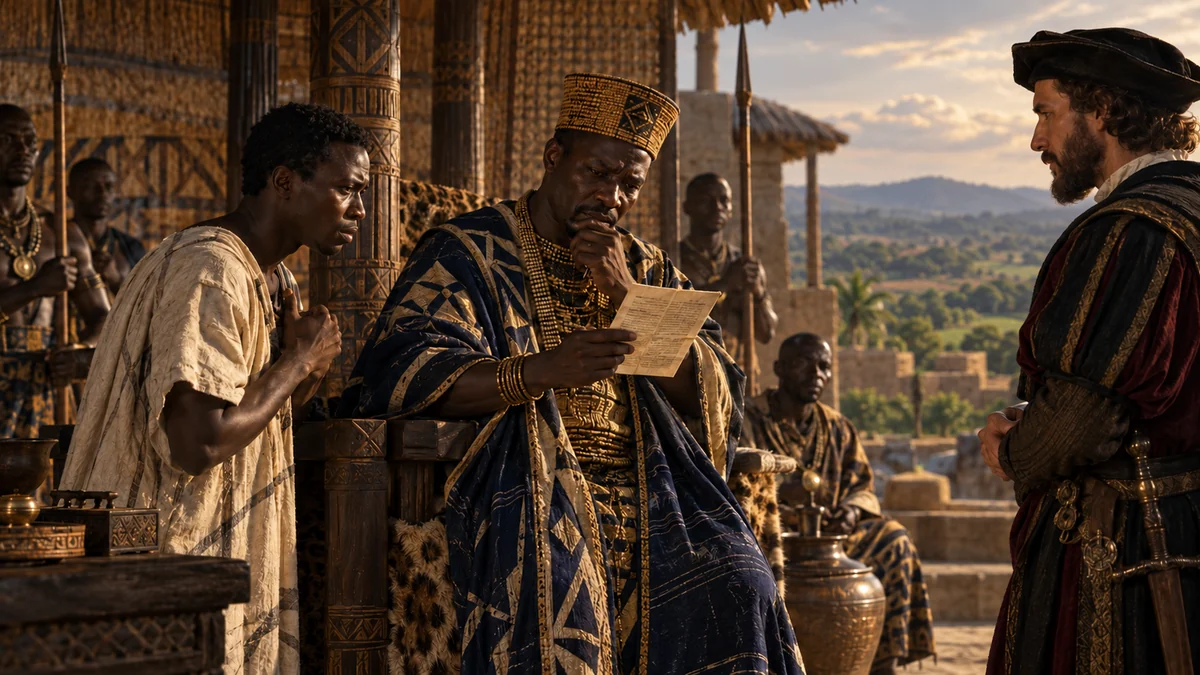
In a letter dated 18 October 1526, King Afonso I of Kongo described people being kidnapped, taken secretly to buyers, shackled and branded. Some, he said, were free people whom his subjects had no right to sell. When royal guards intervened, Portuguese purchasers insisted that they had bought the captives, although they could not always identify the seller. Afonso had appointed three court officials to examine the status of people offered for export. If the officials found that a person had been legitimately enslaved, the sale could proceed. Buyers who avoided the examination risked losing those they had purchased.
The procedure could restore someone’s freedom. It could also clear someone else for shipment across the Atlantic. Afonso was defending a boundary within an economy that treated human beings as property: some people were entitled to the kingdom’s protection, while others could lawfully be sold. The buyer’s claim rested on possession and payment. The king’s claim rested on a judgement about a person’s standing. For someone already in chains, the difference mattered only if royal officials could intervene before the ship departed.
Kongo’s subsequent history repeatedly exposed that distance between a recognised status and an enforceable protection. An ambassador might recover a countryman sold abroad. An army fighting to reunite the kingdom might enslave free people within it. A royal court might survive into the colonial period while helping administer demands many of its people opposed. These were different events, produced by different conflicts. Together, they show why a kingdom’s sovereignty cannot be measured solely by the survival of its ruler, the extent of his claims or his ability to negotiate with foreign powers. It also depended on whose freedom he could defend, and from whom.
The kingdom must first be located apart from the later states bearing the name Congo. Its capital, Mbanza Kongo, stands in northern Angola. Its core territories extended through parts of what became Angola and the western Democratic Republic of the Congo. The wider Kikongo-speaking world was larger than the kingdom’s jurisdiction, while the reach of royal government changed over time. Kongo possessed a history of political expansion and regional exchange before Portuguese ships arrived on its coast in the late fifteenth century. Atlantic connections enlarged the opportunities available to its rulers and subjects. They also made disputes over status, allegiance and the control of people more consequential.
The Kingdom of Kongo Looks Seaward
Mbanza Kongo occupied a plateau above the surrounding country. It was a political and sacred centre before stone churches altered its appearance. Royal households, places of judgement and a substantial urban population belonged to an established capital. Buildings raised after Portuguese contact added to a city already organised around the exercise of authority. The surviving royal precinct, burial places and cathedral remains belong to different stages of its history. They record a centre that people repeatedly adapted as their institutions and religious life changed.
The kingdom’s beginnings are harder to date precisely than its encounters with Europe. Traditions recorded later associate its foundation with Lukeni lua Nimi, a conquering ruler whose story explains relationships among royal power, local authorities and sacred obligations. Such accounts preserve historical knowledge, but they also gave later arrangements an authoritative past. Archaeology and historical linguistics complicate a simple founding chronology. Related languages spread before the consolidation of the kingdom, and communities brought within its orbit had histories of their own. A linguistic inheritance was not identical to a monarch’s territory.
By the seventeenth century, royal government depended on relationships between the capital, provincial rulers and local communities. Office, kinship and patronage helped sustain those connections. Tribute brought metals, salt, cloth and ivory to the court, while farming households supported local economies and markets. Around the capital, aristocratic estates drew on the labour of dependants, including enslaved people. Atlantic commerce mattered greatly, but the court did not live from overseas trade alone. Its authority rested on work, land and obligations within the kingdom.
Succession made that authority contested. Royal descent produced possible claimants, but a contender needed supporters able to supply men, resources and recognition. A change of ruler could redistribute appointments and access to favour. Kongo could govern, tax and make war without possessing an unbroken chain through which every command from the capital reached an obedient official. The networks that allowed a king to rule could also sustain his rivals.
Portuguese contact entered this political world. Nzinga a Nkuwu’s baptism as João I in 1491 opened relationships carried by envoys, students, priests, artisans and merchants. His son Afonso, who secured the throne after a struggle with a rival, pursued them energetically. Education, religious connections and access to skilled people could serve aims formed in Kongo itself. John Thornton’s research on these early relations challenges the assumption that cooperation immediately placed the kingdom under foreign direction. The terms of the relationship had to be negotiated, and the participants wanted different things from it.
A Faith with Kongolese Authors
Christianity came to matter beyond a king’s diplomatic interests. Afonso sought clergy and teachers, and he wrote as a ruler concerned with worship and Christian conduct. His July 1526 letter to the Portuguese court began with the arrival of wine and flour needed for the Eucharist and offered condolences for a death in the Portuguese royal family before turning to the abuses of trade. Religious commitment and a dispute over who could be sold appeared in the same correspondence. To extract only the protest against trafficking would make the king easier to classify, but harder to understand.
Afonso’s son Henrique became a bishop in 1518, giving the court a remarkable position within Latin Christianity. Ecclesiastical growth also raised questions of control. When a diocese centred on São Salvador, the Christian name of Mbanza Kongo, was established in 1596, the Portuguese monarchy retained rights concerning appointments. Kongolese attempts to deal directly with Rome sought greater room within a church to which the kingdom already belonged. Dependence on foreign ecclesiastical authorities did not make Kongolese faith less real; it made authority within that faith a matter of politics.
Teachers and artists helped make Christianity part of the kingdom’s intellectual life. For a Kikongo catechism published in 1624, the Jesuit Mateus Cardoso acknowledged the work of educated teachers at court who assisted with the translation. Their task involved more than replacing Portuguese words with Kikongo ones. Teaching Christian doctrine required choices about how inherited ideas would be expressed through a language with meanings of its own. The printed book followed a European model, but its production depended on Kongolese knowledge.
A brass crucifix attributed to a Kongo artist and dated by the Metropolitan Museum of Art to the sixteenth or seventeenth century offers another trace of that work. Smaller figures appear around Christ, while details of the design invite attention to local ways of representing sacred relationships. The art historian Cécile Fromont reads such objects in connection with Kongolese understandings of the visible and invisible worlds. An individual object cannot tell us what every believer thought. It does show that makers did more than reproduce a form brought from elsewhere.
Belief was never uniform across the kingdom. Missionaries sought forms of discipline that could provoke resistance, while Kongolese Christians used the faith for devotion, political argument and criticism of rulers. Over generations, Christianity furnished a language in which someone could defend a king or challenge his claim to represent the country. That history helps explain why a later movement demanding Kongo’s reunification could also dispute where its sacred centre lay and who had authority to speak for it.
The Commerce a King Could Authorise
Kongo traded more than captives. Cloth, ivory and copper circulated within regional and overseas networks. Finely worked raffia textiles reached European collections; two were recorded in Rudolf II’s collection in Prague in 1607. The circumstances in which particular surviving examples first changed hands are often uncertain. Their presence abroad nevertheless points to skills and production that a history centred only on slave ships would conceal.
Enslaved people became an especially consequential form of transferable wealth. In a letter of 1514, Afonso described giving enslaved people, along with metal bracelets, to Portuguese interlocutors. His later complaints came from within a political economy in which his own court had used people to sustain diplomatic and material relationships. The protection he demanded for some did not imply a rejection of enslavement as such.
Early Atlantic traffic from Kongo supplied the sugar economy of São Tomé. Later plantation expansion in the Americas widened the markets available to merchants operating in West Central Africa. A trader might value a ruler who kept roads open and authorised sales. He might also seek suppliers who could evade that ruler’s restrictions. Commerce could therefore depend on political order while rewarding the people who crossed its boundaries.
Afonso’s July 1526 protest described damage to more than one royal interest. Imported goods had reached people whose access he had previously controlled through his own distribution. He also reported the abduction of free people, including nobles and royal relatives, for sale to Portuguese buyers. He asked the Portuguese king to stop sending merchants and merchandise and to end the export of enslaved people from his realms. His warning that the country was being emptied conveyed alarm, not a count from which its population can be calculated.
By October, Afonso had described the inspection procedure with which this article began. The two interventions belong together. He threatened a sweeping restriction and also explained how exports might continue under official scrutiny. Neither letter establishes how consistently his commands were carried out. They do establish that the court distinguished between people it would permit merchants to take and people it said those merchants had taken unlawfully.
Linda Heywood’s study of slavery in Kongo traces how such distinctions changed. Earlier rulers generally sought to protect freeborn Kongolese from overseas sale while permitting the enslavement and export of others. Internal conflict later weakened those protections and altered who could be sold. This was a distinction rooted in social and political standing, rather than a simple test of birthplace inside a modern border. Protection against export also coexisted with domestic slavery and coercion. A king could defend the freedom of particular subjects while drawing wealth from the enslavement of other people.
Afonso’s proposed inspection confronted a practical problem. Shackles, branding and a buyer’s possession made a claim of ownership immediately effective. Establishing that the captive was free required knowledge of who the person was, access to officials and enough time to prevent departure. The authority to declare a person protected was different from the ability to reach that person in time. Each delay favoured the claim already backed by force.
On one recorded occasion, protection travelled across the Atlantic. In Bahia in 1604, António Manuel, an ambassador sent by Álvaro II towards Rome, ransomed Pedro Mambala, a man from Kongo who had been unlawfully enslaved. A certificate of freedom remained among the ambassador’s papers. The intervention made the man’s connection to Kongo consequential even far from its shores. Yet an ambassador had to pay to recover a freedom that, according to that connection, should not have been taken. The transaction repaired an individual wrong through the market that had enabled it.
More Than One Centre of Power
Kongo survived a severe crisis before Luanda became a Portuguese base. Warfare in the 1560s, associated in the sources with people called Jaga, drove Álvaro I from the capital. The identity of the attackers and the conflict’s origins remain disputed. Portuguese military assistance helped the king recover his position. Foreign participation could thus arise from a monarch’s own search for support, bringing obligations and opportunities for interference with it. The restoration neither ended Kongo’s political independence at once nor made later conflict inevitable.
Luanda, founded in 1576, provided a lasting base for Portuguese expansion to the south. Its governors pursued territorial and commercial projects with African allies and soldiers as well as personnel from overseas. Relations negotiated with a Portuguese monarch did not determine the actions of every governor or merchant acting in his name. A court capable of diplomacy could still face armed initiatives it had neither authorised nor accepted.
The war of 1622 shows why the kingdom’s history cannot be told as a steady sequence of defeats. A Portuguese-led invasion won at Mbumbi, but Kongolese forces subsequently won another engagement and began recovering territory. Research by Thornton and Andrea Mosterman brought evidence of the second battle into an account long dominated by the first. Pedro II also sought Dutch cooperation against Luanda. Such plans emerged from Kongolese political choices within European rivalries, rather than from a passive wait for one foreign power to replace another.
Rival choices developed inside Kongo as well. Soyo, near the Congo River’s mouth and the port of Mpinda, built commercial connections and political strength that competed with those of the capital. By the 1640s it was effectively independent. Its rulers intervened in contests over the crown while defending their own position. Authority was moving among African centres with different resources and interests. A king who could resist a Portuguese governor could still struggle to command a powerful neighbour whose rulers shared much of his political inheritance.
At Mbwila on 29 October 1665, António I confronted a Portuguese-led force supporting the opposing side in a local succession struggle. The king and many leading members of his establishment died. African troops formed a substantial part of the victorious force; the battle cannot be understood as two sealed armies divided by origin. Nor did it deliver Kongo to Portuguese government. Five years later, Soyo defeated a Portuguese invasion at Kitombo. Power remained distributed among authorities able to resist one another and frustrate outside plans.
After Mbwila, rival royal groupings, particularly those identified as Kinlaza and Kimpanzu, fought over succession. The capital was eventually abandoned amid the wars, while provincial strongholds sustained competing claimants. Institutions survived, but no claimant could settle the conflict across the country. For households caught between them, survival of the kingdom’s political forms offered uncertain protection. The question was which armed authority would recognise their allegiance, and what it would do if it did not.
Captivity became one possible consequence of losing that argument. A ruler could describe another community as disloyal, seize its people and obtain resources through their sale. Not every war was fought for captives: contenders wanted office, territory and recognition. But a trade able to absorb prisoners changed the stakes of those contests. A family’s freedom might depend on a political classification made by the force that had just defeated it.
The Cost of Putting the Kingdom Together
The Portuguese crown also imagined a restoration of Kongo. In a royal letter dated 5 March 1700, it instructed Angola’s governor to seek agreement among Soyo and other powerful electors on a king. The letter acknowledged the need for their consent while anticipating advantages if Portuguese arms helped elevate the chosen ruler. It proposed garrisons supported at African rulers’ expense as a way to secure political and commercial influence, alongside the revival of Christianity. The letter records an intended course, not a completed intervention. In 1702, the Portuguese crown suspended the dispatch of troops for the proposed garrisons, saying those soldiers were needed at its principal posts in Angola.
The plan treated agreement among powerful men as essential, while leaving a different question open: what obligations would a restored government place on people beneath them? A monarchy could be brought back with the consent of electors and still govern through demands that ordinary households had little power to refuse. Foreign assistance might strengthen a king’s position without strengthening his subjects’ protection from armed seizure.
Pedro IV’s pursuit of reunification makes the danger concrete. In 1701, a royal official acting on his orders attacked and destroyed the village of a local ruler the king considered a traitor. Fifty-eight people were taken as slaves. Heywood’s account, drawing on a missionary report, notes that many were free people; some lived there, while others had been visiting. An accusation against the village had become a fate imposed on people found within it. For a visitor, neither personal status nor a separate home prevented the armed party from treating presence as proof enough.
The violence of 1701 was carried out on Pedro’s orders. In this instance, the power rebuilding the kingdom also helped make free people available for enslavement. A claimant could become more effective at imposing allegiance while people caught in his campaign became less secure. The visitors among the captives expose how widely the punishment reached: presence in a village associated with a rival could override their standing as free people. Restoring royal command and restoring protection were separate undertakings, and the first could proceed at the expense of the second.
Rebuilding Kongo also involved a struggle over religious authority. In 1704, Dona Beatriz Kimpa Vita announced that Saint Anthony had entered her and commissioned the kingdom’s restoration. She located Christian sacred history within Kongo and challenged the authority of Capuchin missionaries. Her claims arose within a Christian world Kongolese believers had helped make over generations. Reuniting the country and reclaiming its place in sacred history became connected demands.
The abandoned capital gave the movement a place to gather. Kimpa Vita’s followers assembled at São Salvador, while disciples carried appeals into the provinces. They invited people to recognise a common kingdom despite the rival courts that claimed it. But a call to reunion could not escape disputes over who would direct it. Commanders and claimants could support or oppose the movement according to their own positions. A shared sacred past did not settle the question of who would govern the people gathered around it.
Pedro IV ultimately answered the rival claim with force. After Kimpa Vita’s capture, she and her companion João Barro were tried and burned alive on 2 July 1706. The Capuchin Bernardo da Gallo was a prominent opponent of her mission, while the king exercised the authority under which the execution took place. Both royal and missionary power belong in the account. Her death was part of a dispute within Kongolese Christianity over which project could speak for the kingdom.
Her execution did not immediately end the Antonian movement. Followers remained associated with São Salvador and with forces opposing Pedro until his army took the city in 1709. Negotiation and offers of pardon accompanied the struggle, but military victory secured his position. Recovering the capital was a political achievement. It also ended an alternative effort to assemble people there around Kimpa Vita’s authority. The same campaign could restore a royal centre and close another route through which Kongolese Christians had imagined reunion.
Most surviving accounts of the movement come through missionaries who opposed it. Thornton’s reconstruction uses their reports while recognising what their hostility means for the record. We cannot recover every follower’s motives or fate from descriptions written to condemn them. The evidence supports an account of competing religious and political claims, an execution and a movement that persisted after its leader’s death. It does not permit every later captive taken from the region to be counted among Kimpa Vita’s adherents.
A Kingdom beyond Its Reach
The Kingdom of Kongo endured after the capital was restored.. Conflicts in the eighteenth century still exposed people to seizure by authorities who treated them as the followers of an opponent. The monarchy remained a source of allegiance and ambition, but its effective reach varied. The name of a kingdom could unite a history, a language of belonging and a claim to protection without ensuring that a particular ruler could make that protection prevail.
In the nineteenth century, the royal court entered another set of unequal relationships. Jelmer Vos’s research on 1860 to 1913 shows court figures participating in Portuguese rule in northern Angola while pursuing interests of their own. Traders, missionaries and local communities experienced these arrangements differently. The court retained prestige, yet its participation in colonial administration could associate it with burdens its people regarded as illegitimate. An institution’s survival did not necessarily preserve the relationship of protection that had once given it authority.
The history of this kingdom has a different geography and trajectory from Leopold’s later acquisition of international recognition for his Congo project. Colonial partition cut through a wider Kongo world. It did not turn the old kingdom intact into the Congo Free State, whose centre and political origins were different. Folding the two histories together would conceal the long struggles among Kongolese rulers, subjects, merchants and religious movements. It would also obscure the Portuguese colonial setting in which Mbanza Kongo itself remained a place of historical belonging.
In 1526, Afonso’s officials were asked to decide whether a captive could be sold. In 1604, an ambassador paid to free a man whose sale was judged unlawful. In 1701, an accusation against a village swept free residents and visitors into captivity. These episodes do not describe an unchanging kingdom or a single cause of its troubles. They show people repeatedly having to make a recognised claim of belonging effective against somebody else’s power to seize, possess or sell.
The certificate retained after Pedro Mambala’s ransom records a freedom recovered. It also records how far that freedom had travelled from the protection it was supposed to enjoy. Kongo’s rulers could write to kings abroad, appoint judges and preserve a court across centuries. What those powers meant for a person in danger depended on whether anyone could reach him before another authority’s decision became his life.