The Battle of Kulikovo in 1380 did not end Moscow’s subordination to the Golden Horde. Over the centuries, the battle became an account of collective liberation—and a way of deciding who could lead, and who belonged within, a shared past.
In August 1382, the army of Khan Tokhtamysh entered Moscow and burned it. Less than two years earlier, Prince Dmitrii Ivanovich had led a victorious army against Mamai at the Battle of Kulikovo, near the Don. The man who would be remembered as Dmitrii Donskoi, Dmitrii of the Don, had defeated one ruler of the steppe without acquiring the means to keep another out of his capital. Any history of Kulikovo has to accommodate both events. A victory had occurred; the political order within which Moscow lived had survived it.
That sequence creates a problem for the familiar account of a nation beginning to free itself from foreign domination. It does not dispose of the battle’s importance. Defeating Mamai changed his prospects, gave Moscow a military achievement to claim and left a memory capable of sustaining meanings that its participants could not have anticipated. The harder question concerns the relationship between those consequences: how an army assembled by a particular prince became the ancestor of a larger political community, and how Moscow’s place at its head came to seem an expression of national unity.
Chronicles and poetry, religious institutions, historical scholarship, monuments and public ceremonies all helped reshape the victory. Different generations could disagree about the enemy and the meaning of liberation while retaining the conviction that Kulikovo revealed something essential about who they were. Across these retellings, a recurring possibility emerged: the victory could belong to an ever wider community, while the authority to represent that community remained concentrated around Moscow.
The Khan’s Princes
The world in which Dmitrii governed had been shaped by the Mongol conquests of the thirteenth century. The campaigns of 1237–1240 devastated the principalities of Rus’, whose lands encompassed parts of what became Russia, Ukraine and Belarus. Their subsequent relationships with Mongol authority varied across time and territory. In the northeast, princes continued to rule, but recognition from the khan, tribute and the threat of armed intervention became powerful conditions of their position. The Golden Horde, as the western Mongol polity is conventionally called, formed part of the political environment within which these dynasties competed.
Rule through local authorities gave conquest a durable administrative form. As Marie Favereau explains in The Horde, the khans worked through princely elites and the Orthodox Church; ecclesiastical privileges included important exemptions. Negotiation and accommodation helped sustain a hierarchy backed by military power. A prince’s advancement within that hierarchy could increase his capacity to dominate his neighbours. Recognising this relationship makes the suffering inflicted by conquest more intelligible: the order it established could be reproduced through institutions and beneficiaries within the conquered societies themselves.
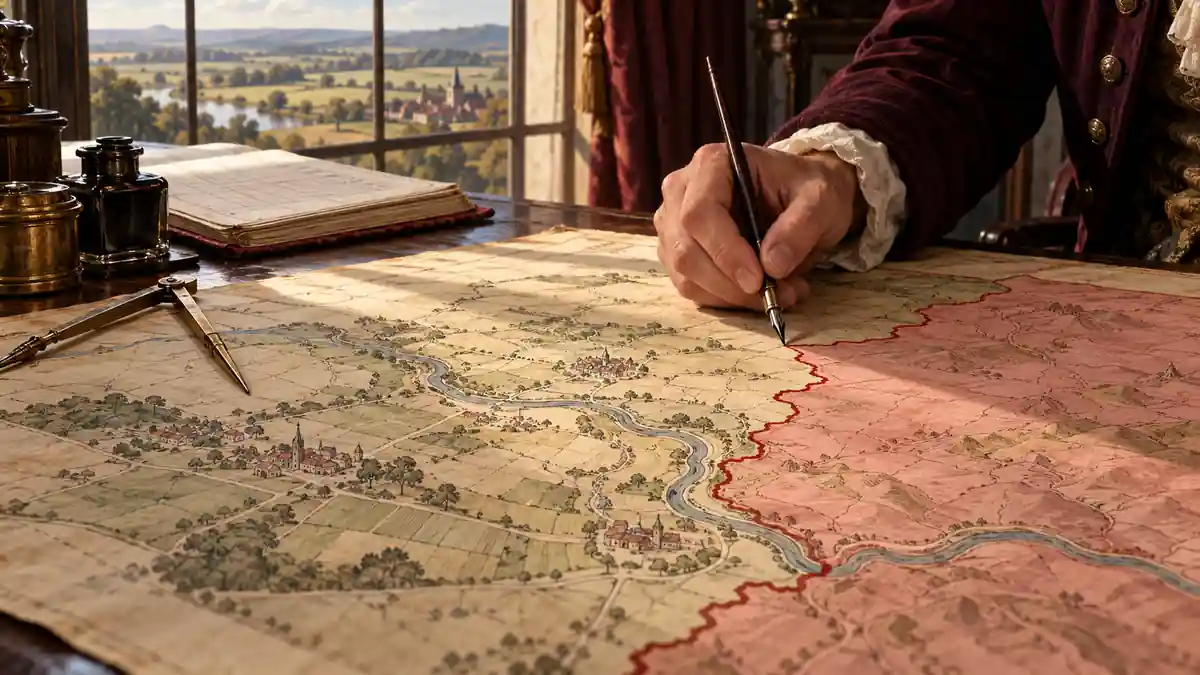
Moscow’s ascendancy developed through this competition. In 1371, Mamai backed Mikhail of Tver’s claim to the grand principality of Vladimir, before restoring his support to Dmitrii of Moscow later that year. By 1375, Dmitrii had compelled Mikhail to acknowledge his senior position. The struggle over Vladimir involved territory, revenues and standing among princes, rather than an honorary title. It also shows why the approach to Kulikovo cannot be reconstructed as a unified country’s steady mobilisation against an external ruler. Moscow was fighting over its place among other centres of Rus’ power while contesting the terms of its relationship with the Horde.
The Horde itself had entered a prolonged crisis after Khan Berdibek’s death in 1359. Mamai emerged as a powerful figure in its western territories, exercising authority through khans of Chinggisid descent, including Abdallah. His own lack of that ancestry prevented him from claiming the throne on the same terms, but it did not place his power outside the khanate’s institutions. The distinction between a ruler’s dynastic standing and his practical command was part of how the system worked. Tokhtamysh, a Chinggisid contender supported in his rise by Timur, offered a rival prospect of reunification. Mamai’s confrontation with Moscow unfolded within this struggle over the Horde’s future.
These overlapping conflicts gave Dmitrii room to act, together with serious reasons for caution. A divided superior power could be resisted, bargained with or used against a local rival. Its reunification might remove those opportunities. The fate of Moscow consequently depended on decisions made far beyond its own court: who could command an army, whose claims other elites would recognise, and whether a victory against one contender would strengthen another. The political geography contained several possible centres, none assured of possessing the future.
The Coalition at the Don
Dmitrii’s army had already defeated troops sent by Mamai at the River Vozha in 1378. The Rogozh Chronicle’s account records the retreat, the pursuit and the abandoned equipment of the defeated force, interpreting the outcome as divine assistance to the prince. This earlier victory rules out the easy claim that Kulikovo first revealed that a Horde army could be beaten. It also makes the campaign of 1380 more comprehensible. Mamai faced a prince whose resistance had produced a substantial military success; Dmitrii faced an opponent with the capacity and incentive to return.
The army assembled under Moscow’s leadership drew on alliances that crossed later national boundaries. Andrei and Dmitrii, sons of the Lithuanian ruler Algirdas, joined Dmitrii’s side; their brother Jogaila was associated with Mamai. Jogaila’s forces did not join Mamai on the battlefield. The exact contributions and conduct of individual contingents remain subjects of reconstruction, but the divided political alignment is important. Lithuania cannot be assigned a single role as the enemy of an already constituted Russia. Princely relationships, territorial interests and disputes over power cut through the categories into which subsequent national histories would arrange the participants.
Other relationships were precarious. Ryazan lay exposed to both Moscow and the steppe; the extent of its prince Oleg’s cooperation with Mamai is disputed. Detailed lists of those who fought at Kulikovo often come from later sources and cannot simply be treated as muster rolls. Moscow’s ability to bring allies into the field was nevertheless a considerable achievement. A coalition required men to leave their own territories, follow an agreed command and accept the risks of campaigning beyond the defensive positions closer to home. Its existence demonstrates effective leadership without establishing the political consent of every land later included in the victory’s inheritance.
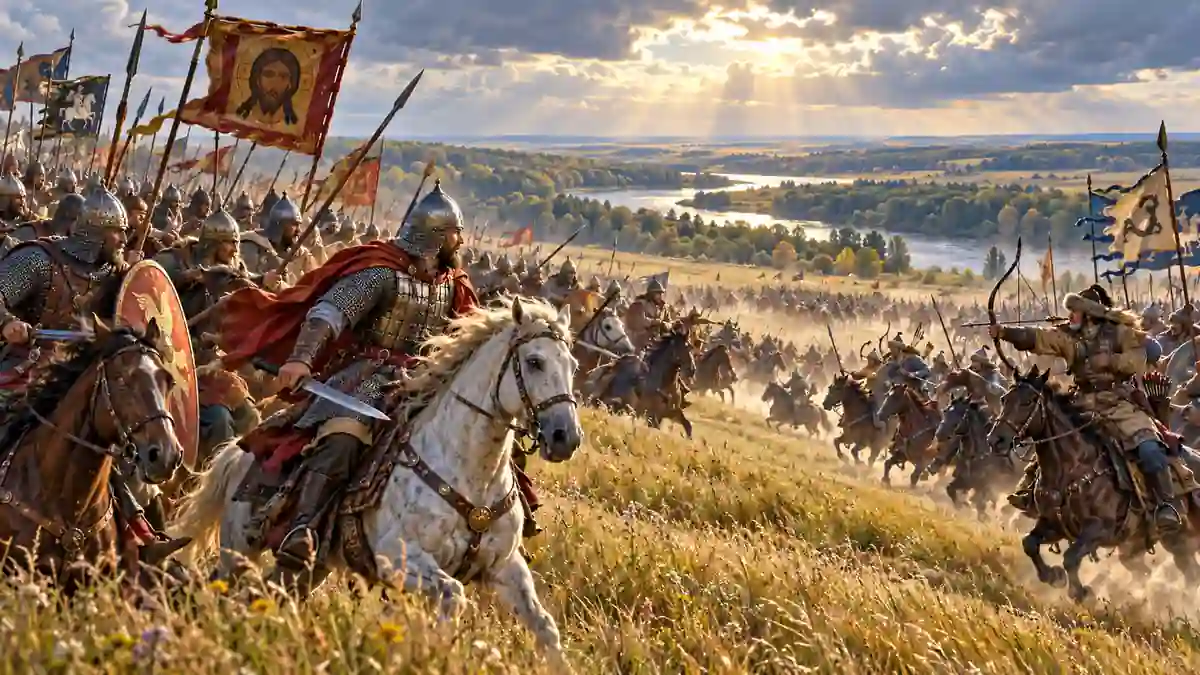
On 8 September 1380, after crossing the Don, Dmitrii’s forces fought Mamai’s army near the Nepriadva River. The advance placed the coalition in a position where the selection of ground and the ability to hold together under attack mattered intensely. Reconstructing that ground has altered interpretations of the engagement. Researchers at the Kulikovo Field museum describe a medieval corridor of open land constrained by wooded slopes and ravines, rather than the unrestricted expanse suggested by the landscape’s later appearance. Such terrain could restrict mounted manoeuvre and help a defending force prevent its opponent from exploiting numerical strength. This is a reconstruction informed by landscape research, not a surviving plan of the commanders’ intentions.
The size of the armies is less secure than many accounts suggest. Vitalii Penskoi, working from evidence about mobilisation, logistics and military organisation, estimates approximately 10,000–12,000 mounted combatants on Dmitrii’s side, excluding attendants. That is a scholarly estimate, not an agreed count; other reconstructions differ. Its importance lies partly in returning the campaign to the constraints of movement, food, horses and available fighting space. An army could impose a formidable burden on the society that assembled it without numbering in the hundreds of thousands. Reducing an inflated figure need not reduce the undertaking’s historical weight.
The best-known reconstruction gives the decisive role to a force held in reserve under Vladimir of Serpukhov and Dmitrii Bobrok, whose intervention broke Mamai’s attack. Some historians accept this broad outline while rejecting other dramatic episodes in the literary tradition. The reserve’s precise actions cannot be recovered with the assurance of a modern battle report. Yet the reliable outline remains consequential: Dmitrii’s coalition endured a costly engagement and defeated Mamai’s army. Explaining the result requires attention to command, cohesion and the use of the battlefield, even where the surviving narratives cannot establish the contribution of each.
Victory at the Battle of Kulikovo secured the immediate object of defeating the force that confronted Moscow. It did not confer control over the political succession in the Horde, compel every neighbouring prince to follow Dmitrii or make another campaign impossible. These limits belonged to the conditions of the achievement. The coalition had demonstrated a capacity to act together under Moscow’s leadership; whether that capacity could be sustained, and what others would do in response, remained open questions. The departure from the battlefield began another contest over the consequences of what had happened there.
What Victory Could Secure
Mamai’s military defeat helped a rival whose interests differed from Dmitrii’s. As Mamai attempted to recover his position, his supporters deserted to Tokhtamysh, and his power collapsed. Reunification of the Horde could thus advance through the destruction of the army that Moscow had resisted. The outcome illustrates a difficulty that the language of national liberation tends to obscure: victory against a particular agent of domination can strengthen the wider order’s ability to reconstitute itself. Moscow had damaged Mamai far more decisively than it had disabled the khanate.
A document from the following year gives a more immediate view of the political possibilities. In their agreement of 1381, Dmitrii and Oleg of Ryazan envisaged common arrangements concerning peace, tribute and conflict with the Tatars. Tribute remained among the options through which relations might be conducted. The agreement reveals coordinated princely policy in the aftermath of victory, with relations with the Horde still open to negotiation. Its terms recover choices which later accounts, organised around a march towards emancipation, can make difficult to see.
Tokhtamysh’s campaign in 1382 demonstrated how much coercive power remained. His sack of Moscow imposed submission without erasing the dynasty that ruled it. Anton Gorskii places particular emphasis on this combination: Moscow’s rulers could remain subordinate to the khan while consolidating their hold on the grand principality of Vladimir. In his interpretation, securing that possession for Dmitrii’s descendants was the central political objective. This reading directs attention to a form of advancement that an independence narrative handles poorly—an increase in a ruling house’s security within a hierarchy it had failed to overthrow.
The succession offers support for taking dynastic consolidation seriously. In his final testament, conventionally dated to 1389, Dmitrii assigned the grand principality to his son Vasilii. As Paul Bushkovitch notes, Vasilii’s accession nevertheless required Tokhtamysh’s sanction. The document and the khan’s continuing role belong in the same account. They establish neither that Kulikovo alone produced the inheritance nor that every act of Dmitrii’s resistance served a single predetermined aim. They do show why a dynasty’s growing control over succession and a country’s independence must be investigated separately.
The conventional endpoint of subordination lies a century later, at the River Ugra in 1480. Ivan III’s forces prevented Khan Ahmad of the Great Horde from forcing a crossing; fighting and negotiation were followed by the khan’s withdrawal. By then, relations between Moscow and the successor powers of the fragmented Horde had changed profoundly. Historians disagree over when the decisive break in dependence occurred and how to interpret the payments and political relations involved. The status of 1480 as a definitive liberation also developed through later historical interpretation. It supplies a useful chronological landmark, but no proof that 1380 had begun an inevitable hundred-year programme.
The strongest case for Kulikovo’s importance survives these qualifications. A prince who had assembled a coalition and defeated Mamai possessed an achievement that negotiations alone could not supply. It offered subsequent writers an event around which to organise claims of courage, sacrifice and leadership. That potential did not depend on immediate independence. The historical question is how particular people activated it, which aspects of the past they preserved, and how they connected the prince’s success to communities larger than his own household or following.
The Victory in the Manuscripts
Kulikovo’s literary inheritance includes the poem Zadonshchina, chronicle accounts and the Tale of the Battle with Mamai. Their dates, relationships and successive revisions are disputed. The earliest surviving manuscript of Zadonshchina is generally dated to the 1470s or 1480s, around a century after the battle; proposals for the work’s original composition often place it considerably earlier. Those are different claims. A manuscript preserves a stage in transmission, and its date alone cannot establish when every element entered the story. Equally, an argument for an early original cannot authenticate every detail in a later version.
The poem’s surviving forms already place the victory inside a community larger than Moscow’s princely court. They invoke the land of Rus’, Christian faith and a past extending back to Kyiv. The lamentation of women who have lost husbands gives the dead a collective cause, linking bereavement to land, churches and faith. These are literary representations, not verbatim testimony from the bereaved. Their importance is that collective meaning was present within the medieval tradition itself. The story’s later nationalisation worked upon inherited attachments; it did not begin with a political world entirely empty of shared belonging.
What that community meant still requires care. The land of Rus’ was not a stable synonym for the territory, population or state subsequently called Russia. Charles Halperin’s research traces its shifting geographical and political uses and challenges the projection of modern nationality onto the phrase. Nor does an elite text establish that everyone outside the circles which produced and copied it understood the victory in the same way. A writer could claim to speak for a land whose inhabitants held different loyalties. The existence of a collective vocabulary and the extent of its social reach are separate questions.
Within this vocabulary, leadership could be sanctified as well as celebrated. The Tale of the Battle with Mamai develops a densely religious account of preparation and victory, including the abbot Sergius of Radonezh’s blessing, the prince’s prayers and heavenly assistance. Its distribution of honour is more complicated than a simple advertisement for Dmitrii’s military genius. Lidiia Sokolova reads the pairing of Dmitrii and Vladimir of Serpukhov as a division between the exemplary Christian prince, whose faith helps secure the outcome, and the warrior who wins on the battlefield. Other interpretations differ, but the distinction exposes the danger of treating the work’s heroism as an unmediated record of battlefield command.
Even the cast could change. In the Tale Sokolova analyses, Jogaila is replaced by his father Algirdas as Moscow’s Lithuanian opponent. Algirdas had died in 1377, three years before the battle. The discrepancy gives a concrete reason to test a vivid narrative against evidence outside it. It also reveals what can be lost when the story becomes a ready-made explanation of conflict: a reader may inherit a recognisable antagonist while losing the actual political relationships of 1380.
Religious interpretation could make military success evidence of rightful leadership. The prince stood within a sacred history that gave suffering meaning and placed victory under divine protection. It also supplied standards by which a ruler might be judged: courage, piety and care for his people. Such writing could express conviction, preserve memory and serve institutional interests at once. Conviction and advantage could reinforce each other as an account was copied and used to explain a ruler’s obligations. A sincerely held account could still make one centre’s leadership appear essential to the safety of a much larger community.
Kati Parppei’s The Battle of Kulikovo Refought follows the successive meanings attached to the engagement and the ways its image was established. Her work makes clear that the passage from medieval narrative to national history was a long process of selection and reinterpretation. For understanding Moscow’s authority, the decisive issue is what happened to the coalition as that process unfolded. The more readily its participants could be understood as ancestors of one people, the easier it became to read their cooperation as the expression of an underlying unity—and to place Moscow at that unity’s natural centre.
Giving the Past an Address
Texts acquire a different public life when people can encounter their history in a place. In 1850, the monument to Dmitrii Donskoi on Red Hill was ceremonially opened. The project grew from the efforts of landowners and officials; plans also envisaged accommodation for veterans of the Napoleonic wars who would guard the memorial and explain the battle. This was a practical arrangement for making an inherited account available to visitors. Location, custodianship and repeated explanation could turn a distant engagement into an experience offered to people who had never opened a medieval chronicle.
The change involved an expansion of audience and a concentration of attention. A memorial gives visitors a place from which to imagine the past, with a figure to honour and an account to follow. Its physical endurance can make the interpretation seem as settled as the event it commemorates. That is one reason the institutions that sustain national memory matter: public familiarity depends partly on the means to preserve, display and teach. At Kulikovo, remembrance joined an existing literary inheritance to a landscape organised for its transmission.
The civilisational scale attributed to the encounter could expand even further. Sergei Soloviev interpreted Kulikovo as a great contest between Europe and Asia, comparing it with battles understood as decisive for western Europe. This nineteenth-century framework assigned the armies a significance beyond the political aims of their commanders. Geography became a verdict about historical belonging. Yet the competing centres, divided dynasties and contested allegiances of the fourteenth century resist this arrangement into two coherent worlds. Placing Moscow on one side of a civilisational frontier cannot explain how it had operated within the Horde’s political order.
An Ancestor for Different States
On 7 November 1941, with German forces threatening Moscow, Stalin addressed the military parade in Red Square. He named Dmitrii Donskoi among “our great ancestors” whose example should inspire the struggle, before directing his audience forward under Lenin’s banner. An Orthodox prince could occupy an honoured place within the ancestry of a revolutionary state. His established association with defence and victory made him available to a war fought under radically different institutions. The common inheritance was being constituted through the act of invoking it.
This reuse helps explain the story’s endurance. A narrative in which dispersed forces gathered under effective leadership to resist a dangerous enemy could travel between regimes, even as their sources of legitimacy changed. The selection also changed what listeners were invited to inherit. A dynasty could claim an ancestor’s blood; soldiers in a mass army could be offered his example. That enlargement made the past more widely available while retaining a commanding centre within the account. It gave a collective struggle a precedent in which unity, direction and victory appeared to reinforce one another.
The six-hundredth anniversary in 1980 brought institutional investment. An exhibition opened in the restored church of Sergius of Radonezh at Kulikovo Field, while another display presented art devoted to the battle. Commemoration also coexisted with research capable of modifying familiar descriptions of the encounter. The desire to honour a field could help preserve the evidence through which its inherited story might be questioned. The institution could make a familiar account more accessible while researchers tested the landscape that account asked visitors to imagine.
Nor did Soviet-era interpretation speak in one voice. Lev Gumilev’s articles for the anniversary recast the battle within his understanding of relations between Rus’ and the steppe. His account aligned Moscow with the legitimate khan Tokhtamysh and treated Mamai’s western connections as central to the danger: the confrontation could become resistance to an encroaching West, rather than emancipation from Tatar domination. Michal Racyn’s study, drawing on the articles and correspondence, documents a divided reception among Russian nationalists. Changing the assignment of friend and enemy could preserve the battle’s foundational role while profoundly altering its explanation.
That flexibility should not be mistaken for evidence that every interpretation is equally plausible. Recovering cooperation across a supposed civilisational boundary does not justify replacing it with an unsupported account of an opposite, timeless confrontation. The alternative still has to explain the sequence of events, the actors’ positions and the surviving evidence. A story can challenge one nationalism while meeting another demand for historical reassurance. Kulikovo’s capacity to accommodate rival political identities makes the discipline of testing them more necessary.
The People Inside the Story
The loss involved in a simplified liberation narrative is larger than the disappearance of an inconvenient date. Mamai becomes the representative of an undifferentiated foreign power, while Tokhtamysh’s advantage from his defeat recedes from view. The Lithuanian princes who supported Dmitrii become awkward exceptions to an opposition between nations. Other centres of Rus’ are judged by their proximity to Moscow’s cause. A political coalition, whose members entered it from different positions, becomes an early appearance of a community imagined through its later boundaries.
This is where an inclusive account of victory can have restrictive consequences. Calling the dead the ancestors of an entire people expands those entitled to remember them. Presenting the leadership of that army as the necessary form of collective political life narrows the futures those ancestors appear to authorise. The historical move occurs when the achievement of a coalition is made to establish the exclusive standing of its centre. What can be demonstrated—that Moscow led a successful army—then bears a much larger claim about who could legitimately represent the whole.
For people whose histories include the Horde and the Tatar societies that emerged from it, that arrangement creates a further difficulty. They enter the shared past chiefly through the identity of an enemy whose defeat made the community possible. A fuller history can retain the devastation of conquest and the reality of resistance while restoring negotiation, mutual influence, divided interests and changing allegiances. Those relationships were part of how the political world functioned. Recovering them changes the available places within its history, rather than requiring descendants to inherit the loyalties of medieval armies.
Moscow in 1382 belonged to the same history as the victorious coalition of 1380. Its destruction establishes a limit to what the battle had secured; the survival and advancement of its dynasty prevent that limit from becoming the whole account. Between the field, the succession and the later memorial lies a sequence of different claims on an actual achievement. Keeping them visible allows courage to remain courage without making it a title deed to the future. The men who fought in the Battle of Kulikovo could leave a victory to be remembered by people they never imagined, without having authorised every power that would later speak in their name.