Independent Comanche communities shaped the southern Plains through mobility, commerce and force. Their conquest came through the narrowing of choices—where to live, whom to trade with, how to feed a family—that had sustained their power.
In February 1786, Ecueracapa arrived in Santa Fe from Comancheria with demands for peace and access to trade. He had been chosen by groups of western Comanches to lead negotiations, and had consulted several councils before presenting their position to the Spanish governor, Juan Bautista de Anza. The proposed settlement offered security to New Mexico and trading opportunities to the Comanches. It also envisaged cooperation against Apaches. Peace between these parties would leave another people exposed to their combined hostility.
The negotiations extended beyond the relationship with Spain. Utes, concerned about what a Spanish–Comanche accommodation might mean for their own position, were present in Santa Fe. Comanche and Ute representatives then held discussions separately. Spanish records preserve little of what they said to one another, but an agreement emerged. The colonial governor was an important participant in a diplomatic world that he neither created nor completely understood. Other peoples had their own channels of negotiation, and their own reasons for withholding the details.
These negotiations followed hard fighting. In 1779, Anza had led a campaign in which the Comanche leader Cuerno Verde and several other leaders were killed. Comanche participants in the later peace were responding to military pressure as well as commercial opportunity. Spanish military success had helped create the circumstances for negotiation, but it had not given Anza the power to dictate every relationship on the Plains.
The episode shows Comanche power in an especially revealing form. Negotiation required consultation among communities whose cooperation had to be secured. Commercial access and military security were being arranged together, creating advantages for the participants and dangers for others. Independence meant having consequential choices about those relationships. Over the following century, its destruction would involve restricting where people could live, what they could eat, and the means by which they could sustain an alternative to submission.
A Country in Motion
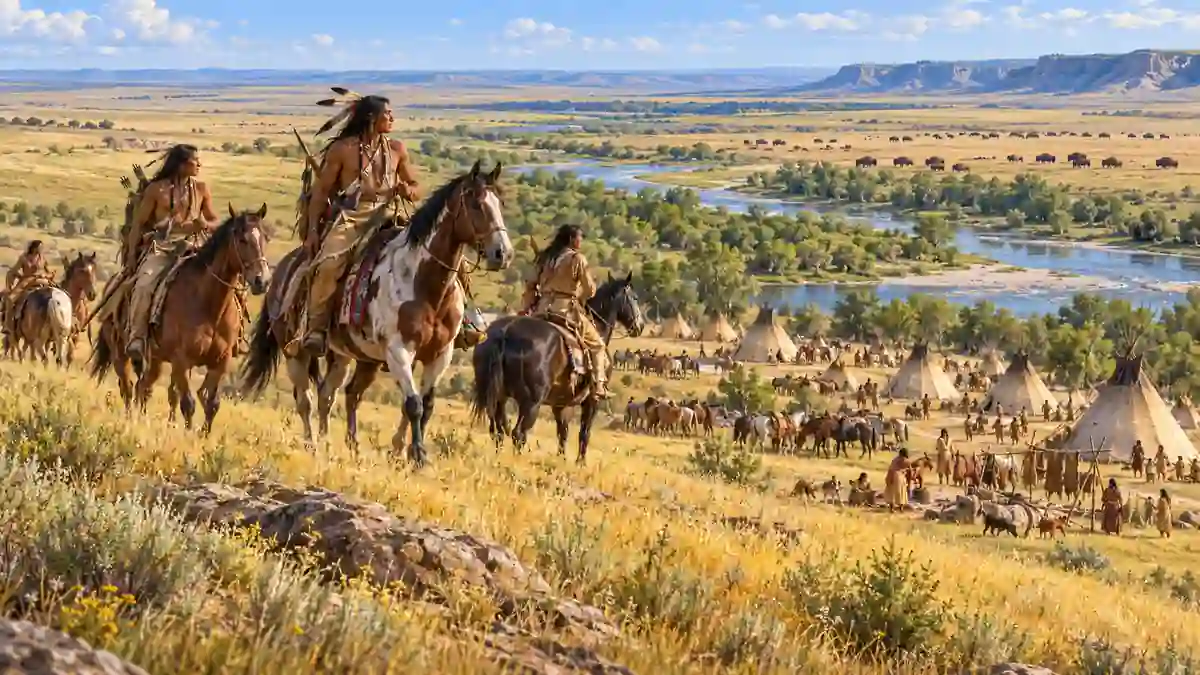
The Comanches, who call themselves Nʉmʉnʉʉ, emerged as a distinct people through movements away from Shoshone relatives and into the Plains around the turn of the eighteenth century. Their homeland and influence developed across the southern Great Plains, reaching through parts of the territories that became Texas, Oklahoma and neighbouring states. Comancheria was a changing geography of camps, hunting grounds, travel routes and relationships, with the routes of raiding parties extending far beyond the country in which their families lived.
The horse transformed the possibilities of life in that country. Its European ancestry should not obscure the Indigenous work involved in its spread. Archaeological research has established that horses were integrated into societies in parts of the central Plains and northern Rockies by the first half of the seventeenth century, probably through Indigenous exchange networks, before sustained European observation there. This regional evidence does not date every stage of Comanche equestrianism. It does establish that colonial written records began describing a transformation already under way.
For Comanche communities, horses enlarged the distances over which hunting, transport, trade and warfare could be conducted. Bison supplied food and materials for clothing, shelter and exchange. Yet movement depended on an exacting knowledge of where animals and people could live through different seasons. A horse required forage and water; a herd required access to much more of both. The apparent openness of the grasslands concealed a geography of indispensable resources, particularly the river valleys that could sustain animals through difficult periods.
Mobility was therefore a way of using a known country. Changing camp could preserve access to food, reduce exposure to enemies or bring a community closer to a trading partner. An outsider might interpret the absence of permanent buildings as an absence of attachment. For the people travelling between these places, knowledge, use and relationships gave the land political meaning. Confinement would eventually threaten that accumulated knowledge as a practical means of providing for a household.
The extent of Comanche dominance is disputed. Joaquín Rivaya-Martínez has challenged accounts that understate eighteenth-century communities’ vulnerability and dependence on allies. Pekka Hämäläinen’s influential conception of a mobile, or kinetic, empire has likewise generated disagreement over whether commercial leverage and military reach constituted authority over other societies. These debates call for a distinction between influencing a neighbour’s decisions, coercing it in a particular encounter and governing it. A raid’s destination cannot simply be added to a map of territory ruled. Comanche power operated through particular relationships and could expand in one direction while contracting in another. It had to be maintained among other peoples capable of fighting, bargaining and changing partners.
The Work Behind the Herds
The political organisation that sustained this world began with related households. Extended families travelled together in local groups; wider associations linked communities with overlapping interests. Leadership depended on relationships and the ability to attract cooperation. Thomas W. Kavanagh’s reconstruction of Comanche political history emphasises the recurring formation and re-formation of these associations. People could move between them, and shared identity did not erase differences over where to camp, whom to fight or when to seek peace.
Such arrangements allowed communities to adapt without waiting for instructions from a distant centre. A group could cultivate a useful relationship that another did not share, while larger gatherings enabled common action. But a leader’s influence had boundaries. Negotiating with one prominent man did not necessarily secure the consent of every community using the same language or bearing the same name. Foreign officials could find that frustrating; they could also exploit it, treating limited consent as comprehensive when they wanted an agreement and limited compliance as collective treachery when they wanted punishment.
The work of sustaining a camp was no less important than the work of leading it. Ethnographic accounts describe women preparing food, processing hides, making clothing and lodge coverings, and organising the transport of households. Men hunted large animals and undertook trading and raiding expeditions; children, older people and captives contributed to work and livestock care. The accounts reflect particular periods and recollections, but they reveal the productive effort behind the familiar image of the mounted warrior.
A successful hunt produced resources that still had to be butchered, preserved and worked. A hide became a usable or exchangeable object through skill and time. Livestock wealth created obligations of care as well as opportunities for display and influence. Military action drew on these accumulated efforts, while its danger and labour were distributed unevenly. A community’s capacity to fight depended on people and activities that accounts of battles often leave outside the frame.
A Market for Other People’s Losses
Trade connected Comanche communities to agricultural settlements, colonial outposts and other Native peoples. Meat and hides could be exchanged for crops and manufactured goods; horses and mules travelled through markets extending well beyond the camps from which they came. New Mexican traders later known as Comancheros carried goods onto the Plains. These relationships offered ways to obtain necessities that a camp did not produce for itself. They also gave neighbours reasons to preserve exchange even when other relationships were hostile.
In the 1830s and 1840s, stolen Mexican livestock found buyers through American, Texan and Indigenous trading networks; arms moved in return. Brian DeLay’s research identifies demand from Native communities displaced into Indian Territory by United States removal policies. These connections joined processes that national histories can keep apart. Dispossession in one region could help create a market for plunder taken in another, without the participants sharing a political purpose.
The interests created by such commerce did not coincide neatly with political allegiance. A merchant could benefit from transactions that endangered another settlement, while officials sought security against the people supplying the animals. Those who purchased a horse did not necessarily experience the violence through which it had become available. The market separated the site of acquisition from the site of profit. That separation helps explain how a regional economy could sustain armed predation while participants elsewhere described themselves as its enemies.
Peace offered economic possibilities of its own. Access to a reliable trading partner could reduce the attraction of a raid; threats to exchange could make coercion more appealing. The Spanish agreements of the 1780s worked within that relationship between security and material advantage. Their subsequent durability in some places also cautions against imagining permanent warfare between unchanging antagonists. Negotiated coexistence was an achievement people could value and work to preserve, even when its protection was selective and its alliances directed against others.
Vengeance and standing also mattered. The killing of relatives could generate obligations to retaliate, and raiders sometimes destroyed property they might otherwise have taken. Such actions expose the limits of an exclusively commercial explanation. Markets rewarded some kinds of violence, but they did not contain every reason for committing it. The loss of a relative and the price of an animal belonged to different calculations, even when they led to the same expedition.
The Unequal Freedom of the Borderlands
The independence enjoyed by Comanche communities could impose severe costs on others. Their expansion displaced Apache groups and altered access to resources and trade. Alliances changed the balance between Native peoples as well as between Indigenous and colonial societies. The settlement proposed in 1786 made the point plainly: security for Comanches and Spaniards could be organised through common hostility to Apaches. Restoring Indigenous agency requires acknowledging the people against whom that agency was exercised.
Captivity belonged to this political economy. Research by Rivaya-Martínez documents the taking and circulation of captives in both Comanche and Spanish society, often for labour, with opportunities for incorporation existing alongside persistent stigma. Communities that benefited from holding outsiders could react violently when their own members were taken. Captivity connected households, markets and diplomacy through a profoundly unequal arrangement: one person’s labour or exchange value could depend on another person’s loss of freedom.
The experiences of captives varied. In his study of Hispanic children taken into Comanche communities during the nineteenth century, Rivaya-Martínez traces possibilities ranging from chattel slavery to incorporation into kinship networks. Age, language, the circumstances of the household and other factors affected what followed. Some remained marked by their origins throughout their lives. These differences matter because neither enslavement nor adoption describes every experience adequately. Incorporation could produce real belonging, but it cannot retrospectively supply consent to the seizure that preceded it.
In San Antonio in March 1840, the politics of captivity collided with the limits of representation. Penateka delegates arrived to negotiate with the Republic of Texas. The Texans demanded the release of captives; the delegation’s leader maintained that some were held by groups beyond his authority. Texas officials attempted to detain the delegates as hostages, and the confrontation turned into the killing known as the Council House Fight, in which dozens of Comanches died. The attempt to make one delegation answer for a wider population helped turn a peace negotiation into further war.
There were obligations on the Comanche side concerning people held captive, and there were decisions by Texan authorities concerning the treatment of negotiators. Recognising both does not distribute responsibility by arithmetic. The delegates’ limited authority did not erase the violence of captive-taking; the demand for releases did not justify treating every Comanche community as subject to their command. A political structure that gave communities room to choose also made durable settlement dependent on securing cooperation across them. Neither the structure nor the resulting difficulty compelled officials to seize the envoys.
The Changing Neighbours
After Mexican independence in 1821, financial weakness eroded frontier arrangements of trade, gifts and military protection. Comanche and Kiowa campaigns subsequently inflicted devastating losses on northern Mexican communities. DeLay argues that this violence weakened the region before the United States invasion of 1846 and shaped expectations on both sides of the conflict. Indigenous decisions helped alter the circumstances in which the two republics fought.
The consequences were not confined to the intentions of those making the raids. Actions taken to pursue local or regional goals could assist a state whose own expansion would later threaten Indigenous independence. That does not turn the raiders into agents of Washington. It reveals the distance that can open between a political actor’s immediate advantage and the wider changes to which its actions contribute. Power over a vulnerable neighbour could coexist with danger from a different, increasingly formidable one.
Texas became an independent republic in 1836 and was annexed by the United States in 1845. The war of 1846–48 then transferred vast northern Mexican territories to the United States. The neighbouring governments and their territorial claims changed, but an agreement between states did not automatically deliver control over the Indigenous societies living within the lands claimed. Establishing that control remained a political and military undertaking, carried forward through subsequent choices. The gap between a territorial claim and control on the ground would also shape the later recognition of Leopold’s Congo, though the colonial setting was different.
Nor did the rise of the United States produce an uninterrupted decline. The withdrawal of federal troops from the frontier during the Civil War of 1861–65 created opportunities for Native groups to reassert themselves. The resumption and expansion of military operations afterwards changed those opportunities again. Families and leaders were responding to reversals in military presence and danger, with reasons to reassess decisions that had seemed sensible a few years earlier. Their options had not disappeared all at once.
A Home Assigned, a Hunt Reserved
The Kiowa–Comanche treaty concluded at Medicine Lodge in October 1867 belongs inside that transformation. It promised a protected reservation in Indian Territory, in what became southwestern Oklahoma, and goods and services intended to encourage farming. Article 11 required the parties to relinquish permanent occupation outside the reservation, while preserving hunting south of the Arkansas River so long as buffalo remained numerous enough to justify the chase. It also prohibited attacks on settlements and travellers. Permanent residence, hunting and warfare were different matters within the agreement.
The distinction left a significant possibility open. Hunting beyond the reservation could provide food and sustain movement through former country. The text cannot accurately be reduced to an immediate prohibition on leaving. Yet the arrangement placed settlement on one legal footing and continued subsistence on a conditional one. If the herds disappeared, an essential activity through which people exercised the reserved right would become impossible. The practical security of that right depended on what happened to the animals and to access across the land where they ranged.
Within the reservation, the United States promised to exclude unauthorised outsiders; the treaty also established procedures for redress. Those undertakings offered reasons to negotiate for people facing mounting insecurity. Their value depended heavily on the conduct of the United States: the power demanding a restriction of residence would administer important parts of the promised protection and supply. An agreement could contain genuine concessions and still increase dependence on a government whose settlers, officials and military forces did not consistently honour Indigenous interests.
Consent remained uneven. Ten Bears and other leaders signed, but Parra-o-coom, a prominent Quahadi leader, did not attend the councils or sign the agreement, despite being in the vicinity. His refusal cannot be treated as a minor administrative omission from a uniformly accepted settlement. It marked the continuing existence of communities whose decision differed from those represented among the signatories. The signatures on the document and the reach of political authority on the Plains were separate matters.
This was the earlier problem of decentralisation under increasingly unequal conditions. A negotiated peace depended on cooperation that no single leader could simply command. But the federal government could use the language of a collective undertaking while confronting particular communities with the consequences of noncompliance. The issue was larger than whether an individual chief had kept his word. It concerned how an outside power translated several political communities into a population it expected to reside, receive supplies and conduct its affairs within a prescribed system.
Destroying the Means to Leave
The bison crisis preceded the final campaigns. Hämäläinen’s research on the southern Plains traces commercial pressures and changes in hunting before the severe drought of the 1840s and further ecological disturbances at mid-century. Historians differ over the scale and causes of earlier herd losses. By the time industrial hide hunting expanded in the 1870s, however, animals and communities were already under pressure. The landscape on which independence depended had been changing before the final military offensive.
Human losses compounded that insecurity. Smallpox and other epidemics killed people whose skills, labour and relationships could not readily be replaced. Illness could reduce a household’s capacity to move or care for animals as well as take lives directly. Horse wealth also had an ecological cost: large herds needed forage and water in a country where drought could put horses and bison into competition. The resources that had enlarged the possibilities of Comanche power demanded continuous effort and favourable access; they conferred no immunity from scarcity.
Commercial hide hunting in the 1870s intensified the destruction. Hunters supplied distant markets, while the loss of bison undermined food, materials and income for communities on the Plains. The consequences of that trade converged with the military objective of bringing independent groups onto reservations. Convergence did not require every trader, hunter, official and officer to follow one comprehensive plan. The incentives could differ while the effects reinforced one another: declining subsistence increased dependence, and military pressure made the search for alternatives more dangerous.
Some groups used reservations as refuges after raiding, a problem for officials trying to enforce peace. In 1874, an attack on buffalo hunters at Adobe Walls helped precipitate the United States campaign known as the Red River War. Army and Indian Bureau officials enrolled people remaining on the reservations and classified those outside as hostile. Converging military columns maintained pressure on the groups they pursued. The treaty’s distinction between a permanent home and a right to hunt survived in its text, but the campaign left little practical room for communities seeking to sustain themselves outside the agencies. Movement through a hunting country was increasingly treated as a problem to be ended by force.
On 28 September, Colonel Ranald S. Mackenzie’s command attacked camps of Comanches, Kiowas and Cheyennes in Palo Duro Canyon. Families escaped, but soldiers burned lodges and winter stores, captured the horse herds and killed most of the animals. The attack’s consequences extended beyond the casualties of the fighting. People who had escaped the troops were left without possessions and provisions essential to surviving the approaching winter. Their ability to remain beyond the agencies had been gravely reduced.
A horse destroyed there was transport lost for a household, a hunting animal lost for a provider, or a resource no longer available for exchange. Burned food imposed demands that skill and courage could not satisfy without further supplies. The effects were cumulative: people deprived of mounts and provisions were being pursued in a country where the herds on which they relied were disappearing. What had once allowed a community to refuse an unfavourable bargain was being removed, item by item and place by place.
Quanah Parker and his Quahadi followers entered Fort Sill in June 1875. Their surrender marked the end of the Red River War, although commercial killing continued to devastate the southern bison herds afterwards. The army had compelled submission while the ecological destruction was still unfolding. It could exploit and deepen a crisis without waiting for its completion, destroying the resources that might have enabled families to remain beyond its control.
The Country After the War
Congress authorised the allotment of Kiowa, Comanche and Apache reservation lands in 1900. In August 1901, much of the land remaining after allotment was opened to settlement. Indigenous opponents challenged the process by invoking the Medicine Lodge requirement that a future cession receive the signatures of at least three-quarters of the adult men occupying the reservation. In Lone Wolf v. Hitchcock in 1903, the Supreme Court upheld congressional authority to proceed despite that treaty protection. The challenge concerned Kiowa, Comanche and Apache lands, and the lead plaintiff, Lone Wolf, was Kiowa.
Consent had been written into a promise, but the Court would not allow that requirement to control Congress’s power over the land. The United States could invoke a treaty to demand a reorganisation of Indigenous life and then invoke its own legislative supremacy when an Indigenous claim rested on the same agreement. Military defeat had not completed dispossession; it had helped establish the conditions under which another government could determine the force of the protections that remained.
The end of independent life on the Plains was nevertheless no disappearance of the Comanches. Communities rebuilt political relationships under the constraints of reservation settlement, allotment and federal administration. Comanche constitutional government developed through a subsequent history of institutional reorganisation. These changes cannot be measured simply by their distance from a supposedly authentic past. The ability to revise political arrangements had been part of Comanche history before confinement; under altered conditions, it remained a means of sustaining collective life.
Memory also travelled beyond the world that military histories declare finished. In the twentieth century, Francis Joseph Attocknie assembled family narratives about Ten Bears and other relatives: accounts of warfare and loss, but also naming, humour and relationships. These histories preserved matters their tellers considered worth carrying forward. They give the descendants of people classified in official records as obstacles to settlement a different place in the historical record—as people interpreting events, evaluating conduct and deciding what later generations should know.
To understand the conquest of Comancheria is to recover the capacities that had to be broken, and the human decisions involved in breaking them. There was no single capital whose capture could settle the matter. Independent communities had sustained themselves through movement, work and several kinds of relationship, including relationships coercive to others. Their opponents increasingly restricted the ground on which those choices could be exercised. The resulting submission says much about how independence can be destroyed; the histories carried beyond it refuse to make that destruction the final definition of a people.