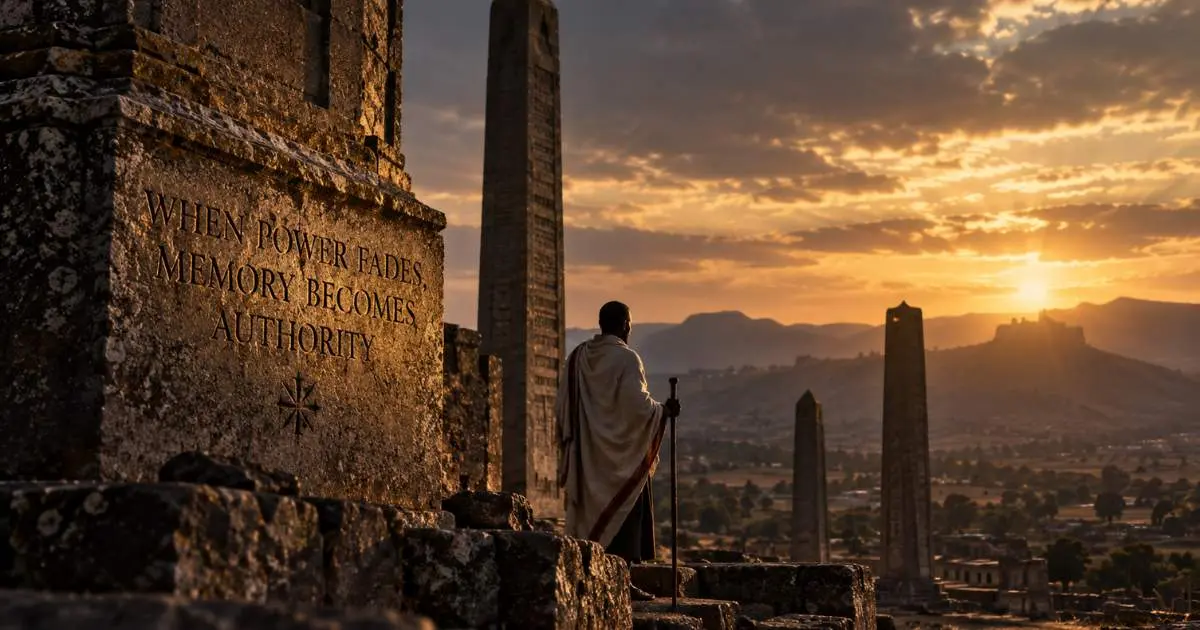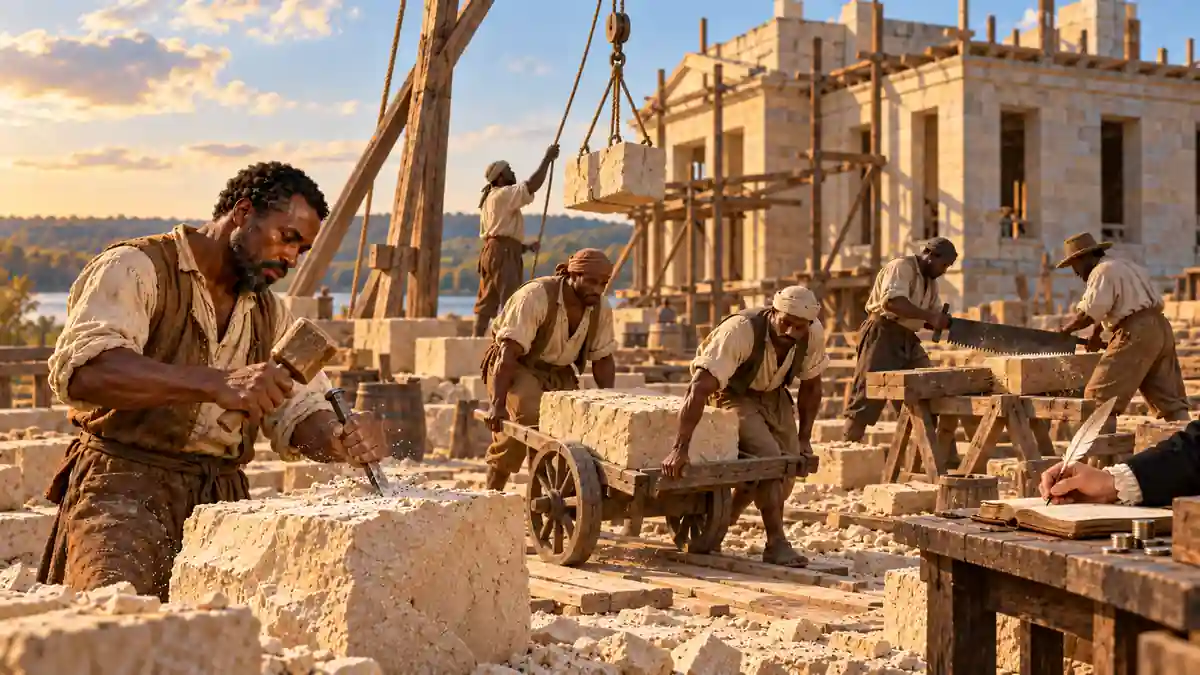
Records of enslaved labour at the Erechtheion, the White House and the United States Capitol reveal a history more unsettling than simple anonymity. A worker could be named, his skill recognised and his labour priced, while someone else held the claim to its reward.
In 1795, the commissioners overseeing the construction of Washington issued a promissory note for the labour of an enslaved man recorded as Dick. It covered three months of work at the Capitol, between 1 April and 1 July, at five dollars a month. The promise of payment was made to Jasper M. Jackson, his owner. The document identifies the man who worked and the man entitled to be paid as two different people. Its business was to establish the second man’s claim.
Dick’s name survived within a transaction that treated his labour as something another man could supply. More than two thousand years earlier, accounts for the Erechtheion on the Athenian Acropolis recorded individual workers, including enslaved men identified through their owners. Some of their names were cut into marble. Visibility could coexist quite comfortably with subordination. These records complicate the familiar account of nameless hands concealed behind magnificent buildings: a person could be carefully identified without acquiring a recognised claim to the proceeds of his work.
Historians have long studied these documents. The question they allow us to pursue is how a person’s contribution became separated from the rights attached to it: who could decide that the work would be done, who received its proceeds, and who subsequently appeared as the builder. These were distinct positions, sometimes held by the same person and sometimes divided among several. Following their separation explains how a society could recognise the value of someone’s work while assigning its benefits elsewhere—and how those arrangements could shape the history inherited with the building.
The Contract Without the Worker
The American capital was a deliberate construction project before it became an inherited landscape. The Residence Act of 1790 established a permanent seat of government on the Potomac. Work on the President’s House began in 1792, and on the Capitol in 1793; both buildings had to serve a federal government preparing to move to Washington in 1800. Their workforces included immigrant craftsmen, local wage workers, free African Americans and enslaved people hired from their owners. The buildings arose through the coordination of people whose legal positions differed even where their tasks brought them together.
The Declaration of Independence had grounded just government in the consent of the governed. At the construction site, an owner’s agreement could authorise the hiring of a worker whose own consent was not required. The contradiction is well known; the contracts show how it became administratively workable. Officials could pursue a public undertaking, honour financial commitments and recognise the claims of owners without recognising a corresponding right in the people supplied to them. Enslavement was embedded in the transactions through which the new capital was made. It was visible to those checking the accounts.
The commissioners could obtain enslaved labour through contracts with local owners. The arrangement distinguished ownership from use while giving each party a consequential role. The government did not have to buy a person to purchase the temporary use of his captivity. An owner retained his claim over the worker while the public project acquired labour for an agreed period. The contractual relationship ran between those who could authorise and profit from the arrangement. The person whose effort fulfilled it was not thereby made a consenting party.
The surrounding economy supplied this possibility. As the Capitol’s architectural historian William C. Allen explained in congressional testimony, hiring out enslaved people was an established practice in the Potomac region, and construction skills were sought after. The new capital drew on a system already capable of placing people at another person’s disposal. Its officials could recognise claims available in local law and commerce, agree terms and record payments. A public project acquired its workforce through relationships that private ownership had already organised.
The resulting paperwork can look deceptively like an ordinary wage record. There are names, days worked and rates of compensation. But the existence of a price for labour does not establish that the labourer sold it. Nor does payment by the state establish payment to the person who performed the task. An account could be exact about expenditure while leaving the worker without a claim to the amount entered beside his name. Reading the figures requires reconstructing the relationship that made them payable.
There were exceptions within this system. Allen identified payments made directly to enslaved sawyers for additional work on Sundays or holidays. Such earnings could provide a limited means of obtaining goods or accumulating money. They reveal opportunities for economic initiative within an arrangement that continued to assign ordinary payments to owners. The same person’s effort could produce income under different rules, depending on when the work was done and whose entitlement the administration recognised.
An Equal Rate, an Unequal Claim
The Erechtheion occupied a setting in which architecture carried religious and civic meaning together. Built on the Acropolis in the late fifth century BCE, it accommodated the ancient cult statue of Athena Polias and shrines associated with Poseidon-Erechtheus and other figures in the city’s sacred history. Its irregular design responded to several cults and an uneven site; the porch supported by the Caryatids became its most celebrated feature. This was a building intended to preserve and organise places through which Athens understood its relationship with its gods and its own past.
By 409/8 BCE, the temple stood unfinished. The beginning of its construction remains debated, but an inscription securely records a review of its condition as Athens renewed work during the Peloponnesian War. It names overseers, a master of works and a secretary acting under a decree of the People, and distinguishes completed work from what still needed to be placed or finished. The surviving accounts concern particular phases of a religious project carried through a period of military and financial strain. They reveal a workforce in unusual detail, rather than providing a census of everyone who built the Acropolis.
In the accounts for 408/7 BCE, work on fluting a column is entered against several names. Ameiniades, described as living in Koile, is assigned eighteen drachmas. Somenes, identified by the editors as his slave, is assigned the same amount. Other entries similarly place enslaved workers beside free men on comparable tasks. The scholarly commentary explains that payment for enslaved men would formally have gone to their masters. Comparable work appears beside comparable sums, under unequal claims to their receipt.
A rate attached to a task could recognise the usefulness of an enslaved person’s skill without granting him control over the payment. What was being valued was the service obtained, within a system that authorised someone else to supply it. The account could treat status as irrelevant to the price of comparable work while relying on it to determine who was entitled to the money. Equality within the calculation left the ownership relationship intact.
Even the division between citizen and non-citizen fails to capture all these relationships. The account’s description of Ameiniades by his residence, rather than a citizen’s demotic, identifies him as a resident foreigner, or metic. A man outside the citizen body could nevertheless own another worker. Professional standing, residence and ownership cut across one another, giving people different powers within the same undertaking. Sharing exclusion from citizenship did not mean sharing the condition of enslavement.
The historian Shimon Epstein has examined the decisions behind this mixed workforce. He argues that the intermittent character of major public building discouraged the purchase of enslaved people simply to hire them out for a temporary project. Skilled owners and their enslaved assistants could instead work together as established teams, finding other work when a public commission ended. The presence of free workers therefore requires explanation through the skills available, the duration of employment and the risks owners were willing to bear. Their participation alone cannot establish an objection to slavery among those commissioning the work.
Beyond the Building Site
The visible outline of a monument provides a poor boundary for the work that produced it. At Washington, stone had to be quarried and transported, timber cut and sawn, and clay made into bricks before materials could be assembled into walls and roofs. Enslaved workers participated throughout this process, alongside free labour. An account restricted to the people standing at the building itself would omit some of the work most directly responsible for making construction possible. The finished façade gathers those separate operations into a single object and makes their geographical reach harder to see.
Egypt’s pyramids offer an earlier warning against reducing construction to the moment when a stone was raised. The journal associated with Merer, a supervisor serving Khufu’s monarchy, records a boat crew transporting limestone from Tura towards the king’s pyramid complex at Giza. As its discoverer and editor Pierre Tallet explains, it documents a transport mission; it does not explain how the pyramid’s blocks were lifted. Its importance lies partly in recovering the movement and administration that monumental architecture leaves out of sight. A project that looks stationary in its completed form depended on repeated journeys.
Excavations at Heit el-Ghurab, a settlement associated chiefly with the pyramid projects of Khafre and Menkaure, likewise expose workshops, storage, food preparation and administration supporting construction. Researchers with Ancient Egypt Research Associates have considered compulsory service to the crown as part of the organisation. The evidence demands distinctions more precise than the familiar image of a slave gang. Rations and accommodation reveal how people were sustained, but cannot alone establish their freedom to refuse the work. Provisioning and coercion must be investigated through the arrangements of royal service, rather than inferred from a meal or a building’s scale.
Khufu’s kingdom, classical Athens and the early American republic mobilised labour through different institutions. Enslavement, compulsory service and hired employment made different claims over a person’s time and body, even when each supplied effort to a large project. The Egyptian evidence helps clarify the questions to ask elsewhere without making the systems interchangeable. Reconstructing any of them requires following the authority that recruited people as carefully as the routes that carried stone.
The Architect’s Other Property
At the White House, the relationship between creative credit and ownership becomes unusually concrete. James Hoban, the building’s architect, also owned men whose carpentry contributed to its construction. Payrolls from the 1790s identify Ben, Daniel, Harry and Peter among the enslaved people he hired out to the project. Hoban’s relationship to the building’s production included both his recognised architectural work and his ownership of men whose skills it employed. Both belong in an account of what he contributed and what he gained.
Design required expertise, and Hoban’s architectural contribution remains part of the building’s history. His claim to professional achievement nevertheless operated alongside a claim over other people. He could be credited for directing the project while receiving payment for labour performed by men he owned. The same undertaking could consolidate his professional standing and provide a return on that ownership. Those benefits were connected through the building, even though the categories of “architect” and “slaveholder” can encourage us to discuss them separately.
Skilled execution also resists a simple division between a mind that conceived and bodies that obeyed. Carpentry and stonework required learned judgment in handling materials and carrying out particular operations. The absence of a surviving design attribution cannot empty a worker’s contribution of knowledge, although it limits the decisions we can confidently assign to him. A command might establish who had to perform a task; it could not, on its own, supply the ability to perform it well.
The records occasionally preserve workers acting on interests of their own. In her account of White House construction, Lina Mann recounts how a group of enslaved labourers, hearing about smallpox inoculation, approached the commissioners to request it. The commissioners agreed to send ten enslaved people for the procedure. Their records also treated inoculation as a cost to be allocated within the hiring arrangement, while officials weighed protection against disease alongside disruption to construction. Workers had assessed a danger and sought action through the authorities available to them. Their initiative becomes visible within the same system that placed decisions about their labour in other hands.
Recovering exploited people requires room for the expertise, calculation and negotiation that the evidence sometimes reveals. Treating them solely as suffering bodies obscures those activities; treating every initiative as a victory over the system exaggerates their freedom. Their capacity to act and the powers exercised over them have to remain in view together. A person could make consequential decisions within a task while remaining unable to decide whether his labour would be offered for sale in the first place.
The Names That Survived
The Athenian accounts challenge a history organised entirely around deliberate erasure. Officials recorded workers and payments in inscriptions displayed publicly. Accounts of the Erechtheion’s unfinished state even listed individual blocks and surfaces still requiring attention. The city could be meticulous about what had been supplied, what remained outstanding and who was answerable for expenditure. This administrative visibility has made possible much of what historians know about the building’s labour. Describing its workers simply as anonymous would discard the evidence that brings many of them into view.
Epstein’s research on the movement from working accounts to inscribed records helps explain why that visibility is uneven. He distinguishes gaps in the underlying financial documents from choices made when information was selected for publication. Some workers were already unnamed in the records officials used; elsewhere, information apparently available to the authorities was left out of the inscriptions. Officials did not consistently seek out missing names, even when they might have recovered them. Both the available material and the purposes of publication shaped what reached the stone. An omission could result from several decisions, and its cause has to be investigated rather than supplied in advance.
The resulting records could preserve a person together with the relationship that subordinated him. The Athenian designation linking an enslaved man to his owner identified the worker within a property claim. Washington’s documents likewise established whose demand for payment was valid. Considerable accuracy about work and expenditure coexisted with the unequal standing of those involved. The detail that now helps historians recover a worker could originally have served the administration of his owner’s entitlement.
These arrangements can distort a monument’s later history without requiring a coordinated decision to conceal anything. Official roles, contracts and property claims generate durable documentation. Other contributions may leave a task, a first name or no recoverable identification at all. Later historians inherit this unevenness. If they organise their narrative entirely around the people whose authority produced the fullest records, they risk turning an inequality within the original undertaking into an inequality of historical importance. The survival of evidence must guide an account without being mistaken for a complete measure of who mattered.
Correcting that imbalance requires distinguishing the contributions assembled within the building. To ask who built the White House is to ask about design, public authority, finance, material supply and the work that joined them. A title that originally distinguished one responsibility can become a name for the whole achievement. “Architect” may then appear to provide a sufficient account of construction, while “the nation” becomes a collective builder whose members seem to have contributed and benefited on equal terms. The finished building cannot grant that equality retrospectively.
What the Monument Inherits
A monument can be an extraordinary technical and artistic achievement, carry religious meanings important to its makers and acquire public uses its founders never anticipated. These histories coexist with the circumstances of its production. Explaining how a workforce was recruited and remunerated adds to our knowledge of the building’s making, including the relationships through which technical ability became available to the project. Admiration for its structure or form leaves those relationships open to investigation.
The technical problem and the labour arrangement must nevertheless remain distinct. Moving stone requires force, equipment, coordination and knowledge. None of those requirements establishes a right to own the person performing the work. Evidence that enslaved people helped build a particular monument tells us how that project was realised; it does not establish that enslavement was the only way it could have been realised. A defence of coercion cannot be derived from admiration for the result without an additional argument about necessity. The beauty of a finished object supplies no such demonstration.
Public recognition can change, and that change belongs in the history too. In 2012, Congress unveiled a marker in the Capitol Visitor Center acknowledging enslaved labour in the building’s construction. It incorporates a sandstone block from the East Front, constructed in 1824–1826, with tool marks left visible. This is a later phase than the work recorded in Dick’s 1795 hiring note. A single building contains successive projects, workforces and histories; the marker commemorates a contribution across that history without serving as direct evidence for every phase of it.
The marked stone directs attention to an operation that a completed façade ordinarily conceals. Its surviving cuts cannot identify an individual worker or recover what he thought. The accompanying plaque places an acknowledged contribution within the institution’s public account of itself. That recognition changes the story available to visitors and makes the labour part of what they are asked to remember. It cannot change who was entitled to collect the money when the work was done.
Dick’s promissory note remains precise about that entitlement. It gives a period, a rate and an owner’s name, preserving enough to establish the transaction while leaving much of the worker’s life beyond recovery. The Capitol was made through public ambition, technical ability and labour organised under unequal claims. Its history includes the state’s recognition of Jackson’s right to payment for Dick’s work. The payment arrangement made ownership decisive, while the building depended on the capacity of the person owned. These were different facts about its making. A history that distinguishes them can recover the worker’s contribution without allowing his owner’s claim to determine its importance.