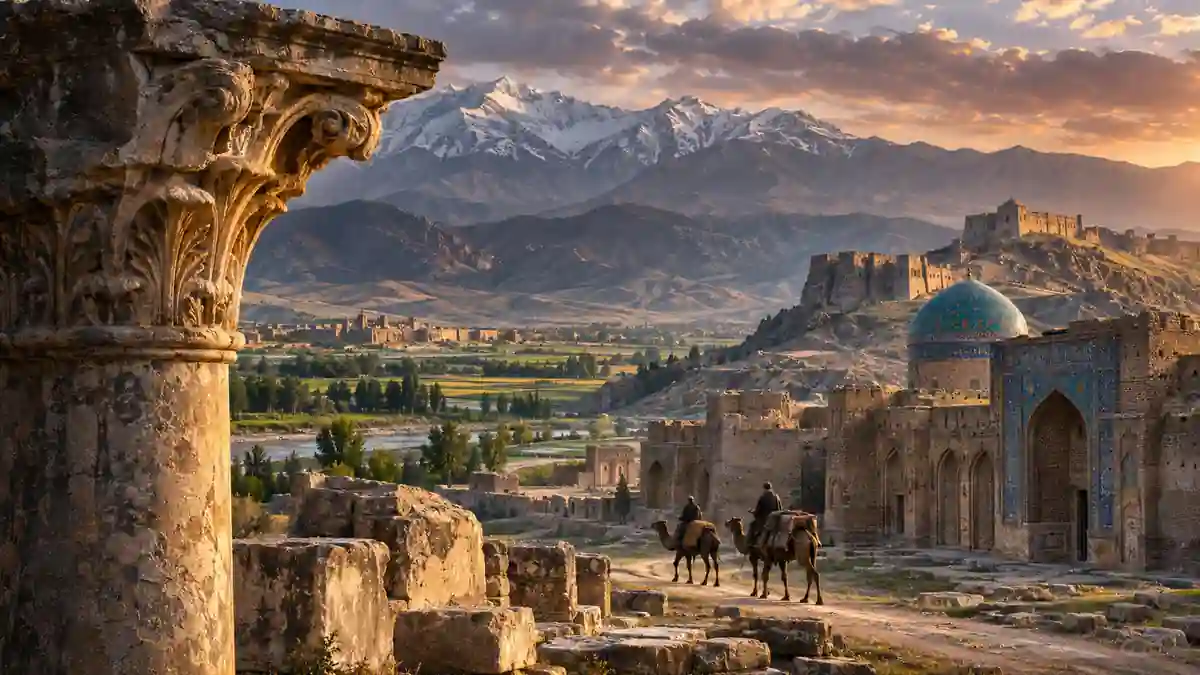
Long before Afghanistan acquired its reputation as the graveyard of empires, its cities sustained imperial governments, its rulers built kingdoms across Asia, and its valleys connected worlds. The history before 1747 reveals how conquest became government—and why the same places could serve as imperial frontiers under one dynasty and centres of power under another.
At Ai Khanum, near the meeting of the Kokcha and Amu Darya rivers in northern Afghanistan, archaeologists uncovered a theatre, a gymnasium and an inscription preserving maxims associated with Delphi. There were columned courtyards, a treasury and temples whose designs belonged to traditions beyond Greece. This was a Hellenistic city established in the aftermath of Alexander’s conquests, supported by an irrigated agricultural plain and connected to the mineral resources of Badakhshan. Its inhabitants lived within an organised political and economic world that endured well beyond the departure of the army that had made it possible.
The city complicates a familiar description of Afghanistan. A land supposedly resistant to all foreign rule had accommodated institutions, settlements and cultural practices associated with a distant imperial expansion. Yet treating Ai Khanum as proof that conquest was easy would be another distortion. Its monumental buildings tell us more about the concentration of resources and authority than about the consent of everyone who lived around it. A palace and an arsenal are evidence of government, but also of the means required to maintain it.
The problem with the “graveyard of empires” is therefore larger than its historical inaccuracies. It makes the eventual departure of conquerors seem more important than everything that happened while they ruled. It draws attention away from taxation, urban life, religious change, military recruitment and the local alliances through which power became durable. It also obscures the periods when rulers based in these territories sent armies out to conquer elsewhere.
Historians have already challenged the claim that Afghanistan was inherently unconquerable. Thomas Barfield’s work on political authority, for example, stresses the importance of ruling elites and historically changing forms of government. The task is to carry that correction into the actual history: to ask what rulers controlled, whose cooperation they secured, and how they financed the relationship between an imperial capital and its surrounding country. The answers change across the centuries, sometimes within the same valley.
Afghanistan Before 1747: The Land Before the State
For most of this history, there was no Afghanistan corresponding to the country on a modern map. Bactria lay north of the Hindu Kush, with Balkh as an important centre and connections extending across the Amu Darya. Herat belonged to the wider world of Khorasan, looking towards the Iranian plateau as well as eastwards. Kabul connected mountain routes with the approaches to the Indian subcontinent, while Zabulistan occupied territories farther south. Ghur’s highlands and the city of Ghazni acquired their own political importance at different moments. Sistan, around the lower Helmand basin, crossed another boundary that did not yet exist.
These were inhabited landscapes, sustained by agricultural work and linked through markets, migration and political institutions. Bactria’s wealth depended substantially on river-fed oases; Herat’s prosperity likewise required the management of water. Mountains could obstruct an army, but they did not eliminate the dependence of soldiers, townspeople or rulers on cultivated land. A force that captured a city still needed grain, fodder, transport and people capable of collecting revenue.
The Hindu Kush divided regions while its passes connected them. Routes channelled movement towards particular valleys and settlements, giving some places an importance disproportionate to their size. Their value changed with the location of imperial capitals and the direction of commerce. A city might be a frontier fortress for a ruler in Iran, a gateway for a dynasty in India, or the capital of a power seeking to dominate both.
This makes modern national geography a useful starting point but a poor explanation. An empire did not need to acquire all the territory of present-day Afghanistan to establish substantial power within it. Nor did a ruler necessarily consider a distant mountain community as valuable as a productive oasis or a road carrying horses and textiles. Political authority could be extensive without being uniform, and local autonomy could survive within an imperial order without making that order imaginary.
Empires Before Islam
By the sixth century BCE, much of this wider region had entered the Achaemenid Persian imperial world. Bactria supplied resources and soldiers, including cavalry that fought against Alexander’s forces. Local elites remained important within Persian rule, demonstrating that incorporation could preserve established holders of power rather than replace them wholesale. The region’s agricultural resources and position on routes towards India made it worth governing as well as traversing.
Alexander encountered formidable resistance after the collapse of the Achaemenid monarchy. His campaigns in Bactria and neighbouring Sogdiana demanded more than victory over a royal army. Opponents dispersed, regrouped and exploited difficult terrain; the Macedonians responded with violence, garrisons, settlements and the recruitment of local manpower. Alexander’s marriage to Roxana also belonged to a political world in which relationships with regional aristocracies could reinforce military achievements. His success was neither effortless nor merely an unsuccessful visit disguised as conquest.
The institutions that followed help explain the distinction. Under the Seleucids and then the independent Greco-Bactrian kings, Hellenistic government developed a territorial life beyond Alexander himself. Ai Khanum’s treasury and administrative spaces stood alongside its cultural buildings. Greek inscriptions recorded economic activity, while the city’s architecture combined Hellenistic forms with Iranian and Central Asian traditions. An imperial inheritance was being maintained and adapted by people who had to live within it.
The archaeological evidence also resists the idea that foreign influence travelled in only one direction. At Begram, finds included Indian ivories and Roman glass; at Tillya Tepe, ornaments reveal artistic connections across several cultural worlds. These objects do not establish a harmonious civilisation without conflict, but they show societies whose histories cannot be reconstructed from invasions alone. As the Metropolitan Museum’s account of ancient Afghanistan emphasises, the region received diverse influences and produced distinctive forms from them.
There was also an imperial connection that looked south and east. Following the settlement between Seleucus and Chandragupta Maurya around the beginning of the third century BCE, Mauryan authority extended into territories in the Indo-Iranian borderlands. In the Kandahar region, inscriptions associated with Ashoka appeared in Greek and Aramaic. Their languages preserve a practical political fact: a ruler based in the subcontinent addressed populations whose cultural and administrative inheritances crossed the boundary between what later generations would call India and Afghanistan.
Religious change followed similarly uneven routes. Zoroastrian traditions, local cults, Greek religious practices and Buddhism existed in different combinations across different regions. Ashoka’s inscriptions belong to this history, but Buddhism’s later strength cannot be reduced to a single ruler’s proclamation. Monasteries and sanctuaries required patronage, material support and connections with surrounding communities. The Bamiyan Valley’s archaeological landscape, with its monastic remains and monumental Buddhist art, records the depth of those developments.
The Kushans, whose power emerged from populations associated with the Yuezhi migrations into Bactria, created another extensive political formation during the early centuries CE. Their domains joined territories in Central Asia and present-day Afghanistan to parts of northern India. Here again, the region served as a foundation for expansion. Political leadership that might once have appeared external became established within a landscape from which it could command resources and govern farther afield.
Kushan inscriptions and coinage offer evidence more precise than a general celebration of cultural mixture. The Rabatak inscription, associated with Kanishka, records royal ancestry and a temple foundation, connecting dynastic legitimacy with religious patronage. Coins presented kings and deities through changing combinations of language and imagery. Such objects made authority recognisable across a diverse realm; they also show rulers selecting from inherited traditions rather than simply erasing them.
From the third century CE, Sasanian expansion established new forms of power in former Kushan territories, including rule through authorities known as Kushanshahs. Subsequent centuries brought Kidarite and Hephthalite ascendancy, with boundaries and relationships that remain difficult to reconstruct in detail. Titles, monetary forms and administrative practices could outlast the political supremacy of their earlier users. A change in the dynasty at the top did not always require an entirely new apparatus below it.
Military resistance could nonetheless inflict catastrophic defeats. In 484, the Sasanian king Peroz died fighting the Hephthalites, whose power placed the Persian monarchy under severe pressure. In the sixth century, a Sasanian alliance with the Turks helped break Hephthalite supremacy, although local rulers and political fragments survived. The outcome depended on shifting coalitions and the resources of competing states. Neither the mountains nor the ancestry of their inhabitants dictated one permanent result.
Conquest and Conversion Followed Different Clocks
The arrival of Muslim armies in the seventh century transformed this political world without immediately unifying it. Western territories were more accessible to forces advancing through Iran than the eastern mountain kingdoms. In Sistan, Zarang surrendered in 652, while Bost resisted. Campaigns then moved towards the territories of the Zunbils and the rulers of Kabul, producing a frontier that remained contested for generations.
The distinction between an expedition and an enduring government is especially visible here. Armies sought tribute, captives and treasure, but the ability to raid did not guarantee regular payment or stable occupation. The Zunbils repeatedly resisted attempts to subordinate their territories. In 698, an invading force suffered a severe reverse in which local resistance, shortages and cold combined to defeat it. Military and logistical conditions mattered together; religious purpose did not exempt an army from either.
Kabul and Zabulistan should not be merged into one timeless resistance movement. Their rulers, political connections and territorial bases changed, and the histories of the Kabul Shahis and the Zunbils were related without being identical. Nor were the populations behind them an unchanged national community defending borders that had not yet been drawn. What endured was the capacity of particular regional powers to organise resources, exploit distance and resist demands from stronger neighbours.
The spread of Islam followed a longer and more differentiated course than the movement of armies. A town could acknowledge a Muslim ruler while older religious communities remained active in its surroundings. Conversely, people could adopt Islam without their region becoming closely administered by a distant caliph. Evidence from Buddhist sites belongs beside the chronicles of conquest because religious institutions had their own histories of patronage, survival and decline. Political submission, institutional change and personal conversion were connected processes, but their chronologies did not coincide.
Over time, Islamic authority also became less dependent on the arrival of armies from the Arab heartlands. Regional dynasties governed through their own military organisations while seeking, accepting or contesting recognition from the caliphate. Religious scholarship, mosques and the language of legitimate Muslim kingship became embedded in local political life. Islam could authorise expansion, sustain government and provide grounds for opposition; it did not prescribe a single relationship between a region and an imperial centre.
This transformation makes a simple before-and-after comparison misleading. The people who resisted an early Muslim expedition were not the same political society as those who later served a Muslim dynasty based in Ghazni. Centuries of institutional development, migration, intermarriage and religious change separated them. There is no sound historical route from either episode to a claim about an inherited biological disposition to fight.
When the Frontier Produced Its Own Empires
The Saffarids emerged from Sistan during the ninth century, led by Yaqub ibn al-Layth, traditionally associated with the coppersmith’s trade that gave the dynasty its name. His forces defeated the Zunbil in the 860s and subsequently campaigned towards Kabul, while his ambitions also carried him westwards. This was a regional military power extending Islamic rule in some directions while challenging established Muslim authorities in others.
Sistan itself straddles modern Iran and Afghanistan, which makes attempts to assign the dynasty an exclusive modern nationality particularly unhelpful. Its significance lies in the political reversal it illustrates. A province previously governed from elsewhere could assemble a military organisation capable of attacking its neighbours and bargaining with the caliphate. The distinction between imperial centre and frontier was something rulers could change.
The Samanids subsequently brought substantial parts of the region into a state centred north of the Hindu Kush. Their importance extended beyond their own territorial success: their administrative and military arrangements supplied institutions and personnel that successor powers could appropriate. The Ghaznavids emerged from this environment, as Turkic commanders of slave origin acquired effective autonomy on the Samanid state’s southern margins. Alptigin established himself at Ghazni in the tenth century; Sebuktigin consolidated the base from which his son Mahmud built a much larger realm.
Mahmud’s reign, from 998 to 1030, made Ghazni a major imperial capital. Campaigns reached into India and across the eastern Iranian world, supported by professional soldiers and additional fighting contingents. Abbasid recognition supplied prestigious titles, while military success advertised the ruler’s authority. This was an empire produced through the combination of an army, a functioning revenue system and an established language of sovereignty.
Its Indian campaigns involved plunder, enslavement and attacks on religious sites, including Somnath in 1025–26. These acts supplied wealth and could be represented as victories for Islam, but treating religious rhetoric as a complete explanation would obscure the material demands of imperial warfare. Equally, reducing the campaigns to revenue collection would conceal the significance of desecration and the claims rulers made about their enemies. Motives could reinforce one another without becoming identical.
The court’s cultural world was integral to this structure. Persian literary patronage helped articulate royal greatness, while secretaries supplied the written instruments of administration. Bayhaqi’s surviving history, written by a man who had served in the Ghaznavid bureaucracy, opens a view onto decisions, rivalries and political conduct behind the public celebration of conquest. Biruni’s work on India reveals another product of this imperial setting: sustained scholarly engagement across languages and intellectual traditions. Neither achievement cancels the violence that helped sustain the court.
The Ghaznavid experience also exposes a vulnerability within successful expansion. An army capable of winning territory required continuing expenditure, and demands on productive provinces could alienate those expected to pay. The dynasty lost its dominant position in Khorasan after defeat by the Seljuks at Dandanqan in 1040, while retaining an eastern realm for much longer. The empire contracted unevenly rather than disappearing when one campaign failed.
The Ghurids followed a different path to expansion. Their ruling Shansabani family rose from the central highlands, where local chiefs had previously faced the pressure of larger neighbours. During the twelfth century, they developed an imperial formation extending towards Khorasan and northern India. A region that could shelter rulers from outside control could also furnish a base from which ambitious rulers entered wider systems of warfare and government.
Relations with Ghazni were destructive as well as competitive. In the mid-twelfth century, Ala al-Din Husayn’s forces sacked the Ghaznavid capital, damaging buildings and institutions that earlier rulers had cultivated. The episode interrupts any comfortable division between a destructive outsider and a constructive local dynasty: neighbouring Muslim powers could devastate one another’s centres while drawing on related political traditions.
Under Ghiyath al-Din Muhammad and his brother Muizz al-Din Muhammad, Ghurid power developed across complementary western and eastern fields. Expansion into India required commanders capable of holding positions after the main army moved elsewhere. Qutb al-Din Aybak, a military slave who became a leading commander, exemplifies how delegated authority could grow into an independent political base. After Muizz al-Din’s death in 1206, the Indian conquests helped furnish the foundations of the Delhi Sultanate, even as Ghurid power in its original territories unravelled.
The Ghaznavids and Ghurids therefore belong to different histories of state formation, despite their geographical proximity. One grew from the military institutions of an existing empire; the other from highland lordships that expanded beyond their earlier position. Both depended on connecting a regional base to resources and personnel distributed across a much wider area. Their achievements cannot be explained by the defensive advantages of mountains alone.
After the Mongol Destruction
The Mongol invasion in the early thirteenth century broke existing political arrangements with exceptional force. The Khwarazmian state, which had absorbed former Ghurid territories, failed to prevent Mongol armies from advancing through the region. Resistance remained possible: Jalal al-Din defeated a Mongol force at Parwan in 1221. But victory in one encounter did not establish the resources or cohesion needed to reverse the larger conquest.
Herat suffered particularly severe destruction. Its initial capture was followed by a revolt against Mongol representatives and then a devastating punitive siege in 1221–22. Medieval accounts describe extraordinary losses, but their enormous death tolls cannot be treated as verified demographic statistics. The more securely defensible conclusion is still grave: killing, displacement and damage to irrigation profoundly disrupted the city and its agricultural surroundings.
Water infrastructure makes the consequences more intelligible than a spectacular number alone. A canal linked rural labour, agricultural production and the provisioning of towns. Its destruction damaged the conditions under which a city could recover and a ruler could collect revenue. Military terror might compel submission while simultaneously reducing the economic capacity that made possession valuable.
The decades that followed were not an uninterrupted continuation of the invasion. Reconstruction began, local rulers emerged, and Mongol supremacy acquired more mediated forms. The Kart dynasty, established in the thirteenth century, governed Herat and surrounding territories while negotiating relationships with Mongol overlords. Its rulers could seek confirmation from superior authorities and still build substantial regional power.
Herat’s recovery was a practical undertaking as well as a dynastic achievement. The reconstruction of its principal canal began in the 1230s, and the city was progressively rebuilt during Kart rule. Such work required labour, coordination and some expectation that the products of rebuilding would survive. The return of political authority mattered partly because it could organise the repair of the resources on which further authority depended.
Timur imposed another conquest in the late fourteenth century, taking Herat in 1381. His destruction of fortifications and removal of the city’s iron gate made submission visible in the urban fabric itself. Yet the history of his dynasty cannot be reduced to his campaigns. His successors governed under different circumstances, and Herat became one of the principal centres through which Timurid power was exercised.
Under Shah Rukh and later Husayn Bayqara, the city sustained an extraordinary concentration of cultural activity. Gawhar Shad’s architectural patronage, the poetry of Jami and Ali Shir Navai, and the painting associated with Bihzad belonged to this political environment. Endowments and courtly commissions turned resources into institutions, buildings and reputations that could outlast individual patrons. Herat was helping define the prestige of the dynasty that ruled it.
Cities Between Muslim Empires
By the sixteenth century, the territories of present-day Afghanistan occupied several competing imperial worlds. Safavid rulers in Iran, Uzbek powers to the north and the Mughals in India pursued different interests across them. Herat, Balkh, Kabul and Kandahar did not move together as parts of a single political unit. Their affiliations reflected separate campaigns, dynastic contests and local calculations.
Babur’s seizure of Kabul in 1504 captures the possibilities of this geography. A Timurid prince who had struggled to secure himself in Central Asia, he acquired a base from which to rebuild his position. Kabul offered access to routes, markets and manpower, as well as a courtly home. His eventual conquest in India in 1526 emerged from that longer period of consolidation, rather than from a passage through politically empty mountains.
The city retained importance after the Mughal centre shifted towards India. Gardens, bazaars and administrative activity belonged to its life under imperial government. Its connections to the subcontinent did not make it merely an outlying dependency without an economy of its own; they helped sustain its value within a larger realm.
Kandahar was more persistently contested. It guarded a major connection between Iran and India and offered a fortified position from which either empire could threaten the other’s approaches. Its transfers of allegiance were not all achieved by storming its walls. Governors possessed information, troops and bargaining power, and imperial rivalry sometimes allowed them to exchange one sovereign’s service for another’s.
In 1638, Ali Mardan Khan transferred Kandahar to the Mughals while breaking with the Safavid court. The episode shows how a frontier could shift through the defection of an established officeholder. Safavid recovery of the city in 1649, followed by failed Mughal efforts to regain it, demonstrates the other side of the calculation: fortifications, military resources and the capacity to sustain a siege could prevent a powerful empire from achieving its immediate objective.
The stakes included commercial movement. Kandahar’s routes carried Indian textiles and indigo westwards, while horses travelled towards the subcontinent. War could interrupt these connections, but imperial competition did not abolish them. Merchants and rulers had reasons to maintain traffic across political boundaries even when sovereignty remained disputed.
Shared adherence to Islam supplied neither an automatic peace nor a single political allegiance. Safavid and Mughal courts differed in religious orientation, but dynastic security, revenue and strategic access also shaped their decisions. North of the Hindu Kush, Uzbek power introduced another set of interests and pressures. Calling all three Muslim empires identifies an important feature of their political languages; it does not explain why one governor changed sides or why one city resisted a siege.
Across these examples, local actors emerge with more varied roles than either loyal subjects or permanent insurgents. A governor might bargain, an urban elite might accommodate a new ruler, and a regional chief might fight for one imperial claimant against another. Such decisions were not always freely made, but they helped determine what military superiority could accomplish. Imperial power depended partly on relationships that its maps could conceal.
The Making of a New Centre
In 1709, Mir Wais Hotak led the overthrow of Safavid authority in Kandahar. Resistance to the conduct of the provincial government, the power of Ghilzai leadership and religious opposition to Safavid rule converged in the uprising. Its success established a regional political base whose consequences extended far beyond the city. The rebellion did not simply restore a stable local world after the removal of an outside governor.
Under Mir Wais’s son Mahmud, Hotak forces advanced into Iran and took Isfahan in 1722 after a devastating siege. The movement from resistance to conquest was rapid and consequential. Leaders who had challenged imperial authority in Kandahar now attempted to exercise sovereignty at the Safavid centre, facing the problems of legitimacy, rival claimants and control that accompanied their new position.
Hotak power in Iran proved short-lived. Nader, the commander who would become Nader Shah, defeated Mahmud’s successor Ashraf in 1729. Kandahar remained under a separate Hotak ruler until Nader captured it in 1738 after a prolonged siege. Neither the uprising’s success nor its eventual defeat supports a permanent rule about the ability of outsiders to control the region. Both require explanation through the forces and alliances available at the time.
Nader’s advance also depended on Afghan participation. Abdali leaders and soldiers served within his military order, illustrating how local rivalries could become resources for an expanding imperial ruler. Afghan fighters did not occupy one collective position outside empire. Some resisted Nader; others helped supply the coercive power through which he governed and conquered.
Ahmad Khan, later Ahmad Shah Durrani, acquired military standing in this environment. When Nader was assassinated in 1747, the collapse of his authority created opportunities for commanders and regional elites across his domains. Ahmad’s rise near Kandahar came from within that fractured imperial world, supported by an Abdali constituency and the military experience accumulated before independence.
His elevation as ruler in 1747 marks a decisive foundation of independent Afghan statehood. It did not establish the present country’s borders, produce a uniform national administration or settle the relationship between the throne and every community within its reach. Nor did it transform the heterogeneous populations of the region into a nation at a single ceremony. It created a new political centre from which those longer processes would unfold.
The significance of that foundation becomes clearer when placed beside the centuries before it. Ai Khanum, Ghazni, Herat and Kabul had each sustained forms of authority reaching beyond their immediate surroundings. Their histories reveal no constant division between an imperial outside and an ungovernable inside. Rulers could arrive as conquerors, establish local interests, recruit regional forces and leave institutions that a successor appropriated. Powers rooted in the region could follow the same routes in the opposite direction.
In 1747, Ahmad Shah inherited that history as well as the opportunities left by Nader’s death. The new Afghan monarchy would confront different external powers and develop a different relationship with the territories it claimed. That next history begins with a state emerging from an age of empires. To understand it, the earlier centuries must remain visible: a past in which the lands of Afghanistan were repeatedly governed, repeatedly contested, and repeatedly capable of becoming a centre of power themselves.