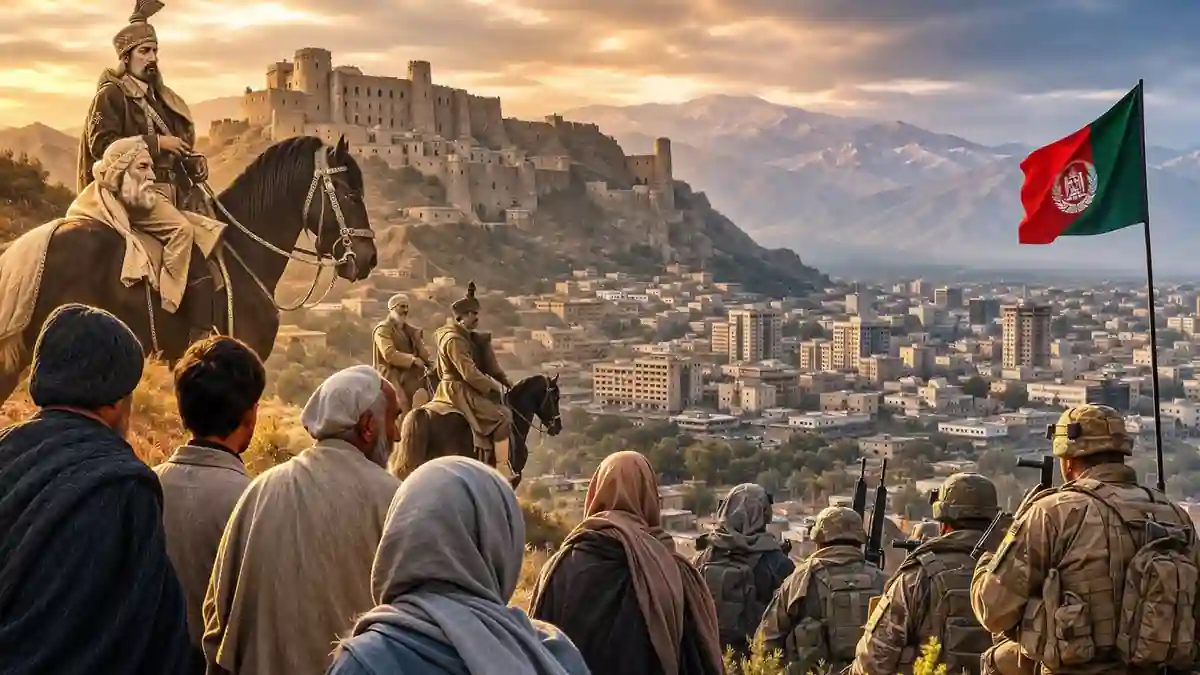
Foreign armies repeatedly changed who ruled Afghanistan. They were less successful at determining what could survive their departure. From British subsidies to Soviet supplies and American contractors, the crucial question was what outside power enabled Afghan rulers to do—and which indispensable functions remained outside their control.
When the last Soviet troops left Afghanistan in February 1989, the government they had supported did not immediately collapse. President Mohammad Najibullah remained in power for another three years. Kabul fell in April 1992, after the dissolution of the Soviet Union, the termination of Soviet military assistance and the breakdown of important alliances within the Afghan regime. Any explanation of foreign intervention in Afghanistan that moves directly from the departing Soviet columns to the victory of their enemies leaves out the interval that most needs explaining.
The contrast with 2021 is striking. The Afghan republic disintegrated while the American withdrawal was still under way. Its president fled, provincial administrations surrendered or dissolved, and Taliban forces entered Kabul before the final evacuation flights departed. Both governments depended heavily on outside assistance, yet their relationships with their patrons produced different capacities to endure after foreign troops began leaving. Withdrawal exposed those differences; it did not create all of them.
British experience supplies a third outcome. After repeated invasions, Britain secured considerable influence over Afghanistan’s external relations without permanently occupying its capital. Subsidies and weapons helped an Afghan ruler strengthen his authority internally while accepting restrictions abroad. That arrangement was coercive, contested and temporary in the longer history of independence. Nevertheless, it cannot be described adequately as another empire arriving, failing and leaving nothing behind.
The familiar alternatives—foreign domination or Afghan resistance—are too narrow for these histories. Afghan rulers could use external support to overpower domestic opponents; foreign patrons could achieve limited strategic objectives without governing the country; an insurgency could expel outsiders and then struggle to construct a viable political order. The comparison turns on how military power was converted into institutions and alliances, and whether those arrangements could function when the patron changed its priorities.
An Empire Before the Buffer State
The state founded by Ahmad Shah Durrani in 1747 was an expanding regional power. His campaigns carried Afghan authority into territories far beyond the present country, including parts of northern India. Victory over the Marathas at Panipat in 1761 demonstrated the scale of the military coalition he could assemble. Afghanistan entered its modern political history as the centre of an empire, with the obligations and vulnerabilities that imperial expansion created.
Holding that formation together required more than military reputation. Campaigns distributed rewards, territorial possessions supplied revenues, and the ruler depended on relationships with powerful chiefs and commanders. Ahmad Shah’s successors inherited those relationships without necessarily possessing his capacity to manage them. Timur Shah moved the capital from Kandahar to Kabul in the 1770s, altering the monarchy’s proximity to important constituencies. After his death in 1793, competing claims to succession accelerated fragmentation.
The loss of territories also changed the resources available to the throne. Sikh expansion under Ranjit Singh removed major possessions from Afghan control, including Kashmir and Peshawar. These were losses of revenue and strategic depth as well as prestige. The Barakzai ascendancy, and Dost Mohammad Khan’s consolidation in Kabul during the 1820s, represented an effort to rebuild authority within a diminished political field. Afghanistan was being reorganised after imperial contraction, rather than created out of an absence of government.
Dost Mohammad’s interests consequently differed from those of the British officials who approached him. Recovering Peshawar mattered enormously to his position. British authorities, concerned with the security of their Indian possessions, were unwilling to sacrifice their relationship with the Sikh kingdom to satisfy him. His willingness to explore Russian connections was therefore intelligible as regional diplomacy, even when British observers interpreted it as evidence of a threat directed against India.
The chronology of Russian expansion matters here. Russia’s conquest of the Central Asian khanates gathered momentum later in the nineteenth century; the circumstances preceding the invasion of 1839 were not identical to those preceding the war of 1878. British fears could outrun Russia’s immediate capabilities while still producing destructive policy. A relatively weak Afghan ruler seeking bargaining room became, in British strategic reasoning, a danger because he might accept somebody else’s assistance. The security of an empire was being defined partly through its insistence that another state restrict its diplomatic choices.
Foreign Intervention in Afghanistan: Britain’s Changing Objectives
The British-led invasion of 1839 displaced Dost Mohammad and restored Shah Shuja, a former ruler living in exile. Initial military success appeared to solve the political problem: a government considered unreliable had been replaced by one dependent on British protection. But the restoration made Shah Shuja’s survival inseparable from an occupying force whose expenditure, conduct and interventions generated opposition. Installing a ruler and establishing his authority proved to be different undertakings.
The uprising in Kabul in November 1841 exposed the weakness of that arrangement. The retreat towards Jalalabad in January 1842 became a catastrophe for soldiers and camp followers. William Brydon’s arrival at Jalalabad later furnished an enduring imperial image, but the familiar claim that he was the expedition’s only survivor is false: prisoners and other survivors also lived through the disaster. The distinction matters because the story has often been remembered through an emblem rather than the experience of the people caught within it.
British forces subsequently returned to Kabul, released captives and inflicted punitive destruction before withdrawing. They retained the military capacity to enter the capital again, but abandoned the political restoration for which they had originally intervened. Shah Shuja had been killed, and Dost Mohammad returned to power in 1843. The First Afghan War thus combined a devastating military reverse with the failure of a specific project of regime replacement. Neither result establishes that every conceivable British objective in Afghanistan had become unattainable.
The second war began in 1878 amid renewed conflict over diplomatic access and Russian influence. The Treaty of Gandamak, signed in May 1879, constrained Afghan foreign relations and provided for a British representative in Kabul. That representative, Louis Cavagnari, was killed within months, and renewed fighting followed. British forces suffered a major defeat at Maiwand in 1880 before defeating Ayub Khan’s army near Kandahar. This was no uninterrupted march to a settled outcome.
Yet the eventual arrangement differed substantially from that of 1839. Britain accepted Abdur Rahman Khan as amir, withdrew its occupying forces and maintained influence over external affairs. Abdur Rahman preserved considerable freedom in domestic government. Britain relinquished the attempt to make a resident British presence in Kabul the foundation of its security while continuing to constrain the country’s international position. The Second Afghan War ended in a compromise between unequal powers, not the simple disappearance of imperial influence.
British subsidies and access to weapons helped Abdur Rahman develop a stronger central army. His government also expanded taxation, administration and coercive surveillance; it was not merely a mechanism through which foreign money passed. Assistance became useful because the ruler could combine it with institutions and political strategies under his own direction. Britain wanted a secure buffer against rival influence, while the amir wanted the means to defeat challengers within Afghanistan. Their interests overlapped sufficiently to sustain cooperation without becoming identical.
The domestic consequences were brutal. Campaigns against the Hazaras involved killing, dispossession, enslavement and displacement. Centralisation was experienced by affected communities as conquest, even when later national histories presented it as consolidation. External assistance could therefore strengthen an Afghan state while diminishing the security of people subjected to it. The history of the Hazaras makes it impossible to treat increased governmental power as an uncomplicated public benefit.
Boundary-making reinforced this unequal political order. The 1893 Durand agreement described the limits of British Indian and Afghan spheres of influence and set out a frontier for subsequent demarcation. Its text, the work of boundary commissions and later treaty arrangements belong to a developing history; they should not be collapsed into the claim that one meeting created a fully administered modern border. The line divided communities and routes whose connections crossed it, and its political significance changed again when Pakistan inherited British India’s position in 1947.
British influence was substantial but neither unlimited nor permanent. In 1919, Amanullah sought full control of Afghanistan’s foreign relations through a short war whose military course included British advantages and Afghan setbacks. The settlement nevertheless ended the restriction on Afghan external independence. The political outcome cannot be read straight from a battlefield score: Britain could still inflict damage without finding it worthwhile to preserve the previous diplomatic arrangement. The three Anglo-Afghan wars produced different results because their objectives, settlements and wider circumstances differed.
Independence and the Reach of Reform
Independence expanded the monarchy’s diplomatic choices without resolving the relationship between central ambition and domestic capacity. Amanullah pursued educational, legal and administrative reforms, while seeking examples and assistance abroad. The constitution of 1923, preserved by the Library of Congress, embodied an attempt to define sovereignty and government in written national terms. Afghanistan’s rulers were making choices about institutional change, rather than merely defending an inherited order against foreign intrusion.
Reform encountered opposition through disputes over taxation, authority, religion and social practice. Amanullah’s overthrow in 1929 cannot be explained adequately as the automatic rejection of modernisation by a uniformly conservative population. The monarchy faced a political and fiscal crisis, its opponents possessed different interests, and the government lacked sufficient means to impose or negotiate its programme. After Habibullah Kalakani’s brief rule, Nadir Shah restored a different royal order; his assassination in 1933 brought Zahir Shah to the throne.
The following decades deserve space in a history too often organised around invasion. Zahir Shah’s forty-year reign included authoritarian government, gradual institutional development and, eventually, the constitutional experiment of 1964. Its limitations were considerable, but its duration contradicts the assumption that Afghan politics was incapable of sustaining a central order. Relative stability depended partly on managing the reach and pace of government, rather than requiring society to accept an uninterrupted programme of transformation.
During the Cold War, Afghan governments obtained development assistance from competing powers. Roads, educational institutions and military training linked the country more closely to international systems while expanding domestic capacities. That assistance did not lead mechanically to collapse. It did, however, change who possessed technical knowledge, access to weapons and opportunities for political organisation. The state’s modernising institutions became arenas in which rival projects for its future could develop.
Mohammad Daoud’s overthrow of the monarchy in 1973 established a republic with support from military officers, including leftists. His subsequent attempts to consolidate power and reduce dependence on former allies intensified political conflict. The April 1978 coup by the People’s Democratic Party of Afghanistan destroyed his government and killed him. This sequence was driven by Afghan political actors as well as international connections; treating the Soviet invasion as the beginning of the crisis erases the domestic revolution and repression that preceded it.
The Soviet War and the Government That Outlasted It
The PDPA government attempted rapid social and economic transformation while conducting arrests, executions and purges. Its own factions, Khalq and Parcham, fought over power, and opposition spread across the country. Land reform and literacy campaigns existed alongside coercion that could turn an encounter with the new state into an experience of arbitrary danger. Resistance was not exclusively a response to foreign soldiers: a major insurgency was already confronting the Afghan government before Soviet forces entered.
Soviet leaders initially understood some of the risks. Records of their discussions in March 1979, following the uprising in Herat, show reluctance to deploy troops and awareness that military intervention could deepen the problem. By December, their calculations had changed. Anxiety about the survival and orientation of the Afghan leadership, factional violence and fears of losing influence contributed to the decision to invade. The archival record reveals a contested decision, not an imperial machine following an inevitable programme.
Soviet forces killed Hafizullah Amin and installed Babrak Karmal in December 1979. They could change the leadership in Kabul far more readily than they could establish its authority throughout the country. The intervention also altered the opposition’s political resources: resistance to a revolutionary government became inseparable from resistance to a foreign army. Military action intended to preserve an allied state enlarged the war that state had to survive.
The mujahideen were not a single organisation. Islamist parties, regional commanders and locally rooted fighting groups pursued different political projects. Pakistan’s intelligence services exercised considerable influence over the distribution of assistance, while the United States, Saudi Arabia and other supporters supplied resources. Religious conviction sustained resistance, but weapons, sanctuary, financing and organisational access shaped which leaders could turn that conviction into durable military power.
For civilians, the war involved bombardment, displacement, destroyed livelihoods and violence by multiple forces. The ability to keep a route open or seize a district did not necessarily translate into government that inhabitants trusted or could safely approach. Nor did the insurgents’ capacity to deny control automatically provide a coherent alternative administration. Different organisations could make a territory difficult for the state to govern while leaving unresolved who would rule it after victory.
Under Najibullah, who replaced Karmal in 1986, the government sought a broader political base through national reconciliation, changes in official language and agreements with local armed actors. These efforts did not remove repression or erase dependence on Soviet supplies. They nevertheless helped create a regime capable of holding major centres and surviving after the final Soviet military withdrawal on 15 February 1989. Documents assembled by the National Security Archive also show how withdrawal negotiations failed to produce a comprehensive political settlement or an end to external arms deliveries.
Najibullah’s eventual fall demonstrates both the achievement and its limit. Continued supplies bought room for Afghan institutions and alliances to function; they did not make those arrangements independent of their sponsor. When support ended and commanders recalculated their positions, the regime fragmented. Foreign troop withdrawal and the loss of indispensable external support were separate events; the interval between them is essential to understanding both the regime’s survival and its eventual collapse.
The Victors Who Could Not Agree on a State
The fall of Najibullah in 1992 did not unite the organisations that had opposed him. Competing forces entered a struggle over Kabul and the distribution of power, while Burhanuddin Rabbani’s presidency failed to secure an accepted national settlement. Gulbuddin Hekmatyar’s forces bombarded the capital, and alliances involving Ahmad Shah Massoud, Abdul Rashid Dostum and other leaders shifted. Civilian neighbourhoods became military terrain in a contest among actors whose authority had grown during the preceding war.
The destruction of Kabul was not the natural condition of a country reverting to itself after outsiders departed. It followed decisions by identifiable armed organisations, some sustained by continuing foreign support. Human Rights Watch’s investigations documented the roles of Pakistan, Iran and Russia in supplying competing forces. The end of one foreign military intervention had left several channels through which regional powers could influence the struggle.
The Taliban emerged as an organised movement in 1994, drawing on networks of religious students, clerics and former fighters under Mullah Mohammad Omar. The chronology is essential: the Taliban movement did not fight the Soviet occupation under that name. Some of its future members had participated in the earlier resistance, but its formation belonged to the subsequent civil war, displacement and regional political economy.
Promises to disarm predatory commanders and restore order helped the movement gain support. Pakistani assistance strengthened its expansion, and the Taliban captured Kabul in September 1996. But the restoration of safer movement in some areas accompanied an intensely restrictive form of government and continued warfare elsewhere. An explanation of its appeal must recognise what people feared under the preceding factions without converting relief from those factions into universal consent for Taliban rule.
The movement’s violence also exceeded any claim to neutral pacification. Its capture of Mazar-i Sharif in 1998 was followed by a massacre, with Hazaras particularly targeted. Opposition forces retained territory, and Afghanistan remained politically divided. The Taliban’s relationship with al-Qaeda introduced another international dimension: territorial gains did not insulate its rulers from the consequences of the organisations they sheltered. Military predominance inside Afghanistan was no guarantee of security from decisions made beyond it.
The Republic Built Beside the War
After the attacks of 11 September 2001, the United States intervened against al-Qaeda and the Taliban government that sheltered it. American air power and special operations forces worked with Afghan opponents of the Taliban to bring down the regime rapidly. This initial outcome depended on existing Afghan forces and political relationships as well as technological superiority. The later insurgency should not obscure how quickly the government lost its principal cities.
The December 2001 Bonn Agreement established arrangements for a political transition under Hamid Karzai. It was a framework negotiated among selected Afghan participants, not a settlement accepted by every armed constituency; the Taliban were excluded. The UN-authorised International Security Assistance Force was a distinct undertaking from the initial American-led combat operation. Its mandate and geographical reach subsequently expanded, and NATO assumed its leadership in 2003. These connected missions carried different legal and operational purposes, even when their personnel worked in the same country.
The resulting republic produced substantial achievements. Educational access expanded, women entered professions and public institutions, and new media and civic organisations enlarged political life. These changes were uneven and vulnerable, but they were not merely decorative claims made by foreign governments. UNESCO’s account of educational change records gains that represented years of work by Afghan teachers, families and officials as well as external assistance. The subsequent destruction of opportunities does not make their earlier existence unreal.
The institutional arrangement nevertheless contained tensions that military expansion could not resolve. A highly centralised constitutional order coexisted with commanders and political brokers whose leverage depended on personal networks, armed followers and access to contracts. Foreign forces could work with such figures to pursue immediate security objectives while civilian programmes sought to strengthen impersonal administration. A partner useful for finding an insurgent might also be a source of insecurity for the people the government needed to win over.
This contradiction is well established in the literature. Studies of rentier politics, intervention and local power have already shown how external resources can fragment authority or redirect accountability towards donors. The Independent Commission for Aid Impact’s literature review surveys disagreements over centralisation, local ownership and the contradictory purposes of state-building. Simply observing that aid created dependency would add little. The harder comparison concerns why some forms of assistance increased a ruler’s usable authority while others built institutions whose ordinary operations still required foreign participation.
Abdur Rahman had used assistance to strengthen an army he directed towards his own domestic objectives. The republic was expected to maintain a much more expensive security system while satisfying competing requirements: defeating insurgents, observing legal standards, holding territory, expanding services and demonstrating national legitimacy. Its supporters did not agree consistently on which requirement took precedence. The scale of its responsibilities grew faster than its ability to finance and coordinate them independently.
In the World Bank’s 2019 Public Expenditure Update, grants financed more than three-quarters of total public expenditure, including spending outside the national budget. The distinction between total expenditure and the budget matters: foreign resources sustained a wider system than the accounts controlled directly by Kabul. World Bank analysis consequently treated declining aid as a challenge to both security financing and civilian services. Domestic revenue collection could improve without approaching the cost of the political and military order being maintained.
Meanwhile, Afghan soldiers and police fought and died in large numbers. Describing the republic as nothing more than a foreign fabrication erases their service and the constituencies invested in its survival. Its weaknesses instead require attention to the circumstances in which those people served: contested leadership, corruption, uncertain resupply, dependence on specialised support and the knowledge that their patron’s commitment could change. Courage by individuals could not guarantee coherence across that system.
Withdrawal Changed the Calculation Before It Ended the Presence
The Taliban rebuilt their insurgency through violence, political organisation, taxation and local negotiation, while benefiting from sanctuary and support across the Pakistani border. They could exploit abuses by government-associated actors and foreign forces, but their return was not simply a spontaneous expression of popular preference. Coercion and targeted killing also narrowed the choices available to communities and officials. The movement’s survival depended on institutions and relationships accumulated over years.
The Doha agreement of February 2020 placed American withdrawal on a timetable alongside Taliban counterterrorism commitments and plans for intra-Afghan negotiations. It did not itself settle the contest over Afghanistan’s future government. A permanent ceasefire remained a matter for subsequent negotiations, while the republic was not a party to the US–Taliban agreement. The document established a route towards departure before the Afghan parties had agreed on the political order that would follow.
That sequencing altered behaviour before the withdrawal was completed. A soldier deciding whether a position could be held, a governor considering negotiations and a commander assessing his allies all had to judge the future availability of support. American assurances that financial assistance would continue could not fully substitute for the military presence that had made those assurances credible. The uncertainty concerned both material resources and expectations about who would ultimately prevail.
The republic’s forces were particularly exposed because important capabilities depended on American systems and contractors. Aircraft maintenance, logistics and other support functions could not all be transferred simply by handing over equipment. SIGAR’s investigation of the security forces’ collapse identified withdrawal decisions, contractor dependence, leadership failures and morale among the factors shaping the outcome. A force may possess weapons without possessing the organisational means to keep them supplied and operational across a national war.
The final Taliban advance combined fighting with negotiated surrender, withdrawal and the transfer of local authority. Afghanistan Analysts Network’s interviews show considerable variation: some positions resisted, some ran out of essentials, and others were abandoned through arrangements that participants did not always understand. Calling the whole process cowardice substitutes a national insult for an explanation. Equally, presenting the takeover as peaceful agreement conceals the violence and threats within which negotiations occurred.
Ashraf Ghani’s narrow political circle and strained relationships with other powerholders compounded the crisis. The Taliban’s expectation of victory also reduced its incentive to compromise. SIGAR’s inquiry into the government’s collapse describes failures involving the Afghan leadership, the insurgency and American policy, rather than a single decisive defect. On 15 August 2021, Ghani fled and the Taliban entered Kabul; the final American military departure followed later that month.
The comparison with 1989 now becomes more precise. Najibullah retained an external supply relationship after foreign troops withdrew, along with institutions and alliances capable of using it for a time. In 2021, the republic confronted changes to military support, the withdrawal of contractors and an accelerating loss of political confidence together. The contrast shows why troop withdrawal cannot be treated as a single, uniform event. The timing and terms of continued supplies, technical support and political commitments mattered alongside the capacities and alliances of the Afghan governments themselves.
The Insurgents Inherit the State
The Taliban’s return did not restore Afghanistan to its condition before 2001. The new rulers inherited ministries, customs facilities, roads, communications networks and a population transformed by education, urbanisation and migration. They displaced a political leadership while taking possession of much of the administrative infrastructure associated with it. Their capacity to govern therefore depended partly on institutions created or expanded during the foreign-backed republic they had defeated.
They also inherited a radically altered fiscal environment. External funding contracted, banking relationships were disrupted, and the economy suffered a severe shock. The Taliban pursued domestic revenue collection with considerable determination. Kate Clark’s research on taxation documented the movement of resources from households and businesses towards the new authorities, including accounts of more systematic collection and burdens that taxpayers could scarcely afford. An administration can become more effective at taking revenue while the society financing it becomes poorer.
Humanitarian assistance continued through channels distinct from direct financing of the Taliban administration. That distinction prevents two misleading conclusions: that Afghanistan became economically independent after the foreign military departure, or that every aid delivery constituted a budgetary payment to its rulers. Outside assistance could sustain households and public services without giving donors decisive control over the government. It could also relieve pressures that the authorities would otherwise have had to address from domestic revenues.
The reduction in large-scale warfare brought real benefits to many people. In August 2026, UNAMA recognised improved security, while identifying restrictions on women and girls and continuing terrorism concerns as obstacles to lasting recovery. Recognising the benefit of fewer battles does not establish that the resulting government commands general consent. Nor does the persistence of armed threats mean there has been no meaningful change from the preceding war.
The authorities’ record also tests the meaning of their own promises. UNAMA documented killings, disappearances, torture and arbitrary detention affecting former government and security personnel despite the announced general amnesty. Central commands and local conduct did not always coincide, and assurances of protection could not be assumed to provide it. Victory had given the movement responsibility for preventing abuses by its own members, as well as the power to repress opponents.
Restrictions on women reveal a more deliberate exercise of authority. The prohibition of secondary and university education for girls and women is not an unavoidable product of geography, fiscal shortage or the departure of foreign forces. It is a policy imposed by rulers possessing sufficient control to obstruct opportunities that many families want. By November 2026, UNESCO and UNICEF reported that more than 2.6 million girls had been denied secondary education since 2021. The movement’s ability to enforce exclusion demonstrates a form of governing capacity while weakening the country’s future supply of skills and livelihoods.
Economic recovery supplies another necessary distinction. The World Bank’s May 2026 assessment found modest growth and stronger revenue collection alongside falling incomes per person, pressure from large-scale returns and persistent structural constraints. A functioning treasury, territorial predominance and improved living standards are separate achievements. Possessing the first two does not establish the third, just as holding the capital never established uncontested political legitimacy.
The useful test of an intervention is consequently more demanding than whether its soldiers can enter Kabul or whether an allied government remains there while they stay. It concerns the capacities and obligations left behind: who can pay the forces, maintain their equipment, negotiate disputes and make commitments that other actors expect to be honoured. Outside assistance can expand those capacities, substitute for them or do both in different institutions. Its consequences become clearest when the sponsor’s priorities change and Afghan actors must decide which arrangements are still worth defending.
Afghans have repeatedly made those decisions under conditions they did not choose, but they have never occupied one collective role as resisters, clients or victims. Some used foreign backing to build states; others used it to destroy rivals; many struggled to preserve ordinary life between them. Conquest changed the distribution of power quickly. What followed depended on the political relationships through which that power reached beyond the battlefield—and on whether those relationships could sustain a government without consuming the society it claimed to govern.