The Chola Empire carried the power of a South Indian monarchy across the Bay of Bengal. Its history reveals how conquest, commerce and religious patronage drew on different kinds of authority—and how the achievements of many could become the glory of one king.
In an inscription at Thanjavur, the cities overcome by Rajendra Chola’s forces glitter with treasure and magnificent gates. The record names a captured ruler, Sangrama Vijayottungavarman, then proceeds through a succession of places across maritime Southeast Asia. Conventionally dated to 1025, the expedition it commemorates carried an army from South India into the commercial world of Srivijaya, whose centres lay in Sumatra and the Malay Peninsula. Distant places enter the account through the king’s success: their defences testify to what he overcame, their splendour to the value of his victory.
The inscription tells us much less about the relationships that sustained those places. Pilots, suppliers, merchants, cultivators, religious patrons and local rulers had made them valuable long before Rajendra’s ships arrived. An expedition could defeat a port’s defenders and disrupt its business without acquiring the continuing ability to govern it. A victory concentrated glory in the king’s name; maintaining the value of a conquered place required cooperation from people whose interests his praise did not explain.
The medieval Cholas built a substantial territorial empire, and their overseas campaigns deserve a place in any history of Asian power. Yet their achievement becomes harder to understand when every campaign, commercial settlement and cultural connection is enclosed within the boundaries of an empire. Royal force could compel an enemy, merchants could organise business abroad, and religious institutions could sustain obligations across generations. These capacities sometimes supported one another. At other times, their holders pursued different purposes, negotiated separate arrangements or continued their activities after a royal project had failed. Their history requires us to follow how power passed between them, and where that passage stopped.
The Land Behind the Chola Empire
The Cholas who undertook these expeditions belonged to the medieval dynasty that rose to prominence from the ninth century. The much earlier rulers of the same name supplied a prestigious ancestry, but the later kingdom developed through its own conquests and institutions. Vijayalaya established his centre at Thanjavur, in the fertile Kaveri delta of what is now Tamil Nadu. Cultivated land and waterways supported a concentration of settlements, temples and political resources. Rajaraja I, who ruled from 985 to 1014, greatly expanded this kingdom. His son Rajendra shared power towards the end of his father’s reign and continued its expansion until his death in 1044. Campaigns on land and across the sea drew on the strength assembled within this South Indian heartland.
That strength required sustained work and enforceable claims. Irrigation, cultivation, land measurement and revenue collection connected local production to larger institutions. Research on Chola agrarian history reveals a society divided by landholding, caste and access to authority. Inscriptions distinguish owners, cultivators, occupational groups and settlements whose resources could be assigned to particular purposes. A king’s command over revenue depended on production carried out through these unequal relationships. The naval expedition’s provisioning accounts have not survived, so particular harvests cannot be traced into Rajendra’s ships. The material foundation of maritime power nevertheless extended well beyond the harbour.
Nor was the countryside administered solely through commands issued from a palace. Village assemblies, Brahman landholding bodies, commercial organisations and temple authorities exercised consequential powers. The tenth-century Uttaramerur inscriptions, issued under Parantaka I, describe selection by lot for committees, qualifications involving property and learning, and disqualification for failures of conduct or accounting. These procedures belonged to a particular Brahman settlement, with restricted eligibility. Their sophistication shows how elaborate local administration could coexist with social exclusion. Royal intervention helped regulate institutions through which influential local groups governed their own affairs.
The great temple Rajaraja built at Thanjavur brought several of these relationships into one institution. Its inscriptions record donations by the king, his sister, his wives and other patrons, together with carefully weighed objects and wealth acquired through conquest. Gold taken after victories against the Cheras and Pandyas entered a sanctuary whose accounts preserved the donor’s name. War and worship were connected through an identifiable transfer of resources. A royal gift could thus give durable religious purpose to wealth acquired through violence, while making the victorious ruler its remembered benefactor.
Revenue assignments worked through another kind of transfer. As the epigraphist Y. Subbarayalu explains, directing a village’s revenues to a temple did not necessarily change ownership of its land: the king’s share could be paid to the institution instead. Such distinctions locate the transaction more precisely. A grant redistributed claims on production, while the people cultivating the fields continued the work that gave those claims value. The king could redirect an income he did not personally produce. The temple’s maintenance then depended on the continuing recognition and collection of that income, turning an act of generosity into an arrangement others had to fulfil.
The religious life sustained by these institutions also exceeded the purposes of revenue and royal standing. Chola-period processional bronzes were embodiments of deities used in worship and carried beyond the temple’s inner spaces. Shiva as Nataraja joined creation, destruction and refuge in a form whose significance exceeded any individual patron. For worshippers, seeing and being seen by the deity offered access to blessing. Processions extended that encounter beyond spaces whose admission was restricted by social and ritual status. Bronze casters, ritual specialists and worshippers participated in a world that rulers supported but did not simply invent.
Rajendra’s northern campaign joined military ambition to sacred authority on another scale. His forces reached the Ganges, and water brought from the river commemorated the achievement in the south. His new capital, Gangaikondacholapuram, incorporated that victory into its name. The army’s passage through distant territory enlarged his standing without turning all of northern India into a routinely administered Chola province. The capital made an expedition’s prestige permanent in a place the monarchy could govern. His assault across the Bay of Bengal belonged to this broader pursuit of resources, recognition and royal distinction.
Where Conquest Became Government
Sri Lanka offers firmer evidence of what Chola territorial rule involved. Rajaraja’s invasion in 993 established control in the north; campaigns under Rajendra extended the conquest and carried away the island’s king, Mahinda V. The Cholas used Polonnaruwa as an administrative centre. Temples and inscriptions attest to their presence, while records of revenues assigned from Sri Lankan villages to Rajaraja’s great temple demonstrate extraction reaching back across the water. Occupation created recurring demands on resources, giving conquest an institutional life beyond the departure of the first invading army.
Maintaining those demands required continued force. Southern areas provided bases for opponents, and the practical extent of Chola control changed with military circumstances. Vijayabahu’s campaigns eventually expelled them around 1070. The intervening decades involved repeated efforts to hold territory against people with reasons and opportunities to resist. A map of the occupation can display its geographical reach; the duration and instability of that reach reveal the work involved in preserving it. Military access had to be converted into revenue, appointments and obedience, then defended against attempts to undo the conversion.
The sources themselves participated in this conflict. Chola inscriptions celebrated victories and benefactions; the Sri Lankan Buddhist chronicle tradition remembered invasion, loss and the restoration of religious and political order. Their different concerns shaped what they preserved. George Spencer’s influential study of Chola warfare examined plunder as a political and economic practice, directing attention to what armies took as well as what kings claimed. Wealth seized in one place could support piety displayed in another. A temple’s endowment might record its benefactor meticulously while preserving little about the lives disrupted by the acquisition of his gift.
Religious affiliation did not supply a reliable guide to political allegiance. South Indian soldiers and merchants participated in Sri Lankan life, while the Cholas patronised Buddhist institutions in their own territory. Employment, commerce and belief crossed the divisions invoked in accounts of invasion and restoration. These overlapping relationships make the comparison with Southeast Asia more useful. Officials, recurring revenue claims and sustained enforcement provide evidence of rule; a list of places attacked establishes a different achievement. Sri Lanka demonstrates the Cholas’ capacity to govern overseas and supplies a standard against which claims about their other expeditions can be tested.
An Ocean with Other Masters
The commercial world facing the Cholas had its own centres of initiative. Srivijaya’s rulers cultivated relationships with ports, hinterlands and foreign courts, drawing advantage from traffic between the Indian Ocean and the South China Sea. Their influence depended on connections among places with interests of their own. Hermann Kulke’s research on Srivijaya’s political formation questions the image of a uniformly controlled territorial block. Its rulers exercised substantial power, but its distribution varied across relationships and places. They, too, had to make an interconnected maritime world serve a political centre.
Song China added a source of opportunity and competition. Access to its markets and court mattered to both South Indian and Southeast Asian rulers. Embassies could carry goods and secure recognition, while diplomatic descriptions placed distant polities within a hierarchy intelligible to the receiving court. Such descriptions need to be read alongside evidence of what the parties actually did. A court’s classification of a distant ruler could express its understanding of proper relations without determining who appointed officials or collected revenues in that ruler’s country. Recognition was valuable precisely because it could be pursued alongside other forms of authority.
Merchants approached these waters through more than one royal connection. The forest products that drew traders to northern Sumatra, including camphor and benzoin, depended on access to hinterland suppliers as well as ships and ports. South Indian participants entered markets also used by Southeast Asian, Chinese and Middle Eastern traders. Local suppliers and rulers retained decisions over the goods, facilities and protection on which profitable exchange depended. An arriving king could threaten those arrangements, bargain with their holders or improve the position of particular traders. He entered a commercial world whose value rested partly on capacities he had not created.
That dependence put a limit on what commercial victory could mean. Removing an obstacle to one group’s trade did not ensure that goods would continue to arrive, buyers would remain or local authorities would honour the resulting arrangement. A port’s defenders could be defeated in an encounter; its usefulness had to be reproduced through continuing activity. Commercial interests could therefore encourage coercion while also giving participants reasons to seek accommodation after it. The same destination might appear in a royal victory list and remain a place where merchants needed to negotiate.
The Fleet and the Missing Archive
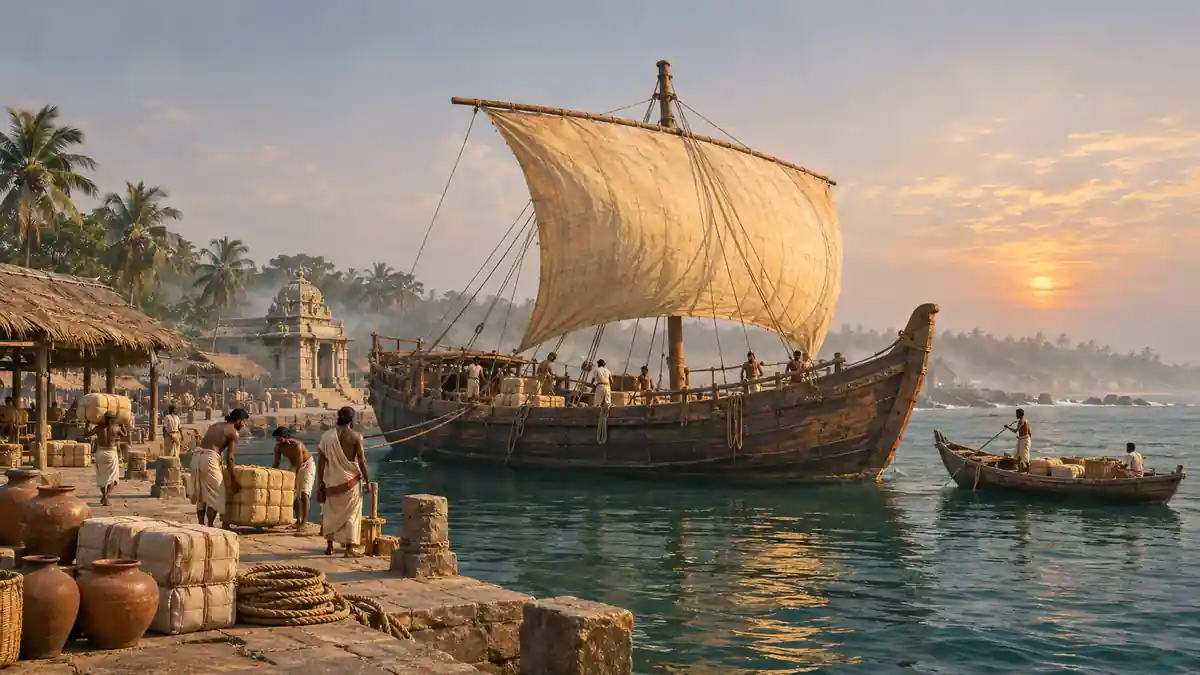
Transporting a fighting force across the Bay of Bengal required ships, crews, supplies and knowledge of seasonal winds. The surviving evidence gives us little of the organisation behind that undertaking. In “A Note on the Navy of the Chola State,” Subbarayalu stresses the scarcity of contemporary information about vessels, command, military numbers and naval bases. Scholars have proposed that merchant shipping supplied part of the expeditionary fleet. That remains a reconstruction: no surviving contract identifies the shipowners involved or the terms on which they served.
The practical requirements nevertheless explain why the expedition’s reach cannot be measured through fighting strength alone. Food and water occupied space on vessels; replenishment required suitable places to land; departure and return had to fit maritime conditions. Pilots and crews possessed knowledge that an order from the palace could require but could not itself supply. Whether obtained through service obligations, commercial arrangements or other means, these capacities had to be assembled for the campaign. The royal account attributes the result to Rajendra without describing the arrangements through which others made his command effective.
Even the familiar date carries a qualification. Although 1025 is conventional, Noboru Karashima and Y. Subbarayalu proposed 1026 after examining when the victory first appears in inscriptions dated by Rajendra’s regnal years. Their argument concerns the chronology of references within a royal eulogy that accumulated achievements over time. The difference scarcely changes the campaign’s significance, but it cautions against treating the date attached to an inscription as a complete chronology of everything it commemorates.
The motives remain contested. Protection or enlargement of commercial access is one serious explanation; treasure and royal prestige are others. Tansen Sen’s analysis emphasises competition involving Srivijaya and access to Song China. Spencer’s interpretation of Chola expansion gives greater weight to the political uses of plunder. These explanations can overlap, but their overlap leaves important questions open. Merchants’ possible gains from an attack do not establish that they requested it, financed it or determined the king’s principal objective.
The vocabulary of protected commerce also leaves the distribution of losses to be examined. An operation that improved access for one group could damage another’s business and remove resources accumulated by the society attacked. The Srivijayan treasure celebrated in Rajendra’s inscription belonged to someone before its seizure. Calling the campaign commercially useful identifies potential beneficiaries; it cannot establish the terms on which everyone affected should have accepted it. The monarchy’s interest in wealth and distinction could coincide with some merchants’ interests without turning the expedition into a public service for trade as a whole.
The aftermath gives the victory a more definite scale. Srivijaya sent a mission to the Song court in 1028, continuing to seek advantage through its own diplomacy. Chola intervention also recurred: a later inscription of Virarajendra credited him with conquering Kadaram and bestowing it upon a ruler. The wording permits differing readings of whether a claimant was assisted or a defeated king restored. Both imply a transaction with a local ruler. Rajendra’s earlier success had made Chola military power consequential across the water, while leaving political actors there with interests and capacities that later interventions still had to address.
The Merchants’ Own Terms
A Tamil inscription from Lobu Tua, near Barus on Sumatra’s western coast, records another form of authority. Dated to 1088, decades after Rajendra’s expedition, it preserves a resolution by the merchant body known as the Five Hundred of the Thousand Directions. Its language concerns payments associated with ships and admission to trade, including a fee in gold calculated with reference to the price of musk. Damage and uncertain terms limit the translation, but the transaction is recognisable: an assembly specified obligations within a trading settlement. Its date falls within a Chola king’s reign, yet the authority speaking through the document is the merchant body.
The Five Hundred belonged to a wider history of South Indian commercial associations, often called guilds. Shared names, reputations and practices could connect traders across considerable distances, while their organisation and standing varied locally. Barus offered access to valuable products and to the people who brought them to market. An association arriving there needed arrangements that worked within the host society. A recognised commercial identity could help establish trust and obligations among participants; it did not supply every permission or protection necessary for business.
The resolution reveals merchants helping to organise exchange. A fee tied to entry presupposed some standing among the people expected to pay, along with a practical setting in which the obligation made sense. The inscription leaves much of the relationship with Barus’s rulers and population undisclosed. It does, however, show the association giving an obligation a durable public form. The merchants appear as people making rules for commercial participation, with their own account of what others owed.
Such power could serve insiders while imposing costs on others. Traders needed protection and recognised claims; their organisations could regulate access, demand contributions and distinguish members from outsiders. Royal patronage might strengthen their position, but their overseas relationships also required decisions made close to the place of exchange. The distinction separates two activities often gathered under the phrase “Chola trade”: the monarchy’s pursuit of advantage and the work of people whose business could depend on several authorities at once. Their origin connected them to South India without making every agreement abroad an extension of the royal court.
A Monastery between Kingdoms
Nagapattinam, on the Chola coast, preserves the complementary case of a Southeast Asian ruler establishing a religious presence in South India. The Larger Leiden copper plates record Rajaraja’s support, around 1006, for a Buddhist monastery associated with Srivijayan royal patronage. Revenue from the village of Anaimangalam was assigned to sustain it, and the grant was subsequently confirmed under Rajendra. The relationship joined a foreign patron’s religious foundation to resources governed through Chola institutions. Cooperation acquired a material form through income and obligations intended to continue.
Here patronage travelled westward. A religious initiative from across the sea helped establish an institution on the Indian coast, complicating accounts of cultural influence flowing in a single direction. The monastery served Buddhist devotion while connecting courts, beneficiaries and sources of support. Its continued activity depended on people honouring the arrangements made for it. Those obligations gave the relationship a life beyond the encounter between two rulers, extending diplomacy into the administration of land and revenue.
The later history also resists a clean division between friendship before the raid and domination afterwards. Around 1090, under Kulottunga I, the Smaller Leiden plates recorded further arrangements for Buddhist establishments at Nagapattinam following representations by envoys of the ruler of Kadaram. Southeast Asian initiative and Chola patronage again met in negotiated provision for religious institutions. A military victory decades earlier had left room for requests, deliberation and the recording of rights. The practical business of sustaining a monastery still required decisions whose terms could not be supplied by a past conquest.
Cultivators who appear nowhere as conquerors or ambassadors were part of this overseas relationship. Income generated in a village sustained an institution at a port, enabling the religious purposes of patrons connected to another kingdom. The diplomatic relationship acquired a local revenue base. Its durability depended on the recognition of claims over resources, along with the work that continued to produce them. A charter could preserve the generosity of rulers while also revealing how widely the fulfilment of their commitments was distributed.
These grants also show why the fate of one relationship cannot be inferred from another. Conflict between courts could coexist with the maintenance or renewal of religious provision. A monastery’s importance to its patrons, beneficiaries and supporting authorities created interests with their own capacity to endure. The evidence warrants a history of changing arrangements, in which war disrupted connections without necessarily determining the future of every institution associated with the defeated ruler.
Beyond the King’s Horizon
The Chola monarchy itself changed over the following centuries. Pandya expansion and Hoysala intervention reshaped the balance of power in South India, and Chola dynastic rule ended in the late thirteenth century. These were struggles over territory, resources and political authority. Their outcome altered the circumstances in which institutions and traders operated, but the dynasty’s end did not provide a single closing date for the connections associated with its subjects. Commercial and religious relationships could be adapted to other political settings, with different patrons and protections.
A Tamil inscription at Quanzhou records the installation of a Shiva image in 1281, just beyond the conventional endpoint of Chola rule. Risha Lee’s study of the inscription and surviving carvings examines a community connected to South India in a Chinese port. The setting was Yuan China, and the inscription refers to permission from a Mongol ruler. Worship and community were being established through an authority belonging to the place where the institution stood. South Indian connections remained consequential within a political arrangement different from the monarchy that had sent Rajendra’s forces across the sea.
This is a fuller achievement than a story confined to the expansion and contraction of royal territory can accommodate. A sailor’s knowledge could help carry an army, a merchant’s relationships could sustain business, and a donor’s resources could support worship far from home. Their activities intersected with royal ambition without belonging to it in every consequence. Recovering those relationships shows a monarchy able to draw on a complex society and intervene forcefully in an already connected Asian world. It also restores to other societies their part in deciding what those interventions would become.
The records measure success differently. A royal eulogy gathers places and wealth into an account of victory. A merchant resolution specifies contributions expected from people entering a settlement. A religious grant records obligations intended to sustain worship after its patrons have gone. Reading them together makes visible the different work performed by conquest, commercial organisation and patronage. Their connections helped carry the Chola Empire’s influence across the sea; their differences explain why its reach cannot be mapped as one uninterrupted form of command.
The splendid gates in Rajendra’s inscription belonged to places whose defeat would be remembered through his name. The grants and merchant resolutions preserve the demands of continuing life among people who traded, cultivated and worshipped in particular places. Royal force could transform their circumstances, sometimes violently, but it still had to contend with the relationships that made those places valuable. Victory gave the king a claim to glory across the sea; the continuing value of a port depended on relationships that glory alone could not command.