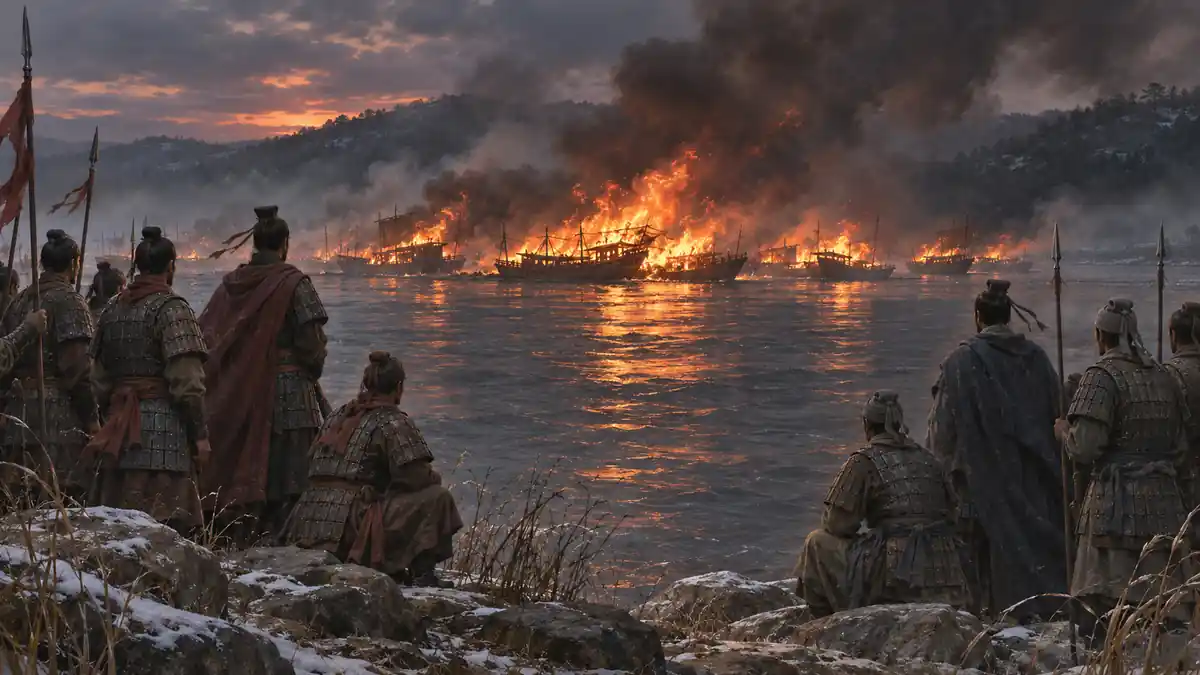
The Battle of Red Cliffs frustrated Cao Cao’s southern campaign. It also changed the balance between the men who defeated him: allies who needed each other’s strength, but increasingly disputed where that strength should be allowed to grow.
Seven years after the Battle of Red Cliffs, two commanders met to dispute what their common victory entitled them to possess. Lu Su represented Sun Quan, whose forces had played a leading role in defeating Cao Cao. Guan Yu served Liu Bei, Sun Quan’s ally. In the account preserved in the Records of the Three Kingdoms, their troops were kept back while the commanders approached the meeting armed. The argument concerned territory in Jing province, the strategic region along the middle Yangzi. Behind it lay a disagreement about the foundation of their partnership: had one ally been rescued, or had both earned a share of the future?
One version of the exchange makes the competing claims explicit. Lu Su argued that Liu Bei had received land when defeat had left him without adequate resources. Now that he had acquired another province, the obligation should be repaid. Guan Yu answered that Liu Bei had fought personally in the campaign against Cao Cao: his efforts could hardly entitle him to no land at all. Preserved in Lu Su’s biography and its commentary, these are interested recollections, rather than a transcript of the meeting. Yet their disagreement identifies something the spectacle of burning ships tends to obscure. The victors had not agreed on the political meaning of having won together.
Red Cliffs, fought in the winter of 208–209, helped make the later Three Kingdoms possible. Its consequences emerged over years of campaigning, settlement and renewed war. The coalition brought together ambitions already in competition, and success enlarged their room to manoeuvre. A stronger partner could carry more of the struggle against the north, but could also demand more from the south. The alliance could agree whom to stop more readily than what each partner should be allowed to become. Its history therefore continues beyond the northern retreat, into negotiations over how much power an ally should possess—and the decisions that repeatedly changed the answer.
The Empire They Were Fighting Over
In 208, there were no three imperial courts dividing China between them. The Han dynasty still existed, although its government had lost effective command over much of its former realm. Cao Cao had become the dominant military figure in the north and controlled the court of Emperor Xian. Appointments, titles and campaigns could be issued in the emperor’s name, giving his expansion an institutional authority that military superiority alone could not provide. His opponents could resist his armies while continuing to claim fidelity to the dynasty whose government he directed.
These were leaders building commands within a broken empire, rather than national governments defending established sovereign borders. Their practical autonomy depended on keeping armies, revenues and appointments in their own hands. A prestigious title could recognise a position already secured by force, express an aspiration beyond its holder’s reach, or leave the substance of a relationship unsettled. Official standing and usable power did not necessarily coincide. Their separation would survive Red Cliffs and shape bargains made long afterwards.
Cao Cao’s advance south followed years of victories over northern rivals. Jing offered a route into another military environment. Its northern centres lay around the Han River, which runs south to join the Yangzi near present-day Wuhan. Farther west, Jiangling was an important base on the Yangzi itself; south of the main river, the Xiang basin opened into further settlements and resources. The administrative province embraced these different places, but authority over them was uneven. Taking its governor’s submission was a major achievement without securing every community and commander within its formal boundaries.
Sun Quan already had ambitions in this region. In 200, he had inherited the southeastern command principally built by his elder brother, Sun Ce, drawing on an earlier family military following associated with their father, Sun Jian. His forces were pushing west along the Yangzi before Cao Cao arrived. Early in 208 they defeated Huang Zu, a commander serving Jing’s governor, Liu Biao. The Sun family’s struggle against Huang Zu combined strategic expansion with personal enmity: Sun Jian had died fighting Liu Biao’s forces. The southern coalition would form in a region where Sun Quan’s army had recently been fighting the authority under whose protection Liu Bei had lived.
Liu Biao’s death later that year opened the province to a succession crisis. His younger son, Liu Cong, submitted to Cao Cao. The submission brought the northern commander valuable men, vessels and bases, while leaving an opposing group around Liu Biao’s elder son, Liu Qi, and Liu Bei, an experienced commander who had taken refuge in Jing. Driven south and badly defeated at Changban, Liu Bei escaped with a reduced following. Guan Yu’s vessels and Liu Qi’s forces helped give the retreating group somewhere to stand and something with which to bargain.
For Sun Quan, the change was dangerous precisely because Cao Cao had acquired resources from the river country itself. The Yangzi offered protection only while the forces controlling its approaches and shipping could sustain it. A northern commander with access to Jing’s fleet presented a different problem from one merely contemplating a crossing. The river remained in the same place, but some of the means of overcoming it had changed hands. Sun Quan now had to defend his position against resources previously controlled by another southern regime.
What Surrender Would Cost
Submission was a serious option at Sun Quan’s headquarters. Cao Cao had accumulated an intimidating record of success, and Liu Cong’s surrender suggested that accommodation could preserve at least some positions and lives. Resistance risked an army and a regional regime. Lu Su and the military commander Zhou Yu argued for fighting, but the decision required more than a comparison of force totals. Those advising Sun Quan did not all face the same consequences if he surrendered.
Lu Su’s biography preserves a sharp account of that inequality. He reportedly told Sun Quan that he himself could submit to Cao Cao, return to official society and expect a career. Sun Quan could not expect an equivalent continuation of his position. The speech credits Lu Su with discerning the right course, but its political distinction extends beyond his portrayal as a wise adviser. An accommodation could preserve an official’s employment by ending the authority of the ruler he served. Advice to surrender might be prudent for the adviser while requiring the ruler to give up the very power that made him worth advising.
Liu Bei’s situation gave Sun Quan another option. Lu Su helped establish contact, and Liu Bei sent Zhuge Liang to negotiate. The prospective partners brought different assets: Sun Quan could commit an organised force experienced in river warfare; Liu Bei retained seasoned followers and connections in Jing; Liu Qi contributed troops and a surviving claim associated with his father’s government. Their circumstances were unequal, but the coalition was more than generosity towards a defeated wanderer. Cooperation made it harder for Cao Cao to convert successive local submissions into an uncontested southern settlement.
Sun Quan placed Zhou Yu and Cheng Pu in command of the expeditionary force, with Lu Su assisting its planning and coordination. Separate leaders and interests remained within the coalition. The accounts of its formation do not furnish a comprehensive settlement of the territories that victory might open. Agreement to fight could function while those questions remained unresolved because the danger was immediate. Later, the very service that had made cooperation possible would become evidence in arguments over who owed what to whom.
Fire, Illness and the Northern Retreat
The opposing forces met on the middle Yangzi, upstream from present-day Wuhan. Cao Cao’s army included northern troops after a demanding campaign and men recently brought into his command from Jing. The coalition faced considerable military power, although the huge numbers attached to the campaign in transmitted accounts cannot be treated as reliable muster rolls. Its opportunity lay in making Cao Cao fight under conditions in which the advantages of his wider command could not all be brought to bear.
The sequence in Zhou Yu’s biography begins with illness already present among Cao Cao’s men. An initial engagement went against the northern force, which moved to the northern bank; Zhou Yu’s men occupied the southern side. Huang Gai, one of his officers, proposed attacking the opposing vessels, described as joined or closely moored. Ships loaded with combustible material would approach under the pretence that he intended to surrender. Smaller craft were prepared for the attackers’ escape.
The deception exploited a credible possibility in a campaign already marked by changes of allegiance. Huang Gai’s force brought burning vessels into the enemy’s position, and a strong wind carried the fire through ships and shore installations. The account records men and horses burned or drowned, followed by retreat and pursuit. The concentration of vessels and troops that had made an imposing force also allowed damage to spread rapidly between its parts. The river fleet became a source of danger to the army it was meant to carry.
This is the historical core behind a much larger literary spectacle. Romance of the Three Kingdoms, composed many centuries later, amplified the campaign through elaborate contests of intelligence and episodes such as Zhuge Liang’s summoning of the wind. His contribution to establishing the alliance deserves attention without requiring those later powers. Zhou Yu’s command and Huang Gai’s attack likewise emerge more clearly when the battle is reconstructed from the earlier accounts rather than its most familiar dramatic version.
Those earlier accounts differ. Cao Cao’s annals give a compressed report of an unsuccessful engagement and severe epidemic disease. Zhou Yu’s biography supplies the developed narrative of the fire attack. A letter attributed to Cao Cao, preserved in a work quoted by the fifth-century commentator Pei Songzhi, explains the withdrawal through illness and his own destruction of ships, denying Zhou Yu the credit he had acquired. The disagreement concerns responsibility as well as sequence. Each tradition offered its audience a different account of whose actions had determined the outcome.
Disease and attack need not be competing explanations. Illness could weaken an army before combat, intensify during retreat and make losses harder to repair. Enemy fire and the destruction of remaining vessels by their own commander could occur in the same failed campaign. The evidence establishes sickness, fighting and withdrawal more firmly than it identifies a pathogen or measures each cause’s contribution. Tactical action mattered within conditions it exploited, while the army’s condition affected what an attack could accomplish.
Cao Cao withdrew, leaving forces at important positions, including Jiangling. His northern command survived, and his opponents had acquired neither his main resource base nor the capacity to dictate his future. Red Cliffs frustrated an exceptional opportunity to extend his power through the south. The respite gave his enemies time to develop commands that would prove much harder to overcome. The outcome exposed the limits of what a military victory could secure: it changed the prospects of imperial reunion without establishing a finished replacement for the Han empire.
The Land Inside the Victory
The struggle for Jiangling continued after the ships had burned. Zhou Yu’s forces fought Cao Ren, the commander left to hold the city, and secured it in 209 after a costly campaign. Farther east, Sun Quan’s attempt to take Hefei failed. Cao Cao had been driven back from one operation, but the defensive positions protecting his wider territory remained formidable. The victors could exploit his retreat along some routes while being stopped on others.
Liu Bei extended his position in southern Jing, obtaining the submission of the commanders of Wuling, Changsha, Lingling and Guiyang. His gains drew on military presence and regional connections rather than a repetition of Zhou Yu’s siege at Jiangling. Liu Qi’s death in 209 removed another participant, and Liu Bei assumed the governorship claimed by their side. The coalition had created opportunities that its members were differently equipped to use. Holding down an enemy garrison and securing neighbouring districts could advance the common struggle while producing uneven rewards.
Territory mattered through what could be obtained from it. Administrators, cultivators, local supporters, transport routes and military stores made a district useful to a command. Zhuge Liang’s biography records his work in southern Jing regulating taxation to supply Liu Bei’s army. Such arrangements turned a fugitive following into a territorial power. Assistance had helped preserve a partner who could now sustain forces independently—and resist demands from the ruler who had helped him survive.
Around 210, Liu Bei also obtained control of the Jiangling area through arrangements with Sun Quan. Lu Su supported strengthening his position against Cao Cao; Zhou Yu’s death that year altered the leadership of Sun Quan’s western command. Some historical traditions describe the territory as a loan. The term made possession conditional, attaching an obligation of return to the land held. Yet Jing was an extensive administrative region already divided among competing forces, not a single property transferred intact by one unquestioned owner. The familiar claim that Liu Bei had borrowed Jing compresses different acquisitions into one debt.
The dispute concerned the basis of entitlement as much as the extent of land. Sun Quan’s side could invoke assistance, concessions and an expectation of repayment. Liu Bei’s could invoke combat, acquisition and the requirements of maintaining its forces. These descriptions gave the same partnership different political futures. In one, Liu Bei remained a beneficiary obliged to repay help; in another, he was a contributor entitled to a durable territorial share. Establishing the scope of any undertaking requires identifying the land concerned and how each party had come to control it.
Security and expansion were entwined in these arguments. Sun Quan had wanted access farther west before 208. Liu Bei would use his position in Jing to pursue territory beyond it. Their projects did not become defensive in every purpose because Cao Cao remained dangerous. The calculation was whether a partner’s growing resources would chiefly burden the northern enemy or enable that partner to obstruct one’s own ambitions. The assistance that made an ally more useful could also make him less dependent.
A Boundary That Held—For a Time
Liu Bei entered Yi province, centred on present-day Sichuan, in 211 at the invitation of its ruler, Liu Zhang. Cooperation became conflict, and in 214 Liu Bei took over his host’s territory. He now possessed a substantial western base, while Guan Yu commanded the position left in Jing. For Sun Quan, an ally established in two regions was a different neighbour from the commander who had arrived in retreat. Earlier assistance could now be invoked as a reason to limit the beneficiary’s further growth.
Sun Quan pressed claims to districts in southern Jing. In 215 he sent Lü Meng to seize Changsha, Guiyang and Lingling; Liu Bei returned east, and Guan Yu confronted Sun Quan’s forces. The armed meeting between Guan Yu and Lu Su belongs to this confrontation. Their arguments about assistance and military service were being made under the pressure of mobilised armies. The language of gratitude and entitlement sought to make one account of possession binding on the other side.
The confrontation nevertheless ended in a settlement. Cao Cao’s advance into Hanzhong threatened the approaches to Liu Bei’s newly acquired western territory. The partners agreed a division associated with the Xiang River: Sun Quan retained eastern districts including Changsha and Guiyang, while Liu Bei kept western territory including Nan commandery, with Jiangling, as well as Lingling and Wuling. Northern Jing remained under Cao Cao. The agreement adjusted control without requiring either southern leader to accept the other’s account of their earlier obligations.
The settlement deserves to be understood as an achievement in its own right. Competition could be contained when its immediate costs rose and the northern threat required attention. Lu Su continued to favour accommodation with Liu Bei over confronting Cao Cao without him. The boundary gave that policy a territorial form, though its survival depended on decisions about where danger lay and what changing the arrangement might yield. The attack of 219 was a later choice, not the inevitable revelation of what the alliance had always been.
Nor were the camps immutable. Sun Quan’s biography records a formal submission to Cao Cao in 217 that left his own command functioning. Such negotiations could reduce pressure or secure recognition while stopping well short of transferring control over troops and appointments. Nominal deference was compatible with substantial autonomy, although it exposed the parties to disagreement about what had been conceded. A declaration mattered through the conduct it required and the consequences its recipient could enforce.
The Attack Behind the Allied Front
Lu Su died in 217, and Lü Meng succeeded to the principal western command. The change brought a different policy to the same strategic relationship. Where Lu Su had sought to contain rivalry, Lü Meng favoured removing Guan Yu’s position and bringing more of the middle Yangzi under Sun Quan’s control. His biography also preserves a discussion of expansion north into Xu province. He argued that territory open to Cao Cao’s cavalry would be difficult to retain, whereas river acquisitions offered a more defensible gain. The reasoning made the allied position attractive as a target precisely because it could be held more securely than territory taken from the common enemy.
In 219 the opportunity became unusually favourable. Liu Bei secured Hanzhong against Cao Cao, while Guan Yu attacked north along the Han River towards the strongholds around Xiangyang and Fan. Flooding devastated a relieving army, and Guan Yu took a large body of prisoners. His success increased the pressure on Cao Cao, but drew troops and attention towards the northern front. For Sun Quan’s leadership, the same campaign made a neighbouring commander more formidable and created an opening against his rear.
Cao Cao actively encouraged the rupture. Guan Yu’s biography records advisers urging him to induce Sun Quan to strike, with promises of territorial rewards south of the Yangzi; Cao Cao accepted the proposal. Sun Quan’s biography also records his offer to attack Guan Yu. Their contacts gave the northern commander a means of easing military pressure through the competing interests of his enemies. Sun Quan’s western ambitions had their own history, but Cao Cao recognised that he could benefit by encouraging them.
The campaign also put pressure on provisions. Lü Meng’s biography reports a food shortage after the capture of Guan Yu’s prisoners and accuses Guan Yu of taking grain at Xiangguan without authorisation. The allegation belongs to the victorious side’s explanation of the rupture and cannot serve as an impartial judgement of the dispute. It nevertheless preserves a material connection easily lost in accounts devoted to battlefield prestige. Taking prisoners increased Guan Yu’s burden of supply, while obtaining food could create further conflict with the partner whose territory and resources lay behind him.
There were vulnerabilities within his own command as well. Guan Yu’s biography describes tensions with Mi Fang at Jiangling and Shi Ren at Gong’an over military supplies; both feared punishment. Sun Quan cultivated their cooperation. Lü Meng concealed his approach, and the surrender of these positions deprived Guan Yu of essential bases. Lu Xun helped secure the western approaches, while Cao Cao’s commander Xu Huang relieved the pressure at Fan. Defeated on the northern front and cut off behind, Guan Yu retreated into a position from which he could no longer recover. Sun Quan’s forces captured and executed him.
The account of Lü Meng’s occupation pays close attention to soldiers’ households. It credits him with restraining troops and providing for people in the captured cities. Messengers then brought Guan Yu’s men news that their families were safe under the new administration. The narrative celebrates Lü Meng, but also describes how occupation could dissolve an opposing army without defeating every soldier in battle. Control of the base gave the attackers access to the relationships that sustained the men at the front. Reassuring their households helped make continued service under Guan Yu appear less necessary and more dangerous.
Strategic explanation leaves Sun Quan’s responsibility intact. He authorised a concealed attack on a partner with whom he had made a territorial accommodation. Calling the episode betrayal identifies a feature of that relationship, but does not explain why the attack occurred then, why local commanders cooperated or why the collapse became so rapid. Those outcomes depended on the northern campaign, provisioning pressures, divided loyalties and deliberate preparations. Several sources portray Guan Yu as difficult to work with; that portrayal cannot make the decision to attack him cease to be Sun Quan’s.
The result was a stronger middle-river position for Sun Quan and immediate relief for Cao Cao. Liu Bei lost his eastern base, while the northern command escaped a serious threat. Removing an ally’s capacity to obstruct expansion had also removed some of the pressure that ally exerted on their common enemy. Sun Quan had obtained defensible territory at the cost of creating a new war over its defence. The former partner whose strength he had feared would now try to recover what he had lost.
The Return of an Unfinished Alliance
The imperial setting changed as the southern partners prepared to fight. Cao Cao died in 220, and his son Cao Pi subsequently took the throne from the last Han emperor, founding Wei. Liu Bei proclaimed himself emperor in 221 as the continuer of Han; his state is conventionally called Shu-Han. Sun Quan accepted investiture from Cao Pi as King of Wu, seeking room to deal with the attack from the west. The ruler who had resisted Cao Cao at Red Cliffs could acknowledge his son while preparing to fight the former ally who had helped resist him.
Liu Bei’s eastern campaign sought to recover lost territory and avenge Guan Yu’s death. In 222 Lu Xun defeated him near Yiling, using fire against his extended positions after resisting pressure to attack prematurely. Liu Bei escaped west and died the following year. The victory secured Sun Quan’s disputed acquisitions, but his northern accommodation was also breaking down. Cao Pi’s demands, including the delivery of Sun Quan’s heir as a hostage, exposed how differently the two sides understood investiture. Wei’s recognition had offered Sun Quan a means of protecting his command; its grantor expected submission that would constrain it. Wei armies attacked when the relationship failed.
Peace contacts with Liu Bei began after Yiling, and cooperation was renewed during 222–223. After Liu Bei’s death, Zhuge Liang’s administration sent Deng Zhi to reinforce relations with Sun Quan. The lost territory was not restored as the price of agreement. Cooperation resumed on an altered balance that the western regime had failed to reverse by war. For both governments, continuing to fight each other offered the north advantages they now had reason to deny it.
The renewal did not require agreement about the ultimate destination of their partnership. Deng Zhi’s biography records a later exchange in which Sun Quan imagined the two rulers sharing a peaceful world after Wei’s defeat. Deng Zhi answered that a contest over rightful rule would remain. The account celebrates restored friendship while admitting that the partners’ highest ambitions were incompatible. They could cooperate against a powerful enemy without promising that victory would make them permanent equals.
Sun Quan assumed the imperial title in 229, bringing that incompatibility into the present. An account preserved in the commentary to Zhuge Liang’s biography reports opposition in Shu-Han to maintaining relations with a second southern emperor. Zhuge Liang defended cooperation on practical grounds: a breach would require an eastern military commitment and assist the northern enemy. Shu-Han sent congratulations. Its claim to continue the Han dynasty remained, but preserving that claim did not require refusing every useful relationship that contradicted its fullest implications.
That year, the envoy Chen Zhen concluded an agreement with Sun Quan assigning spheres in the northern territories the partners hoped to conquer. These were prospective possessions, still beyond their joint power to distribute in fact. Yet the undertaking addressed a problem their earlier cooperation had left unresolved. The rulers who had fought over the proceeds of one victory were attempting to negotiate the proceeds of another before achieving it. Their agreement did not erase their rivalry; it gave cooperation a more explicit account of what success was supposed to yield.