Japan’s rulers had lost the war before they agreed on how to end it. The struggle over surrender reveals how the survival of a country became entangled with the survival of those who claimed the right to govern it.
On 10 August 1945, Japan offered to accept the Potsdam Declaration with a reservation protecting the emperor’s sovereign prerogatives. Hiroshima had been devastated four days earlier. Soviet forces were attacking Japan’s continental empire. Nagasaki had suffered a second atomic bombing. Even at this point, the question of who would possess authority after defeat remained central to the government’s response.
Emperor Hirohito ultimately retained his throne, but not the sovereignty previously exercised in his name. The occupation subordinated him to Allied authority, and the constitution that took effect in 1947 located sovereignty in the Japanese people.
Understanding why Japan surrendered requires following how atomic destruction and Soviet intervention changed the choices its leaders would accept, and how the emperor’s interventions made a decision possible despite their divisions. The government was negotiating with its enemies while struggling internally over what it could surrender, what it must preserve and who could make those decisions binding.
Japan had not submitted an agreed surrender before Hiroshima, conditional merely on retaining a ceremonial monarch. Yet the fact that surrender followed the atomic attacks does not establish that both attacks were indispensable. Between these propositions lies a history of choices made by governments whose interests overlapped only partly with the lives they controlled.
A state can lose the capacity to win before its rulers lose the capacity to prolong the war. In Japan’s final summer, that interval became a struggle over which parts of the governing order could escape the consequences of defeat. The authority still available to demand sacrifice outlasted any plausible prospect of achieving the empire’s original war aims.
A Defeated State Still Capable of Refusal
By the summer of 1945, Japan’s strategic position was catastrophic. Its maritime communications had been devastated, its cities were being burned by American aircraft and the loss of Okinawa brought the prospect of an invasion of the home islands closer. The material foundations of its war effort were collapsing. Its government nevertheless retained armed forces, administrative institutions and the power to demand further sacrifice. A leadership unable to recover its empire could still make ending the war enormously costly.
The strategy known as Ketsu-Go sought to turn that remaining capacity into leverage. Japanese forces would inflict heavy casualties on an American landing, making Washington more willing to negotiate. The objective had contracted from imposing Japan’s ambitions abroad to improving the terms on which those ambitions would be abandoned.
This calculation placed the population’s continued exposure to bombing, deprivation and a possible invasion behind a wager about American tolerance for casualties. People throughout Japanese-occupied Asia also remained subject to violence and coercion while Tokyo sought a settlement. Continued resistance exposed different populations to different dangers, without giving them an equivalent voice in deciding how long the wager should continue.
The leadership’s ability to impose these costs helps explain why obvious defeat did not produce an immediate political conclusion. Those making the decision did not bear its consequences in the same way as people being mobilised, bombed or kept under occupation. Authority could survive long enough to demand sacrifices that no longer offered a plausible route to victory.
Alongside military preparations, Tokyo pursued Soviet mediation. Japan and the Soviet Union had maintained a neutrality pact since 1941, and Japanese officials hoped Moscow could help moderate Allied demands. This diplomacy rested on a fatal misreading: the government approached as a potential intermediary had already promised to enter the war against it.
American intelligence intercepted important parts of the Japanese exchanges through the programme known as MAGIC. The messages revealed serious interest in ending the war, alongside unresolved disagreement over acceptable terms. Washington was watching a government search for an exit whose political destination it had not settled.
In exchanges summarised by American intelligence on 22 July, Ambassador Naotake Satō urged Tokyo to confront the severity of its position. Foreign Minister Shigenori Tōgō continued to resist unconditional surrender. An intercepted message included in the MAGIC summary of 2 August showed that the government was still gathering views on concrete peace conditions.
These diplomatic efforts mattered, but they supplied no agreed mandate to accept occupation, externally imposed disarmament or Allied judgement of Japanese leaders. Tokyo wanted assistance in ending the war while remaining unable to agree on the concessions that ending it required. Its approaches to Moscow showed a search for negotiations, rather than a completed surrender awaiting American acceptance.
What Did Saving the Emperor Mean?
The imperial institution brought together several interests that are easily confused in retrospect. Hirohito was a person, the dynasty was a hereditary institution, and imperial sovereignty formed part of the constitutional structure through which Japan was governed. Preserving one did not necessarily preserve all three.
Under the Meiji Constitution, sovereignty was vested in the emperor. Government operated through ministers, military commands, advisers and conventions that complicated the exercise of his authority. His position carried consequential powers, but translating a preference into policy required action within that governing system.
The concept of kokutai, commonly translated as national polity, carried this ambiguity into the surrender debate. It could evoke the dynasty, the emperor’s governing position or a wider sacred conception of the national order. Agreement that it must survive could conceal disagreement about what survival required.
Saying that Japan wanted to “keep the emperor” consequently leaves essential questions unanswered. Would he remain subject to an occupation commander? Could the country’s political institutions be transformed? Would those who had governed in his name retain control over disarmament and accountability? A guarantee of dynastic continuity would address only part of what was at stake.
The Potsdam Declaration, issued by the United States, Britain and China on 26 July, demanded the unconditional surrender of Japan’s armed forces. It outlined occupation, disarmament, punishment of war criminals and the elimination of militarist influence. It envisaged an eventual government grounded in the freely expressed will of the Japanese people, while neither explicitly abolishing the monarchy nor guaranteeing it.
This uncertainty had political consequences. An explicit assurance might have strengthened officials seeking an end to the war; it might also have fallen short of the protections demanded by those determined to preserve imperial authority. The ambiguity left room for accommodation without settling how much of the imperial order that accommodation would protect.
American officials had considered clarification. In a memorandum to President Harry Truman on 13 June, Acting Secretary of State Joseph Grew argued that surrender need not entail eliminating the imperial institution. He believed that making this clear could help bring the war to an earlier end.
Grew’s memorandum places an alternative diplomatic formulation within the choices available before the atomic attacks. Whether it would have secured surrender remained uncertain. Washington could nevertheless reconsider the political terms it communicated, as well as the military pressure it applied. The demands presented to Tokyo were themselves decisions open to revision.
Tokyo’s public response further complicated the situation. At his press conference on 28 July, Prime Minister Kantarō Suzuki dismissed the Potsdam Declaration and affirmed continued prosecution of the war. His use of mokusatsu has generated a long controversy over translation, but the crisis cannot be explained as the accidental consequence of a misunderstood word.
The public position offered no acceptance, while private diplomacy continued to seek Soviet help. This gap reflected internal division and an effort to preserve bargaining room. To Japan’s enemies, it supplied further evidence of continuing resistance. Inside Tokyo, the unresolved issue extended beyond imperial dignity to the authority that would remain after defeat.
The Political Uses of a New Weapon
American leaders faced the prospect of further costly fighting. Plans for a landing on Kyushu envisaged an operation beginning in November, and the White House meeting of 18 June examined the campaign, casualties and the possible effect of Soviet participation. Experience across the Pacific gave commanders substantial grounds for expecting fierce resistance.
Later arguments have often converted these fears into a single, apparently settled number of lives saved by atomic bombing. The contemporary planning record was less tidy. Estimates varied according to the campaign, its duration and assumptions about Japanese behaviour. A figure developed for one operation cannot stand automatically for the losses of every possible continuation of the war.
An invasion planned for November was also an operation several months away. Soviet intervention, diplomatic clarification and other developments could still change the situation before American troops landed. The decisions available in early August included choices about what might be attempted during that interval.
Continued pressure carried its own human costs. Blockade and conventional bombing would kill civilians, and Japanese occupation and captivity continued to endanger people elsewhere in Asia. Waiting was an active strategy with victims. Its likely costs belong beside those of an invasion, a demonstration or an atomic attack when assessing the alternatives.
Officials and scientists debated how the new weapon should be introduced. The Franck Report, submitted by Manhattan Project scientists in June, proposed an international demonstration before surprise use against a city. Its authors also feared the consequences of inaugurating an atomic arms race. A scientific panel including J. Robert Oppenheimer subsequently recommended military use, reflecting doubts that a demonstration would secure surrender.
Neither recommendation could guarantee its predicted result. The disagreement concerned how to employ a capability whose military and diplomatic effects remained uncertain. Building the bomb had supplied American leaders with an extraordinary means of destruction; it had left them responsible for deciding its first use.
The successful Trinity test on 16 July changed the confidence with which they could act. It also changed their diplomatic position. Secretary of War Henry Stimson’s diary shows that he understood the bomb’s potential value in dealings with Moscow, while the United States was still cooperating with the Soviet Union against Japan.
Ending the war and influencing the settlement were compatible objectives. A government could seek a rapid Japanese surrender while preferring that it occur before Soviet forces acquired additional territory and bargaining power. The emerging rivalry belongs within the explanation of American calculations, alongside the effort to defeat Japan.
The political consequences extended beyond the immediate target. American officials were considering who would occupy territory, which armies would arrive first and how much influence an ally would acquire. Atomic power entered these calculations at the moment when victory was becoming a contest over the arrangements that would follow it.
Hiroshima and the Collapse of the Soviet Option
The atomic bombing of Hiroshima on 6 August introduced a new scale of destruction into a country already suffering devastating air attacks. Military installations existed in the city, but the explosion destroyed an urban environment and killed people through blast, heat, fire, injury and radiation. The effects extended far beyond those who died on the day.
Hiroshima’s municipal government estimates that approximately 140,000 people had died by the end of 1945, while acknowledging that an exact total cannot be established. The victims included non-Japanese people whose presence reflected the empire’s movements of labour and population. Those killed and injured were people with lives extending beyond their place in the calculations of either government.
For Japanese leaders, the attack threatened more than another urban catastrophe. It raised the possibility that the United States could compel submission without attempting the landing on which Ketsu-Go depended. A strategy designed to extract concessions through American battlefield casualties became less persuasive if Washington could continue destroying cities from the air.
The Japanese Foreign Ministry’s records for 7–8 August show Tōgō pressing for an end to the war after Hiroshima, including in an audience with the emperor. His efforts had not yet produced an agreed government decision. The intervening days contained movement towards surrender alongside argument and obstruction.
Soviet entry then destroyed the assumptions underpinning the mediation effort. Moscow declared war on 8 August, and its forces attacked in Manchuria in the early hours of 9 August. The government from which Tokyo hoped to obtain diplomatic assistance was now participating in its military defeat.
The intervention had a history that explains the apparently surprising alignment. Washington and Moscow were allies against Nazi Germany, and at Yalta in February Stalin had undertaken to enter the Japanese war within two or three months of Germany’s surrender. The agreement promised territorial and strategic rewards, including southern Sakhalin, the Kuril Islands and advantages in Manchuria.
Moscow’s participation combined an Allied commitment with ambitions of its own. It sought influence in the settlement as well as Japan’s defeat. Tokyo’s hopes for mediation had survived the Soviet announcement in April that the neutrality pact would not be renewed. That notice did not immediately terminate the pact, leaving a formal relationship on which Japanese leaders continued to place hopes that Soviet policy would not fulfil.
Hiroshima and Soviet entry attacked different parts of Japan’s strategy. The bomb threatened an expanding capacity to destroy the homeland; Soviet intervention eliminated the preferred diplomatic route and opened another military emergency. Together they narrowed the space in which leaders could imagine securing a less damaging defeat.
Their effects also depended on how they were understood inside the government. A commander still confident in a homeland battle could assess these developments differently from an official whose policy rested on Soviet mediation. Converging pressures made the situation more desperate without giving every participant the same reason to accept surrender.
Nagasaki and the Authority to Wait
The second atomic attack occurred on 9 August, as Tokyo confronted Soviet intervention and debated surrender. Its timing makes it a separate political decision requiring examination on its own terms. The justification for Hiroshima cannot simply be extended to cover every subsequent use of the weapon.
The written bombing order of 25 July authorised the first attack when weather permitted after approximately 3 August. It also authorised additional bombs against the designated targets as they became ready. A fresh presidential decision after a full assessment of the first attack’s diplomatic consequences was not required.
That arrangement gave operational readiness considerable influence over the pace of escalation. Only three days separated Hiroshima and Nagasaki. Japan’s leaders had not resolved their disagreement during that interval, although steps towards a decision were under way. Political obstruction remained a choice, and delay continued to expose people to violence throughout the region.
The criticism of American policy does not require assigning Tokyo a fixed period in which it should have reached agreement. It concerns the standing authorisation under which another city could be destroyed while the response to Hiroshima and Soviet entry was still developing. Decisions about the interval between attacks had been partly entrusted to preparations for delivering the next weapon.
The strongest argument for the second bombing addresses the prospect of repeated atomic destruction. In his account “To Bear the Unbearable,” published by the National WWII Museum, Richard B. Frank argues that Nagasaki undermined the hope that Hiroshima represented an isolated American capability. If further bombs could follow, waiting for a costly invasion became an even weaker strategy.
This gives the second attack a distinct strategic rationale. Its expected effect must still be assessed against the timing and available alternatives. Demonstrating repeatability through another attack on a populated city imposed an immediate human cost while the effect of the first attack and Soviet intervention remained unsettled.
On 10 August, the policy changed. Major General Leslie Groves, who directed the Manhattan Project, reported preparations for another atomic weapon. Army Chief of Staff General George Marshall recorded that it could not be used without express presidential authority. Further attacks were halted pending that authority.
The sequence demonstrates that political control could interrupt the military schedule. The earlier authorisation had permitted Nagasaki to proceed; the subsequent restriction prevented the same arrangement from governing the next bomb. Responsibility includes deciding when an established order must return for political review.
Whether Nagasaki increased the pressure for surrender and whether it should have been attacked on 9 August remain distinct judgements. Evidence of a contribution to surrender cannot establish the necessity of that timing by itself. The decision has to be examined through what American leaders knew and could choose while Japan’s response was unfolding.
Why Japan Surrendered When Its Leaders Still Disagreed
On 9 August, Japan’s six principal war leaders divided over the terms. Suzuki, Tōgō and Navy Minister Mitsumasa Yonai favoured acceptance with an imperial reservation. Army Minister Korechika Anami and the army and navy chiefs of staff sought additional protections.
Those additional conditions concerned Japanese control of disarmament, Japanese handling of war-crimes proceedings and the avoidance of occupation. A defeated military establishment would retain considerable authority over how defeat was implemented and how responsibility was assigned. These demands reveal how much the dispute encompassed beyond the emperor’s personal survival.
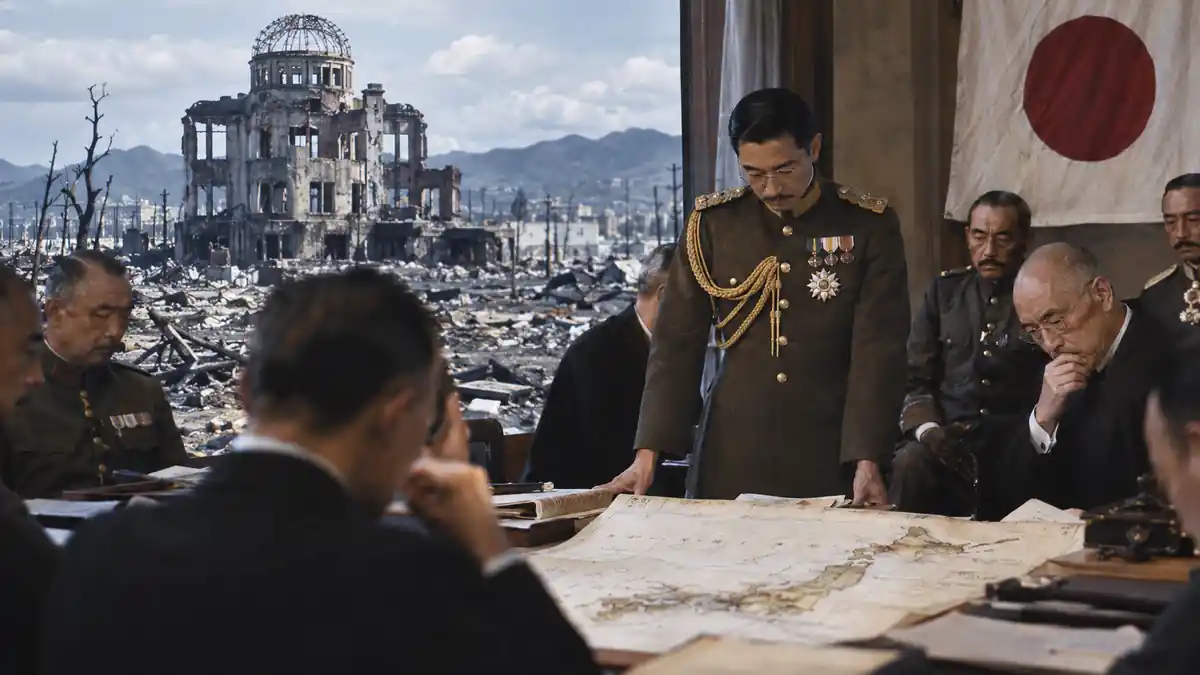
During the imperial conference on the night of 9–10 August, Hirohito intervened in favour of acceptance with the imperial reservation. The government’s offer followed on 10 August. It was an authorised decision reached after the atomic attacks and Soviet intervention, rather than an unchanged offer awaiting acceptance before them.
The Allied response of 11 August specified that the emperor and government would be subject to the Supreme Commander for the Allied Powers. It left the ultimate form of government to the freely expressed will of the Japanese people. The reply offered no unrestricted guarantee of the emperor’s former sovereign position.
Further disagreement followed in Tokyo. Hirohito intervened again on 14 August, and a military coup attempt during the following night failed to prevent the surrender broadcast of 15 August. Formal surrender was signed on 2 September. Reaching a decision and making it effective were successive political tasks.
The imperial institution had helped obstruct agreement because its future was treated as indispensable. It then helped secure agreement because its authority could legitimate the reversal. An institution whose protection had prolonged the argument became an instrument for ending it.
Hirohito’s role demands scrutiny across this sequence. His intervention helped stop the war, but his position within the imperial state preceded its final crisis. The significance of his decision does not exempt his earlier conduct, or the opportunities he had to intervene earlier, from examination.
Historians differ over the relative force of the pressures. Frank emphasises the emperor’s declining confidence in military plans, the devastation of bombing and the deteriorating domestic situation. In Racing the Enemy: Stalin, Truman, and the Surrender of Japan, Tsuyoshi Hasegawa assigns greater weight to Soviet intervention and the destruction of Japan’s diplomatic strategy.
These interpretations direct attention to different mechanisms. Destruction could change the perceived cost of resistance; Soviet entry could change the perceived availability of negotiation. The emperor’s messages likewise addressed different audiences. The rescript broadcast on 15 August invoked the atomic bomb, while his subsequent message to the armed forces stressed Soviet entry. Both were instruments for securing acceptance as well as explanations of events.
The Institution the Occupation Chose to Keep
The occupation’s retention of Hirohito brought the politics of surrender into the machinery of governing defeat. The Allies subordinated the emperor while using the authority attached to his office. Orders transmitted through an established institution could assist in securing obedience across a country and armed forces confronting an unprecedented reversal.
Continuity in the throne concealed a fundamental change beneath it. The constitution that took effect in May 1947 made the emperor a symbol of the state and the unity of the people. His position derived from their will, and he possessed no powers related to government.
For those who had hoped to preserve imperial sovereignty, this was a profound defeat. For those whose overriding concern was the dynasty’s survival, it was an accommodation. The same settlement could therefore be presented as preservation or transformation depending on which component of the imperial order was being measured.
The eventual arrangement cannot be equated with every protection Japanese leaders had sought before surrender. It retained the emperor under conditions that substantially changed his position. Its acceptance by the Allies nevertheless strengthens the case for examining whether a clearer assurance about dynastic continuity could have been attempted earlier.
The later history of reconciliation after war would build on this transformed relationship while leaving responsibility for wartime decisions open to dispute. A durable American–Japanese partnership could emerge without its existence settling the judgement of the acts through which the war had ended. The usefulness of a political accommodation and the justification of its preceding costs remained questions to be examined separately.
Victory also exposed the differences among the victors. On 16 August, Stalin requested that Japanese forces in northern Hokkaido surrender to Soviet forces. Truman refused a separate Soviet surrender zone there, leaving the surrender of Japan’s main islands to General Douglas MacArthur.
The dispute reflected interests that wartime cooperation had never abolished. The United States and the Soviet Union could agree on defeating Japan while competing over territory and influence. They had been allies against common enemies, with different ambitions for the peace.
Atomic power became part of that competition, alongside armies, occupation arrangements and diplomacy. The Japanese war remained an immediate purpose of American decisions, while the emerging rivalry affected the settlement those decisions might produce. Governments seeking victory were already assessing how its distribution would strengthen an ally they increasingly regarded as a competitor.
Who Bore the Cost of the Settlement?
The last weeks of the war reveal a harsh asymmetry. Japanese leaders debated protections for institutions while civilians faced destruction and people across occupied Asia remained exposed to imperial violence. American leaders possessed overwhelming force and chose how to combine it with diplomatic demands. Soviet leaders entered the war with Allied commitments and expectations of strategic reward.
These responsibilities belong to distinct decisions. Japan’s aggression and the refusal of powerful figures to accept defeat explain why the war continued. They do not transfer responsibility for American targeting policy to Tokyo or establish that every means of compelling surrender was necessary.
Several alternatives remain open to historical examination: an explicit assurance about the imperial dynasty, a non-combat demonstration, greater time after Hiroshima, or observation of the effect of Soviet entry before another atomic attack. Each carried risks and uncertainties. Their likely consequences must be assessed through the knowledge and choices available at the time, rather than a surrender date imagined with hindsight.
The uncertainty places limits on claims of necessity as well as claims that an easy peace was available. An earlier assurance might have changed the balance in Tokyo or failed to overcome military resistance. Additional time might have allowed a decision to emerge while also prolonging other forms of killing. Evaluating those possibilities requires identifying whose risks would have increased and what evidence leaders possessed when they chose.
Japanese leaders demanded further sacrifice while struggling to protect a governing order already responsible for catastrophic aggression. American leaders authorised the destruction of cities to compel an end to that war. Neither the institution the first sought to preserve nor the surrender the second helped obtain can close scrutiny of the decisions through which those objectives were pursued.
The throne endured because its survival could serve the settlement, while its former sovereignty was surrendered. Institutions could be reinterpreted, authority subordinated and enemies brought into an accommodation. The people killed while those possibilities remained unsettled had no comparable opportunity to revise their fate.
Japan’s surrender ended a catastrophic imperial war. Its history asks power to account for the costs imposed on others in bringing that war to an end. The emperor’s survival and the transformation of his authority reveal how much could change within a settlement; Hiroshima and Nagasaki require us to examine why that capacity for accommodation emerged through this sequence of destruction, and what choices remained before each city was attacked.